5 Things You Need for a Comfortable Retirement

Editor’s Note: We are happy to post this retirement article by guest author Sierra Powell… concise and solid advice for all current and prospective retirees. Photo credit: https://www.pexels.com/photo/people-on-seashore-1377070/

Retirement is a new chapter– An opportunity to savor the results of years of diligence, to follow your interests, and to unwind, free from the demands of 9-to-5 employment. Reaching a comfortable retirement calls for careful decisions supporting your lifestyle and future requirements. Whether you desire to see the world, spend time with loved ones, or just enjoy a slower paced life, several essential components will enable you to have all you need for a safe, happy retirement.

Creating a Comprehensive Financial Plan

A good financial plan is the foundation of a comfortable retirement since it provides a clear road map for handling your money in the next few years. This approach covers forecasting your spending, figuring out revenue sources, and developing a plan for withdrawing money without quickly running out of savings. It goes beyond simple saving. First, project your monthly costs using the lifestyle you want. Add needs such as food, healthcare, and shelter; also include discretionary expenditures for entertainment, vacation, and hobbies. Knowing your planned costs helps you to decide if your revenue sources are adequate to meet them. You can also opt for a good local financial advisor. For example, if you live in Florida, seek a financial advisor in Tampa if you need guidance in selecting the best plan for yourself and your family.

Prioritizing Health and Wellness

Enjoying a nice retirement depends on keeping excellent health. It becomes difficult to enjoy your newly acquired independence without bodily well-being fully. Emphasize keeping active, following a healthy diet, and planning frequent doctor visits. Time spent in wellness not only improves your mood but also lowers your chance of chronic diseases that could affect your finances or quality of life. Think about adding pursuits that keep your body and mind active. Without taxing your joints too much, low-impact activities like yoga, swimming, or walking provide excellent advantages. Just as crucial is mental stimulation; consider picking up a pastime that tests your brain, acquiring a new skill, or club membership.

Building a Strong Social Network

A strong social life improves your retirement experience by offering company, encouragement, and chances to remain active. Retirement typically alters your daily schedule, particularly if most of your prior social life came from employment. By means of actions to establish and preserve a solid network of friends, family, and community ties, you may prevent emotions of isolation and loneliness, therefore influencing both mental and physical health. To meet new people and be active, join clubs, volunteer groups, or neighborhood organizations that fit your interests. To keep your social calendar full, get in touch with old pals, throw events, or schedule visits with loved ones.

Ensuring Housing Stability

Your degree of retirement comfort depends mostly on your choice of living environment. Your house should fit your way of life, be reasonably priced, and call for little upkeep. Downsizing to a smaller house, condo, or senior living complex provides the ideal balance for some between cost and convenience. Smaller spaces cut maintenance, decrease utilities and liberate resources for additional uses. Think about things like family, closeness to hospitals, and services supporting your everyday requirements. If you would like to keep your present house, think about implementing changes that would help keep aging in place. Simple adjustments that improve mobility and safety include adding grab bars in the restroom or substituting ramps for stairs.

Creating a Flexible Budget

Unexpected expenses might develop in retirement even with the finest financial preparation. Creating a flexible budget lets you negotiate these shocks without sacrificing your general financial situation. Set aside some of your savings, especially for unexpected vacation demands, house repairs, or medical bills. An emergency fund serves as a financial cushion so you may handle pressing needs without compromising your monthly income flow. Your budget should also contain a provision for discretionary expenditure for unplanned events such as family visits, holidays, or new interests. This adaptability lets you enjoy the advantages of retirement without feeling limited by your means.

Conclusion

Making decisions according to your beliefs and future vision can help you to create a comfortable retirement. Every component of your retirement plan supports your way of life and well-being, thereby enabling you to savor this new chapter with peace of mind. Accept the chance to live life on your terms, knowing that your careful planning has set a firm foundation for your next years.

Our Next Chapter

Bookends – Stage 5: “Living the Dream”

Welcome back to my blog site for music educators… actually hopefully thought-provoking reflections for teachers in any subject area or grade level, school administrators, classified school staff (secretaries, aides, custodians, etc.), and professionals in all fields.

It has taken me more than a year to revisit (and expand on) all of the sections from my workshop (October 2023) presented to Seton Hill University music education students, and now we close with “The Final Chapter” – a focus on self-reinvention and transitioning to retirement in anticipation of successfully Crossing the Rubicon to enjoy our “senior years.” This entire presentation was inspired by the mission statement of the Pennsylvania Music Educators Association (PMEA) Council for Teacher Training, Recruitment, and Retention – “The Life Cycle of a Music Educator” – for which I had the privilege of serving eight years as the State Chair (still a council member). To recap, here is an outline of my previous blogs on the evolution of an educator, a journey through career “passages” to follow:

Stage 5: Next Chapter/Living the Dream Years –
Retirement Prep & Mastery

To start with, the term “retirement” is a misnomer. Typically, in most dictionaries (online and printed), it is defined as “the withdrawal from one’s career, occupation, or office usually because of age,” or even the synonyms “seclusion from the world,” “privacy,” “the act of going away,” “retreating,” or “disappearing.” No, perhaps more appropriate definitions would support the advances in medical science, a better standard-of-living, our healthier lifestyles and improvements in self-care, and longer lifespans. Retiring from your first career may only be the halfway point! Sample online quotes:

“The ‘new retirement’ is not an ending, it’s a new beginning, the start of a new life journey of vastly expanded proportion.” Dr. Richard Johnson, Flourishing in Retirement

“Retirement now is mostly about change. And it may not look all that different from what immediately precedes it.” Huffington Post: http://www.huffingtonpost.com/arianna-huffington/its-time-to-retire-our-definition-of-retirement_b_5774878.html

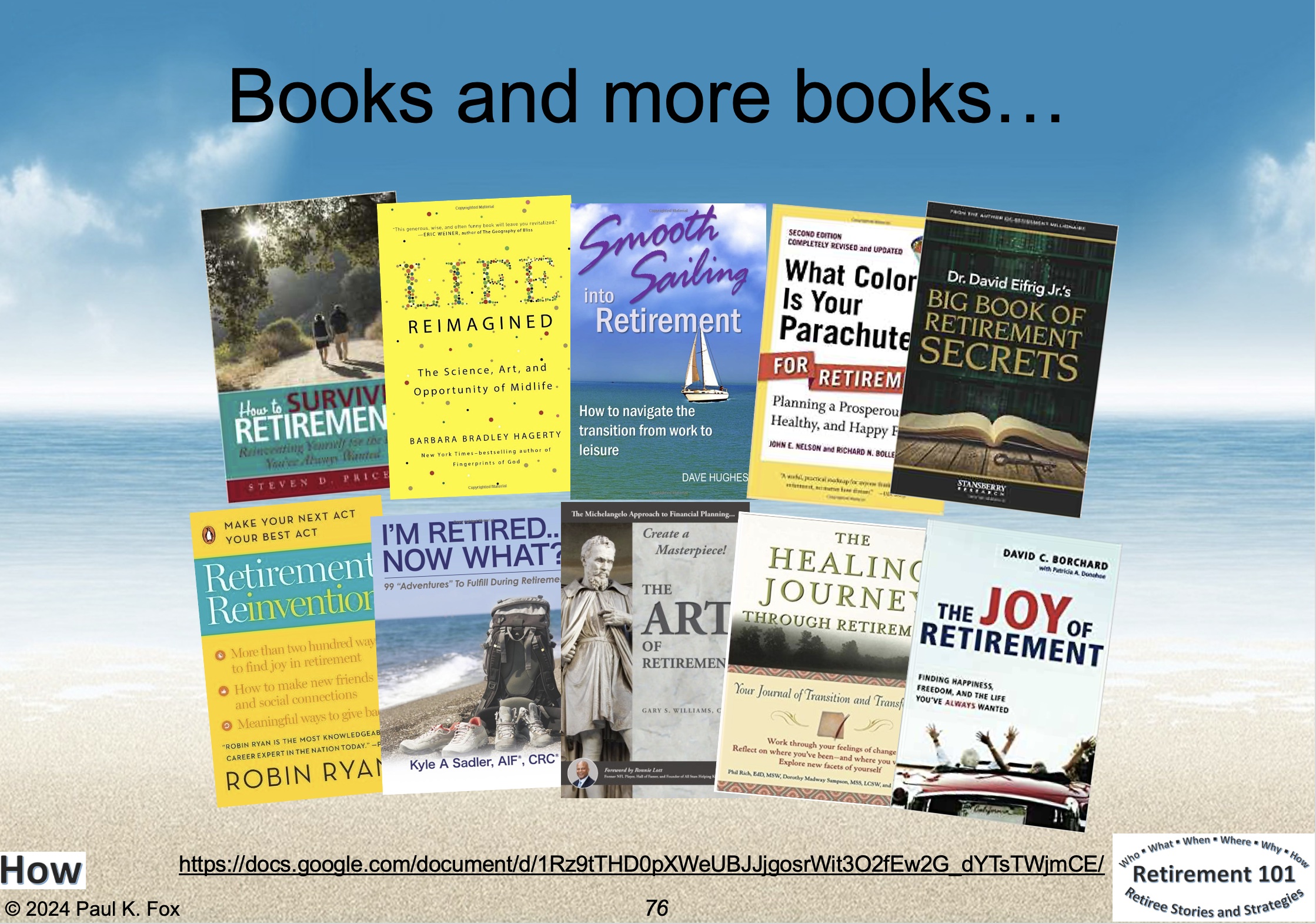
Retirement is “reinventing yourself for the life you’ve always wanted.” Steven Price, How to Survive Retirement, Skyhorse Publishing, 2015

In my experience hosting the annual PMEA conference session “Retirement 101 – the Who, What, When, Where, Why and How” and sharing retiree stories and strategies, I have come to the conclusion that there are many other misconceptions about taking this big step:

  • You retire FROM something. (Nope! You need to retire TO your next phase of life, new goals, pursuits, etc., and not run away from your past. We have often paraphrased the theme of author Ernie Zelinski writings in past paulfox.blogs: Retirees must search for and define the things that your job had provided in the past: 1) Purpose/new life mission, 2) Structure/schedule, and 3) Community/interaction with people.)
  • It’s an easy transition. (For many, it can feel like the most tumultuous transition ever experienced with “change,” sometimes overwhelming swings in emotions, and personal challenges!)
  • It takes little time to prepare. You just fall into it! (No, the research recommends “intentional and comprehensive” advance preparation, starting at least 3-5 years before you “pull your plug.”)
  • The decision is based almost entirely “on the money.” (True, a soon-to-be-retiree should draft a post-employment household budget, analyze net worth and pension/social security benefits, pay off as many loans as possible, and make appointments with an estate planner, elder attorney, and/or financial advisor. However, we retire for a host of very personal reasons – travel, relocation, encore or new careers, caring for family members, etc., and the likely greater challenge is a renewed exploration of self-reinvention, defining new pathways, renewing relationships, and mapping out your rest-of-life strategies and goals. In other words, what are you going to be when you grow up?)
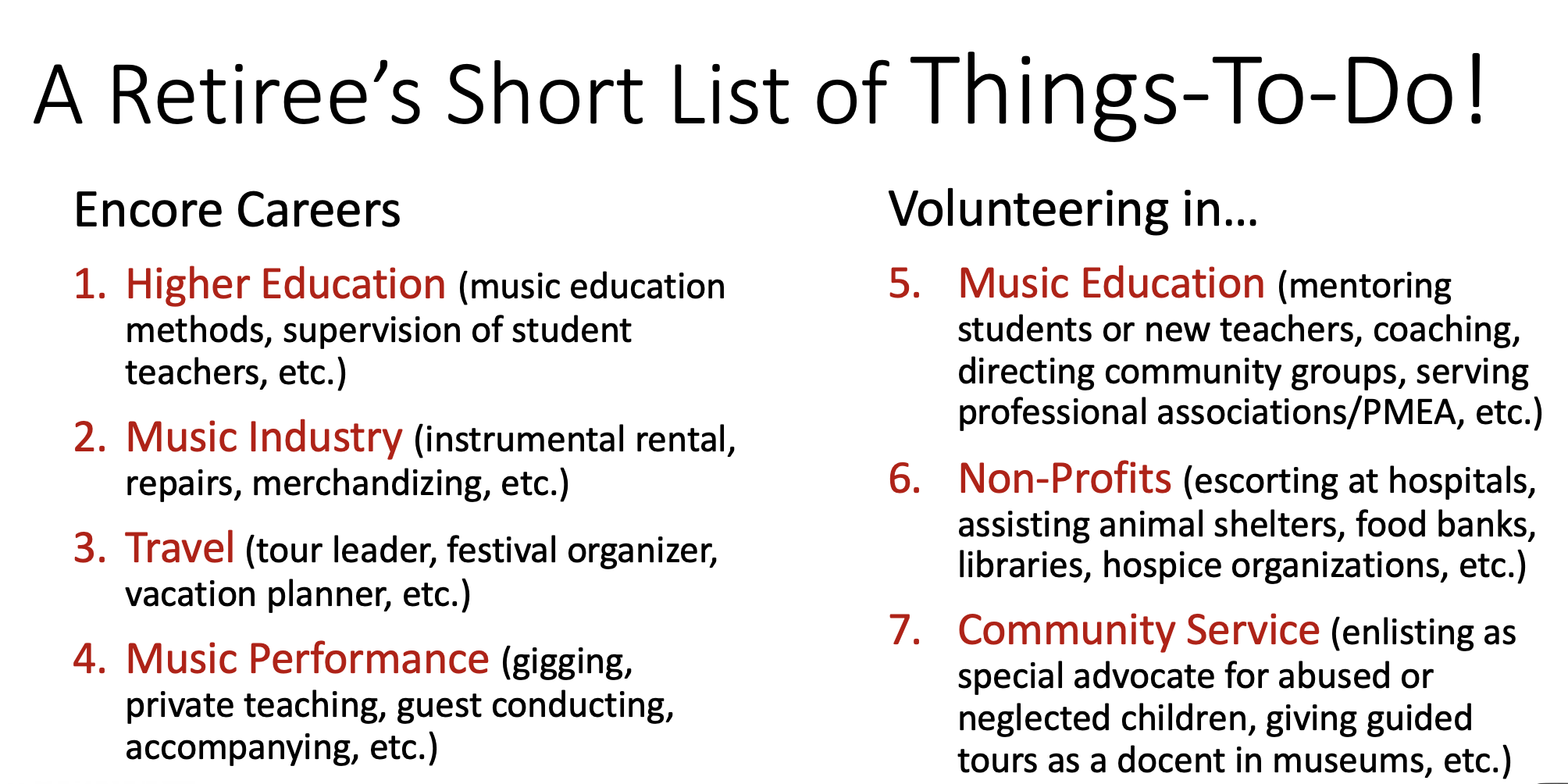
  • It’s completely different from anything you’re doing right now. (Music educators have a variety of skill sets that they will likely retain in future part/full-time employment or volunteer work. They can advance their personal artistry in the singing or playing an instrument, accept solo “gigs” or perform in community or professional ensembles. They can teach privately, direct church or community bands, orchestras, choirs or jazz groups, coach sectionals, compose music or design halftime shows, judge school groups, present workshops, choreograph/direct musicals, serve in college music education programs, etc. The list goes on and on… and is only limited by the retiree’s imagination and interest.)

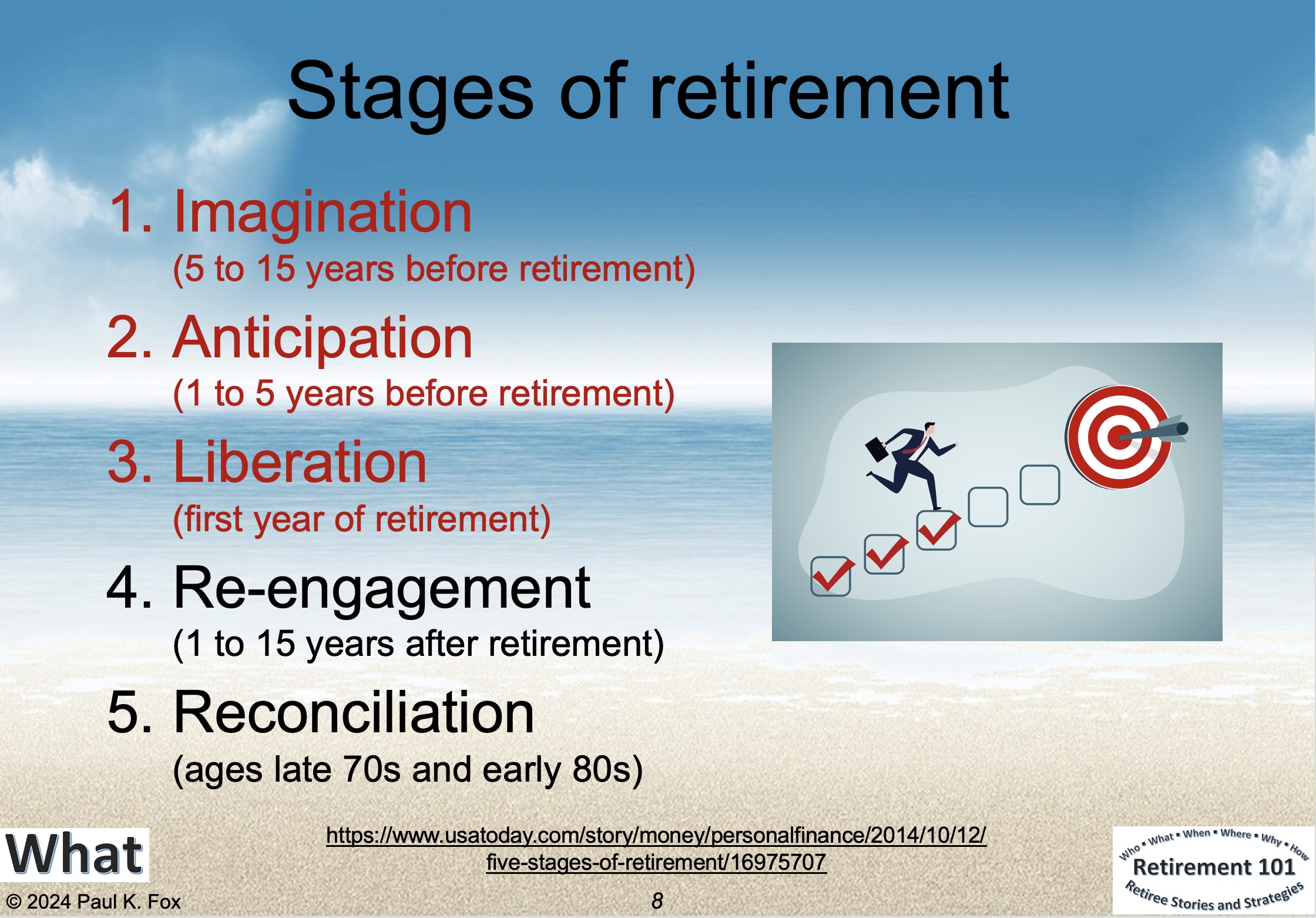
In almost every book on retirement, there are discussions about the “stages of retirement” (defined by gerontologists – experts on aging) that graphically show the importance of advance planning. (See below.) The first three stages certainly provide opportunities to rethink, recharge, reinvent, retool, and redefine one’s life purpose and meaning, become productive, and begin that new chapter in their lives.

Retirement can be a little bumpy. It’s not unusual to feel many “up’s and down’s” through the transition. A lot may have to do with whether you had really wanted to leave your job when you did or if you took the necessary steps in retirement preparation. Many have suggested to take a year or two “internship” to explore your options, rest a little and take a break from all of that stress, celebrate the free time (you seem to) instantly have, and then assess and “test” what might be your next (more permanent) steps.

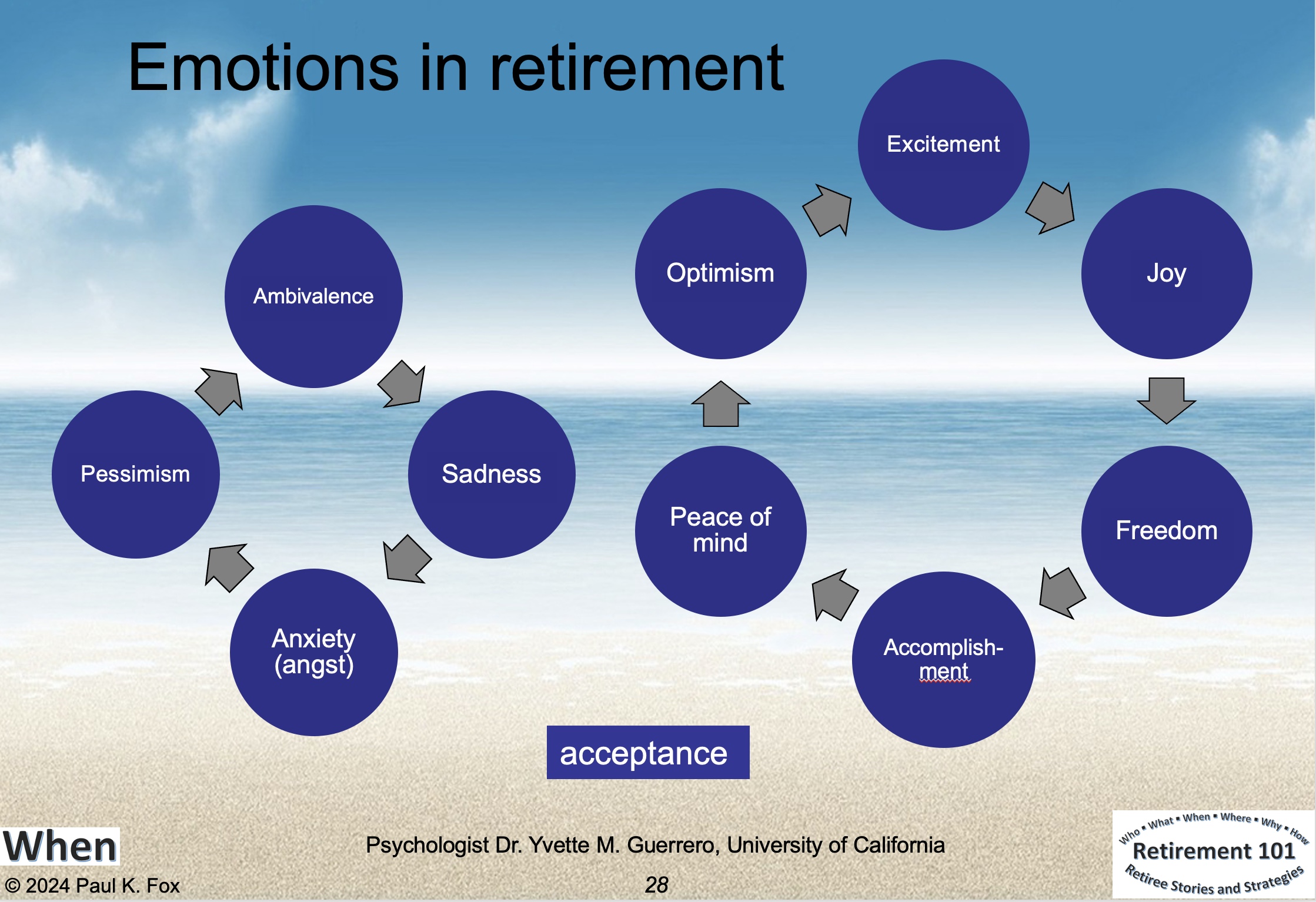
Prepare for the emotional roller-coaster! Initially, you are very EXCITED about your upcoming retirement. You feel pure JOY about the anticipated FREEDOM, and everyone throws you a party or two. You take moments to sum up your career legacy and ACCOMPLISHMENTS. A blessed PEACE-OF-MIND envelopes you, no longer having to worry about that next concert, recruitment campaign, or lesson target. With the future in front of you, you feel OPTIMISM. And then, after the excitement dies down…

At times, you feel a little AMBIVALENT about all of this “change!” SADNESS could come saying good-bye to your colleagues and experiencing a loss in professional identity and sense of purpose. Perhaps you may experience ANXIETY (angst) about what the future will hold, and PESSIMISM on whether you will “get it together” in your new life.

But, finally… ACCEPTANCE and adjustment!

Both emotional cycles may happen at different times or nearly simultaneously. These are normal “speed bumps,” and the perfect reason why you should remain as active as you can with your relationships, especially with people who have already made the retirement journey.

Are you ready to retire over the next 3-5 years? Well, as the PMEA Retired Member Coordinator for ten years (with the help of numerous inspirational music teacher retirees in PMEA), I have spent a lot of time preparing what amounts to be a “mock instructional manual” and other resource materials for fellow PMEA members. These are all posted here on the PMEA website. (This one of the best reasons to maintain your PMEA professional association and pay your dues… We continue to advocate, advise, and assist all PA music educators… from preservice to “living the dream!”)

Free “nuts and bolts” are listed below for you to peruse as you prepare for this life-changing passage.

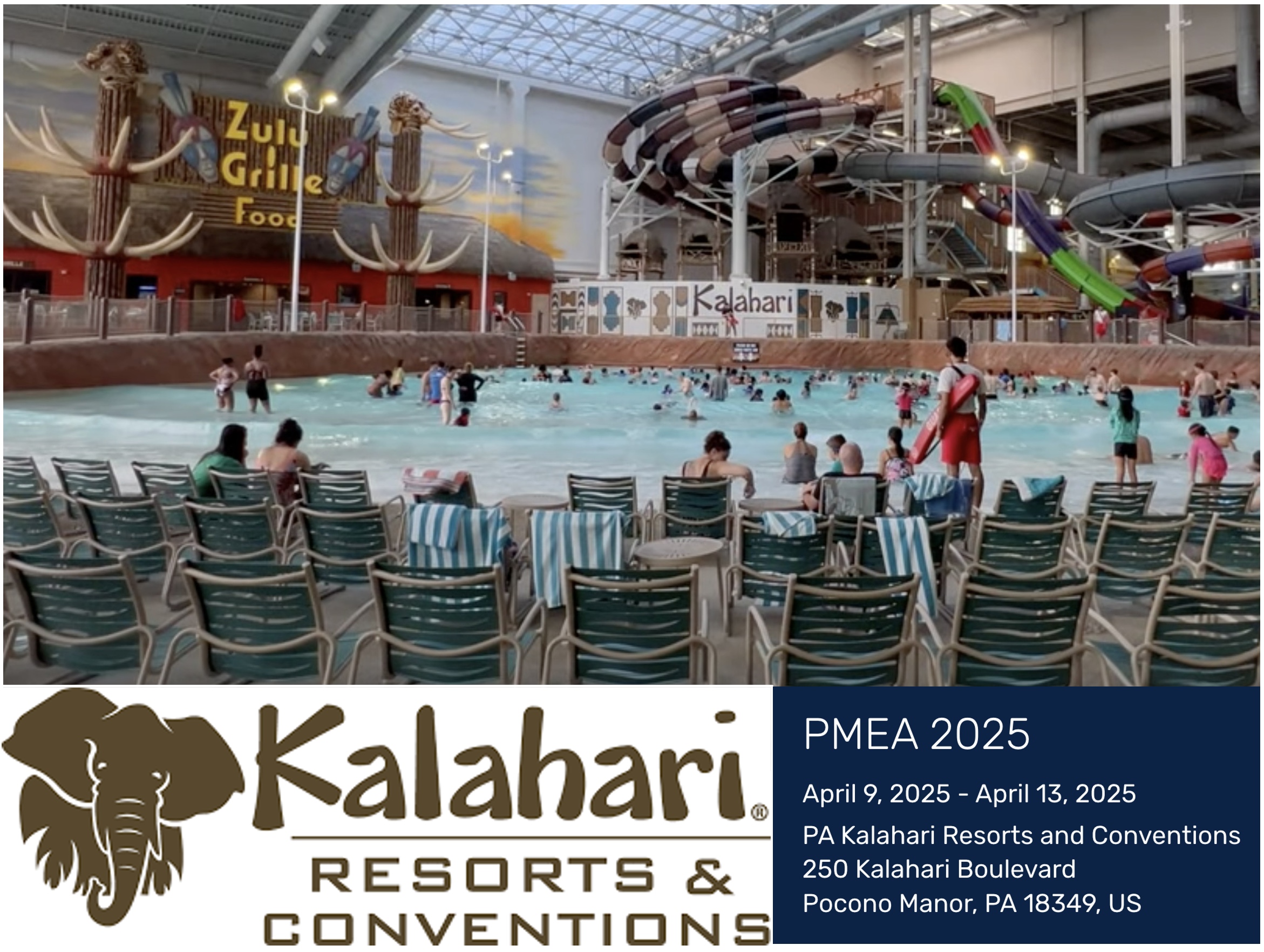
What’s next? How about attending the PMEA Annual Conference on April 9-13, 2025 at the Kalahari Resort/Poconos (“home of the world’s largest indoor water park!”) and enjoy some time away from it all? The Kalahari offers some family-fun recreation and PMEA will provide concerts, keynotes, exhibits, and sessions of stimulating professional development for the entire “life cycle of the music educator.”

PMEA members, I hope you plan to attend my Friday session at the conference…

Looking forward to seeing you there! At any time, if you need help or more ideas on retirement prep, I’m just a quick email away. (Click here.) Let me hear from you!

PKF

© 2024 Paul K. Fox