
“A good teacher can inspire hope, ignite the imagination, and instill a love of learning.” – Brad Henry
Standards and Benchmarks of Top-Rated Educators in Music and Other Academic Subjects

The best way to prepare for a job interview is to become aware of how you will be judged in comparison with your peers. What are the standards (or behaviors or criteria) of outstanding teachers? For what are administrators looking to fill the vacancies and build/maintain a quality staff?
Interviews will sort out (and rank) the competencies, certifications, education levels, and overall experience of the candidates. Obviously, mastery of subject content and teaching methods will be evaluated. However, you may be surprised that significant focus will be placed on personality traits, social skills, and evidence of personal drive, reliability, versatility, vision, and habits of professionalism.
In short, you may be the best musician this side of the Mississippi, the “model lesson planner,” and can conduct Orff’s Carmina Burana or Shostakovich‘s Festive Overture blindfolded, but if you cannot inspire students, work with coworkers, and communicate effectively, your interview and chances for being hired are doomed from the start.
Adapted from David Berliner and William Tikunoff, “The California BTES: Overview of the Ethnographic Study,” effective teachers score high on…
- Accepting
- Adult involvement
- Attending
- Consistency of message
- Conviviality
 Cooperation
- Student engagement
- Knowledge of subject
- Monitoring learning
- Optimism
- Pacing
- Promoting self-sufficiency
- Spontaneity
- Structuring

Effective teachers score low on…
- Abruptness
- Belittling
- Student defiance
- Counting hours or “clock punching”
- Illogical statements
- Mood swings
- Oneness (treats whole group as “one”)
- Recognition-seeking
In previous blogs (e.g. https://paulkfoxusc.wordpress.com/2015/07/01/the-meaning-of-pro/), I have defined the qualities of a “professional.” How many of these traits do you model?
- Succeeded in and continues to embrace “higher education”
- Updates self with “constant education” and retooling
- Seeks change and finding better ways of doing something
- Like lawyers/doctors, “practices” the job; uses different techniques for different situations
- Accepts criticism (always trying to self-improve)
- Proposes new things “for the good of the order”
 Can seemingly work unlimited hours (24 hours a day, 7 days per week)
- Is salaried (does not think in terms of hourly compensation, nor expects pay for everything)
- Is responsible for self and many others
- Allows others to reap benefits and credits for something he/she does
- Has obligations for communications, attending meetings, and fulfilling deadlines
- Values accountability, teamwork, compromise, group goals, vision, support, creativity, perseverance, honesty/integrity, fairness, and timeliness/promptness
- Accepts and models a corporate standard of behavior and appearance

It is worth reading “Weigh In: What Makes a Great Teacher” by Jacqueline Heinze in the Winter 2011 issue of Administr@tor Magazine (see http://www.scholastic.com/browse/article.jsp?id=3755567). Among the numerous responses were these notable quotes:
- “A great teacher must be resilient.”
- “Great teachers are instructional leaders and curriculum designers.”
- “Great teachers love what they do and perceive teaching as their calling.”
- “Great teachers are empathetic and engaged.”
Also check out these websites for additional insight on the characteristics of a exemplary educator:
- http://www.theatlantic.com/magazine/archive/2010/01/what-makes-a-great-teacher/307841/
- http://www.greatschools.org/gk/articles/what-makes-a-great-teacher/
- http://www.npr.org/sections/ed/2014/11/08/360426108/five-great-teachers-on-what-makes-a-great-teacher
 Since the process of teacher selection in the public schools involves recruitment, screening, hiring, placement, induction, and evaluation, it is advisable for prospects to know the assessment practices already in place. According to the Pennsylvania Department of Education, Pennsylvania has adopted The Framework for Teaching as the overarching vision for effective instruction in the Commonwealth.
The Framework for Teaching is written by Charlotte Danielson, an internationally-recognized expert in the area of teacher effectiveness specializing in the design of teacher evaluation systems that, while ensuring teacher quality, also promote professional learning.
The introduction to The Framework of Instruction Evaluation Instrument 2013 states its purpose:
“The Framework for Teaching identifies those aspects of a teacher’s responsibilities that have been documented through empirical studies and theoretical research as promoting improved student learning. While the Framework is not the only possible description of practice, these responsibilities seek to define what teachers should know and be able to do in the exercise of their profession.” – Charlotte Danielson
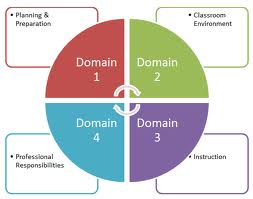
The model focuses the complex activity of teaching by defining four domains of teaching responsibility:
- Planning and Preparation
- Classroom Environment
- Instruction
- Professional Responsibilities
The domains can be further broken down into…
Domain 1: Planning and Preparation
- 1a Demonstrating Knowledge of Content & Pedagogy
- 1b Demonstrating Knowledge of Students
- 1c Setting Instructional Objectives
- 1d Demonstrating Knowledge of Resources
- 1e Designing Coherent Instruction
- 1f Designing Student Assessments
Domain 2: Classroom Environment
- 2a Creating an Environment of Respect and Rapport
- 2b Establishing a Culture for Learning
- 2c Managing Classroom Procedures
- 2d Managing Student Behavior
- 2e Organizing Physical Space
Domain 3: Instruction
- 3a Communicating with Students
- 3b Using Questioning and Discussion Techniques
- 3c Engaging Students in Learning
- 3d Using Assessment in Instruction
- 3e Demonstrating Flexibility and Responsiveness
 Domain 4: Professional Responsibilities
- 4a Reflecting on Teaching
- 4b Maintaining Accurate Records
- 4c Communicating with Families
- 4d Participating in a Professional Community
- 4e Growing and Developing Professionally
- 4f Showing Professionalism
Many Pennsylvania districts assess their professional staff and verify their teacher’s professional growth via rubrics or other evaluative tools, as well as the collection of artifacts that support these domains. Archives of these “best practices” would be assembled in portfolios for the principal’s year-end review (samples printed in blue below are possible artifacts for music educators in particular):
Domain 1: Planning
- Assessment Tools
- Lesson Plans
- New Curriculum Innovations
- Personal/Professional Goals
- Music Repertoire/Program Lists
- Subject Outlines
Domain 2: Classroom Environment
- Audio-Visual Resources Including Recordings
- Formal Observations
- Informal Observations
- PowerPoint Presentations
- Sample Classroom Displays/Bulletin Boards
Domain 3: Instruction
- Arrangements (Teacher Composed)
- Conferences with Colleagues/PLCs/Teams
- Meetings with Mentors/Curriculum Leaders/Principals
- Printed Concert, Musical, Drama, or Recital Programs
 Sample Homework and Worksheets
- Student Composed Music/Lyrics/Exercises
- Warmup Drills and Style/History Handouts

Domain 4: Professionalism
- Act 48 Clinics and Workshops
- Congratulatory Notes from Parents/Staff
- Grade Books and Attendance Records
- Letters/Newsletters Sent Home
- Minutes of Department Meetings
- Professional Development Programs
- Student Recommendations
- Student Records
Individual school districts define their own “vision of a model teacher,” aligning the selection criteria with the goals of the school system and the needs of the individual schools. For example, Upper St. Clair School District (an Allegheny County public school system located in southwestern Pennsylvania, and where I worked 33 years as music educator and seven years as Performing Arts Curriculum Leader) adopted the following Assessment Criteria for Teacher Candidates (developed by Superintendent Dr. William Pope, Human Resource Director Ms. Jean Toner, and other staff). “In a nutshell,” these are what USC calls “core behaviors” or standards of personality traits, skills, and knowledge, and serve as categories for assessment of all job applicants during the interview process:
Instructional
- Educational Philosophy
- Knowledge/Experience
- Classroom Management
- Technology
- Oral Expression
- Written Communications
 Professional
- Leadership
- Teamwork
- Judgment
- Problem Solving
- Planning & Organizing
- Innovation
Personal
- Initiative
- Dependability
- Adaptability
- Self-Insight and Development
- Energy and Enthusiasm
- Appearance
My next blog on this subject will provide examples of music teacher interview questions for each of the above criteria… suitable for individual practice or group mock interview sessions, and to assist in the formulation of stories/anecdotes that would support a candidate’s mastery of each standard. The importance of this preparation is explored in a previous blog: https://paulkfoxusc.wordpress.com/2015/08/02/when-it-comes-to-getting-a-job-s-is-for-successful-storytelling/.
PKF
© 2015 Paul K. Fox
This post is featured by Twinkl in their ‘Teaching Writing’ blog.



 paulfox.blog