The Life Cycle of a Successful and Happy Music Educator
Joyous Holidays, Season Greetings, and Happy New Year from “The Foxes!” This is a time for reflection and gratitude… and we feel blessed for all the opportunities allowing us to share our insights, gifts and experiences with other music education professionals.
We hope to inspire YOU and literally model the concepts in this blog series. We continue with our discussion first introduced a month ago in Bookends – Part One – The Life Cycle of a Successful and Happy Music Educator, exploring:
Stage 3: Inservice/Growing Years (this blog)
Stage 4: Veteran/Sustaining Years (future blog)
Stage 5: Next Chapter/Living the Dream (future blog)
This article is an abstract from a session presented to Seton Hill University music education student teachers on October 17, 2023. Click on this link to download the slide summary in PDF format.
“I have written a lot of articles in support of these topics… now compiling them for your easy access. Depending on your current status and interests, feel free to peruse the checklists (links) in this series. It is possible a few of the resources contained within these blogs have gone inactive, but I believe enough are there for you to gain the insight, tools and motivation to achieve professional development for life.”
– Paul Fox
Stage 3 – Inservice/Growing Years
[ ] 8. Becoming a Music Educator:For a review of Bookends – Part One, take a step backward and revisit what you have done to “get ready” for your “rookie years.” Take special note on the things-to-do list (“secrets”) as a first-year educator (perhaps completed during your student teaching semester):
Subscribe to a discounted NAfME + PMEA first-year membership (If you are a recent college graduate in your first year of teaching, or if you are the spouse of a current or retired NAfME member, contact NAfME at 800-336-3768 or email memberservices@nafme.org) to find out if you qualify for a reduced rate.
Hook up to PMEA Mentor or other state’s MEA support program for new teachers.
Need to fill in a few gaps missing from your college courses in skills and knowledge? Continue your “enrichment” viewing PMEA Webinars and the exhaustive video library in the NAfME Academy.
At some point you will be writing/editing curriculum, so research the awesome resource of Model Curriculum Framework (Have to be a PMEA member)
Too busy to participate in the PMEA Annual Conference or NAfME national events? Look into going to a PMEA summer conference (usually at a lower-cost!). Check out your own state’s MEA discounts and offers for collegiate members and new teachers!
[ ] 9. The Care & Feeding of Your Principal:Although not covered in any detail during the Seton Hill University presentation, it is recommended that you read in its entirety “The New Teacher’s Guide to Fostering Positive Relations and Good Interactions with School Administrators” offering a wealth of excellent recommendations from these trustworthy sources:
Enhancing the Professional Practice of Music Teachers: 101 Tips that Principals Want Music Teachers to Know and Do by Paul G. Young (my personal favorite, available from Amazon here)
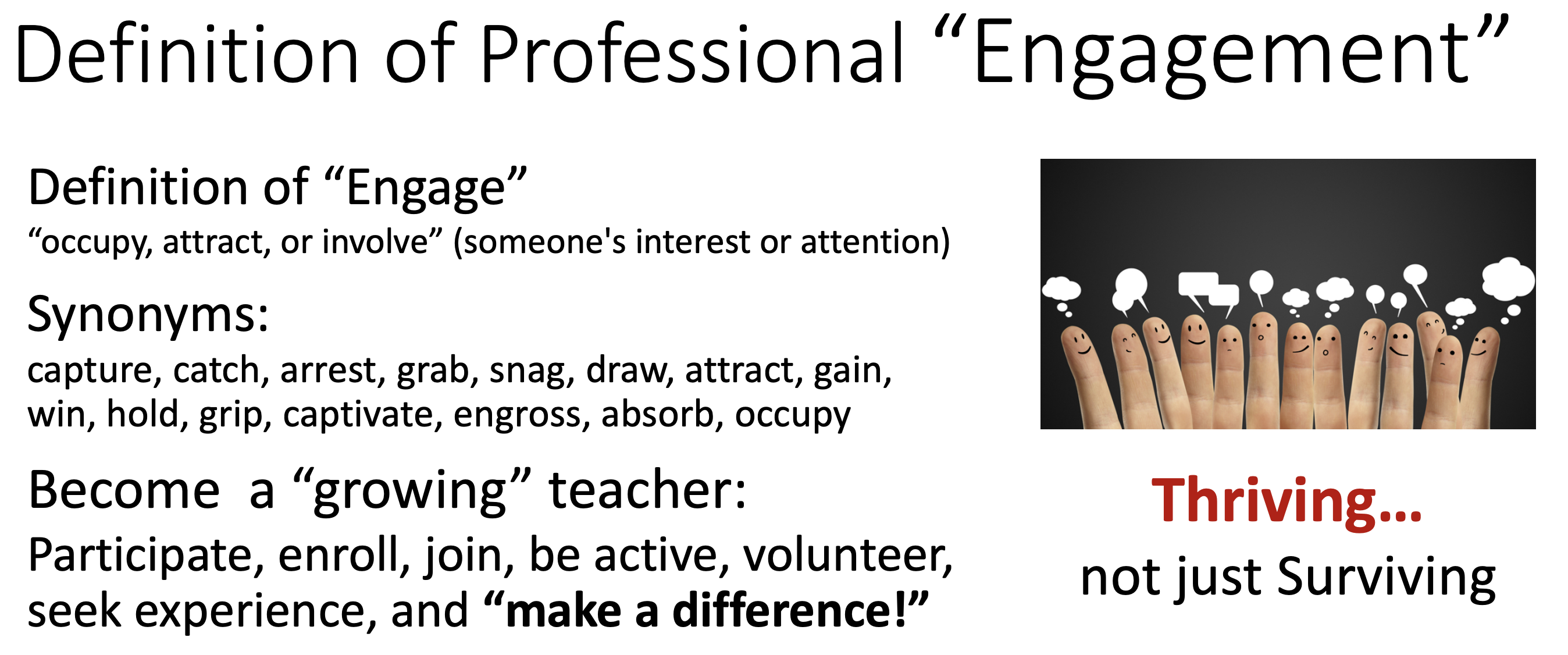
A favorite question I pose to college music ed seniors is, “In what professional associations are you a member and actively involved?” For the price of consuming one fewer Starbucks latte a week, you can open up the Wonderful World of “C’s” – Contacts, Coachings, and other Connections, including research and resources that will benefit your Continuing Education. You can’t afford NOT to join groups like these.
To help “nail down” a few related definitions critical to personal growth and career development in our profession, especially “engagement,” “professionalism,” “collaboration,” and “networking,” please take a little time to travel and consume the following archived blog postings.
[ ] 10. The Meaning of PRO:This is one of the oldest articles at the paulfox.blog site. How about a little soul searching? Are you truly a professional? Do you have the skills, habits, and attitudes of a professional in the field of education?
[ ] 11. Transitioning from Collegiate to Professional (Part II):New teachers have to move away from “book learning” or higher education research and emphasize “practical application,” and at the same time, assess the precise areas needed for immediate (re-)training… everything from new exposure to specialized teaching areas and grade level focus for the job to which you have been assigned, to the enhanced skills of classroom management, student assessment, curriculum writing, class or ensemble warm-up materials, music repertoire and programming, etc.
While we are on the subject, it is important to intentionally seek out mentors or consultants in your early years of becoming an educator. PMEA offers a mentoring program (read all about it here) and PMEA Retired Members are also an excellent resource to “phone a friend” for advice as needed (see their section on the PMEA website here). That leads us to the next most essential “habit” of attending professional conferences… #12 below.
[ ] 12. Getting the Most Out of Music Conferences:Our PMEA Annual Conference sites are cyclical. This article, written on March 5, 2017, showcased that year’s event at the Erie Bayfront Convention Center – coincidentally the same location for this year’s PMEA Annual Conference: April 17-20, 2023. For a sneak peek at the proposed sessions and guest performers, click here.
There are a myriad of conferences offered every year… something for everybody in just about every state. Make plans to go, “recharge your batteries,” and pick up new state-of-the-art ideas, lessons, music, technology, etc. Again, you cannot afford NOT to attend… or becoming stale in your teaching or “stuck in a rut!” Besides, going to your state’s or national conferences and regional workshops are FUN places to meet other like-minded, inspiring colleagues! This is how professionals network, collaborate, and share their “latest and greatest!“
I found myself this past Monday morning with a few extra minutes checking my almost empty “to-do” list and, with the exception of planning to watch the Pittsburgh Steelers football game and the endless chore of raking leaves in my yard (I immediately rejected the latter), I discovered I had very few professional or personal priorities to focus on this week! Wow! Some additional “free time!” Shh… don’t tell anyone!
Down time? As I mentioned in a previous blog-post, since the summer, things had been a little hectic for “this retiree.” When I accepted the position of “admin” to the marching band of the school from where I retired, I discovered how fast we can fill up our schedules with meetings, rehearsals, and performances… to the point that it is hard to imagine how I could possibly have done all of this unless I retired from the regular job! My wife jokingly said, “Those were the days!” (perhaps a little unsympathetically?) as she watched me takeoff for band camp, parent salute nights, late night away football games, etc., while she remained cozy at home. “Been there. Done that! Not anymore!”
Only one professional association got me through more than five decades in music education and 35+ years of full-time directing, equipping me to handle the twists and turns of an ever-changing career (e.g., becoming a choral director even though I had never sang in a high school or college choir), and even attending music festivals as a viola and tuba student for four years in the Penn Hills school district. Who do I credit for giving me this “life force,” “teacher chops,” and music mastery? PMEA. We are so fortunate to have this priceless “collaboration of our colleagues,” numerous resources for the benefit of our own professional development, and services we provide to our music students. Cut me and I bleed PMEA blue!
How Are YOU Feeling?
This blog’s “call to action” is necessary because of the turmoil the pandemic has left the arts education community, new school health and safety mandates, re-prioritization of district resources (in some places away from the arts in spite of the need for more not less social emotional learning), reports of the drop in music participant enrollments, decrease in membership renewals, and teacher shortages.
The crush of COVID-19 and all of the program delays, suspensions, (and hopefully not) permanent losses have made this one of the most challenging times I can ever recall. The only way we can get through this is “together…” and frankly, “if you’re not part of the solution, you’re part of the problem!” This is NO TIME to let your membership and involvement lapse! PMEA and other professional music education organizations (like NAfME, ACDA, ASTA) need your “dedication to the cause,” willingness to help “the team” and one other, and active participation.
Collegiate members, full active members, and retired members – all of us joining forces – can truly “make a difference!” No matter how busy or stressed you are and how much you feel you are “slugging it out in the trenches” alone, we all need to become partners and devote time for and dedication to the associations we are blessed to have right now that support music educators in the Commonwealth, the nation, and the profession.
The Essential Role of Associations
It does not matter which profession you have chosen! You NEED an ASSOCIATION!
The architects may have defined “this essential bond” best:
Membership in the relevant professional organization is one of the things that separates a profession from a conventional job. It is a key element that defines a professional. Membership in one’s professional organization is expected of all professionals. It is important to support the advancement of one’s profession, and becoming a member of the professional organization is a part of that advancement.
Involvement with a professional society will afford the participant an opportunity to network with other colleagues in industry and practice. Making connections with others who have similar interests reinforces why one has chosen this career. It enables new professionals to associate with senior members of the profession and learn from them. Joining a professional organization is critical in keeping abreast of the latest knowledge and practices locally, regionally, and globally. It helps the professional to stay abreast of current issues and opportunities and will also assist in personal advancement for the member who becomes involved.
Many professional organizations offer continuing education, seminars, and lectures along with other opportunities for learning. An active participant will have the opportunity to serve in professional development. Working with people outside of one’s own firm and volunteering will build leadership skills. Opportunities for working with the community for the betterment of society and the local economy will be available. There will be possibilities for making real contributions to the human condition through projects the professional organization may take on as a part of giving back to the community. There are events that will call for public speaking skills and professional visibility which will assist in moving one’s career to another level by connecting with other professions and local leaders in the area. The profession will benefit from members’ service and the members will be rewarded in return by such things as personal fulfillment, professional enrichment, and building a stronger resume as a result.
Further definition of the professional responsibilities and ethical practices will come in part from the professional organization. It is a central core for regulation, education, revitalization, networking and service. Joining a professional organization provides occasions and experiences to renew one’s enthusiasm for the practice of interior design. The interaction can be both inspirational and enlightening. Being a member of a professional organization is a symbiotic relationship between the organization and the member that will benefit them both.
My “top-ten” benefits for membership in a professional association like PMEA are:
Development and sharing of the standards and best practices of the profession
Student festivals and music performance assessments
Professional development and career advancement opportunities: workshops, conferences, and publications
Leadership training
Collaborative projects such as health and wellness seminars, ethics training, library of online resources, etc.
Networking opportunities
Models and resources for curriculum writing
Coaching and mentoring resources
Resources in job hunting and interviewing techniques
Advocacy of music education and “a voice” (more political “clout”) in defining future government public policy
So, What’s in it for Me?
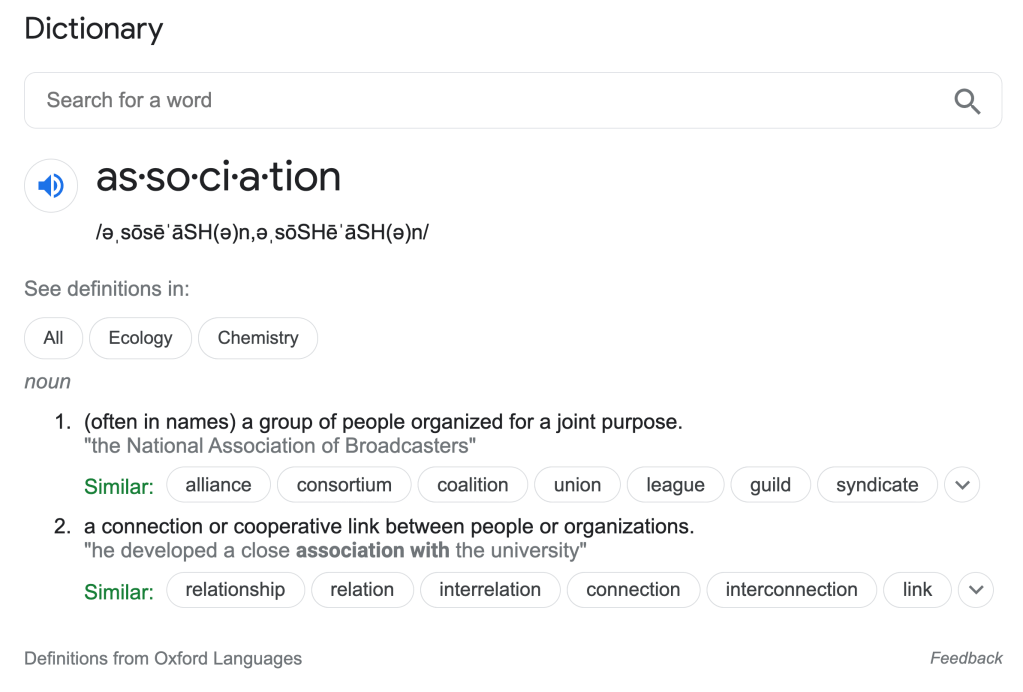
Review a few of the synonyms of “association” mentioned above: “alliance,” “consortium,” “coalition,” “connection,” etc. I am sure you’ve heard the saying: “TEAM stands for Together Everyone Achieves More.” Or, to quote the philosopher Aristotle: “the whole is greater than the sum of its parts.”
The easiest way for me to show the value of joining PMEA and becoming more active, engaged, and successful in your teaching assignment (no matter what the primary specialty – general music, vocal, band, strings, jazz, music theory, technology, etc) is to take a snapshot of the benefits displayed on the www.pmea.net website. Why try to reinvent the wheel? You might be surprised the extent of the HELP that is available just around the corner! Go ahead… click away! Take a peek at what you may be missing!
On a personal note, PMEA has provided me the insight, inspiration, and opportunities for substantial career growth, “places to go and people to meet” to fill-in-the-gaps of the skill training I may have felt were missing, for example methods and media for teaching a high school choral program for more than 16 years and directing/producing 37+ musicals. In addition, PMEA and NAfME have been the sole institutions that I have turned to for more than 50 years for their sponsorship of choral and orchestral music festivals and other enrichment that have provided my students new and highly motivating musical challenges and countless state-of-the-art once-in-a-lifetime experiences.
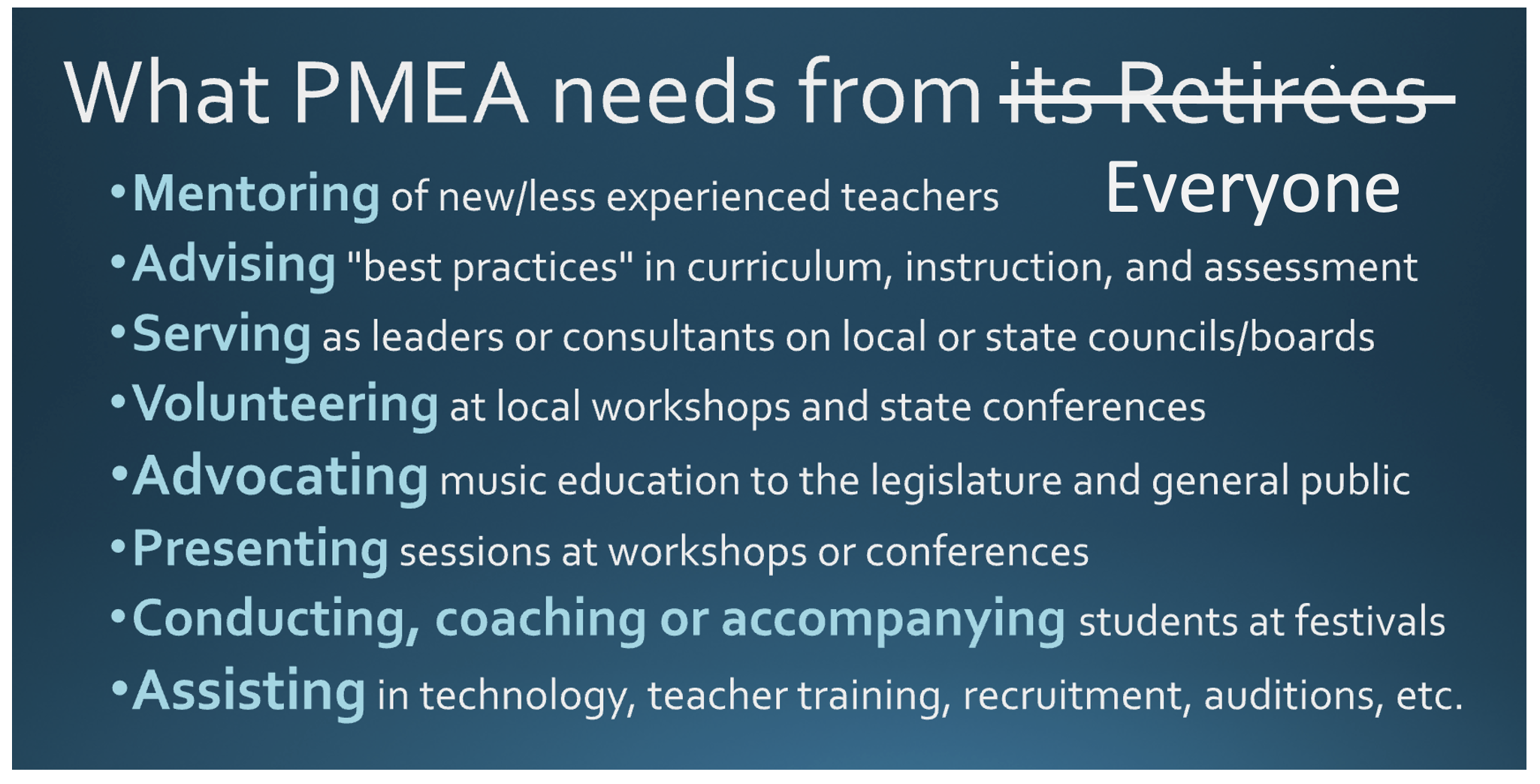
So now, reflect on the title of this blog! It is essential to give back to our association – to help it achieve its mission: “to advance comprehensive and innovative music education for all students through quality teaching, rigorous learning, and meaningful music engagement.” We’re all in this together, and together we can make it better! Slide #6 at the bottom of the retired members’ webpage proposes what PMEA needs from all members (not just retirees):
The number one thing you can do for ANY association is to pay your annual dues, attend its meetings, be active and HELP OUT! In return, PMEA can assist you in finding and sustaining your passions! What are you waiting for? If you have not renewed for the 2021-2022 year, please visit this PMEA membership webpage.
New Teachers’ Guide for Fostering Positive Relations & Good Interactions with School Administrators
Conventional wisdom suggests that the initial school staff you should get to know immediately on a first-name basis in your new teaching job are 1) the building secretary, 2) head custodian, and 3) cafeteria workers. (The first one keeps you out of trouble, the second cleans up your messes, and the last group makes sure you’re well-fed!)
However, even more influential, the principal “assigned to you” will literally “make or break” a smooth transition and orientation into the workplace. Especially if this person was partially responsible for hiring you (a member of the screening committee which chose you out from all of the other qualified candidates), he/she should be your penultimate “mentor!” To validate the administrator’s judgment (and you continuing to be the “hero”), he/she will likely be highly motivated to foster your success!
So… once you land your new position, your first move should be to learn everything you can about “your champion!” Find out his/her goals, needs, and “pet-peeves,” and while you’ll at it, get off on the right foot with relations with all of your school supervisors.
Here are some tips for “rookie” or new music teachers to cultivate these relationships.
According to the article, “The Principal’s Role in the Music Program” by Orville Aftreth in the Music Educators Journal (Vol. 46, No. 3, January 1960, pp. 41-44), “A successful music program requires a principal who enables the following basic attitudes:
A belief in the value and importance of music;
A desire to grow his ability to enjoy, appreciate, and produce music;
A willingness to vitalize school activities through music.”
But, unfortunately, it seems that few administrators have significant and ongoing experiences in making music.
A principal’s musical background influenced their view of music as a key part of a quality education. Most of the principals’ formal experience in the arts ended early in their life, and none took classes on how to be an effective administrator for an arts program. Principal certification courses typically deal with finance, special education, and general leadership and administration.
—D. Benjamin Williams
My own history (35 years of teaching in the public schools with 30+ administrators) was to serve with only one principal who was a former music teacher, and perhaps 10% of the remaining administrators had any real arts education experience (or even regularly played an instrument or sang in a choir).
Williams shared the purpose of his case study: “to gain an understanding of school administrators’ thoughts on their school’s music program in regards to music’s role and value.” He documented the comments of five principals in their advocacy of the arts.
The research questions posed in this study centered on the following:
What are common values and/or themes among administrators when it comes to music in their schools?
Are there common points of advocacy administrators find themselves making in support of their school’s music program?
What do administrators see as benefits of having a music program in their schools?
Where does music fit in the overall vision of a school?
What is music’s role in a quality education?
They mentioned how the arts are an opportunity to plug in, be engaged, and earn scholarships; that they create an identity for the individual and for the school; that they make a whole student and contribute to a whole education; and that they provide opportunities for higher-order thinking, such as critical or creative thinking and problem solving, that are encouraged in core-content areas as well. The pressure placed on education institutions in the 21st century are focused on these concepts, and the principals saw that music helped and encouraged students to develop these abilities. This is why they chose to support, advocate, and build up their school’s music programs.
—D. Benjamin Williams
I repeat: the first advice we give to newcomers to the profession is know your bosses! And, intentionally invite, “educate,” include, and engage them in your music classes and ensembles’ activities! Draw a circle around him/her to become a member of your team!
He drew a circle to shut me out,
heretic rebel, a thing to flout.
But love and I had the wit to win,
we drew a circle that took him in.
Learn techniques to make your principal work for you and your program.
Learn how to think like a principal.
Each year when I return from honor bands or other music related field trips, I make it a habit to purchase my administrators a small token of appreciation to let them know the trip was a great success. Students must write an essay, and they present the administrators with the gift. In the essay, students are required to write what they learned, what the field trip meant to them, and how they will use this experience to make the school better. Praise is effective.
Coming together is a beginning; keeping together is progress; working together is success.
— Henry Ford
Remember that even though you are not taking the role of administrator, you are a leader. You lead a program. You lead a musical family. You are the leader of a superior sound. You are the leader of inspiration for your community. In the most genuine way, lead your administrator to a music education crescendo.
— Lori Schwartz Reichl
After a little brainstorming, I recalled my own working “top-ten list” of techniques for building harmonious interactions and collaborations with your school leaders.
Be the first to arrive and the last to leave, and you will earn their respect! Professionals, especially music teachers who participate in co- and extra-curricular activities, are not “clock watchers” and need to “put in the time” before and after school to prepare and achieve meaningful learning experiences for their students.
Learn what makes them tick! Is your principal a site-based manager? Is he/she a stickler for “chain of command.” I had an administrator who would go bonkers if he thought you back-copied a memo to the superintendent or called a central office manager first. Be sure you conform to the management style of your chief. This is a way of showing him/her respect and cooperation, which in all likelihood, will be returned to you in spades.
Keep your principal “in the loop” and “in your corner,” and make sure you communicate any serious disputes that come up (especially with unhappy parents) that could blow up in your/his/her faces in the future. This also which means you don’t subscribe to the philosophy, “Don’t ask for permission, beg for forgiveness.” Proponents of this belief will tell you to go ahead and stick your neck out, perhaps do something “for the good of the order,” and later declare “oops!” if it goes south and your administrators disapprove. I cannot vouch for the ethics of this position, and “venturing out without a paddle” usually did not serve the best interests of the students. There’s no reason to place “the teacher’s convenience” over the safety and welfare of the children, and you should first try to obtain the legal and political endorsement of your boss(es) as you keep them appraised about what you are doing. Don’t be a nag, just “cc:” when appropriate, and “ask,” don’t “tell!”
Give them credit! Publicly, you make it clear: you and your students’ awards and accomplishments are also your administrators’ awards and accomplishments. If it is possible, have your principal join you on stage to accept any ensemble honors.
Serve on a non-music related committee or project. Principals are always looking for volunteers to help fulfill the overarching goals of the district. This might mean signing up for the strategic planning committee, Middle States accreditation evaluation team, school renovation planning meetings with the architect, etc.
Engage your principal as a participant in your program: concert appearances as guest conductor or solo/ensemble performer, featured narrator or announcer, limited-engagement as a walk-on part in the musical, judge of talent show, etc.
Model professionalism and good time management skills. Be prompt in the completion of all deadlines assigned by administration. Don’t turn your principal (or his secretary) into a “nag” requiring numerous follow-up reminders.
Understand the importance of public perceptions and “appearances.” Many school leaders spend an inordinate amount time trying to defend the sometimes questionable actions of their staff. Don’t make this necessary! Be responsible for your “public brand.” If it looks bad, it is bad… and that’s always up to you!
Don’t just bring up problems, have answers! At odds with an existing policy or practice? Suggest a solution and a Plan B to an issue you would like to address. Upholding “moral professionalism,” tactfully but firmly point out what is not working (and why). But, do your homework first. Share the “facts and stats” and try to propose several different directions to consider (even a Plan C and a Plan D). You will impress the “head honcho” by modeling the traits of flexibility, creative problem solving, and sensitivity to the needs of other staff and programs.
Think long term and back-up your requests with numbers! When you submit your budget for the next school year, include the “tangibles” and statistics that your principal could use to “fight for you.” Include data on and percent changes in student enrollments, per-pupil costs, history of past purchases, etc. and separate your proposals into one, two, three, and/or five-year “plans” to spread out the expense for big-ticket items. Be specific and prioritize! When asked to “cut” my sheet music amounts, I assembled a set of sample folders with all of the music I used in the current year and broke down each selection’s current (replacement) price, each concert’s overall value, percentage of the repertoire used from my library, projected losses, etc. In one case, I predicted that if the district went through with its reduction of the music budget by 20% and (at the time) the cost of sheet music was rising 15%, I would be forced to schedule one fewer public performance in the school year. (It never happened!)
If you have an apple and I have an apple and we exchange apples, then you and I will still each have one apple. But if you have an idea and I have an idea and we exchange these ideas, then each of us will have two ideas.
— George Bernard Shaw
Another resource worth reading is “A Teacher’s Guide to Working With Your Principals” by Kristy Louden. She reflects: “But aside from the obvious factor that your principal is your boss, and you want your boss to think well of you, I have found my relationship with my principal has helped in more ways than I probably realize. Here’s why:
They’ll think of you… (when an opportunity comes up that you might want).
Tip #41: Continuously improve classroom management
Tip #62: Make ethical decisions
Tip #80: Write notes, return phone calls, reply to email
Tip #93: Perform (satisfy your own pursuit of creative self-expression)
Tip #97: Improve your leadership skills (quotes from the book Leadership 101 by John Maxwell)
This final point is an excellent one. You are “in charge” of your own self-improvement projects and professional development. Administrators want to see staff members who seek growth experiences. Don’t wait for the annual implementation of the district’s “latest flavor of the year” in-service program (as it is sometimes referred to by teachers) or your supervisor’s year-end conference. Do your own self-assessment and plan specific and measurable goals and tasks to fulfill them. Always strive to do your best and be harder on yourself than anyone else (even administration) can ever be. Model the concepts of focus, cooperation, self-discipline, and a positive attitude in the workplace.
Now, take a deep breath. It’s all about one step at a time. Soak up these ideas. You can and will nurture happy and productive relationships with your principal and other school administrators, enhance your professional image and effectiveness, and foster opportunities of achievement and self-fulfillment for you and your music students!
Photo credits in order from Pixabay.com: “handshake-regard-cooperate-connect” by johnhain, “laptop-office-hand-writing” by Aymanejed, “marching-band-chicago-thanksgiving” by sam99929, “violin-flute-music-classic” by horndesign, “woman-business-woman-boss” by anna2005, “people” by Russell_Clark, and “wooden-train-toys-train-first-class” by Couleur.















 can about “your champion!” Find out his/her goals, needs, and “pet-peeves,” and while you’ll at it, get off on the right foot with relations with all of your school supervisors.
 Williams shared the purpose of his case study: “to gain an understanding of school administrators’ thoughts on their school’s music program in regards to music’s role and value.” He documented the comments of five principals in their advocacy of the arts.
 Also, you should check out an even more recent NAfME blog,
  Learn what makes them tick! Is your principal a site-based manager? Is he/she a stickler for “chain of command.” I had an administrator who would go bonkers if he thought you back-copied a memo to the superintendent or called a central office manager first. Be sure you conform to the management style of your chief. This is a way of showing him/her respect and cooperation, which in all likelihood, will be returned to you in spades.
 looking for volunteers to help fulfill the overarching goals of the district. This might mean signing up for the strategic planning committee, Middle States accreditation evaluation team, school renovation planning meetings with the architect, etc.
 practice? Suggest a solution and a Plan B to an issue you would like to address. Upholding “moral professionalism,” tactfully but firmly point out what is not working (and why). But, do your homework first. Share the “facts and stats” and try to propose several different directions to consider (even a Plan C and a Plan D). You will impress the “head honcho” by modeling the traits of flexibility, creative problem solving, and sensitivity to the needs of other staff and programs.
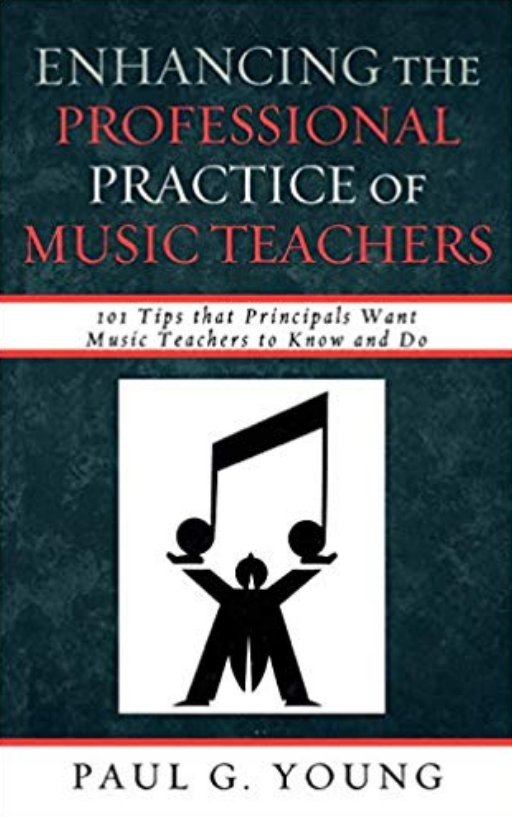 Finally, the most comprehensive manual I have ever read on this subject should be a “required read” for every music educator:
 paulfox.blog