

Putting Your Money Where You Mouth Is… Today and Tomorrow!
This article was submitted for publication in a future PMEA News – the official state journal of the Pennsylvania Music Educators Association. It is mostly targeting school music educators in the Commonwealth – current and retired – but may be appropriate for all advocates who are willing to “roll up their sleeves” to help the profession and associations who support music education.
This article succeeds PMEA Pride… posted on July 1, 2026.

NOW: Opportunities to Support the Mission of PMEA and School Music Programs
The moniker and stated focus of the PMEA Council for Teacher Training, Recruitment, and Retention – “the life cycle of a music educator” – nurtures present and future TTRR stakeholders and supports a broad timeline of numerous transitions, beginning with the Future Maestros Gold Star Awards Program (grades 3-6), then progressing to the TRI-M Music Honor Society (grades 6-12), Future Music Educators Honors Symposium (high school seniors accepted at a college or university to major in music education), PA Collegiate Music Educators Association and pre-service training, rookie to veteran years of professional development and participation in PMEA festivals, conferences, workshops, advocacy initiatives, and research programs, and finally self-reinvention and “keeping our hands in it” involvement during retirement.
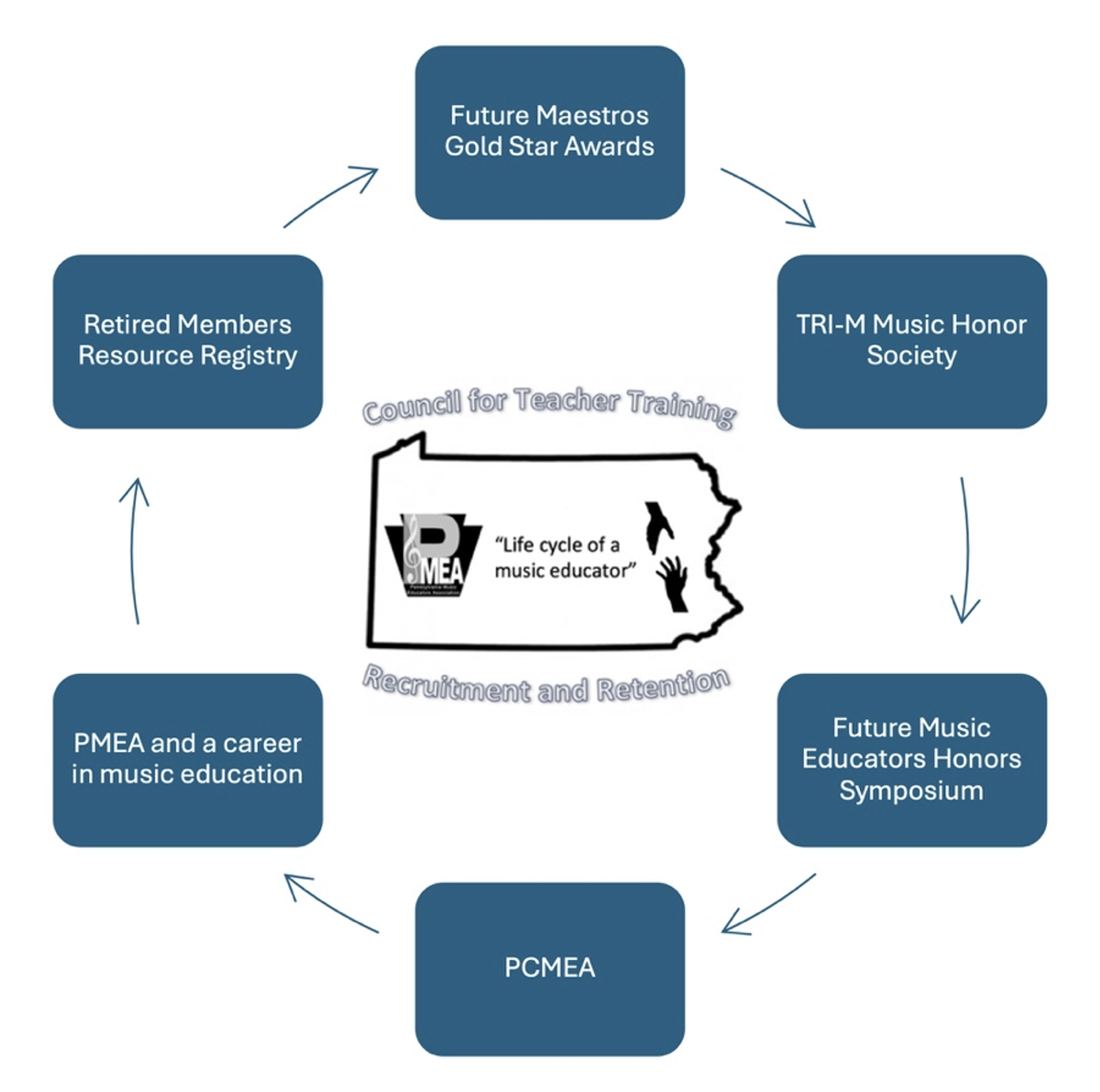
With the goal of “promoting the musical development of all Pennsylvanians,” TEAM PMEA embraces hands-on volunteerism and the value of our collective aspirations to foster the highest standards of collaboration in music education. Throughout our years, our organization offers many meaningful opportunities of giving, becoming eleemosynary (I love this word – look it up!) throughout its members’ upward career trajectory.
I have heard from a former foundation director and school board member that there are two categories of “volunteers” who make major contributions to the vision and everyday fabric of community outreach groups:
- “Busy Bees” or “Worker Bees” (Time & Labor): Active, hands-on volunteers who give their time and physical effort to complete tasks.
- “Money Bees” (Funding & Resources): Donors, sponsors, or fundraisers who support the cause financially rather than with manual labor.

Which one of these roles do you model for PMEA? Both? Obviously, there are countless opportunities for you to serve our PMEA governance, programs, and music education throughout the Commonwealth. I know most of you are already “hands-on” as “busy bees,” fulfilling these essential jobs (just to name a quick dozen):
- Adjudicators and Auditioners (Festivals, Performances, Scholarships, etc.)
- Advocates and Booster Representatives
- Authors (PMEA News) and Arrangers/Composers
- Committee/Council Members
- Conference/Workshop Speakers
- Conference Planners/Screeners and Session Presiders
- Cooperating/Supervising Teachers
- Curriculum Writers
- Festival Hosts
- Guest Conductors
- Mentors
- PMEA Elected Officers

However, for many retired and active members alike, the “money bee” option is also readily available. Depending on your stage in life (and financial resources), you may consider donating a little (or a lot) to these worthwhile PMEA projects:
- Irene R. Christman Scholarship, named after our late PMEA Executive Director who served from 1955 to 1996, is a $1000 award presented to an outstanding PMEA All-State Ensemble participant who will be attending college to major in music education.
- Margaret S. Bauer Grant, in honor of our PMEA Executive Director Emerita, is a program for qualifying PMEA members to help fund professional development, resources, equipment, or creative projects which will enhance music instruction, student learning and forward the mission of PMEA.
- All-State Program Patrons, listed in the printed PMEA All-State Concert Program, are donations that keep costs down for students participating in PMEA’s All-State Festivals.
- Send a Collegiate to the Conference is available to sponsor needy college students to register for their participation in the PMEA Annual Conference.
It is now easier than ever to direct your charitable wishes. Make your selection on the PMEA website: https://www.pmea.net/give/.
PMEA is classified by the Internal Revenue Service as a 501(c)(3) non-profit, tax-exempt organization.

LATER: The Legacy of Individual Giving
The legacy of individual giving — often called planned or legacy philanthropy — is the practice of making significant charitable contributions through an estate plan or will to support nonprofits beyond a donor’s lifetime. It anchors community institutions, shapes cultural futures, and transforms personal values into enduring generational impact.
Legacy giving provides profound personal fulfillment, expands life meaning, and offers powerful tax advantages — such as reduced estate taxes and avoided capital gains.

Legacy giving is not reserved exclusively for the super-wealthy. It functions through flexible financial instruments accessible at many economic levels. Key concepts and vehicles:
- Bequests: Designating a specific dollar amount, a percentage of an estate, or remaining assets to a charity via a will.
- Retirement Funds: Naming a nonprofit as the beneficiary of an IRA or 401(k) to bypass heavy income and estate taxes.
- Life Insurance: Assigning a portion or all of a policy’s benefit to an organization.
- Charitable Gift Annuities: Providing upfront capital to a nonprofit in exchange for fixed annual income payments during the donor’s life.
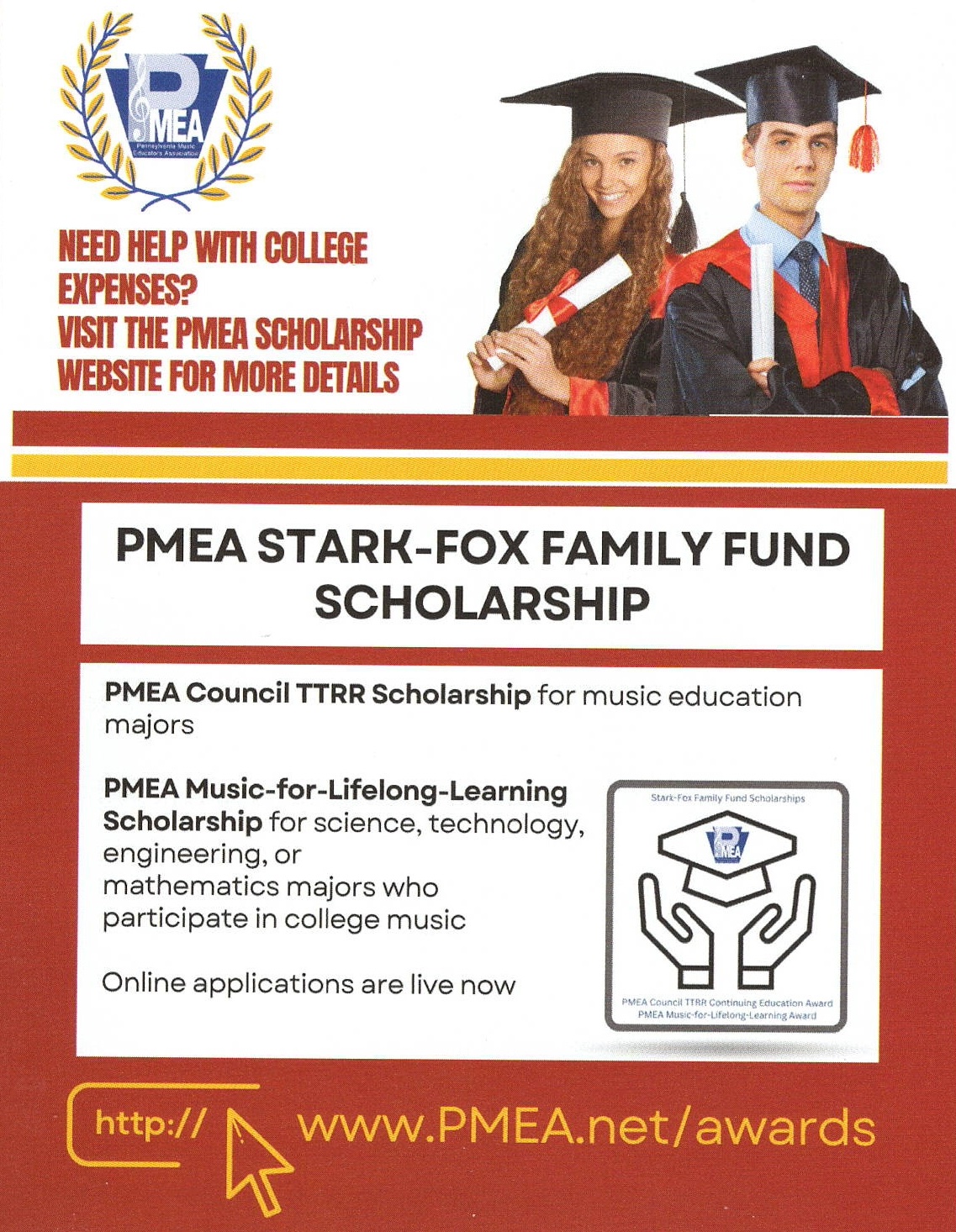
One of the most satisfying moments for my wife and I as retired educators was the establishment of a Donor-Advised Fund as well as funneling “required minimum distributions” from our IRAs to support recognition awards for PA music education majors as well as STEM majors participating in their collegiate music ensembles. As a memorial tribute to our parents who were educators, engineers, and musicians, we set-up a reliable and perpetual funding source to reimburse stellar college students with their educational expenses. For more information about the two separate Stark-Fox Family Fund Awards (PMEA Council for TTRR and PMEA Music-for-Lifelong-Learning Scholarships), visit https://www.pmea.net/scholarships-and-awards/. Past recipients are archived at https://www.pmea.net/scholarships-and-awards/stark-fox-funded-pmea-scholarships/.
No matter the amount, strategy, or pipeline, your “donations to the cause” will make a difference! Thank you in advance for serving as “busy bees” and whenever possible, “money bees,” to assist PMEA and build on and sustain quality music education programs throughout our state.

Credits and Additional Resources
- https://trustarts.org/pct_home/support/individual-giving
- https://www.instrumentl.com/blog/legacy-giving
- https://sunhealthfoundation.org/understanding-legacy-giving-leaving-a-lasting-impact/
- https://ghcf.org/articles/legacy-giving/
- https://www.kencrest.org/connect-with-us/blog/legacy-giving/
- https://www.evertrue.com/legacy-gifts-taking-your-orgs-strategy-to-new-heights/
- https://www.youtube.com/shorts/STWhCOkHIBk
- https://palmerhome.org/legacy-giving-and-tax-benefits/
- https://encouragegenerosity.com/

PKF
© 2026 Paul K. Fox






 13 years ago, I first learned about an ancient tradition for passing on personal values, beliefs, blessings, and advice to future generations called an “ethical will.” At a subconscious level, I must remember the custom, because when my father was diagnosed with lung cancer in 1990, I asked him to write a letter about the things that he valued. About a month before he died, my dad gave me two hand-written pages in which he spoke about the importance of being honest, getting a good education, helping people in need, and always remaining loyal to family. That letter – his ethical will – meant more to me than any material possession he could have bequeathed.

 Support the people and causes that are important to you.

 Directing the South Hills Junior Orchestra (non-salaried sharing of my teaching)







 PSERS (PA pension fund) Planning: 12 months or more away from your projected retirement date, attend a “Foundations for Your Future” program (even attend it more than once), and request a retirement estimate (form PSRS-151), after which you will need to schedule the all-important “Exit Counseling Session.”


 Nope. I cannot accept these archaic definitions! My translation for what it means to face this life-style shift of changing perspectives and expectations, “Crossing the Rubicon” into retirement, is finding alternative but purposeful pursuits, fulfilling “bucket lists,” and reshaping fresh new goals leading to creative ways to self-reinvent and thrive.
 five stages of retirement that he predicts most people go through after leaving their full-time job.
 “The Five Top Stressors in Retirement and How to Cope” by Nanci Hellmich (2014) at USA TODAY


 y engaged man. One example, he transformed his backyard by moving a truckload of large rocks around his garden when he was 80 years old. I attended his 100th birthday party where he played an hour-plus recital with three generations of the Reichenfelds. He always told prospective teachers, “Surround yourself with young people and you’ll never grow old.” The comment I wrote in memory of Eugene Reichenfeld in the online guest book (legacy.com) came from the heart: “With our mentor’s passing, orchestra music and education in our area will never be the same. However, thankfully, Maestro Reichenfeld’s legacy is that he ‘passed on the baton’ and inspired so many future teachers to follow in his footsteps… sharing his love of and skill in strings for eternity! The music lives on!”


