

“New Age” Employment Tools for Music Teachers
Portions of this blog-post reprinted from “Job Searching in the 21st Century – The 5 W’s of the Application” in the Summer 2016 issue of PMEA News, the state journal of the Pennsylvania Music Educator Association. Special thanks goes to contributor Joshua Gibson, PMEA State Director of Member Engagement. PMEA members should go directly to the website, download and read the entire insightful article: http://www.pmea.net/resources/pmea-news/.
Hello and welcome to all collegiate music education majors and prospective job seekers! Here are a few more suggestions to help you go out and find the perfect public school music position, especially in Pennsylvania. But first, if you have not read my past blogs on this subject, please click on the above link “Becoming a Music Educator.”
Are you a PCMEA or PMEA member?
 The number one “tool” for finding a job is not a tool at all – it is all about modeling professionalism, networking with other college students and music teachers, and becoming actively engaged in your state/national music education associations (click on the acronyms to go to their websites) – National Association for Music Education (NAfME), Pennsylvania Music Educators Association (PMEA) and Pennsylvania Collegiate Music Education Association (PCMEA). Interaction with others in your field is essential to build and maintain connections to what is “state-of-the-art” in curriculum/instruction, innovations in teaching and technology, news, trends, and other information related to the field of music education, and even “leads” to possible openings in PA school districts via job banks and conversations with other colleagues at state conferences and meetings. If you are not already a member of NAfME and PCMEA, you are walking away from numerous opportunities and benefits that could help you land a job!
The Mobile Resume
Much has been written about the curriculum vitae (CV) or employment resume. One recommendation is for it to be constantly updating, adaptable, flexible, and “very digital.”  Your “travel document” (paper copy you bring to the interview or “one-of-kind” attachment in response to email application) should be easy-to-modify based on the specific job posting to which you are applying. Your philosophy, goals, education, and teaching experience should focus on and reflect your competencies in alignment with the requirements for the music position. Your professional website and online resume should be more “general” and not rule out being considered for employment assignments outside your major. The PA teaching certificate states you are licensed to teach music in grades pre-K to 12… which means you should be qualified for any opening in elementary, middle, and high school general music, band, choir, jazz, keyboard lab, and strings, right?
If your professional “contacts” (or the school district’s website) help you discover more specifics about the type of music position to which you are applying, you can include on your resume past performances and interactions with students even remotely related to this subject area, as well as become better prepared for the questions and a demonstration lesson at the interview. For example, the school district from which I retired recently began looking for a middle and elementary school band director and high school assistant marching band director. Even if you majored or emphasized in voice, piano, or strings in college, “if you really want the job,” you should be able to revise your resume to include such experiences like playing the flute in your HS marching band for a year, conducting a small instrumental ensemble to accompany your youth church choir, giving a few summer lessons to the bell players in the local drum line where you live, etc. In addition, prior to the first employment screening and mock lesson at the interviews, you could “bone up” on your instrumental methods, suitable middle and elementary band warmups/literature, the meaning/concept of “middle school education,” and perhaps even pull out and brush up playing a few scales on that flute (or whatever) in your closet.
Electronic Business Card
Past blogs (see https://paulkfoxusc.wordpress.com/category/marketing-professionalism/) discuss personal branding, the set-up of a professional website, business cards, and networking. Have you thought about placing a Q code on your business card that scanning would go directly to your e-portfolio and sample recordings, perhaps displaying an excerpt from your senior recital and several videos of your teaching or conducting?
Check out these online resources that are “pro” using a Q code:
- http://www.webdesignerdepot.com/2011/07/30-creative-qr-code-business-cards/
- https://blog.kissmetrics.com/genius-qr-codes/
- https://uqr.me/blog/why-have-qr-codes-business-cards/
To be fair, these sites recommend against placing a Q code on your card:
- http://altitudemarketing.com/should-i-use-a-qr-code/
- http://www.legalproductivity.com/legal-billing/perfect-business-card/
At the every least, you need to print on your business card the URL listing to your website or LinkedIn pages… access to find “everything you always wanted to know about” you as a candidate.

Where Are the Jobs? Websites and Online Hiring Agencies
PMEA State Director of Member Engagement Joshua Gibson shared his research on using the Internet to search for music teacher openings posted in Pennsylvania. (PCMEA and PMEA members should read the entire article, “Job Searching in the 21st Century – The 5 W’s of the Application Process” on pages 62-63 in the Summer 2016 issue of PMEA News.)
With descriptions printed in the journal, you should become familiar with these sites:
- PAEducator: www.paeducator.net
- PAREAP: www.pareap.net
- Teacher Catapult: www.teachercatapult.com
- K-12 Job Spot: www.k12jobspot.com
- Teaching in PA: www.teachinginpacom
- Higher Ed Jobs: www.higheredjobs.com
- Talent Ed – Recruit and Hire: http://talentedk12.com/
PMEA Educational Entities Map
 Another great reason you should be a member of your professional association (PMEA or PCMEA) if you are looking for a job in PA is… the PMEA Job Board. Many PMEA members have relied on the Job Board for the most recent information when it comes to available PA music teacher positions.
Adapted from Google Maps, Gibson recently created/unveiled the latest interactive tool to facilitate a hunt for PA musical jobs: PMEA Educational Entities Map. His explanation:
The PMEA Educational Entities Map will “allow anyone to be able to search jobs in any geographical area in the Commonwealth of Pennsylvania. You can sort by Public School Districts (red), Charter Schools (blue), Career and Technology Centers (green), High Education (yellow), and Intermediate Units (orange).”
The job seeker can also use a specific PA county overlay to outline a specific area, as well as correlate with the PMEA District and PMEA Region maps.
In summary, “Once you click on the specific entry, you will be given the name, address, phone number, website, the employment website, and county of residence.”
For more information about the PMEA Job Board, go to http://www/pmea.net/job-board/. Gibson invites comments or questions for using the PMEA Interactive Map at jgibson@pmea.net.
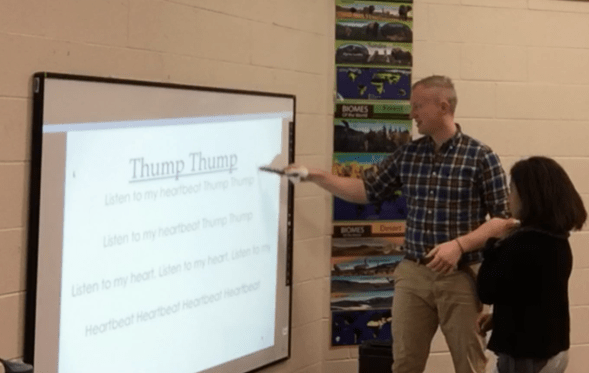
Break-a-leg! Hopefully these 21st Century marketing hints will do the trick! Best wishes on starting (or restarting) your music teaching career!
Photo credits: David Dockan, my former student and graduate of West Virginia University. Check out his professional website: http://www.daviddockan.com/.
Additional Blogs of “Tips and Techniques” for Getting Hired
- The definition and “best practices” of professionalism
- Unified philosophy of music education and avoidance of “specialization” in focus and teacher prep
- Pre-interview preparation and marketing strategies
- The “alphabet soup” of current educational jargon – terms, acronyms, and trends
- S is for storytelling at interviews
- Criteria for selection of the “ideal” school teacher candidate
- A blueprint for success – Preparing for the job interview
- The do’s and don’ts of interviewing
- Planning the “perfect” professional portfolio
- Tips on personal branding
- All eyes on the job resume/music teacher resumes revisited
- Becoming a music educator – the ultimate guide: MAIN PAGE
- Hints for the job search process
- Interview questions revisited
- Networking niceties – the how-to schmooze guide
- Those tricky interview questions
PKF
© 2016 Paul K. Fox

 Do you have a business card, e-portfolio, resume, and professional website?
 Merriam-Webster defines “networking” (noun) as “the exchange of information or services among individuals, groups, or institutions; the cultivation of productive relationships for employment or business.”
 During the 17th century, especially during the reign of Louis the 14th, the “calling card” made its heyday in Europe. “…An individual’s success or failure in society often depended on the strength of their personal promotion.”
 informing customers of its location and services available.
 It gives others a taste of your work, style and personality.
 display… traits of artistry, collaboration, commitment, discipline, even temperament, goal-minded, initiative, leadership, mastery of music and music education, organization, positive outlook, style, tact, and/or teamwork… or just the opposite?
 a new full-time job!
 first ten seconds, and after four minutes, it’s all over. For employment consideration, others have written that you are evaluated by 7% what you say, 38% by your vocal tone, and 55% by your facial expressions.
 After the opportunity presents itself to exchange business cards, you need to save and organize his/her data in a way to be able to place/find the acquaintance for future reference. Why was this professional important to you to remember his or her name? How, when, and where did you meet? Reference the subjects you may have discussed, school affiliation, title, and locality of the contact, so at some point, you can lay your fingers on the name in your file; just search on the “key” word or phrase like “choral director” or “XYZ School District.”
 Plan your first impression

 The walking document of “everything you always wanted to know about you” is your professional resume.
 is the “Prepare Your Materials” section of the Institute for Music Leadership, Eastman School of Music (ESM)/University of Rochester, Careers and Professional Development
  “Professional resume writers urge their clients to first try to trim their resumes down to a maximum of two pages.” One exception for a three-pager might be if the job seeker was to transition from one field to another, having to cover both sets of the candidate’s skills, qualities, and experiences.
 and easy-to-read fonts in your collection. “Your goal is not to make your resume beautiful to your eyes… it’s to make it extremely readable to the people doing the screening and hiring.”
 behind the job assignments, field experiences, or awards… is better. What did you do in each situation, what did you learn, and how did you grow? Check out author Diana in NoVa’s ideas at
 conventions of grammar, punctuation, style, and order of presentation. For example, for new music educators entering the field, it is generally recommended that you list your experience, education, and achievements chronologically starting with the most recent at the top of each section. According to
  singing, etc. However, from an administrator’s perspective, it may be more important to know about the prospective music teacher’s field experiences and previous employment working with children, classroom management skills, professional development goals and initiative (would you be interested in coaching or directing extracurricular activities?), teamwork and leadership skills, personality traits like patience/even temperament/self-discipline, and knowledge of a few “buzz words” of educational terminology and acronyms (like The Common Core, DOK/HOTS, IEP, PLC, RTI, UBD, formative/summative assessments, etc. You are welcome to review some of these completing a crossword puzzle at
  Among her other suggestions are writing “an objective statement” which summarizes your goals to being employed at the school district, “support skills sets with problem solving examples” (see #4 above), and “proofread, proofread, proofread” for accuracy and to enhance your image. Sloppy resumes with typos or misspellings project the wrong message to prospective employers.









 paulfox.blog