The character “Robert McCall” (played by Denzel Washington) in the vigilante action-thriller film series The Equalizer (directed by Antoine Fuqua) mentioned that his late wife was working through “The 100 Books Everybody Should Read” when she died, so he decided to carry on the tradition. It is not clear the exact list he was referring to, but we found a blog by Gillian that settled on Goodreads 100 Books from The Equalizer, for which a checklist is provided by https://uncomplicatedspaces.substack.com/p/100-books-everyone-should-read-pdf.
How many of these can you claim to have read?
Personally, I go through stages… seeking new releases, exploring best-sellers, perusing used or discounted book stores and thrift shops, and revisiting past favorites in my library.
Recently, I have “relaunched a personal voyage” to consume the entire series in sequence of the memorable adventures of classic historical fiction from the Napoleonic Wars, featuring Captains Horatio Hornblower (by C.S. Forester), Richard Bolitho and his nephew Adam Pascoe Boltho (by Alexander Kent, pseudonym of Douglas Reeman), and Lord Nicholas Ramage (by Dudley Pope). You should “cruise” samples of all of these!
If you are a history buff, please enjoy each edition slowly, reveling in the authors’ craftsmanship and immersing yourself in the language, settings, culture, customs, and what life must have been like during that period (~1800-1850) of intense conflicts between France (led by Napoleon Bonaparte) and England (most notably, paralleling the real-life of British naval hero, Horatio Nelson) and the coalition of European powers following the French Revolutionary Wars. A previously blog (here) related the relevance of Hornblower and learning leadership principles. However, I am especially amazed at the depth and breadth (similar style and content) of the Alexander Kent collection. But, better schedule a lot of uninterrupted quiet time on vacation or at the pool, deck, patio, or beach! It will take you awhile to read all 30 of the Kent books (list below provided in order by www.addall.com):
Midshipman Bolitho (1975)
Midshipman Bolitho and the Avenger (1976)
Band of Brothers (2005)
Stand Into Danger (1976)
In Gallant Company (1977)
Sloop of War (1972)
To Glory We Steer (1968)
Command a King’s Ship (1973)
Passage to Mutiny (1976)
With All Despatch (1988)
Form Line of Battle (1969)
Enemy in Sight (1970)
The Flag Captain (1971)
Signal, Close Action! (1974)
The Inshore Squadron (1978)
A Tradition of Victory (1981)
Success to the Brave (1983)
Colours Aloft! (1986)
Honour This Day (1987)
The Only Victor (1990)
Beyond the Reef (1992)
The Darkening Sea (1993)
For My Country’s Freedom (1995)
Cross of St. George (1996)
Sword of Honour (1998)
Second to None (1999)
Relentless Pursuit (2001)
Man of War (2003)
Heart of Oak (2007)
In the King’s Name (2011)
Yes, we should be turning our attention to nonfiction books, too. According to financial guru and famous talk-show host Dave Ramsey, all of us should have a nonfiction book or two on our bed stand.
Want to be a millionaire? Turn off your television. The average millionaire reads a nonfiction book a month. This is how you make your life better: having knowledge tomorrow that you didn’t have today, and then applying it. – Ramsey on Facebook
Dave’s list of books starts off with one of his own: The Total Money Makeover. He also recommends The 7 Habits of Highly Effective People by Stephen Covey, Think and Grow Rich by Napoleon Hill, Good to Great by James C. Collins, The Richest Man in Babylon by George Samuel Clason, Who Moved My Cheese by Spencer Johnson, The E-Myth Revisited by Michael E. Gerber, and How to Win Friends and Influence People by Dale Carnegie.
On a slow day pushing wheelchairs at the local hospital in the Western PA suburbs where I live, my fellow volunteers (Jerry, Rod, and Douglas) and I, all true “bibliophiles” and retirees, brainstormed what were our most inspiring reads. Their list is more spiritual, faith-based, or metaphysical than most:
Book of Joy by Dalai Lama and Archbishop Desmond Tutu
Conversations with God by Neale Donald Walsch
Jesus CEO by Laurie Beth Jones
Many Lives, Many Masters by Dr. Brian L. Weiss
Mutant Message Down Under by Marlo Morgan
Return to Laugher by Elenore Smith Bowen
Tying Rocks to Clouds by William Elliott
When Bad Christians Happen to Good People by Dave Burchett
Now to the “how-to section,” especially focusing on the quest for “living the dream” in our senior years.
Some of the best books about retirement are really about living life well. It’s been said that a reader lives a thousand lives before he dies. So, if words on a page can introduce us to what it’s like to live in another century or a faraway land, then why not introduce us to life in retirement, too?
Die with Zero: Getting All You Can from Your Money and Your Life by Bill Perkins
My Brilliant Friend by Elena Ferrante
From Strength to Strength: Finding Success, Happiness and Deep Purpose in the Second Half of Life by Arthur Brooks
The Midnight Library by Matt Haig
The Year of Magical Thinking by Joan Didion
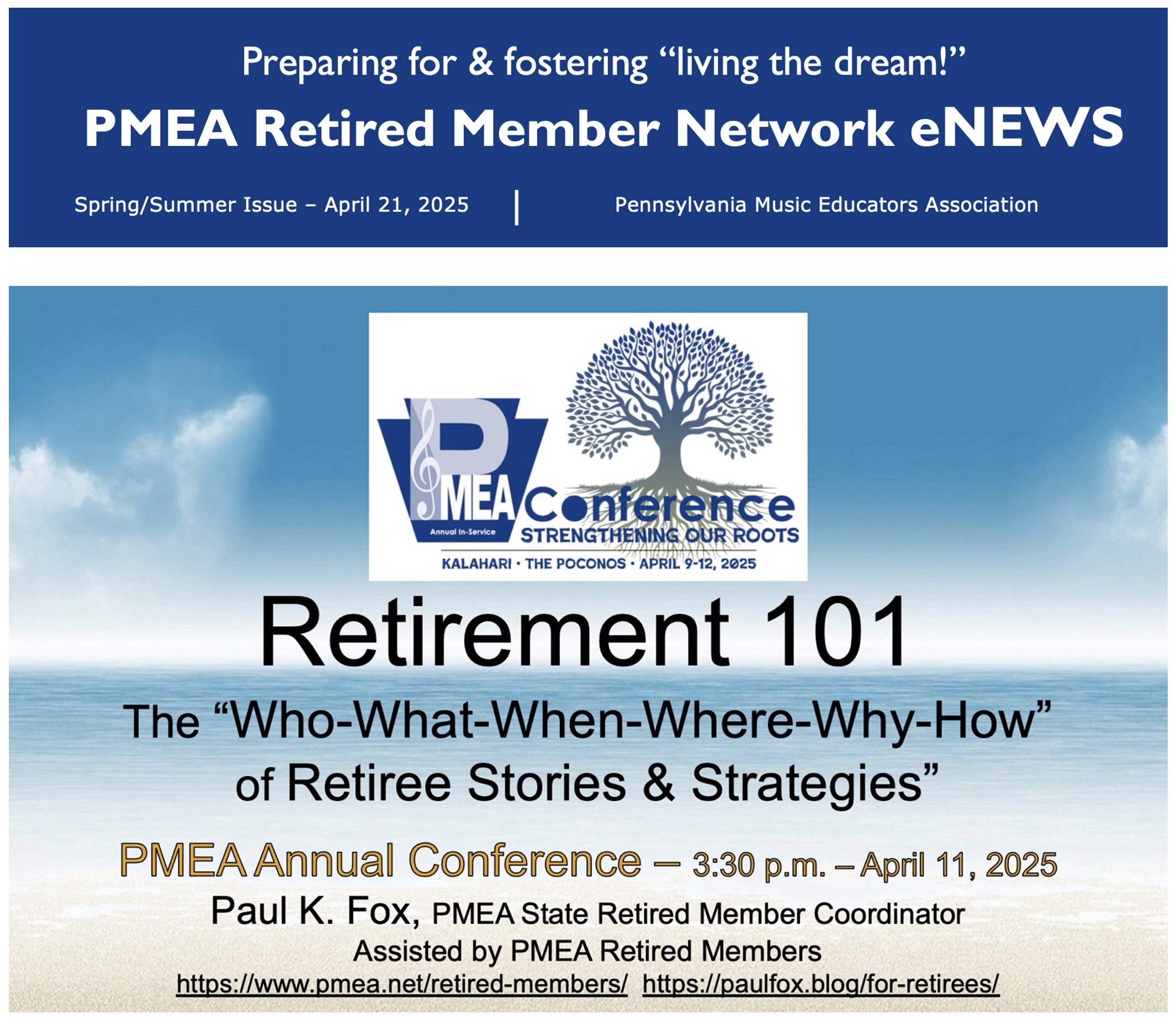
As PMEA State Retired Member Coordinator and editor of Retired Member Network eNEWS, I “float” many images of recommended retirement books to my PA music educator colleagues. If you did not attend the Retirement 101 session at the recent PMEA Annual Conference at Kalahari Resort in the Poconos, take a peek at my annual session’s PDF handout: https://www.pmea.net/wp-content/uploads/2025/04/Retirement-101-PMEA-conference-revised-s041125.pdf.
1820 McLaughlin Run Road, Pittsburgh, PA 15241
I am presenting this workshop at the Upper St. Clair Library on July 10, 2025 at 6:30 p.m. in the Multi-Purpose Room. To my local (Western PA) friends: Come see it for yourself!
Finally, if you are looking for additional resources on how to prepare for that major life passage of transitioning to retirement, many books and websites suggested by numerous expert “silver-haired” colleagues who have already “Cross the Rubicon,” all you need do is visit the Retired Member focus area on the PMEA website. (This is a benefit of PMEA membership and why everyone should continue participating in their professional association even after a complete retirement!) For a sneak preview, click on these links:
Best wishes to you and yours. Feel free to comment on this post (top right link near title), or even refer us to other sites of book lists and retirement prep resources.
Summertime Reading Suggestions for Music Directors
What do authors C.S. Forester, Simon Sinek, Jocko Willink, and Leif Babin have in common?
They offer a fresh perspective on leadership principles, reflections perfectly applicable for the skill-set development of music teachers who desire to better “lead” their music programs, students, and parent boosters.
It was no accident that I chose these books to help explore the truths of inspiring confidence and leading groups of people like we do daily in our classrooms, rehearsal halls, and on the stages or marching band fields. Their use of military (as well as company or government management) anecdotes defines and re-enacts the very essence of leaders, leadership concepts, goals, and public service.
“These [military group] organizations have strong cultures and shared values, understand the importance of teamwork, create trust among their members, maintain focus, and, most important, understand the importance of people and relationships to their mission success.”
Why do we admire music teacher “heroes” and most sought-after conference keynoters in our profession such as “Dr. Tim” Lautzenheiser, Peter Boonshaft, Scott Edgar*, and Bob Morrison* (*the latter two to be featured in the PMEA Summer Virtual Conference on July 20-24, 2020). They inspire us. They recharge us and pick up our spirits. They serve as models of visionaries and coaches. They challenge the status quo and help us to grow!
I believe these books will do the same, assist in your career development to morph into an even better leader and teacher. Since many of us are “stuck at home” during the pandemic for awhile, here is a new “reading list” for personal self-improvement.
ITV/Rex Archive: Ioan Gruffudd in “Hornblower” 2001 TV series
Who is Horatio Hornblower?
To start with, how about a series of historical fiction from the Napoleonic-Wars era?
Hornblower is a courteous, intelligent, and skilled seaman, and perhaps one of my favorite examples of an adaptable “leader.” Although burdened by his (almost shy) reserve, introspection, and self-doubt (he is described as “unhappy and lonely”), the Forester collection illustrates numerous stories of his personal feats of extraordinary cunning, on-the-spot problem solving, and bravery. The first book spotlights an unpromising seasick midshipman who grows into a highly acclaimed, productive, and ethical officer of Her Majesty’s Royal Navy, gaining promotion steadily as a result of his skill and daring, despite his initial poverty and lack of influential friends. And yet, the common thread throughout is that he belittles his achievements by numerous rationalizations, remembering only his fears.
74-gun Royal Navy Ship-of-the-line ~1794
“Hornblower’s leadership is thoroughly self-conscious: what makes him a great leader, morally, is that he assumes as a matter course that he must lead rather than he can lead; Hornblower’s pervasive sense of responsibility would be diminished if it all came to him naturally and that he acts therefore as each situation demands. He can be self-effacing or fierce, or obsequious, all depending on what is necessary to get the job done. As it happens, Hornblower‘s many other gifts, including a formidable diligence, always beyond the call of duty, and a supple intelligence, make him a man others trust and lean on; but for the reader, especially young reader, it’s his moral qualities that are most engaging, it is instructive.”
This set is a wonderful “chestnut” to acquire, sit back in your leather recliner, and devour over the coming months. Even though it may take you some significant time to finish Forester’s eleven novels (one unfinished) and five short stories, I promise you, it will all be worth it!
[If you like the Hornblower assortment, also checkout the works by Alexander Kent and Dudley Pope, all drawing parallels to the exploits of real naval officers of the time: Sir George Cockburn, Lord Cochran, Sir Edward Pellew, Jeremiah Coghlan, Sir James Gordon, and Sir William Hoste.]
Now, how can you personally glean new leadership habits from this treasure chest? Coincidental to doing some research for this blog, I bumped into the article on LinkedIn “Leadership Lessons Learned from Horatio Hornblower.” My sincere thanks and “attaboy” go to Amro Masaad, Education and STEM Leader at Middlesex County Academies, who gave me permission to share his documentation and insightful interpretation of the following leadership tips learned from Hornblower that we can all employ as “best practices” in the education profession:
Don’t be afraid to stand up to a bully.
Don’t insist that all of your successes be praised.
Don’t let employees sabotage your mission.
If you want excellence, you can’t look the other way.
Prove yourself when the situation demands it.
Take one for the team.
Show sacrifice and honor, even with your enemies.
I have always been inspired by the adventures of Hornblower, mostly because of his displays of humanity at a time in history when things were inhumane and primitive. Hornblower consistently modeled his intentions for the care and success of his subordinates while other officers “stepped on them” to get advancement, his unimpeachable moral code that guided his every action, and “taking it on the chin” when necessary for his shipmates and the good of “god and country.”
Leaders Eat Last
I was struck by this quote by Simon Sinek, the author of Start with Why – How Great Leaders Inspire Action, who posted a popular TedTalk lecture of the same name:
“There are leaders and there are those who lead. Leaders hold the position of power or authority, but those who lead, inspire us. Whether they are individuals or organizations, we follow those who lead, not because we have to, but because we want to. We follow those who lead, not for them, but for ourselves. And, it’s those who start with ‘the why’ that have the ability to inspire those around them or find others to inspire them.”
His latest book, Leaders Eat Last, brings up the rationale of mutual collaboration and prioritizing the mission and the needs of your team members. Sinek observed that some teams were able to trust each other 100%, so much so that they would be willing to put their lives on the line for each other, while other groups, no matter what enticements or special incentives were offered, were “doomed to infighting, fragmentation and failure.” Why was this true?
“The answer became clear during our conversation with the Marine Corps general. ‘Officers eat last,’ he said. Sinek watched as the most junior Marines ate first while the most senior Marines took their place at the back of the line. What’s symbolic in the chow hall is deadly serious on the battlefield: great leaders sacrifice their own comfort – even their own survival – for the good of those in their care.”
Throughout his book of vivid narratives from armed conflicts to business “revolutions” of take-overs or new CEO transformations, Sinek dives into the precepts of what constitutes “great” leadership:
The value of empathy should not be underestimated.
Trust and loyalty exist on a two-way street – to earn them, leaders must first extent them to their team members.
The role of leadership is to look out for (and take care of) those inside their “circle of safety.”
For the success of the team, goals must be tangible, visible, collaborative, and written down.
Leaders know: There is power in “paying it forward.” It feels good to help people, or when someone does something nice to us, or even when we witness someone else doing something good.
It’s also a big deal when leaders express that final personal touch and shake hands.
Leadership is all about service… to the “real, living, normal human beings with whom we work every day.”
I have never found a better source for defining the four “chemical incentives” in our bodies (also known as hormones) and numerous actual examples of their daily use (and misuse): endorphins, dopamine, serotonin and oxytocin.
Also intriguing is an expanded Chapter 24 and Appendix section in the book called “A Practical Guide to Leading Millennials.” Similar to another suggestion for summer perusal, UnSelfie: Why Empathetic Kids Succeed in Our All-About-Me World by Michele Borba, Ed.D (Simon & Schuster, 2017) which focuses more on our current young “charges,” Sinek’s differentiation is provided to inspire and educate the ultimate multitaskers of the “distracted generation.”
“This is what it means to be a leader. It means they choose to go first into danger, headfirst toward the unknown. And when we feel sure they will keep us safe, we will march behind them and work tirelessly to see their visions come to life and proudly call ourselves their followers.”
“The biology is clear: When it matters most, leaders who are willing to eat last are rewarded with deeply loyal colleagues who will stop at nothing to advance their leaders vision and their organization’s interests. It’s amazing how well it works.”
This next leadership philosophy, the core premise of the book Extreme Ownership – How U.S. Navy Seals Lead and Win by Jocko Willink and Leif Babin, will not surprise anyone who has ever taken on the inherently risky task of programming a student concert, marching field show, dance recital, or musical/play: the music director assumes full responsibility for the failures and faux pas that may occur during the performance, but instrumentalists, singers, actors, and/or dancers should get all the credit for a successful production.
“Combat, the most intense and dynamic environment imaginable, teaches the toughest leadership lessons with absolutely everything at stake. Jocko Willink and Leif Babin learned this reality firsthand on the most violent and dangerous battlefields in Iraqi. As leaders of SEAL Team Three’s Task Unit Bruiser, their mission was one many thought impossible: help US forces secure Ramada, a violent, insurgent-held city deemed “all but lost.“ In gripping, firsthand accounts of heroism, tragic loss, and hard-won victories, they learned that leadership – at every level – is the most important factor in whether a team succeeds or fails.”
This is a comprehensive textbook on Leadership 101. Admittedly, the rehash of their battle scenes are scary. This is a world so far apart from anything I have ever experienced. We do owe all our veterans a massive depth of gratitude to face such dangers to defend our freedoms and way of life. (As an inexperienced teacher, the worst fear I ever had to face was a homeroom of 99 excitable and talkative Freshman girls in my first year as the high school choral director.)
When possible, I try to share the Contents (chapter titles) of my book recommendations, giving you a broad glimpse of the outline of their publication:
Extreme Ownership
No Bad Teams, Only Bad Leaders
Believe
Check the Ego
Cover and Move
Simple
Prioritize and Execute
Decentralized Command
Plan
Leading Up and Down the Chain of Command
Decisiveness Amid Uncertainty
Discipline Equals Freedom – the Dichotomy of Leadership
From these sections, we can explore these fundamental building-blocks and mindsets necessary to lead and win.
Part I: Winning the War Within (Chapters 1-4)
Leaders must own everything in the world. There is no one else to blame.
A leader must be a true believer in the mission.
Even more important then “the how” and “the what” is “the why” of any plan. Not knowing the rationale of a decision or goal is a recipe for failure. It is a leader’s job to understand the mission and communicate it to his/her team members.*
During situations lacking clarity, leaders ask questions.
Leaders temper overconfidence by instilling culture within the team to never be satisfied and to push themselves harder to continuously improve performance.
Leaders know that over-inflated egos cloud judgment and disrupt everything: the planning process, the ability to take good advice, and the ability to except constructive criticism.
* Who said “great minds think alike?” (Answer: Carl Theodor von Unlanski.) The concept of “the why” is also described in great detail in the aforementioned TedTalk by Simon Sinek.
Part II: Laws of Combat (Chapters 5-8)
Elements within the “greater team” are crucial and must work together to accomplish the mission, mutually supporting one another for that singular purpose.
In life, there are inherent complexities. It is critical to keep plans and communication simple. Complex goals and plans add to confusion which can compound into disaster.
Competent leaders can utilize their own version of the SEAL’s prioritize and execute. It is simple as, “relax, look around, and make a call.” Prioritize your problems and take care of them one at a time, the highest priority first. Don’t try to do everything at once or you won’t be successful.
Leaders delegate responsibility, trust and empower junior leaders to make decisions on their own as they become proactive to achieve the overall goal or task.
Part III: Sustaining Victory (Chapters 9-12)
Effective planning begins with an analysis of the mission’s purpose, definition of the goals, and communication of clear directives for the team.
Effective leaders keep the planning focused, simple, and understandable to all of the team members and stakeholders.
Leadership doesn’t just go down the chain of command, but up as well. Communication to your supervisors is also key.
Leaders must be decisive, comfortable under pressure, and act on logic, not emotion.
In challenging situations, there is no 100% right solution, and the picture is never complete.
Leaders have self-control and “intrinsic self-discipline,” a matter of personal will. They “make time” by getting up early.
Self-discipline makes you more flexible, adaptable, and efficient, and allows leaders and team members alike to be creative.
A leader must lead, but also be ready to follow.
A Leadership Recap for Music Teachers
I am probably not doing justice to these incredible resources. They offer an exhaustive body of knowledge and examples on leadership ideology as well as a dazzling array of practical advice on what habits/skills are essential to become an effective leader. You need to sit back and devour these books one-by-one, apply their relevance to your situation, and come to your own conclusions about prioritizing the needs for your own personal leadership development.
To sum up a few of the theories from all this literature, we could revisit page 277 in Extreme Ownership and quote “The Dichotomy of Leadership” by Jocko Willnick.
“A good leader must be:
confident but not cocky;
courageous but not foolhardy;
competitive but a gracious loser;
attentive to details but not obsessed by them;
strong but have endurance;
a leader and follower;
humble not passive;
aggressive not overbearing;
quiet not silent;
calm but not robotic;
logical but not devoid of emotions;
close with the troops but not so close that one becomes more important than another or more important than the good of the team; not so close that they forget who is in charge;
able to execute Extreme Ownership while exercising Decentralized Command.”
“A good leader has nothing to prove but everything to prove!”
Many years ago, my wife and I were fortunate to participate in almost all of those early PMEA Summer Conferences that were basically leadership training workshops. Initiated and inspired by our first guest clinician Michael Kumer (who was then “modeling leadership” first-hand as Dean of Music for Duquesne University), we were exposed to a rich curriculum of “the greats” on leadership, team building, time management, and professional development. If you have not consumed them yourself, a few of these resources from the first couple years should be added to your reading list:
One Minute Manager by Ken Blanchard and Spencer Johnson
First Things First and other sections from The 7 Habits of Highly Effective People series by Stephen Covey
A Kick in the Seat of the Pants: Using Your Explorer, Artist, Judge, and Warrior to Be More Creative and A Whack on the Side of the Head: How You Can Be More Creative by Roger Von Oech
As a part of fulfilling “total ensemble experience” and to make the learning meaningful, I have always “taught” leadership to my students. The settings may have varied, whether it was as a part of the longstanding tradition of training marching band leaders, student conductors or principals’ who ran sectionals, our spring musical “leadership team” of directors, producers, and crew heads, elected high school choir officers, participants (grades 6-12) in a six-day string camp seminar, or even booster parents in a “chaperone orientation.” Many of my own often-repeated leadership quotes were passed down:
“Leaders aren’t born, they are made. And they are made just like anything else, through hard work. And that’s the price we’ll have to pay to achieve that goal, or any goal.” – Vince Lombardi
“You don’t lead by pointing and telling people some place to go. You lead by going to that place and making a case.” – Ken Kesey
“Things may come to those who wait, but only the things left by those who hustle.” – Abraham Lincoln
“The very essence of leadership is you have to have a vision. It’s got to be a vision you articulate forcefully on every occasion. You can’t blow an uncertain trumpet.” – Rev. Theodore Hesburgh
“Management is efficiency in climbing the ladder of success; leadership determines whether the ladder is leaning against the right wall.” – Stephen R. Covey
Finally, to close this seemingly-endless essay, I would share one of my regular but more unique lessons: “leaders flush.” We advise our plebe leaders-in-training that when anyone on the team sees an opportunity to take care of something that’s not right, or someone who needs help, or a problem that can be resolved on their own, they should take it upon themselves to do what is necessary for the greater good. We cite the example that, if you visit a restroom and discover someone before you did not flush the toilet, you do what’s right. Leaders flush.











 His latest book, Leaders Eat Last, brings up the rationale of mutual collaboration and prioritizing the mission and the needs of your team members. Sinek observed that some teams were able to trust each other 100%, so much so that they would be willing to put their lives on the line for each other, while other groups, no matter what enticements or special incentives were offered, were “doomed to infighting, fragmentation and failure.” Why was this true?
 Also intriguing is an expanded Chapter 24 and Appendix section in the book called “A Practical Guide to Leading Millennials.” Similar to another suggestion for summer perusal, UnSelfie: Why Empathetic Kids Succeed in Our All-About-Me World by Michele Borba, Ed.D (Simon & Schuster, 2017) which focuses more on our current young “charges,” Sinek’s differentiation is provided to inspire and educate the ultimate multitaskers of the “distracted generation.”

![US Navy SEAL Team Three [ST3][Patch][1.5]](https://paulfox.blog/wp-content/uploads/2020/07/us-navy-seal-team-three-st3patch1.5.png) No Bad Teams, Only Bad Leaders
No Bad Teams, Only Bad Leaders

 One Minute Manager by Ken Blanchard and Spencer Johnson

 paulfox.blog