The Tools of Music Selection and Evaluation – An Insider’s Look at Student Placement

Do you know the differences among the terms screening, audition and adjudication?
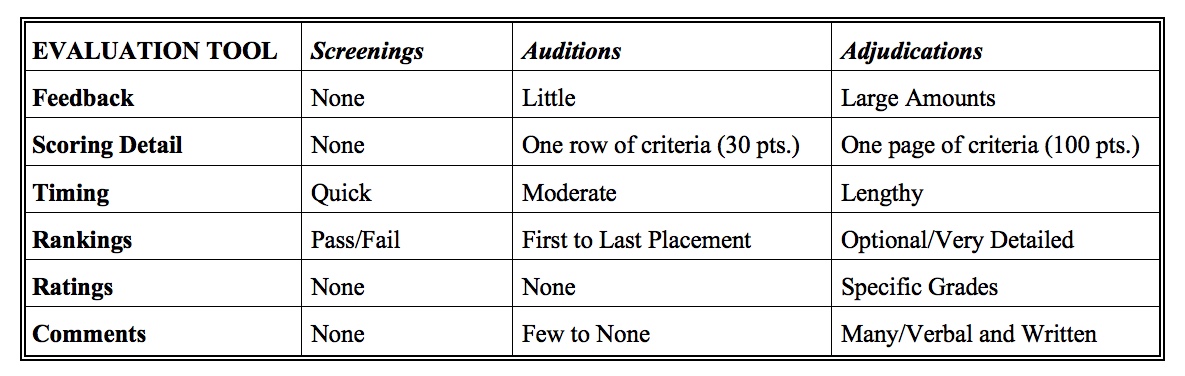
Listed in order of low to high feedback, these evaluation tools furnish staff, students and parents methods for identifying the talent, level of achievement, preparation and potential success for participation in future music and drama productions, festivals or special ensembles, or for rewarding solo parts, seating placement, musical leads, and other student leadership positions.
A screening (sometimes called a pre-audition) is the simplest form of selecting students on a quick “pass” or “fail” basis. One or more judges usually listen for one or two characteristics such as overall preparation or a prerequisite proficiency to determine “thumbs up” or “thumbs down.” In many cases, participants who earn a “passing mark” go on to a more detailed audition to determine ranking for a particular ensemble or part.
 Example of a screening: Pennsylvania Music Educators Association (PMEA) District One regularly sponsors a pre-audition for sopranos and altos auditioning for District SHS Chorus, as well as flute, clarinet and trumpet players for seating in Honors Band and other instrumental festivals.
In some cases, the application form itself is the initial “screening” for a particular event. For example, to participate in a music education association (MEA) like PMEA Junior High Chorus, you must be a 7th through 9th grade student, member in good standing of your school’s choral ensemble, and sponsored by the school music director who is a current MEA member and attending the try-outs. If an applicant does not meet these simple qualifications, then he/she is automatically eliminated from the selection process.
An audition (sometimes called try-out) is the process by which a panel of three or more judges rate a candidate based on a series of specific characteristics or “audition criteria” using a numerical score (usually 1 to 10 or 1 to 5). The sum of these scores from all of the judges reflects an overall ranking, often listed by voice type or instrumental section.
Here are a few local examples of audition criteria:
MEA Ensemble Placement Try-outs: Tone, Rhythm, Intonation, Technique, Musicality and Preparedness
Spring Musical Cast Auditions: Voice (intonation, expression, technique, range), Projection (tone quality, dynamics, overall loudness), Clarity (diction, rhythm, timing, dialect), Movement (blocking, flexibility, grace, coordination), Expression (animation, emotion, presence, characterization), Attitude (stability, reliability, desire, takes direction?)
Frequently very competitive, membership in a particular organization or the assignment of solo parts or leadership positions is usually very limited. Auditions are used to select the “very best” from the pool of contestants—a well-defined “cut-off” is made to fulfill the size of the ensemble/group or availability of solo/lead openings. Every year in most schools, hundreds of students audition for competitive festivals, drama/musical leads, scholarships, or leadership positions—less than 5% earn recognition or “win” a position at the conclusion of these auditions.
While auditions may select or “deselect” students for an event, they cannot be used as instruments of individual evaluation or “grading.” Judges are not expected to write comments or make “value judgments” about the overall achievement, improvement, strengths or weaknesses of each candidate. There simply is not enough time to provide detailed individual feedback from an audition process or to issue a performance rating (such as “superior,” “excellent” or “good”). Therefore, since an audition is only a “snapshot” ranking of people at a specific moment in time and for a specific goal, no references should be made about an individual’s aptitude for success.
This is where the adjudication comes in. The most costly and time-consuming process of the three evaluations, adjudication provides specific comments, ratings and (in some) rankings for determining the strengths and weaknesses of an individual or ensemble. Judges in an adjudication (called adjudicators) are charged with evaluating each candidate or group with a “page” of musical criteria (not just a row or line of scores), defining the assets and needs of the performer(s) and making specific comments about focus areas and methods for improvement.
The best example of group adjudication is the international music festival enrolled by school performing arts groups during their spring music trips. The bands, choruses, jazz ensembles, and orchestras typically perform in front of three adjudicators who each record personal observations on a digital recorder during the music, write a one-page (or more) report on the positive and negative aspects of the group’s level of achievement (accuracy and mastery of technique, tone—blend and balance, ensemble-playing skills, appropriateness of musical selection and stylistic interpretation, poise, overall appearance, preparation, etc.), score the presentation (usually up to 100 points), and grade each group with “superior” or “excellent” ratings in comparison w ith all groups at all adjudications. When I was teaching at the Upper St. Clair High School, this adjudication process took more than a day for all of our ensembles to participate—thirty minutes per performance, costing as much as $50/student, and involving more than ten professional adjudicators and fifteen festival staff members for a multitude of adjudication sites.
For detailed individual appraisals, your MEA may offer noncompetitive Solo or Small/Large Group Adjudication Festivals (see your school music teacher for details). In addition, the hiring of a qualified private music instructor to evaluate your son’s or daughter’s abilities is an excellent idea. Pay for a month’s worth of music lessons (for theater students: drama and dance lessons, too.) and ask for an analysis of his/her strengths and weaknesses. A list of several local private voice or instrumental teachers may be available from your school music director.
In order to build self-motivation, creativity, leadership, self-confidence, teamwork and self-discipline, and to achieve greater skills in problem solving, personal goal setting and stress/time management, music teachers frequently encourage their students to participate in extra-curricular activities. As a further enrichment to the educational program, many musicians, actors, and dancers enroll in screenings, auditions and/or adjudications. However, the competitors in these activities need to develop (and update) realistic self-appraisals and understand the major differences of each evaluative tool. Most of all, we must all learn how to “lose gracefully” and not allow the diminishing of our self-esteem when positive results and recognition are not immediately forthcoming.
Another point: We cannot all be number one! For example, a musical production “team” needs multi-talented members from all skills and ability levels. Some performers need to be in the chorus, others in the dance ensemble for the production numbers, while still others are suited for solos depending on the roles in the play. We need technical and stage operators (otherwise the curtain will not be raised, and backdrops and props will not appear!) After all, a football team would look silly at a game with only quarterbacks. Experts say explore your hidden talents, don’t be afraid to try new things, set “reasonably attainable goals,” prepare hard and long, and, most of all, persevere!
Parents: Does all of this make it a little easier to understand? When your child tells you he/she is planning to participate in the school play, or sign-up for drum major, captain, section leader, or other leadership position in marching band, please review the selection procedures carefully and these three definitions of student placement tools: screening, audition, and adjudication. Make sure both of you are aware of the audition criteria, what is expected, music or conducting assignments, and to allow for ample time for preparation and practice. I recommend to my students to video-record “mock tryouts” and playback and self-assess their progress. Listen to professional recordings of the selections. When appropriate, memorize your lines/music. Add expressive elements to your performance, such as an extended range of emotion, phrasing, and dynamics. Repetition counts! Remember: practice does not necessarily make perfect… repeated “perfect practice” makes perfect.

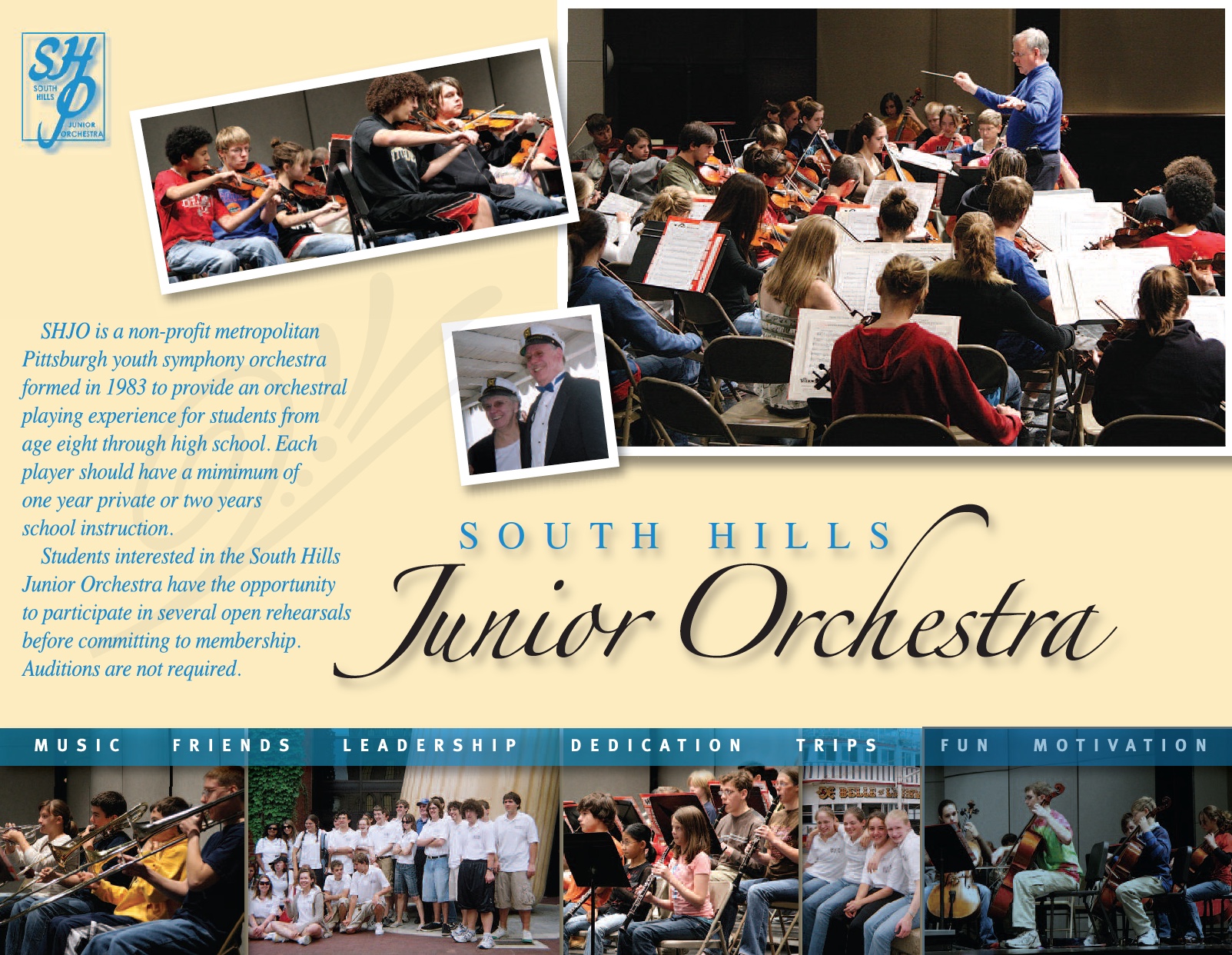
The mission of South Hills Junior Orchestra, which rehearses and performs at the Upper St. Clair High School in Pittsburgh, PA, is to support and nurture local school band and orchestra programs, to develop knowledge, understanding, performance skills, and an appreciation of music, to increase an individual member’s self-esteem and self-motivation, and to continue to advance a life-long study of music. Members of the Orchestra learn, grow, and achieve positions of leadership to serve their fellow members. (For more information about SHJO, please visit www.shjo.org.) This blog-post is free and available to share with other music students, parents, and directors.
Click here for a printable copy.
Other “Fox Firesides” are available at https://paulkfoxusc.wordpress.com/foxs-firesides/.
© 2018 Paul K. Fox
Photo credit from Pixabay.com: “Amber” by Pexels








 paulfox.blog