Rebuilding instrumental technique after a long break
Director’s Note: This is the week to get ready for the return of the South Hills Junior Orchestra after all our vacations! If you live in the Southwestern PA area, we hope you will consider this a personal invitation to “TRY SHJO” and participate in several free and open rehearsals of our community orchestra – a totally “judgment-free” place for creative self-expression of all ages and ability levels. Practices are held in the Upper St. Clair High School Band (1825 McLaughlin Run Road, Pittsburgh, PA 15241) on Saturdays from 10:30 a.m. to 12:30 p.m.
A Google search on my computer fetched the following “AI Overview,” a nearly perfect summary for wind players to recover their “chops” and bring back good tone, intonation, breath support, flexibility of the embouchure, key literacy, and practice habits. For players of all orchestral instrumental sections, I recommend revisiting other articles in the Fox’s Fireside Library to develop a “practice plan” and adopt new musical goals. PKF
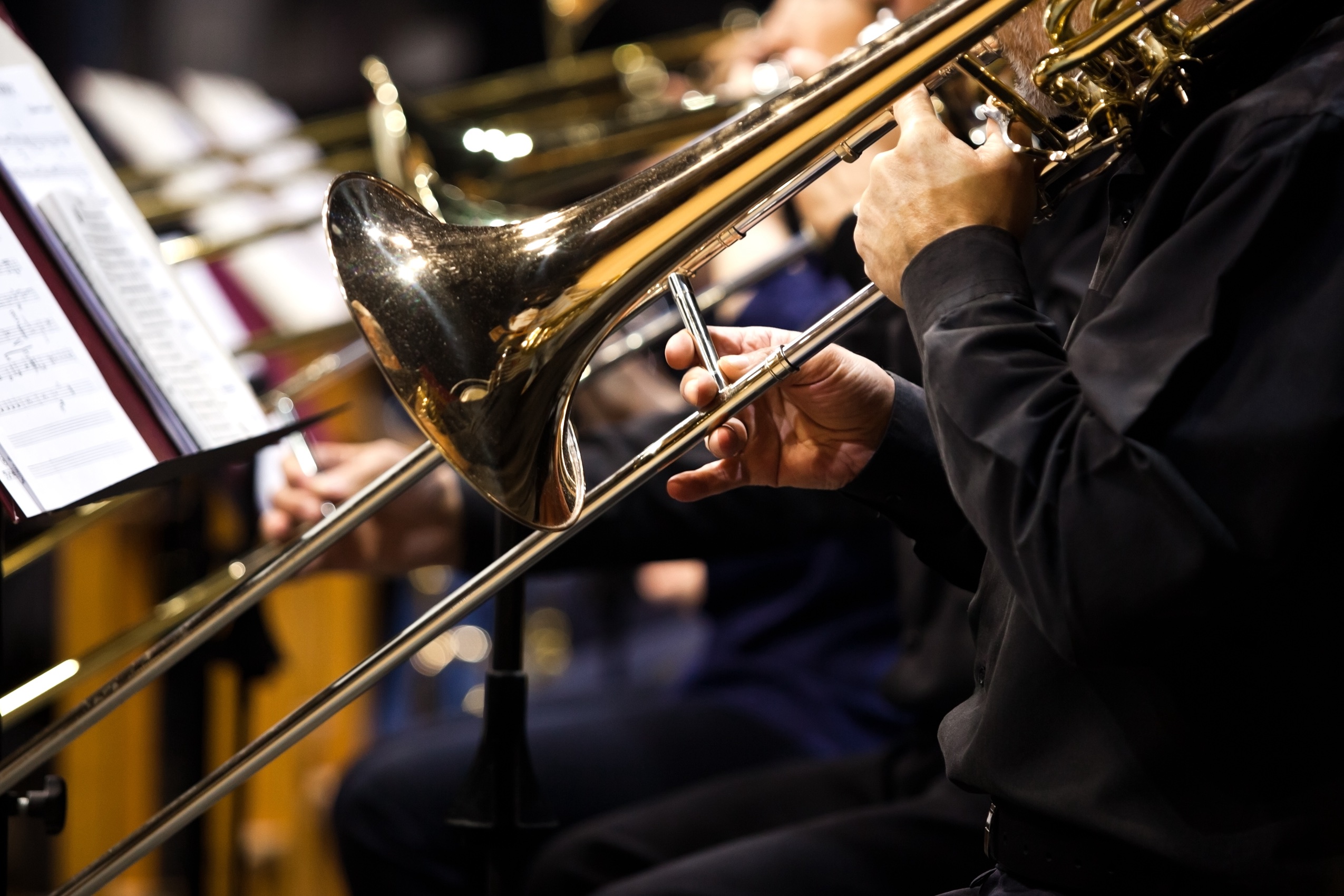
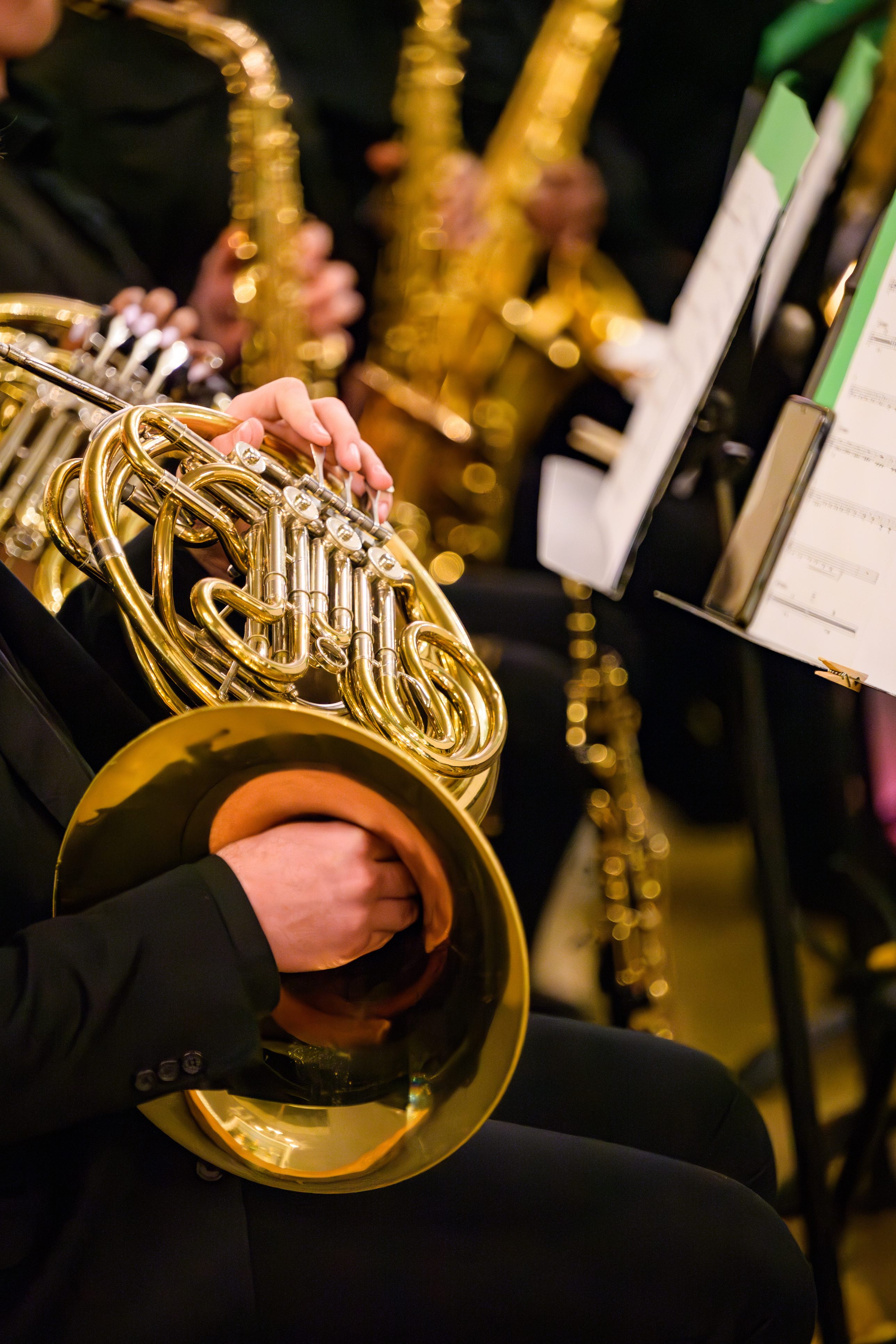
To rebuild your brass and woodwind instrumental technique after a long break, focus on the following gradual, three-stage process: first, restore your tone and response, then regain flexibility and dexterity, and finally, rebuild range and endurance. Prioritize short, consistent practice sessions, and avoid pushing too hard too early to prevent injury and bad habits.
Stage 1: Restore tone and response
Your primary goal is to reacquaint your body with the fundamentals of playing by focusing on soft dynamics and your lowest register.
Breathing exercises: Start without your instrument. Practice deep, diaphragmatic breathing to re-engage your respiratory system and expand your lung capacity. You can use simple routines like inhaling for four counts and exhaling for eight, or try the “pinwheel” exercise to visualize steady airflow.
Buzzing: Brass players should spend time buzzing with just their mouthpiece to get their lips vibrating efficiently again.
Long tones: On your instrument, play sustained, steady notes at a soft volume in your lower-to-middle range. Focus on producing a clear, characteristic tone. Use a tuner to monitor your pitch stability.
Short practice sessions: Limit your initial sessions to 5–20 minutes, with plenty of rest in between. This prevents over-straining your facial muscles and embouchure.
Stage 2: Regain flexibility and dexterity
Once your tone and response feel stable, you can begin to expand your comfortable playing range and improve finger speed.
Scales and arpeggios: Practice basic scales and arpeggios at a slow, controlled tempo. This helps rebuild muscle memory for your fingers while keeping the focus on even, beautiful tone.
Slurred partials (brass) and lip slurs (woodwind): Practice smoothly transitioning between notes without using your tongue. This strengthens your embouchure and improves air control.
Simple music: Play easy, melodic pieces you know well. This helps you focus on phrasing and musicality without the pressure of a difficult score.
Increase session length gradually: Slowly add time to your practice sessions, perhaps moving to 15–30 minutes at a time. Continue to take frequent breaks.
Stage 3: Rebuild range and endurance
After re-establishing your fundamentals, you can begin to increase the intensity and duration of your playing to return to your previous level.
Expand your range: Gently start working your way into your upper and lower registers, but maintain a soft dynamic level. Only increase volume once you can play a note softly with a good tone.
Louder dynamics: Once your full range is accessible, begin practicing with louder dynamics. This is physically demanding, so continue to take frequent rests.
Articulation: Incorporate tonguing exercises. Start with basic single tonguing before adding more complex techniques like double and triple tonguing.
Listen to your body: Your body will be the ultimate guide. If you feel any pain or unusual fatigue, ease up and incorporate more rest into your routine.
Mental preparation and practical tips
Listen to music: Remind yourself of what inspires you and listen to your favorite players to reconnect with the joy of playing.
Record yourself: Objectively evaluate your progress by listening back to recordings. This helps you identify areas that need work and celebrate your improvements.
Revisit old notebooks: Look back at any old lesson journals for useful reminders and insight into your past tendencies.
Service your instrument: A leaky pad or sticky valve can make returning to your instrument unnecessarily difficult. Have a technician give your instrument a “clean, oil, and adjust” to ensure it’s in prime playing condition.
Be patient: You are not expected to be at your former playing level immediately. Trust that your muscle memory will return with consistent, smart practice.
The “E” in RETIREMENT is for Energy, Engagement, Excitement, and Endurance
This blog is all about how to stay young and vibrant – BECOMING A VOLUNTEER! Geared to those of us who have retired, this is very personal and unique to every individual, no matter what the age!
Do you remember the song, “Those Were the Days” performed by Mary Hopkins (1968), the Fifth Dimension (1969), and even Dolly Parton (2000)?
Those were the days my friend We thought they’d never end We’d sing and dance forever and a day We’d live the life we choose We’d fight and never lose For we were young and sure to have our way. La la la la Those were the days, oh yes those were the days
In June 2021, I went back to work. Well, not exactly full-time… but it felt that way!
Remember the times as music educators we spent 15-18 hours a day or more thinking, planning, creating, teaching, problem-solving, schlepping stuff, sweating, and working out beyond the regular school day and during summer months with major music projects like the marching band, spring musical, music adjudication trip, etc.?
Asked by my friend and current Upper St. Clair School District performing arts curriculum leader/HS band director Dr. John Seybert, I signed on to the newly-expanded extracurricular activity (ECA) position as administrative assistant and announcer of the marching band for the school from which I had retired. Filling in the gaps, taking attendance, handling mounds of paperwork, interacting with a whole new generation of music students, and learning a few new software applications along the way like FamilyID, Canvas, Remind, and the district’s Blackboard website, I threw my hat in the ring, not just to continue to serve as the voice of the “Pride of Upper St. Clair” at football games halftime shows (now in my 36th year), but to manage the full schedule of rehearsals, meetings, performances, and blessedly (?) exhausting 24/7 week-long band camp. I forgot how it felt to get up at 6 a.m. and return home around 9:30 p.m.
It has been exhilarating. It has been exhausting!
On another stage, when the local COVID stats fell two months ago, I was invited back to our local community hospital to serve as a volunteer – discharging patients from their rooms or escorting them from the outpatient surgery or endoscopy units. Yes, I was called upon to somehow restore the physical demands I (used-to) place on my personal stamina. Fully fatigued and expended after a shift of 4-7 hours of driving my wheelchair taxis (sometimes carrying over-sized people even though we’re only supposed to move those weighing 250 pounds or less), I find myself yearning for a retiree “power-nap,” only to regroup for the next day’s challenging schedule and another early-morning wake-up.
The best part of these 8-15 hours per week? Choosing one of the finest medical facilities in our metropolitan area – St. Clair Hospital (now “Health”) – I have the chance to meet former music students (grown up), their kids, parents and grandparents, friends, and other acquaintances at their greatest need. And, there’s almost no finer escort “call” than going to the family birth center and bringing to the car a new mommy and two-day-old baby… sharing that special moment with an alum or school staff member!
It has been exhilarating. It has been exhausting!
WHAT
In past articles on a satisfying retirement, I often quote the book How to Retire Happy, Wild, and Free, the search for self-reinvention and new avenues for fulfilling those essential needs of “purpose, structure, and community” that employment had previously provided us. Author Ernie Zelinski’s definition of “purpose” are these goals:
To make a difference in people’s lives
To make a contribution
To find creative expression
To take part in discovery
To help preserve the environment
To accomplish or achieve a challenging task
To improve health and well-being
We learn from Revitalizing Retirement: Reshaping Your Identity, Relationships, and Purpose by Nancy Schlossberg that for retirees it is important to feel “needed” and that pursuits that foster “mattering” are crucial to a positive self-esteem, good mental health, and stable life balance.
It has been suggested that one problem of retirement is that one no longer matters; others no longer depend on us…
The reward of retirement, involving a surcease from labor, can be the punishment of not mattering. Existence loses its point and savor when one no longer makes a difference.”
– Rosenberg and McCullough
The opposite of “mattering” is feeling “marginalized.” I would rather feel worn-out than useless/ignored/discarded!
In his book Design Your Dream Retirement, Dave Hughes recaps with his four essential ingredients of life balance:
Physical activity
Mental stimulation
Social interaction
Personal fulfillment
If you read my bio in the “about” tab above, I think all would agree: mission accomplished! I’ve made myself extremely busy. (Perhaps I “matter” a little too much?) “It’s a good thing I am retired… I would not have enough time to do all of these things if I still had a job!”
Yes, it FEELS good!
WHY
Now some rationale from the online pundits. First, review the article “Why Elderly People Should Volunteer.” According to the “experts,” volunteering is:
Socially beneficial
Good for mental cognition
Giving back to the community
Physically engaging
An opportunity to learn something new
Flexible
A strategy to fill up your day
The reason you get out of bed in the morning
Of course, one has to be careful and follow your doctor’s advice on what tasks will not overwhelm you! The CDC and other medical professionals urge adopting a “safe” routine of regular physical activity as a part of an older adult’s life. Check out websites like https://www.cdc.gov/physicalactivity/basics/activities-olderadults.htm and https://www.cdc.gov/mmwr/preview/mmwrhtml/00001482.htm. Besides keeping your mind active, increasing your physical activity as a volunteer while “living the dream” in retirement will:
Reduce the risk of serious illnesses (heart disease, type II diabetes, and depression
Help you manage a “healthy weight”
Improve your balance and coordination
Decrease the risk of falls or other injuries
Talk with your doctor to find out if your health condition limits, in any way, your ability to be active. Then, work with your doctor to come up with a physical activity plan that matches your abilities. If your condition stops you from meeting the minimum recommended activity levels, try to do as much as you can. What’s important is that you avoid being inactive.
Volunteering is all about being more eleemosynary (adjective defined as “generous, charitable, gratuitous, or philanthropic”). In my workshops on retirement transitioning, I frequently quote two gurus on the benefits of “giving back.”
With a frequently untapped wealth of competencies and experiences, older people have much to give. This fact, coupled with fewer requirements for their time, gives them unique opportunity to assume special kinds of helping roles.
Our increased longevity and generally better health has opened our eyes to new and increased opportunities to contribute to the betterment of society through civic, social, and economic engagement in activities we believe in.
But you already knew all of this, right? There are so many ways to “bring it on” and “make a difference” in your “golden years.” (Wow – three cliches in a row!)
There are so many directions you can go to offer your free time to volunteer:
Escort at local hospital or nursing home
Walk dogs at animal shelter
Serve in charitable fund-raising projects
Assist food banks and meals-on-wheels agencies
Enlist as special advocate for abused or neglected children
Work as hospice volunteer
Maintain parks, trails, nature habitats, or recreation centers
Host an international student
Become a youth director, mentor, or scout leader
Teach summer school, night classes or Performing Arts workshops
Give guided tours or lectures as a docent at a local museum
Apply office management and clerical skills to benefit libraries and other nonprofit associations
Run a school club (share your hobby)
As trained music educators, we can share our precious skills in creative self-expression :
Accompany, coach, or guest conduct school/community groups, college ensembles, or music festivals.
Run for office or chair a committee or council of your state or local MEA association
Serve as presiding chair or member of the your state’s MEA planning committee or listening committees for the music in-service conferences
Participate as guest lecturer or panel discussion member at a conference, workshop, or college methods program
Judge adjudication festivals
Help plan or manage a local festival or workshop
Assist the local music teacher in private teaching, piano playing, marching band charting, sectional coaching, set-up of music technology, instrument repair, etc.
Write for your professional organizations’ publications (like PMEA or NAfME)
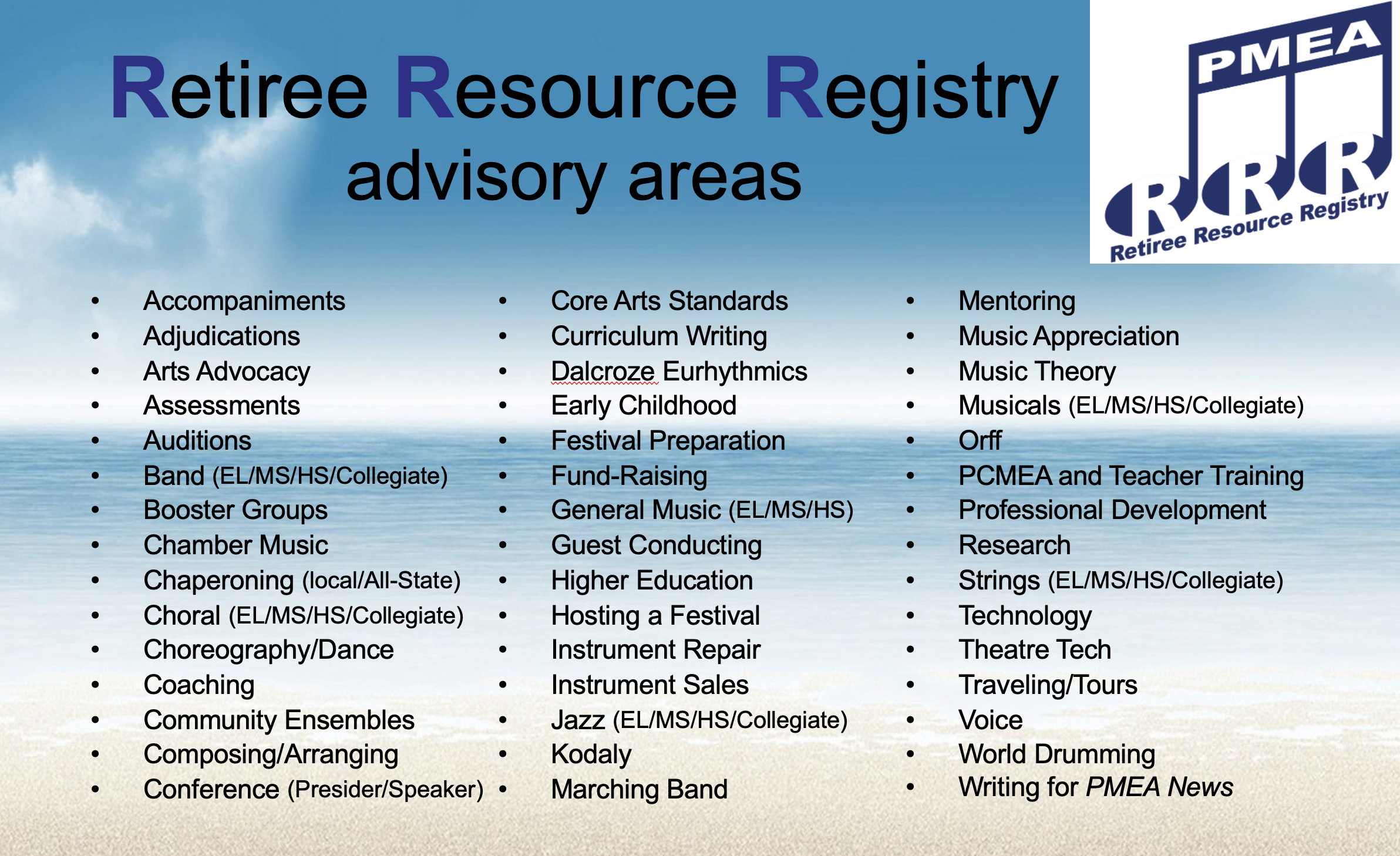
If you are a retired music teacher and member of PMEA, you could sign-up for the Retiree Resource Registry and serve as an informal consultant to others still “slugging it out” in the trenches. Go to the PMEA retired member focus area for more information.
Anyway, back to a little “bragging!” At least “yours truly” is holding his own and hopefully contributing what he can to the success and welfare of others! Are you? In my retirement pastime, I refuse to sit idle, binge-watch movies on Netflix, or view hours of boring TV. To quote another song’s lyrics, this “senior citizen” will never lament…
Life is so unnerving For a servant who’s not serving He’s not whole without a soul to wait upon Ah, those good old days when we were useful Suddenly those good old days are gone Ten days we’ve been rusting Needing so much more than dusting Needing exercise, a chance to use our skills Most days we just lay around the castle Flabby, fat, and lazy You walked in and oops-a-daisy!
Summertime Reading Suggestions for Music Directors
What do authors C.S. Forester, Simon Sinek, Jocko Willink, and Leif Babin have in common?
They offer a fresh perspective on leadership principles, reflections perfectly applicable for the skill-set development of music teachers who desire to better “lead” their music programs, students, and parent boosters.
It was no accident that I chose these books to help explore the truths of inspiring confidence and leading groups of people like we do daily in our classrooms, rehearsal halls, and on the stages or marching band fields. Their use of military (as well as company or government management) anecdotes defines and re-enacts the very essence of leaders, leadership concepts, goals, and public service.
“These [military group] organizations have strong cultures and shared values, understand the importance of teamwork, create trust among their members, maintain focus, and, most important, understand the importance of people and relationships to their mission success.”
Why do we admire music teacher “heroes” and most sought-after conference keynoters in our profession such as “Dr. Tim” Lautzenheiser, Peter Boonshaft, Scott Edgar*, and Bob Morrison* (*the latter two to be featured in the PMEA Summer Virtual Conference on July 20-24, 2020). They inspire us. They recharge us and pick up our spirits. They serve as models of visionaries and coaches. They challenge the status quo and help us to grow!
I believe these books will do the same, assist in your career development to morph into an even better leader and teacher. Since many of us are “stuck at home” during the pandemic for awhile, here is a new “reading list” for personal self-improvement.
ITV/Rex Archive: Ioan Gruffudd in “Hornblower” 2001 TV series
Who is Horatio Hornblower?
To start with, how about a series of historical fiction from the Napoleonic-Wars era?
Hornblower is a courteous, intelligent, and skilled seaman, and perhaps one of my favorite examples of an adaptable “leader.” Although burdened by his (almost shy) reserve, introspection, and self-doubt (he is described as “unhappy and lonely”), the Forester collection illustrates numerous stories of his personal feats of extraordinary cunning, on-the-spot problem solving, and bravery. The first book spotlights an unpromising seasick midshipman who grows into a highly acclaimed, productive, and ethical officer of Her Majesty’s Royal Navy, gaining promotion steadily as a result of his skill and daring, despite his initial poverty and lack of influential friends. And yet, the common thread throughout is that he belittles his achievements by numerous rationalizations, remembering only his fears.
74-gun Royal Navy Ship-of-the-line ~1794
“Hornblower’s leadership is thoroughly self-conscious: what makes him a great leader, morally, is that he assumes as a matter course that he must lead rather than he can lead; Hornblower’s pervasive sense of responsibility would be diminished if it all came to him naturally and that he acts therefore as each situation demands. He can be self-effacing or fierce, or obsequious, all depending on what is necessary to get the job done. As it happens, Hornblower‘s many other gifts, including a formidable diligence, always beyond the call of duty, and a supple intelligence, make him a man others trust and lean on; but for the reader, especially young reader, it’s his moral qualities that are most engaging, it is instructive.”
This set is a wonderful “chestnut” to acquire, sit back in your leather recliner, and devour over the coming months. Even though it may take you some significant time to finish Forester’s eleven novels (one unfinished) and five short stories, I promise you, it will all be worth it!
[If you like the Hornblower assortment, also checkout the works by Alexander Kent and Dudley Pope, all drawing parallels to the exploits of real naval officers of the time: Sir George Cockburn, Lord Cochran, Sir Edward Pellew, Jeremiah Coghlan, Sir James Gordon, and Sir William Hoste.]
Now, how can you personally glean new leadership habits from this treasure chest? Coincidental to doing some research for this blog, I bumped into the article on LinkedIn “Leadership Lessons Learned from Horatio Hornblower.” My sincere thanks and “attaboy” go to Amro Masaad, Education and STEM Leader at Middlesex County Academies, who gave me permission to share his documentation and insightful interpretation of the following leadership tips learned from Hornblower that we can all employ as “best practices” in the education profession:
Don’t be afraid to stand up to a bully.
Don’t insist that all of your successes be praised.
Don’t let employees sabotage your mission.
If you want excellence, you can’t look the other way.
Prove yourself when the situation demands it.
Take one for the team.
Show sacrifice and honor, even with your enemies.
I have always been inspired by the adventures of Hornblower, mostly because of his displays of humanity at a time in history when things were inhumane and primitive. Hornblower consistently modeled his intentions for the care and success of his subordinates while other officers “stepped on them” to get advancement, his unimpeachable moral code that guided his every action, and “taking it on the chin” when necessary for his shipmates and the good of “god and country.”
Leaders Eat Last
I was struck by this quote by Simon Sinek, the author of Start with Why – How Great Leaders Inspire Action, who posted a popular TedTalk lecture of the same name:
“There are leaders and there are those who lead. Leaders hold the position of power or authority, but those who lead, inspire us. Whether they are individuals or organizations, we follow those who lead, not because we have to, but because we want to. We follow those who lead, not for them, but for ourselves. And, it’s those who start with ‘the why’ that have the ability to inspire those around them or find others to inspire them.”
His latest book, Leaders Eat Last, brings up the rationale of mutual collaboration and prioritizing the mission and the needs of your team members. Sinek observed that some teams were able to trust each other 100%, so much so that they would be willing to put their lives on the line for each other, while other groups, no matter what enticements or special incentives were offered, were “doomed to infighting, fragmentation and failure.” Why was this true?
“The answer became clear during our conversation with the Marine Corps general. ‘Officers eat last,’ he said. Sinek watched as the most junior Marines ate first while the most senior Marines took their place at the back of the line. What’s symbolic in the chow hall is deadly serious on the battlefield: great leaders sacrifice their own comfort – even their own survival – for the good of those in their care.”
Throughout his book of vivid narratives from armed conflicts to business “revolutions” of take-overs or new CEO transformations, Sinek dives into the precepts of what constitutes “great” leadership:
The value of empathy should not be underestimated.
Trust and loyalty exist on a two-way street – to earn them, leaders must first extent them to their team members.
The role of leadership is to look out for (and take care of) those inside their “circle of safety.”
For the success of the team, goals must be tangible, visible, collaborative, and written down.
Leaders know: There is power in “paying it forward.” It feels good to help people, or when someone does something nice to us, or even when we witness someone else doing something good.
It’s also a big deal when leaders express that final personal touch and shake hands.
Leadership is all about service… to the “real, living, normal human beings with whom we work every day.”
I have never found a better source for defining the four “chemical incentives” in our bodies (also known as hormones) and numerous actual examples of their daily use (and misuse): endorphins, dopamine, serotonin and oxytocin.
Also intriguing is an expanded Chapter 24 and Appendix section in the book called “A Practical Guide to Leading Millennials.” Similar to another suggestion for summer perusal, UnSelfie: Why Empathetic Kids Succeed in Our All-About-Me World by Michele Borba, Ed.D (Simon & Schuster, 2017) which focuses more on our current young “charges,” Sinek’s differentiation is provided to inspire and educate the ultimate multitaskers of the “distracted generation.”
“This is what it means to be a leader. It means they choose to go first into danger, headfirst toward the unknown. And when we feel sure they will keep us safe, we will march behind them and work tirelessly to see their visions come to life and proudly call ourselves their followers.”
“The biology is clear: When it matters most, leaders who are willing to eat last are rewarded with deeply loyal colleagues who will stop at nothing to advance their leaders vision and their organization’s interests. It’s amazing how well it works.”
This next leadership philosophy, the core premise of the book Extreme Ownership – How U.S. Navy Seals Lead and Win by Jocko Willink and Leif Babin, will not surprise anyone who has ever taken on the inherently risky task of programming a student concert, marching field show, dance recital, or musical/play: the music director assumes full responsibility for the failures and faux pas that may occur during the performance, but instrumentalists, singers, actors, and/or dancers should get all the credit for a successful production.
“Combat, the most intense and dynamic environment imaginable, teaches the toughest leadership lessons with absolutely everything at stake. Jocko Willink and Leif Babin learned this reality firsthand on the most violent and dangerous battlefields in Iraqi. As leaders of SEAL Team Three’s Task Unit Bruiser, their mission was one many thought impossible: help US forces secure Ramada, a violent, insurgent-held city deemed “all but lost.“ In gripping, firsthand accounts of heroism, tragic loss, and hard-won victories, they learned that leadership – at every level – is the most important factor in whether a team succeeds or fails.”
This is a comprehensive textbook on Leadership 101. Admittedly, the rehash of their battle scenes are scary. This is a world so far apart from anything I have ever experienced. We do owe all our veterans a massive depth of gratitude to face such dangers to defend our freedoms and way of life. (As an inexperienced teacher, the worst fear I ever had to face was a homeroom of 99 excitable and talkative Freshman girls in my first year as the high school choral director.)
When possible, I try to share the Contents (chapter titles) of my book recommendations, giving you a broad glimpse of the outline of their publication:
Extreme Ownership
No Bad Teams, Only Bad Leaders
Believe
Check the Ego
Cover and Move
Simple
Prioritize and Execute
Decentralized Command
Plan
Leading Up and Down the Chain of Command
Decisiveness Amid Uncertainty
Discipline Equals Freedom – the Dichotomy of Leadership
From these sections, we can explore these fundamental building-blocks and mindsets necessary to lead and win.
Part I: Winning the War Within (Chapters 1-4)
Leaders must own everything in the world. There is no one else to blame.
A leader must be a true believer in the mission.
Even more important then “the how” and “the what” is “the why” of any plan. Not knowing the rationale of a decision or goal is a recipe for failure. It is a leader’s job to understand the mission and communicate it to his/her team members.*
During situations lacking clarity, leaders ask questions.
Leaders temper overconfidence by instilling culture within the team to never be satisfied and to push themselves harder to continuously improve performance.
Leaders know that over-inflated egos cloud judgment and disrupt everything: the planning process, the ability to take good advice, and the ability to except constructive criticism.
* Who said “great minds think alike?” (Answer: Carl Theodor von Unlanski.) The concept of “the why” is also described in great detail in the aforementioned TedTalk by Simon Sinek.
Part II: Laws of Combat (Chapters 5-8)
Elements within the “greater team” are crucial and must work together to accomplish the mission, mutually supporting one another for that singular purpose.
In life, there are inherent complexities. It is critical to keep plans and communication simple. Complex goals and plans add to confusion which can compound into disaster.
Competent leaders can utilize their own version of the SEAL’s prioritize and execute. It is simple as, “relax, look around, and make a call.” Prioritize your problems and take care of them one at a time, the highest priority first. Don’t try to do everything at once or you won’t be successful.
Leaders delegate responsibility, trust and empower junior leaders to make decisions on their own as they become proactive to achieve the overall goal or task.
Part III: Sustaining Victory (Chapters 9-12)
Effective planning begins with an analysis of the mission’s purpose, definition of the goals, and communication of clear directives for the team.
Effective leaders keep the planning focused, simple, and understandable to all of the team members and stakeholders.
Leadership doesn’t just go down the chain of command, but up as well. Communication to your supervisors is also key.
Leaders must be decisive, comfortable under pressure, and act on logic, not emotion.
In challenging situations, there is no 100% right solution, and the picture is never complete.
Leaders have self-control and “intrinsic self-discipline,” a matter of personal will. They “make time” by getting up early.
Self-discipline makes you more flexible, adaptable, and efficient, and allows leaders and team members alike to be creative.
A leader must lead, but also be ready to follow.
A Leadership Recap for Music Teachers
I am probably not doing justice to these incredible resources. They offer an exhaustive body of knowledge and examples on leadership ideology as well as a dazzling array of practical advice on what habits/skills are essential to become an effective leader. You need to sit back and devour these books one-by-one, apply their relevance to your situation, and come to your own conclusions about prioritizing the needs for your own personal leadership development.
To sum up a few of the theories from all this literature, we could revisit page 277 in Extreme Ownership and quote “The Dichotomy of Leadership” by Jocko Willnick.
“A good leader must be:
confident but not cocky;
courageous but not foolhardy;
competitive but a gracious loser;
attentive to details but not obsessed by them;
strong but have endurance;
a leader and follower;
humble not passive;
aggressive not overbearing;
quiet not silent;
calm but not robotic;
logical but not devoid of emotions;
close with the troops but not so close that one becomes more important than another or more important than the good of the team; not so close that they forget who is in charge;
able to execute Extreme Ownership while exercising Decentralized Command.”
“A good leader has nothing to prove but everything to prove!”
Many years ago, my wife and I were fortunate to participate in almost all of those early PMEA Summer Conferences that were basically leadership training workshops. Initiated and inspired by our first guest clinician Michael Kumer (who was then “modeling leadership” first-hand as Dean of Music for Duquesne University), we were exposed to a rich curriculum of “the greats” on leadership, team building, time management, and professional development. If you have not consumed them yourself, a few of these resources from the first couple years should be added to your reading list:
One Minute Manager by Ken Blanchard and Spencer Johnson
First Things First and other sections from The 7 Habits of Highly Effective People series by Stephen Covey
A Kick in the Seat of the Pants: Using Your Explorer, Artist, Judge, and Warrior to Be More Creative and A Whack on the Side of the Head: How You Can Be More Creative by Roger Von Oech
As a part of fulfilling “total ensemble experience” and to make the learning meaningful, I have always “taught” leadership to my students. The settings may have varied, whether it was as a part of the longstanding tradition of training marching band leaders, student conductors or principals’ who ran sectionals, our spring musical “leadership team” of directors, producers, and crew heads, elected high school choir officers, participants (grades 6-12) in a six-day string camp seminar, or even booster parents in a “chaperone orientation.” Many of my own often-repeated leadership quotes were passed down:
“Leaders aren’t born, they are made. And they are made just like anything else, through hard work. And that’s the price we’ll have to pay to achieve that goal, or any goal.” – Vince Lombardi
“You don’t lead by pointing and telling people some place to go. You lead by going to that place and making a case.” – Ken Kesey
“Things may come to those who wait, but only the things left by those who hustle.” – Abraham Lincoln
“The very essence of leadership is you have to have a vision. It’s got to be a vision you articulate forcefully on every occasion. You can’t blow an uncertain trumpet.” – Rev. Theodore Hesburgh
“Management is efficiency in climbing the ladder of success; leadership determines whether the ladder is leaning against the right wall.” – Stephen R. Covey
Finally, to close this seemingly-endless essay, I would share one of my regular but more unique lessons: “leaders flush.” We advise our plebe leaders-in-training that when anyone on the team sees an opportunity to take care of something that’s not right, or someone who needs help, or a problem that can be resolved on their own, they should take it upon themselves to do what is necessary for the greater good. We cite the example that, if you visit a restroom and discover someone before you did not flush the toilet, you do what’s right. Leaders flush.
The Three T’s to Build Technique, Key Literacy, and Endurance
Just like an athlete’s regular workout to achieve specific goals for improvement in form, strength, and stamina, musicians need to adopt consistent practice habits, and apply a daily routine of the Three T’s:
Tuning and slow/long-tone warmup
Three Scales a Day
Technical Etude or Study
Even if time is very limited, the music directors of the South Hills Junior Orchestra recommend that, at a minimum, every musician spends at least ten minutes a day on a regime of playing scales and at least one technical exercise or etude (usually prescribed by a private teacher) to “maintain their chops,” increase flexibility and resilence, and further their technical proficiency.
The TECH TIP #1 outline below provides a suggested framework to follow (especially suitable for violin, viola, cello, and string players, but adaptable to any instrument).
This involves the following approach:
Consistent drill (ten minutes a day, seven days a week)
Focused drill (no distractions or interruptions, or it doesn’t count)
Repetitive drill (many revolutions and repeats)
Creative drill (innovative and inventive: new keys, articulations, rhythms, etc.)
How to Practice: “Variety is the Spice of Life!”
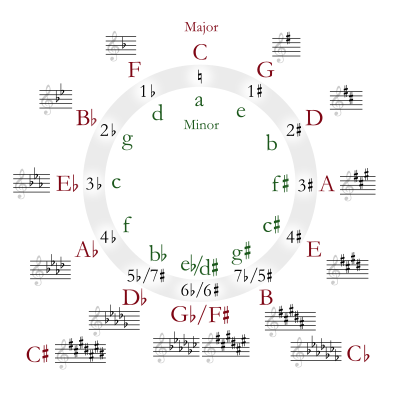
Key to this formula is venturing out of your “comfort zone” and exploring the entire “Circle of Fifths” – different key signatures (don’t just play in the same key every day), Major and minor scales, and numerous varied patterns:
Repeated notes
Unique rhythms
Slow to fast tempos
Slurs
Bowings (strings)
Intervals (e.g. scales in thirds, etc.)
Arpeggios
Dynamics and other expressive markings
Other practice strategies have been previously shared here (click on the “fireside” menu above or go to https://paulkfoxusc.wordpress.com/foxs-firesides/), and offer a host of problem solving techniques suitable for instrumentalists of any age and abilty level.
In addition, here are a few more tips for effective practice:
Play your instrument every day, at least 5-7 times per week. Practicing in short amounts daily is more preferable than “cramming.” Developing technique is much like an exercise workout. Teach your muscles by doing a little bit daily.
Set regular time(s) to practice. Consistency is the key to success.
Find a comfortable, well-lit, quiet place to practice. No television or telephone interruptions!
Practice standing up, not sitting (except cello players). Remember to keep muscles relaxed and loose. Relaxation and breathing exercises prior to the start of a practice session can be especially helpful.
Use a mirror to visually check your form and technique. Use a recorder to aurally check your playing.
When trying to improve intonation, play SLOWLY. Try to memorize your music or passage, close your eyes or play in the dark. By restricting visual input, you may help enhance your aural ability, becoming more sensitive and “attuned” to tuning.
Experts say “start slow and small.” After sight-reading (without stopping) your new selection, break it down into “practice goals” and “problem solve.” At each session, focus on a small section or difficult passage(s). Gradually increase your tempos or add more difficult fingerings/positions/bowings. As you learn each section, overlap your practice goals into repetitive longer “run-throughs” of the music.
Test yourself performing “ten-times-in-a-row” with 100% accurate notes, rhythms and articulations.
LISTEN! If you are having trouble with an orchestra piece, or a new solo work, buy a recording, research it on YouTube, or try to get one from the library. Even better, get multiple recordings of it so you can hear different interpretations. Then, listen to it a lot. Listen to it in the car, on your headphones while taking a walk, as background music while talking to a friend, during dinner, etc.
Don’t forget that the ultimate goal is not to produce the notes you see on the page as you would type in words on a keyboard—the goal is to produce beautiful music. Listen to yourself and “make music” as you practice.
SHJO’s mission is all about supporting school music programs. (For more information, about the Southwestern PA community ensemble, please visit www.shjo.org.) Consult your band or orchestra teacher, as well as a private teacher (if you have one) for more detailed instruction on warmups, tuning, scale reading, and etude assignments.
Sample Scales
If you do not own a scale book, here are a few guides for string players:
Best wishes on setting up a daily ten minute PRACTICE PLAN!
PKF
Three T’s to Build Technique, Key Literacy, and Endurance
Tuning
Three Scales a Day (two Major and one minor)
Technical Etude or Study
What is needed?
SmartMusic, eTuner, or other standalone digital tuner
Lists of scales in different keys
Supplemental materials (such as Essentials for Strings or Essential Elements 2000 for Strings Book 2 p. 44-45)
Violin or Viola Etudes: VIOLIN/VIOLA: Wohlfahrt Foundation Studies Book 1 or Wohlfahrt Foundation Studies Book 2*
Cello Etudes: Sebastian Lee or Alwin Schroeder*
String Bass Etudes: Simandl*
Other instruments: any etude appropriate to your instrument *(ask your private teacher)
Recommendations
Per daily warm-up, perform two Major scales and one minor scale.
Play one scale slow with focus on natural tone production/vibrato and precise intonation.
lay one scale fast with emphasis on articulation or bowing style.
Play one scale using unique rhythmic, slurring, melodic patterns, shifting or in positions.
Play at least one of the above scales in a flat key (Major or minor).
epending on level of achievement, two octaves is the norm; one octave for novices or playing new keys starting on D (violin), G (viola/cello), A (bass) strings, C (all other instruments); three octaves for advanced string students.
Check off the different keys you play on the Circle of Fifths. (The goal is that all string musicians should be able to play scales in keys of 1-5 sharps and 1 to 4 flats.)
Vary your workout to include a range of expressive elements including articulations (staccato, marcato, legato, spiccato, hooked bows, pizzicato) and dynamics (forte to piano).
Definitions
Major Scale: Do-1 Re-2 Mi-3 Fa-4 Sol-5 La-6 Ti-7 Do-8 half steps between 3-4 and 7-8
Melodic Minor UP: Do-1 Re-2 Me-3 Fa-4 Sol-5 La-6 Ti-7 Do-8 half steps 2-3 and 7-8
Melodic Minor DOWN (same as Natural Minor)
Speedy Rhythm Drill (looks like an upside-down pyramid): four sixteenth notes per scale note (up and down), three sixteenths, two sixteenths, and one sixteenth
Speedy Slur Drill (looks like a normal pyramid): one quarter note (once up and down), two eighth notes slurred played twice, three notes (triplet) slurred played three times, and four sixteenth notes slurred played four times.
Slow-Fast drills: four eighth notes followed by four sixteenths (or vice versa)
The 2 + 1 Pattern (or 1 + 2): Triplets Do-Do-Re (or Do-Re-Re), Mi-Mi-Fa, Sol-Sol-La, etc. playing the entire scale using a steady beat in a moderate to fast tempo.
The 3 + 1 Pattern (or 1 + 3): Sixteenths Do-Do-Do-Re (or Do-Re-Re-Re), Mi-Mi-Mi-Fa, etc. playing the entire scale using a steady beat in a moderate to fast tempo.
For a printable copy of this TECH TIP #1, click below:
















 His latest book, Leaders Eat Last, brings up the rationale of mutual collaboration and prioritizing the mission and the needs of your team members. Sinek observed that some teams were able to trust each other 100%, so much so that they would be willing to put their lives on the line for each other, while other groups, no matter what enticements or special incentives were offered, were “doomed to infighting, fragmentation and failure.” Why was this true?
 Also intriguing is an expanded Chapter 24 and Appendix section in the book called “A Practical Guide to Leading Millennials.” Similar to another suggestion for summer perusal, UnSelfie: Why Empathetic Kids Succeed in Our All-About-Me World by Michele Borba, Ed.D (Simon & Schuster, 2017) which focuses more on our current young “charges,” Sinek’s differentiation is provided to inspire and educate the ultimate multitaskers of the “distracted generation.”

![US Navy SEAL Team Three [ST3][Patch][1.5]](https://paulfox.blog/wp-content/uploads/2020/07/us-navy-seal-team-three-st3patch1.5.png) No Bad Teams, Only Bad Leaders
No Bad Teams, Only Bad Leaders

 One Minute Manager by Ken Blanchard and Spencer Johnson



 Major and minor scales, and numerous varied patterns:
 paulfox.blog