Engaging Retiring/Retired Educators

Ask not what NAfME or your state MEA can do for you, but what YOU, a retiree, can do for your professional association and music education.
An adaptation of the famous excerpt from the 35th U.S. President John F. Kennedy’s inaugural address of January 20, 1961.
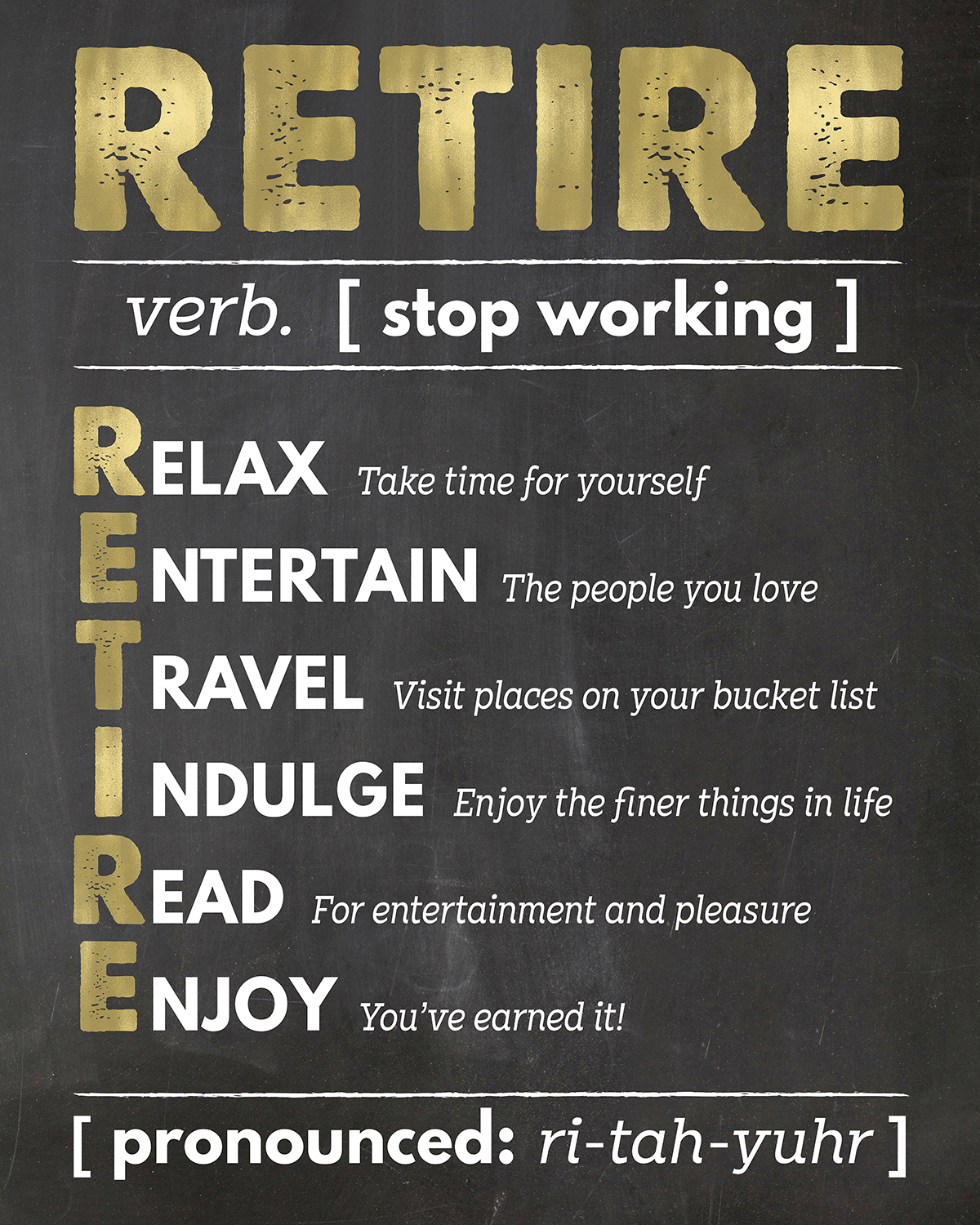
Surfing the ‘Net, I found an appropriate acronym for R.E.T.I.R.E. by Tangled Tulip Designs in pinterestRelax, Entertain, Travel, Indulge, Read and Enjoy! Most retirees would probably agree! The cessation of full-time employment may offer a great release from the day-to-day stress and drudgery of the job and the freedom to venture out, self-reinvent, make future goals, nurture relationships, and explore new personal growth opportunities.

Many attribute embracing a career in music education as “a calling” as opposed to just a form of employment or livelihood. From my experience, I have witnessed that most music educators are passionate for the cause of fostering creative self-expression in their students, more of a 24/7 mission, bringing intense focus and dedication to their lifework.

More to the point: Do we ever truly retire from making music ourselves and fostering this love in others?

THE “WHY!” Retirees matter and are critically needed!

One of my favorite inspirational speakers (Simon Sinek) would say, “start with the WHY!” WHY is this discussion on professional engagement of retired educators so important today?

  1. Their need: An informal poll of my former local educators and administrators revealed that half of them “hate retirement!” According to Dr. Robert P. Delamontagne in his book Retiring Mind (Fairview Imprints), “50% of retirees will suffer some form of acute emotional distress. This is potentially a very large problem given the fact that 10,000 people are becoming eligible for Social Security every day for the next 20 years in the US alone.” Remember this statistic the next time a senior citizen cuts you off on the road or bangs a shopping cart into your leg at the checkout!
  2. Our need: We are facing shortages of qualified teaching candidates across the country with unfilled openings in public school music positions and the critical need of training/mentoring the new hires.
  3. Society’s need: All of our voices should be combined to support the advocacy of music education, actively promoting access to school music by sharing its academic and social benefits with decision-makers, building relationships with administrators and policymakers, and utilizing resources from organizations like NAfME and the NAMM Foundation.

Despite its proven benefits, music education is often the first program to face budget cuts in schools. This is especially concerning in underserved communities, where access to music programs can be life-changing. Now more than ever, we must advocate for music education to ensure that every child has the opportunity to experience its benefits. Investing in music education is an investment in the future of our communities — helping to cultivate the next generation of creative, resilient, and innovative leaders. 
“Why Music Education Matters More Now Than Ever” by Music Will, February 2025

For eleven years (and counting), I serve as the Pennsylvania Music Educators Association (PMEA) Retired Member State Coordinator, as well as the Past State Chair (current member) of the PMEA Council for Teacher Training, Recruitment and Retention. I believe my responsibility to the state association is two-fold:

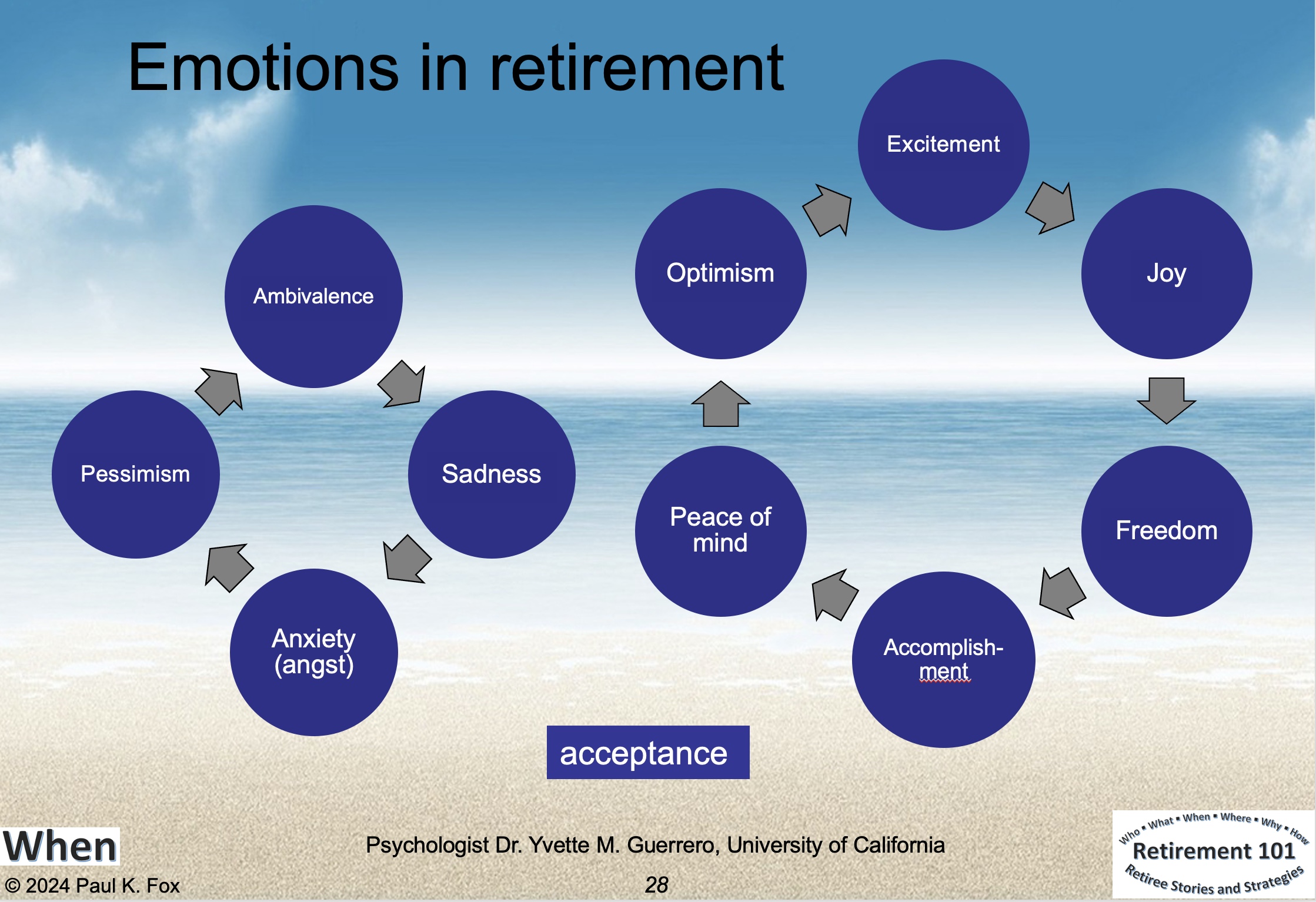
  • Assist soon-to-retire professionals in achieving a smooth transition to a happy and satisfying retirement; to help them cope with the commonly-experienced emotional ups-and-downs of this life passage, wrestling with the question “what do you want to be or do when you grow up?” and making new life lesson plans and personal goals.
  • Reach out to and build meaningful connections with retirees in order to fully engage them towards becoming active in their professional association; to recount, represent, and revitalize the activities of our post full-time employed music educators.

This article proposes a roadmap of crucial pathways to help music teachers approach “retirement bliss” while tapping into their hard-earned knowledge, strengths, and experiences by cultivating the benefits of their renewed participation in our professional associations.

What can NAfME and State MEAs offer retirees?

You have devoted your entire life to inspiring the development of personal artistry and “ah-ha” musical moments in others. Now it is your turn to reap the benefits (and privileges) of this commitment to the profession. NAfME and your MEAs can provide the resources and motivation of “sharing and caring,” directing retirees “places to go, people to meet, and things to do” for fulfilling that “next chapter” or (perhaps better terms) the “refirement” or “rewirement” of senior living.

Do you feel “needed” and know you “make a difference?” Research has shown that the one of the most important motivators for involvement in a professional association is that its members recognize that they are essential to its success. This quote is from Revitalizing Retirement: Reshaping Your Identity, Relationships, and Purpose by Nancy Schlossberg, attributed to Rosenberg/McCullough:

 “It has been suggested that one problem of retirement is that one no longer matters; others no longer depend on us… The reward of retirement, involving a surcease from labor, can be the punishment of not mattering. Existence loses its point and savor when one no longer makes a difference.”

Most people who are one to five years away from “pulling their pin” and putting in their walking papers “do not know what they do not know.” Experts agree: “Retirement preparation is not only about the money!” Our silver-haired colleagues who have already Crossed the Rubicon and are now “living the dream” in retirement can share their trials, tribulations, and (more importantly) numerous success stories about coping with this transition!
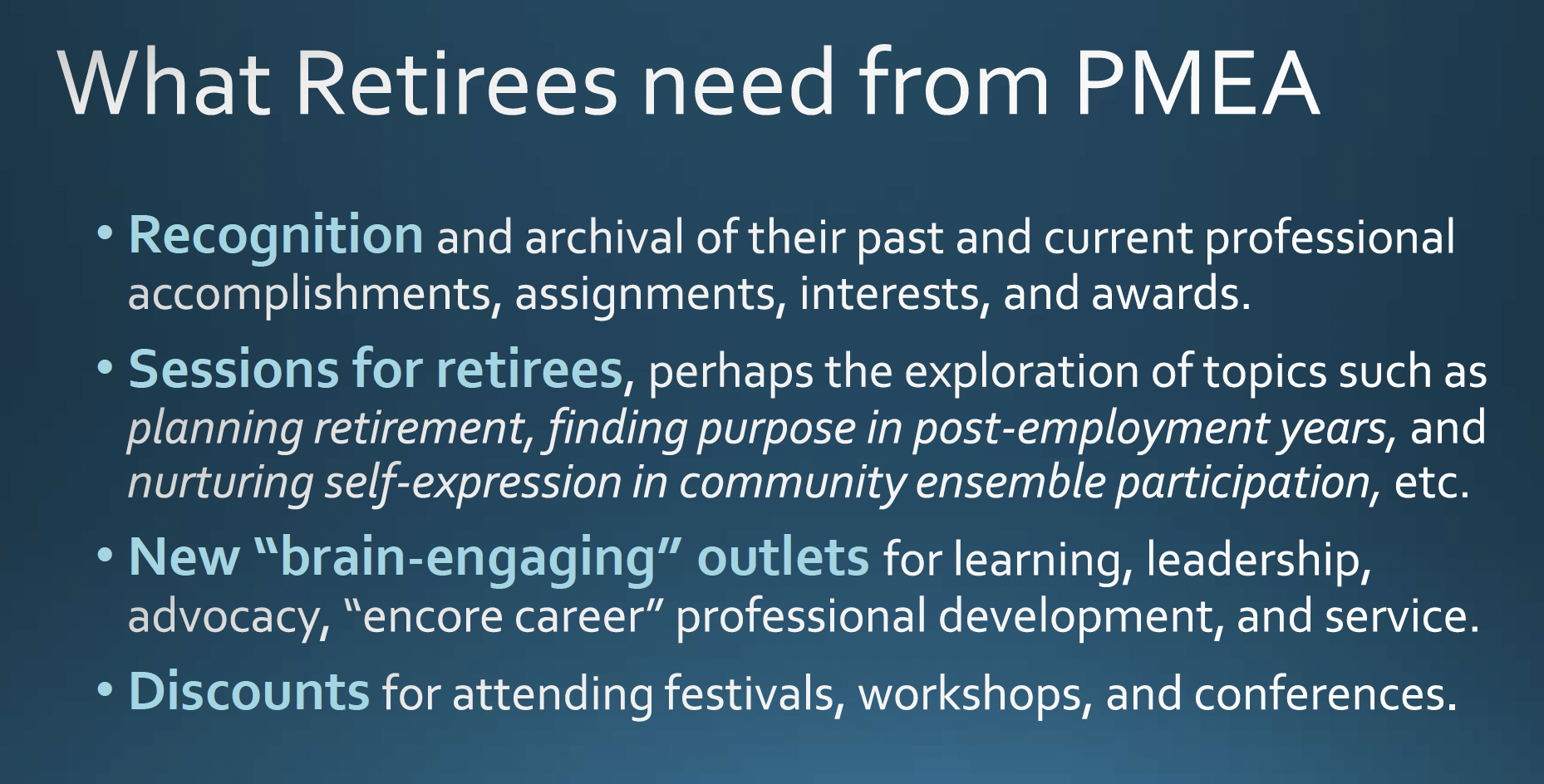
NAfME, PMEA and this paulfox.blog/for-retirees site have archived an exhaustive number of self-help articles. Check out this omnibus NAfME blog “Retirement Prep Top-Ten Treasures.”

The benefits of retired MEA membership are numerous. Besides providing helpful transitioning advice, these advantages also come to mind:

  1. Answers to questions like “What have you always wanted to sing, compose, play, record, conduct, write, publish or present?” and “Where can I share my hard-won expertise and help others in the field?”
  2. Networks and contacts to help you develop “encore careers” in other musical or educational arenas (e.g., higher education, music industry, festival organization, travel/tour planning, composition, guest conducting, private studio teaching, church music, etc.)
  3. Opportunities to “rekindle your expressiveness” by participation in adult community or full/part time performance groups (playing “gigs”)
  4. Places to go/things to see/hear: NAfME/MEA conferences, workshops, and concerts
  5. Exclusive discounts and other benefits (reduced dues and registration fees)
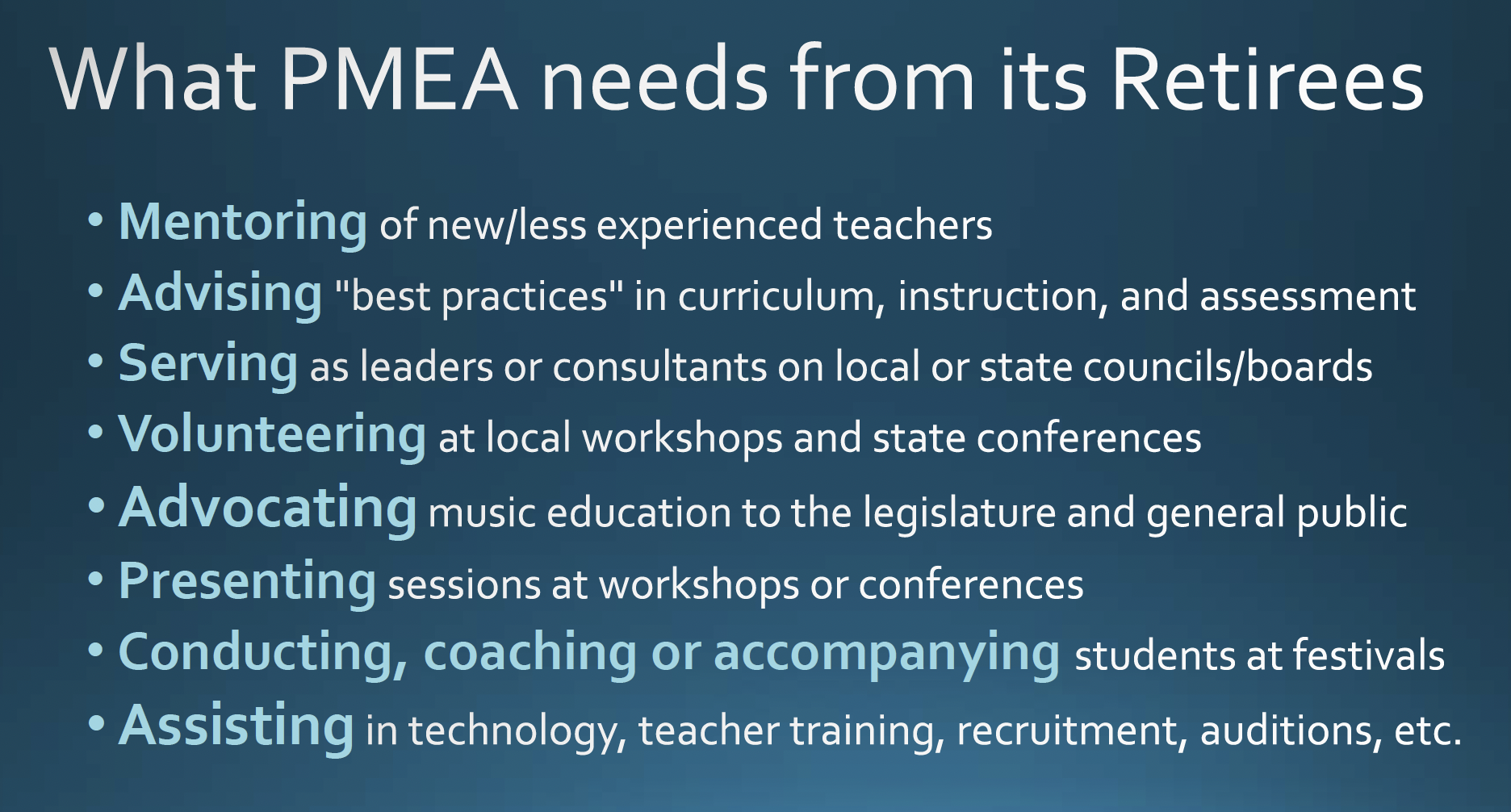
What can retirees offer NAfME and their state MEA?

The relationship of active and retired membership in our MEAs is symbiotic. We know from the history of our associations, “giving back to the profession” remains a high priority with most retirees. This may come in many forms and settings:

  • Leadership or membership in local, state, or national MEA/NAfME office, staff, advisor, or council/committee position
  • Advocates for the promotion of music education to local and state government officials
  • Service as presiding chair or member of the conference or workshop planning committee
  • Service as evaluator of performance groups, conference sessions, or articles for publication
  • Judges of local/state MEA adjudication or commercial festival
  • Accompanists, coaches, arrangers, or guest conductors for festivals or school/community groups
  • Services to the local music teacher in private teaching, piano playing, marching band charting, sectional coaching, choreography, music technology, instrumental repair, stage tech, etc.
  • Writers for state MEA and NAfME publications and blog sites
  • Contributors to online music education forums or the NAfME Connections
  • Donors to and/or fund-raisers of music education charitable projects, scholarship initiatives, etc.
The PMEA Model of Retired Member Participation
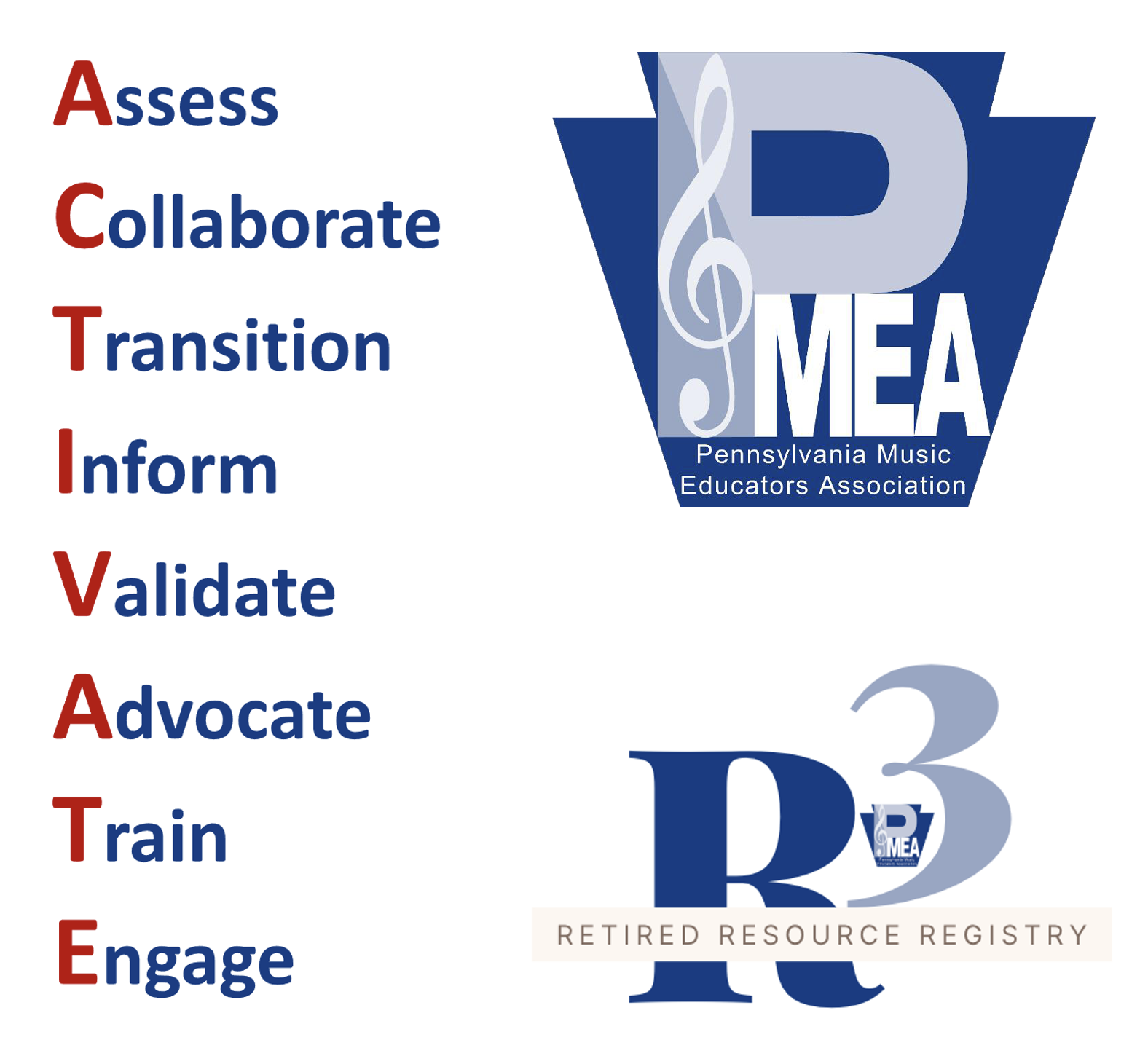
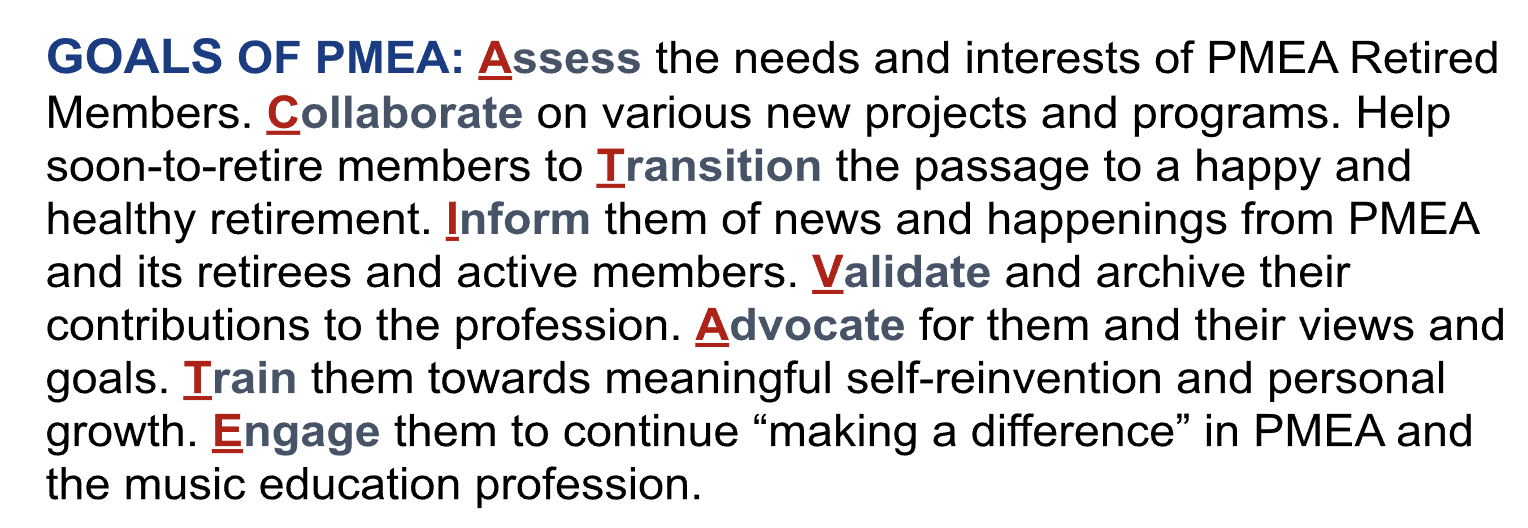
PMEA values the vast wealth of experience and contributions of our retired members. We’re proud of the many programs we offer to retirees and invite you to visit our website to peruse additional information and sample digital newsletters and articles.

Retired members in Pennsylvania are involved in:

  • PMEA elected and appointed offices, staff, committee chairs, and membership on councils
  • PMEA Strategic Plan and Bylaws, Conference Planning, and other state/regional committees
  • Retired Resource Registry* (informal mentoring for new teachers and transfers)
  • How-to-Retire Webinar, Prepping for Retirement, and the Ultimate Retiree Resource Guide
  • Retired Member Breakfast at PMEA Annual Conference
  • Retirement 101 (The Who, What, When, Where, Why, and How) session at PMEA Annual Conference (training for all members retiring or soon-to-retire)
  • Maintenance of PA Community Band, Chorus, Orchestra, and Theater group catalogs
  • Maintenance of PMEA member compositions library
  • Mock Job Interview Committee for music education majors
  • Coffee & Conversations informal “ask an expert” lounge at PMEA Annual Conference
  • Volunteering as presiding chairs for sessions and registration aides at conferences/workshops
  • Pool of conference clinicians, guest lecturers, and members on discussion panels
  • Participation in “Sponsor a Collegiate to Attend the Conference” campaigns
  • All-State Program Patron, or contributor to the annual Irene Christman Scholarship or Margaret Bauer Grant programs.
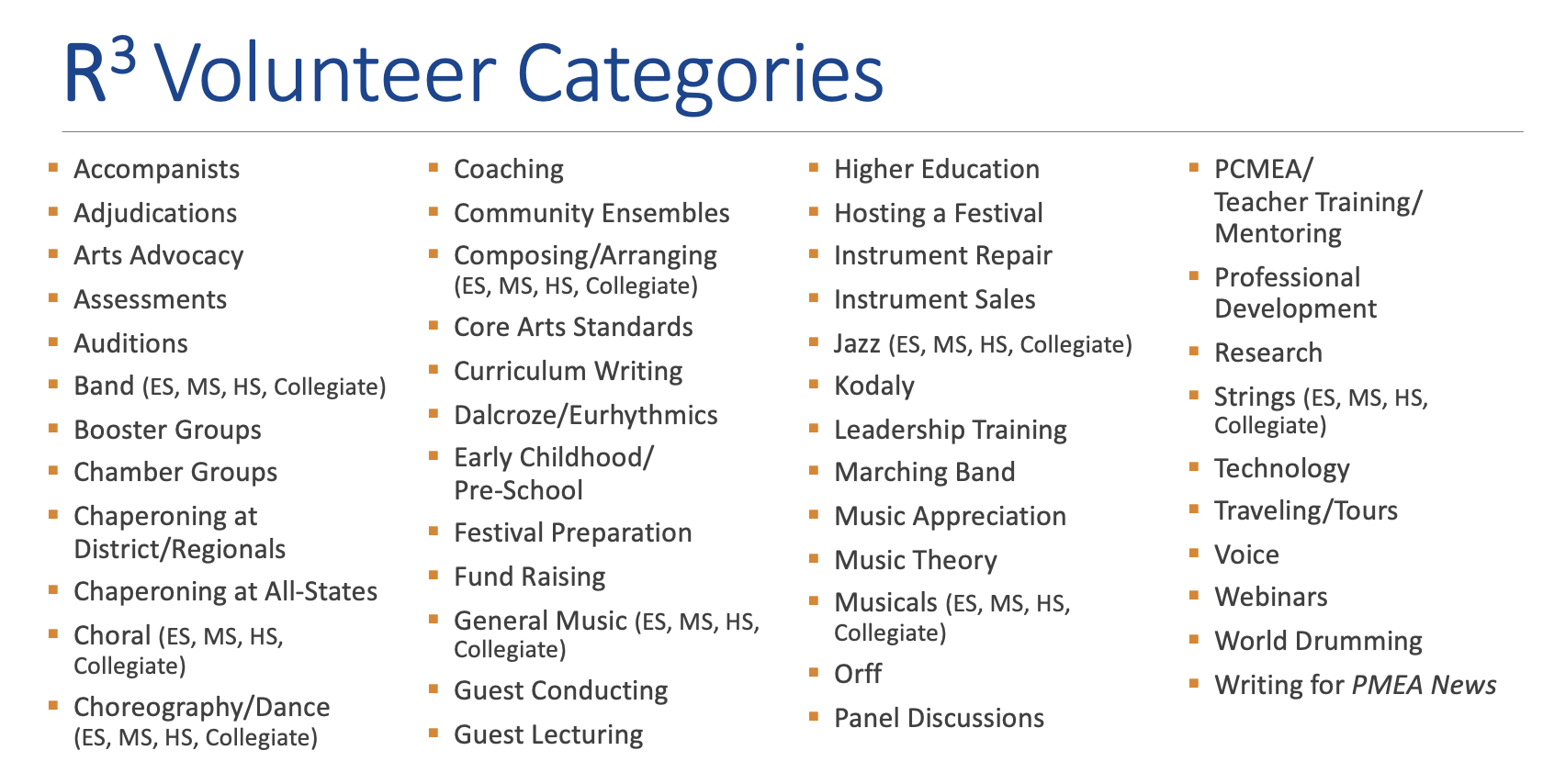
As of October 1, 2025, there are 61 advisors in the PMEA Retired Resource Registry.

*During their annual membership registration, PMEA Retired Members may choose to sign-up for the R3 Retired Member Registry (above volunteer categories) to become available to informally offer advice to college music education majors, new hires, transfers, and newcomers to any music specialty. R3 members may handle inquiries like “What warm-up would you recommend for my middle school choir?” OR “Do you have an idea for an elementary string ensemble concert opener?” OR “How do you teach improvisation… steady beat… breath support?”

The other option with more time commitment is that Retired Members can be officially “trained” as a PMEA Mentor and be assigned to specific individuals who request assistance in their early career assignments.

Coda

How can we help?

What is the future of retired music educator professional engagement? In a word: connections!

Last month, I reached out to Elizabeth Welsh Lasko, NAfME Assistant Executive Director for Membership, Organizational Development, and Marketing Communications and “volunteered” OUR assistance. I suggested that, in keeping with the NAfME 2022 Vision Statement “…an association where all people are heard, seen, and feel they belong throughout their lifelong experiences in music” we should all intentionally recruit more hands-on involvement of our retirees. I pointed out that in the late 1980s, we had a Music Educators National Conference (MENC) Committee for Retired Members led by a National Chairman who served on the NAfME National Assembly. (An excellent booklet, TIPS: Retirement for Music Educators, Copyright © 1989 MENC, was compiled by A. Verne Wilson, then the Past National Chairman of the MENC Committee for Retired Music Educators.)

Ms. Lasko encouraged me to “reach out to retirees” beginning with this article. At the next NAfME Eastern Division Conference, I plan to hold a meeting of retired members, and also connect with all state MEA retired member coordinators (those states who have them). We’re available and on the move! Let’s collaborate and share our resources!
Finally, just for fun, I recently posted the blog “For Book Lovers – Retired or Not” on NAfME Connections (formerly called Amplify). There are already 1,810 members in the NAfME “Retired Members Community.” Please JOIN US! Using this forum, get in touch with me, and respond with YOUR OWN retirement stories, strategies, perspectives on this “life passage,” and more ideas to grow the professional engagement of our music teacher retirees.

Happy trails!

© 2025 Paul K. Fox

Teachers – Take Charge of Your Wellness

The Five C’s of Self-Care

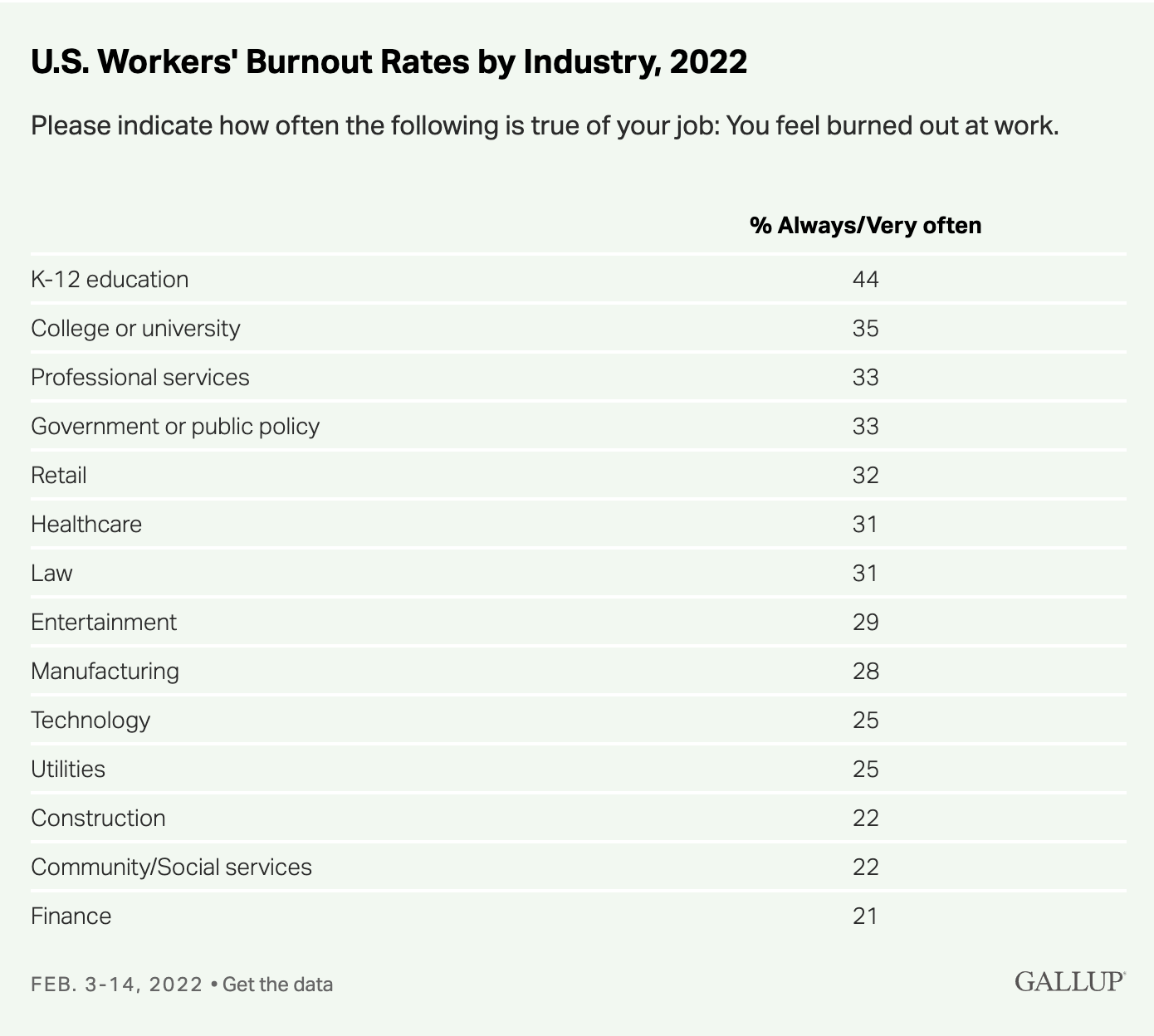
What profession has the highest rates of stress and burnout?

The answer is… educators of grades K to 12. NO FOOLIN’ ⏤ yes, even though today is April Fool’s Day!

The Crisis

Citing a 2022 Gallup Poll at Purdue Global’s website here, “K-12 teachers are the most burned out profession in the U.S.” They go on to say:

In fact, teachers have higher-than-average stress levels compared to other client-facing professionals. This kind of stress can lead to physical and mental health concerns for teachers and negatively affect students’ well-being and achievement.

“Being an educator requires so much of us,” says Carol Laman, faculty member at Purdue Global. “It is emotionally, physically, and mentally demanding.”

Self-care practices can help. According to the National Comprehensive Center, self-care can aid educators in both improving their overall wellness and being more effective for their students. ⏤ https://www.purdueglobal.edu/blog/education/self-care-for-educators-guide/

According to the National Education Association, we have a MAJOR problem!

A study by the advocacy group, Alliance for Excellent Education, reports that 40-50% of new teachers leave within their first five years on the job. Many factors contribute to the high dropout rate, a severe lack of work-life balance and the inevitable high stress levels teachers feel on the job, to name a few. Because of this, self-care is extremely important for teachers. However, it’s hard for teachers to take care of themselves when their career is taking care of students. ⏤ https://www.nea.org/professional-excellence/student-engagement/tools-tips/importance-self-care-teacher

This statistics are overwhelming, as documented in the Teacher Wellbeing Survey by Panorama Education.

Teacher wellness has a significant impact on school climate and student learning. Yet teacher stress and burnout continue to present retention and turnover challenges in districts: 85 percent of teachers have reported that work-life imbalance affects their ability to teach. More than one in five new teachers leave the profession within their first five years of teaching—and this attrition is substantially worse in high-poverty schools. ⏤ https://www.panoramaed.com/products/surveys/teacher-well-being-survey

The Concern – What is “Self-Care?”

The online Oxford dictionary defines “self-care” as “the practice of taking action to preserve or improve one’s own health,” or “the practice of taking an active role in protecting one’s own well-being and happiness, in particular during periods of stress.”

The National Institute of Mental Health (NIMH) provides even more clarification:

Self-care means taking the time to do things that help you live well and improve both your physical health and mental health. This can help you manage stress, lower your risk of illness, and increase your energy. Even small acts of self-care in your daily life can have a big impact.
https://www.nimh.nih.gov/health/topics/caring-for-your-mental-health.

The National Wellness Institute (NWI) further defines wellness as a “conscious, self-directed, and evolving process of achieving one’s full potential… [It] is positive, affirming, and contributes to living a long and healthy life.” NWI addresses six dimensions of wellness, the combination of which “enables us to thrive amidst [life’s] challenges.”

  • Emotional
  • Physical
  • Intellectual
  • Occupational
  • Spiritual
  • Social

In our profession, the defining concerns also involve other major “C’s” within the school workplace – climate and culture – and that “actions speak louder than words!” Edutopia dove into this topic in their blog, “Leaders Must Address Teacher Well-Being With Action, Not Just Self-Care Talk” here.

By listening to educators and building supports that reflect their genuine needs and concerns, these leaders are shifting school cultures in ways that go beyond lip service.
https://www.edutopia.org/article/leaders-teacher-wellbeing-action

The Causes

That leads us to THE WHY – why is this such a crisis?

In my educator self-care workshops (e.g., this example), I bring up the research of Paul Murphy from his book Exhausted – Why Teachers Are So Tired and What They Can Do About It. Consider his litany of possible culprits that may cause burnout in some teachers:

  • Lack of autonomy
  • Dysfunctional work environment
  • Inadequate social support
  • Extremes of activity
  • Poor work/life balance

Another excellent read on the subject is Demoralized – Why Teachers Leave the Profession They Love and How They Can Stay. Author Doris Santoro takes a closer look at these issues:

  • Teachers feel frustrated from accomplishing good work that benefits students, communities, and the profession.
  • Problem is external and does not indicate a “weakness” or lie within the individual teachers themselves.
  • Dissatisfaction in education is due to moral and ethical conflicts.

Only by addressing the moral sources of teacher’s anguish might we stem the tide of teacher exodus. ⏤ “The Problem with Stories About Teacher Burnout” by Doris Santoro in Kappan December 2019/January 2020

What are the symptoms of “burnout?” From the Mayo Clinic and other sources, we learn the following. Do you display any of these on a regular basis?

  • Disillusionment over the job
  • Cynicism at work
  • Impatience with co-workers, administrators, and students
  • Lack of satisfaction in accomplishments
  • Dragging themselves to work and trouble getting started once they’re there
  • Lack of energy
  • Unexplained aches/pains 
  • Self-medicating with food, drugs, or alcohol
  • Changes in sleep/eating patterns

Are these striking close to home? If you said, “Yes, that’s me!” more than a couple times, it is time to seek help. Please consider this a “wake-up call” to visit your health care professional.

The Courses-of-Action

If you Google search “teacher self-care” in your browser, the following comes up from the (experimental?) Google-generative AI Overview, otherwise a good starting point summarizing possible solutions for stress remediation and improving over teacher mental health.

Key Self-Care Strategies for Teachers

Paul Murphy added these “remedies” for improving teacher time management, promoting better work/personal life balance, and de-stressing:

  • Work less/fewer hours
  • Realize that time before school is worth more than twice as much as time after school (so plan accordingly)
  • Use class time to check work
  • Leverage technology
  • Don’t grade everything
  • Stop assigning things

The Courage to Change!

The bottom line – We are our own worst enemies!

Our negative thoughts, self-doubt, and destructive behaviors often hinder our own progress and happiness, making us our own biggest obstacles. ⏤ Google Generative AI and other sources including https://lorimilner.medium.com/the-art-of-being-your-own-worst-enemy-c393e9032d27, https://markmanson.net/when-you-are-your-own-worst-enemy, and https://letherspeakusa.org/why-are-we-our-own-worst-enemies/.

The research suggests that many “bad habits” may disrupt our ability to take care of ourselves and seek change, such as these:

  • Self-Sabotage
  • Negative Self-Talk
  • Lack of Self-Compassion

My insightful Washington-state music teaching colleague Lesley Moffat has written an excellent book, I Love My Job But It’s Killing Me – The Teacher’s Guide to Conquering Chronic Stress and Sickness, and in my opinion, she hits the nail squarely on the head embracing Shakespeare’s “to thine own self be true” in a renewed motivation on self-help:

You must take care of yourself first. This is the hardest lesson of all, yet it is so important. Chances are you got where you are because you ran yourself ragged taking care of other people’s needs. I bet you never said no to requests to be on one more committee, drive carpool, watch a friend’s kids, and every other favor someone made of you, yet I’d also bet there’s a good chance you never take the time to take care of your own needs. When was the last time you read a book for fun? Or went to a movie you wanted to see? Or pursued a creative endeavor that made you happy? Or any one of a million things you want to do? I bet it’s been a long time. ⏤ Lesley Moffat   

It is time to take the plunge towards better personal health, wellness, and balance in your life. There are plenty of resources out there for you to peruse, but don’t just sit there and read them! DO THEM!

Get started today!

PKF

© 2025 Paul K. Fox

Retirement Transitioning Advice from AI?

Season Greetings and Happy New Year from your Pennsylvania Music Educators Association State Retired Member Coordinator. Best wishes for a happy, healthy, and prosperous 2025!

First, on Christmas Eve, here are a few announcements geared to PA music educators… those who have retired from full-time teaching and anyone considering retirement over the next one to five years.

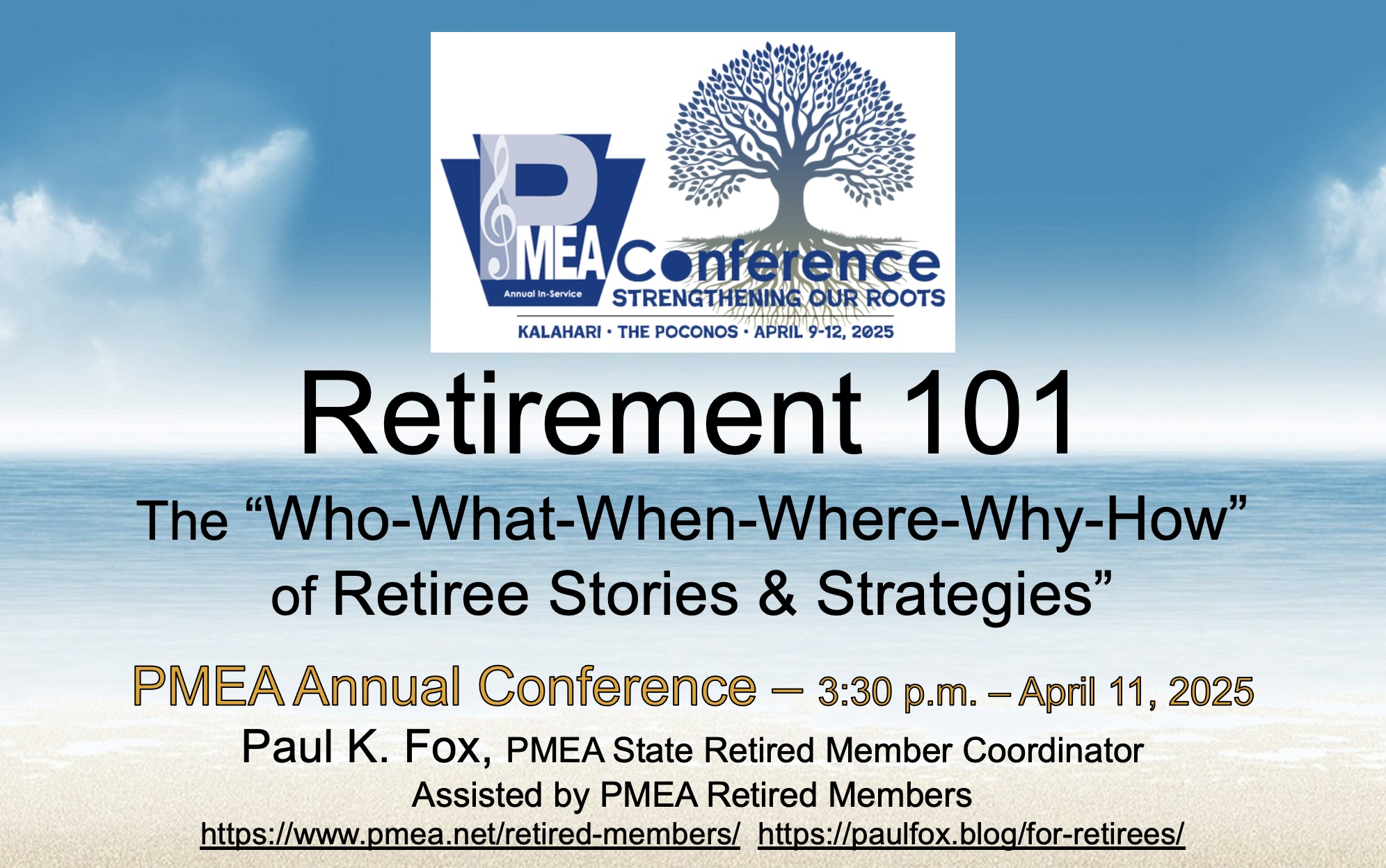
Back by popular demand (or is that just ego and in my head?), we will offer the session “Retirement 101 – the Who, What, When, Where, Why and How of Retiree Stories & Strategies” on Friday, April 11, 2025 (3:30 p.m.) during the PMEA Annual Conference at the Kalahari Resort in the Poconos. A guest panel of PMEA Retired Members will assist and offer their advice answering key questions like the following:

  1. How have you found happiness and success in retirement?
  2. What “new” hobbies, volunteer projects, trips, family connections, and encore careers have you been exploring?
  3. What did you do to reinvent yourself and how did you satisfy those essential “big three” goals of post-full-time employment: finding purpose, structure, and community?
  4. How did you navigate the early phases of retirement? imagination, anticipation, liberation, etc.
  5. What were some of the transitional “ups and downs” you experienced and how did you cope with them?
  6. What are you still doing in music and education?

We are looking for more PMEA retiree volunteers who are planning to attend the conference to join “expert panelists” Rick Coulter, Jeffrey Dent, Dan Klingbeil, Chuck Neidhardt, Louise Victor, and Rich Victor. (Just email me if you’re interested.)

Retired Members are a valuable resource to PMEA. Many of us already serve on PMEA Councils and in District or State official positions. All of us in the profession benefit from the sharing of their extensive “boots-on-the-ground” experiences and wisdom. At the upcoming conference, Retired Members can serve as Presiding Chairs and introduce a session/concert or two. In addition, plans are also underway to sponsor (possibly on Thursday, April 9) a “coffee & conversation” corner or an “ask the expert” lounge. Spaces and the schedule are packed, but if it is possible, Executive Director Abi Young is trying to fit in an informal sitting area with retirees and mentors as “friendly folks” to serve as “gurus” for PCMEA members, newcomers to a music education specialty, or recent transfers to the field. Won’t you join us?

A longstanding tradition, we will be treated to a PMEA Retired Member Breakfast on Friday morning. (Just check the box on the registration form if you are coming… and, by the way, the conference fee is only $20 for Retired Members! What a deal!)

Why Attend the PMEA Annual Conference?

“For some of us, it’s a just chance to catch-up with our colleagues, see our friends, and socialize. Others are more focused and take advantage of the near-perfect opportunity to network with other professionals, perhaps seeking new working relationships, partnerships, or even employment. Many are on a look-out for newly published music, that perfect music lesson or teaching strategy, technology tools, fund-raisers, advance educational venues, or much-needed equipment to purchase for our ensembles or classrooms. Most come to hear/see the “state of the art” in music education – concerts, demonstrations, keynote speeches, panel discussions, exhibits, research presentations, and workshops. PMEA’s PD Council would likely submit that the primary purpose of a conference is for professional self-improvement… What did Stephen Covey call it? His Habit #7 of “sharpening the saw” – to build a balanced program of self-renewal in the four areas of your life: physical, social/emotional, mental, and spiritual. Covey would insist we embrace “the process that empowers us to move on an upward spiral of growth and change, of continuous improvement.” So, in short, conferences help us “grow” – to revive, re-inspire, re-energize, rejuvenate, re-direct, and re-motivate all of us – pre-service, active in-service, and retired teachers towards making successful new connections, updating our knowledge & skills, and forming new goals.”  – PMEA Retired Member Network eNEWS Winter 2024

In addition, Kalahari Resort boasts “the world’s largest indoor water park,” the perfect place to bring family members to enjoy… especially (grand)children, (grand)nieces/nephews, etc.

Next month’s retirement blog by guest author Sierra Powell

One final announcement: In several weeks at this blog-site, we plan to feature a new guest blog entitled “Five Things You Need for a Comfortable Retirement” by Sierra Powell, along with updates of other resources for “living the dream!” See you next year?

OK, What is that “AI Thing?”

This 69-year old educator who has spent more than five decades in fostering creative self-expression in his students is fervently opposed to artificial intelligence. Actually, I thought I was allergic to “AI!” Every time I receive an Apple iPhone update or some new download for my computer, I complain, “Why have they moved that button? It doesn’t look or work the same! Why does everything have to change every month?” Slow down, techies!

However, to dabble in this new technology everyone’s talking about, I printed in my last PMEA Retired Member Network eNEWS on page one a sample article (click here for the Winter issue) compiled by AI Overview (Google). I shared this with an adult violin student from my Saturday orchestra who decided to show me the power of AI (not the old AI I am more familiar with – artistic intelligence!). She used her subscription to a ChatGPT to process my brief outline on the topic “retirement transitioning.” Below is the result generated from a few of my random notes. Created in the first person, AI matched my writing style, a chatty/informal letter printed for soon-to-retire colleagues along with research citations. Frankly, it scares me how close this sounds like something I could have composed! Can you tell it was artificially generated? Does this mean we will we have to teach this old dog (fox) new tricks?

Check out these valuable retirement hints courtesy of ChatGPT!

The Retiree Life: Navigating the Art of Reinvention & Emotional Balance

Here with some reflections, tips, and maybe even a little nudge for us all as we continue this grand adventure called retirement. Whether you’re still finding your rhythm or already feel like a pro at this, there’s always room to reflect, grow, and laugh along the way.

This week, let’s talk about something near and dear to every retiree’s journey: reinventing yourself and coping with the emotional ups and downs that come with this new chapter.

Reinventing Yourself: A Second Act Worth Applauding

Remember when we taught our students to embrace creativity and adapt to change? Turns out, retirement demands the same skills. It’s no longer just about what you did—it’s about who you are.

Reinvention isn’t about completely overhauling your identity. Think of it as expanding your repertoire. Studies show that retirees who actively pursue new interests or roles report higher life satisfaction (Wang et al., 2011). Whether it’s picking up the instrument you haven’t touched in decades, volunteering, traveling, or even starting a small business, the key is to stay engaged.

Here’s a thought experiment: What did you always wish you had time to do but never could because of lesson planning, rehearsals, or concerts? Now’s your chance. I’ve recently heard about retirees dabbling in everything from watercolor painting to writing mystery novels. One retiree even became a beekeeper—talk about a sweet second act!

(From past blogs, the Retirement 101 session, and Retired Member Network eNEWS reviews)

The Emotional Journey: Ups, Downs, and Everything in Between

Let’s not sugarcoat it: retirement is a mixed bag. There’s the freedom (hooray!), but also the occasional pang of loss—of identity, routine, or the camaraderie we had in our teaching careers.

The good news? You’re not alone. Research by Pinquart and Schindler (2007) highlights how important it is to acknowledge these feelings rather than sweep them under the rug. Adjusting to retirement is a process, and it’s okay to feel a little off-balance at times.

Here are a few tried-and-true strategies to help you navigate the emotional terrain:

  • Stay Connected: Loneliness can creep in when you least expect it. Keep up with PMEA activities, or start a retirees’ coffee group. Who better to laugh with about the time your marching band got rained out?
  • Practice Mindfulness: Before you roll your eyes, hear me out! Even just five minutes of quiet reflection a day can reduce stress and boost mood (Chopra et al., 2020).
  • Find Meaning: Volunteering or mentoring can give you a sense of purpose that’s deeply fulfilling. You’ve got a wealth of wisdom—share it!

AI of the future?

The Bottom Line

Retirement isn’t a destination; it’s a journey. And like any good road trip, it comes with unexpected detours, scenic overlooks, and, yes, the occasional pothole. The trick is to embrace it all with curiosity and a sense of humor.

If you’re struggling, remember: reinventing yourself doesn’t happen overnight. Take it one day at a time, and don’t be afraid to reach out for support—whether it’s from family, friends, or your fellow PMEA retirees.

Let’s keep the conversation going. What’s your “second act”? Have you discovered a new hobby or way to cope with the emotional shifts of retirement? Shoot me an email or share your story at our next meeting. Together, we’ll continue to learn, grow, and make this chapter one to remember.

Until next time, keep smiling and stay curious!

References:

Wang, M., Henkens, K., & van Solinge, H. (2011). Retirement adjustment: A review of theoretical and empirical advancements. American Psychologist, 66(3), 204–213.

Pinquart, M., & Schindler, I. (2007). Changes of life satisfaction in the transition to retirement: A latent-class approach. Psychology and Aging, 22(3), 442–455.

Chopra, A., Anthonisen, S., & Reeves, A. (2020). The role of mindfulness in retirement satisfaction. Mindfulness in Aging Journal, 7(4), 312–320.

PKF

© 2024 Paul K. Fox

Music and Literacy Skills

How to Use One to Improve the Other

Editor’s Note: For this month’s blog, we bring back guest writer Ed Carter, a retired financial planner. (See his website here.) His piece, perfect for new music parents, summarizes many of the “intangibles” that music education provides to foster child development, especially the enhancement of language skills. In 2019, I wrote the blog “The Importance of Music Education” (click here) based on an interview I did for a local community news program on the essentiality of teaching music that covered many of these concepts. Special thanks go to Ed Carter for sharing his research and perspective. 

Parents and educators are always looking for ways to improve their children’s learning –
especially when it comes to reading. Sometimes, though, unconventional approaches can work wonders. Experts believe the best way to boost a student’s reading is actually to expand their knowledge and vocabulary by teaching them history, science, literature and the arts.

Understanding the Connection

Children who learn to play an instrument or who join a choir have a longer attention span and better listening skills. Music stimulates the brain in so many ways. In fact, playing music may help the human brain more than any other activity. Some researchers even suggest that musical training can alter the nervous system in a way that improves learning in a way that offsets the academic gap between affluent students and students from lower income backgrounds.

Music improves language skills in particular because there is a neurological connection between maintaining rhythm and reading. Scientific American notes that when children learn how to keep a beat, they are better able to concentrate on a passage and decipher the meanings behind the words. A child’s reading ability relies on making a connection between the symbols they see on the page and the sounds of letters.

The Best Age for Music Lessons?

There is no such thing as a kid being too young for music. Many parents even expose their child to melody and rhythm before they are even born in an attempt to stimulate brain activity. Drumming is a great place to start. It is more important they gain experience with music and learn to develop a meaningful relationship with it at a young age. Children as young as 3 can develop skills like identifying a beat, melody and instruments in music.

By the age of 5, your child may be ready for formal lessons with beginner instruments such as drums, the piano, violin, recorder, guitar or ukulele. If your 5-year-old is not ready to start formal lessons with an instrument, they can still develop their musical skills online. Invest in a kid-friendly laptop and some durable headphones that allow them to interact with online music programs and apps that develop skills that can translate to playing an instrument in time.

To exhibit your genuine interest in your kid’s growing skills, consider creating a music room for them to be able to learn and hone their craft. This dedicated space is a perfect place for distraction-free lessons. It’s a good idea to soundproof the room, too, so others in the home aren’t disturbed. Having a bonus room that can act as a multipurpose room can increase your home’s appraisal value should you decide to sell anytime soon, as such upgrades are what many buyers look for.

Music Mistakes to Avoid

While some children pick up an instrument like a fish to water, all children develop differently. If you push your child into music lessons too early, they can become overwhelmed. Not progressing in their skill can hurt their self-esteem and discourage their progress. Let your child ease into their musical lessons gradually with time.

You can’t just throw money at a music tutor and expect that to be enough. If you want your child to grow in their skills, sit with them as they practice each day. Consistent practice is more effective than long lessons and your presence provides discipline and encouragement.

There is going to be a moment where your child expresses a desire to quit their instrument. Instead of letting them give everything up too soon, always talk with your child about why they feel like quitting and adjust their lesson goals to make playing music fun again rather than a chore. Encouraging your child to stick with it rather than quit teaches your child how important perseverance is in life.

Children all over the country struggle with reading. Adding music lessons to your child’s schooling can help improve their language skills and reading comprehension. There’s no exact age for starting music lessons, but incorporating music into other activities is a great way to start introducing them to rhythm and melody. As they grow up, involve yourself in your child’s learning and measure progress by the goals they reach and the amount of fun they have.

PKF

© 2022 Paul K. Fox

Photo credits:

Burned Out or Bummed Out?

More on Teacher Self-Care: Diagnosis and Remediation

This is Part VI in a series of articles on educator health and wellness, following “Stressed Out!” and “Teacher Self-Care During the Pandemic.”

burnout-90345_1920_geralt

Do you recognize these signs of burnout experienced  by yourself, a coworker, neighbor, or someone you love?

  • Physical: tired, lowered immunity, illnesses, aches and pains, loss of appetite or sleep
  • Emotional: sense of self-doubt, failure, helplessness, loneliness, cynicism, loss of satisfaction/motivation
  • Behavioral: withdrawal, isolation, skipping work, procrastination, frustration, overuse of food, drugs, alcohol

By the time it gets to that third bullet, probably everyone would be aware of the trouble.

You may be on the road to burnout if:

  • Every day is a bad day.
  • Caring about your work or home life seems like a total waste of energy.
  • You’re exhausted all the time.
  • The majority of your day is spent on tasks you find either mind-numbingly dull or overwhelming.
  • You feel like nothing you do makes a difference or is appreciated.

Burnout Prevention and Recovery by Melinda Smith, M.A., Jeanne Segal, Ph.D., and Lawrence Robinson


star-5031540_1920_geralt

Gregory S. Perkins and Angela M. Guerriero, licensed Music Therapists from the Tempo! Music Therapy Services, provided much more detailed definitions of self-care in a session at the PMEA 2020 Virtual Summer Conference. (PMEA members may continue to register and view a video of this workshop until mid-September 2020.) You should know and be on the lookout for these terms:

The United Nations defines self-care as the actions that individuals take in order to develop, protect, maintain, and improve their own health and well being. Self-care involves a personal investment in maintaining physical, psychological and spiritual health, and pursuing a fulfilling, well-rounded life.

Brownout: “A practitioner essentially gives up or performs in a perfunctory manner when confronted with too much stress and too little gratification.” Guy, J. & Norcross, J. (2007). Leaving it at the office: a guide to psychotherapist self-care. New York, NY: Guilford Publications, Inc.

Burnout: “A syndrome of physical exhaustion including a negative self-concept, negative job attitude, and loss of concern and feelings.” Keidel, G. (2002). Burnout and compassion fatigue among hospice caregivers. American Journal of Hospice and Palliative Care, 19(3), 200-205

Recognizing the Need: Self-Care for Music Educators by Gregory S. Perkins, MT-BC, and Angela M. Guerriero, PhD, MT-BC

The Mayo Clinic offers numerous symptoms of “burnout.” How many of these have you “felt” too or noticed in someone else’s demeanor or behavior?

  1. Disillusionment over the job
  2. Cynicism at work
  3. Impatience with co-workers, administrators, and students
  4. Lack of satisfaction in accomplishments
  5. Dragging yourself to work and trouble getting started once you’re there
  6. Lack of energy
  7. Unexplained aches/pains
  8. Self-medicating with food, drugs, or alcohol
  9. Changes in sleep/eating patterns


despair-1235582_1920_geralt

Education Week adds many more danger signs. Are any of these striking close to home?

Exhaustion. This is a fatigue so deep that there’s no way to “turn it off,” no matter how badly you want to. It’s deep in your bones. The kind of tired where you just want to ooze into your bed and disconnect from life.

Extreme graveness. Realizing you go hours without smiling or laughing, or days without a belly laugh.

Anxiety. The constant, nagging feeling that you can and should do more, while simultaneously realizing you need to unplug and spend more time with your family. But there are so many things to do.

Being overwhelmed. Questioning how they can possibly add one more task, expectation, or mandate to your plate. Compromising your values of excellence just so you can check-off 15 more boxes to stay in compliance. All the while knowing it still won’t be enough.

Seeking. Losing your creativity, imagination, patience, and enthusiasm for daily challenges. Craving reflection time and productive collaboration rather than group complaining.

Isolation. Wanting to head for the deepest, darkest cave where no one will see your vulnerability. A place where your limits are unseen and unquestioned and all is quiet.

— Six Signs of and Solutions for Teacher Burnout by Wendi Pillars 


autonomy-298474_1920_geralt

What about the causes of burnout or brownout? Where should we place the blame?

According to Paul Murphy in his book, Exhausted – Why Teachers Are So Tired and What They Can Do About It, the stress of a few problems may stand out as leading culprits at your place of employment:

  1. Lack of autonomy
  2. Dysfunctional work environment
  3. Inadequate social support
  4. Extremes of activity
  5. Poor work/life balance

But, you have no one else but yourself to blame! You must take responsibility for your own health and welfare. Most of the sources in this blog-post (including a few mentioned in past articles from this “care” category) suggest solutions to better self-care, many of which offer answers to address the issue and CAN BE DONE RIGHT NOW.

Here are a few more self-care tips from PsychCentral:

  • Create a “no” list, with things you know you don’t like or you no longer want to do. Examples might include: Not checking emails at night, not attending gatherings you don’t like, not answering your phone during lunch/dinner.
  • Promote a nutritious, healthy diet.
  • Get enough sleep. Adults usually need 7-8 hours of sleep each night.
  • Exercise. In contrast to what many people think, exercise is as good for our emotional health as it is for our physical health. It increases serotonin levels, leading to improved mood and energy. In line with the self-care conditions, what’s important is that you choose a form of exercise that you like!
  • Follow-up with medical care. It is not unusual to put off checkups or visits to the doctor.
  • Use relaxation exercises and/or practice meditation. You can do these exercises at any time of the day.
  • Spend enough time with your loved ones.
  • Do at least one relaxing activity every day, whether it’s taking a walk or spending 30 minutes unwinding.
  • Do at least one pleasurable activity every day; from going to the cinema, to cooking or meeting with friends.
  • Look for opportunities to laugh!

What Self-Care Is and What It Isn’t by Raphailia Michael, MA


successful-2668386_1920_geralt

We should also review “Five Tips for Avoiding Teacher Burnout” by Mary Beth Hertz, an Edutopia blog (read the entire article for greater depth and clarity):

  1. Maintain your “other” life.
  2. Be a stakeholder when changes are made.
  3. Find lessons and opportunities in everything.
  4. Nurture peer connections.
  5. Keep it light.

Edutopia, from the George Lucas Educational Foundation, is a wonderful resource. Most recently, three valuable “streams” of articles have been released on coping with the preparations and stress in the reopening of schools for the 2020-2021 year:

I also recommend this blog-post of the Regional Education Laboratory Program which describes “teacher well being” as “the reaction to the individual and collective physical, environmental, and social events that shape how educators respond to their students and colleagues.” They discuss how three prominent human behavior frameworks— Maslow’s Hierarchy of Needs, the Five Stages of Grief and Loss, and the Concerns-Based Adoption Model (CBAM)— can be used to address the challenges that teachers face when adapting to change and identify approaches to support teacher well being.


help-4955863_1920_geralt

In addition, the following perspectives come from a variety of self-proclaimed practitioners:

“One of Leonardo da Vinci’s seven essential elements of genius is known as Sfumato, Italian for ‘smoked,’ or ‘going up in smoke.’ This principle is the ability to embrace uncertainty, the unknown, and the unknowable. In my interpretation, it’s also an ability to ‘let go’ of everything that’s left undone when you know you’ve done your best. Embrace Sfumato.”  — Wendy Pillars

“Self-care needs to be something you actively plan, rather than something that just happens. It is an active choice and you must treat it as such.” — Raphailia Michael

“Remember that example about putting on your own oxygen mask before helping others? This is where that analogy really comes in to play. It’s time for you to take a good hard look at your self-care versus your care for others and decide if you are in a place where you have a good balance or if you need to make this a priority… Why is self-care… such a critical component of your physical and mental health? Because in order for you to function at your peak, you need to meet the needs your body and mind have for rejuvenation, relaxation, and rebirth. If you are constantly putting out efforts toward other people and events but never taking time to refuel yourself, then you will run out of steam and it will manifest in your body as an illness, weight gain, acne, joint pain – you know the drill – again.” — Lesley Moffat in I Love My Job But It’s Killing Me

“It’s estimated that teachers make about 1,500 decisions every school day. When you combine those decisions with all the necessary self-regulation involved with teaching kids, it’s no wonder our willpower is gone by five o’clock. We are exhausted.” — Paul Murphy

The term “unprecedented times” has become a hallmark for describing the context in which leaders must respond to changing needs during the COVID-19 pandemic. Effective responses in education are dependent upon teachers as the front-line workers in classrooms, so it’s essential that administrators take care of teachers. When they do so, they also take care of students.

When teachers don’t have the resources they need, and especially when sustained job demands are high, teachers experience chronic stress — and eventually burnout.

Teachers who are burned out are less effective as teachers, have less supportive relationships with students and, in turn, the students they teach have lower academic and social outcomes.

How to Prevent Teacher Burnout During the Coronavirus Pandemic by Laura Sokal, Jeff Babb, and Leslie Eblie Trudel


man-4957154_1920_geralt

We should all read the above blog-post from The Conversation, which offers these conclusions based on a national Canadian education survey conducted in May 2020:

  1. Teachers’ concern for vulnerable students is one of the most stressful aspects of their jobs right now.
  2. Teachers are seeing magnified inequities.
  3. When giving teachers initial resources, less is more.
  4. Perceived support matters to teachers’ resiliency.
  5. Teachers are concerned about effectively engaging students through remote learning, and professional collaboration can help.

Finally, we’ll end this epistle on “things to do to avoid burnout” with a timely and practical article from Carlee Adams found on the We Are Teachers site: 15 Smart Ways to Prevent Teacher Burnout That Really Work. Repeating many of the suggestions above, these “find these” remedies resonated with me:

  • “Find someone you can be vulnerable with…”
  • “When you feel hopeless, find perspective…”
  • “Find your own voice and allow it to change over time…”
  • “Find your people; they get you!”

The bottom line? If you “feel” consistent periods of burnout, brownout, or being bummed out in your career as negative influences to your “calling” as a teacher, you cannot sit back and let things continue “as is!” Most professionals cannot self-diagnose this problem (but, perhaps a family member may clue you in!). If you notice that you are continually having trouble sleeping, difficulty with relationships or communicating your thoughts to others, or find yourself feeling significantly depressed or lethargic, it may be time to visit your health care professional.

PKF


Photo credits (in order) from Pixabay.com by Gerd Altmann


© 2020 Paul K. Fox