More Sources to Prep You to Make a Good Impression at Employment Screenings
If you have been closely following this section of the https://paulkfoxusc.wordpress.com blog-site on “Marketing Professionalism,” you have consumed a lot of advice on numerous topics for preparing for the job search, developing your personal brand, and especially “conquering” employment interviews, such as:
 This article’s focus will be on the seemingly intangible… “body language!” Many say that during the interview, first impressions are critical — “the first ten seconds will create the interviewer’s first judgments about you, and then after four minutes, it’s all over.” The research also suggests that during the interview, the evaluation of your merit is based 7% on what you say, 38% on your voice or how you say it, and 55% on our facial expressions and non-verbal cues.
A good starting point to the introduction of “nonverbal communication” was posted by Jonathan Burston in his Interview Expert Academy website: http://www.interviewexpertacademy.com/body-language-the-3c-triangle/:
Using a triangle to symbolize his concepts, the “3Cs of Body Language” are:
- Context of the situation/environment you are in… with friends (relaxed) or the boss (more stressed)
- Clusters or groups of body language signals that you give off unconsciously
- Congruence or links between what the person is saying, the tone of their voice, and the signals their body is giving off
He summarizes, “The 3C Triangle will help you understand the core parts of reading body language. Next time you’re with someone, either a friend, family member, work colleague or an interviewer, remember to use the 3C’s. Keep practicing.”
Probably one of the most unique presentations on this subject is a TED talk filmed in 2012: “Your Body Language Shapes Who You Are” by Amy Cuddy. Check out the transcript at http://www.ted.com/talks/amy_cuddy_your_body_language_shapes_who_you_are/transcript?language=en.
“Social psychologist Amy Cuddy shows how “power posing” — standing in a posture of confidence, even when we don’t feel confident — can affect testosterone and cortisol levels in the brain, and might even have an impact on our chances for success.”
Although some of her findings referenced in her talk are an ongoing debate among social scientists, Amy Cuddy’s research on body language reveals that we may be able to change other people’s perceptions — and even our own body chemistry — by simply changing body positions.
 Some of Cuddy’s assertions:
- “When we think about nonverbal behavior, or body language — but we call it nonverbals as social scientists – it’s language, so we think about communication. When we think about communication, we think about interactions.”
- “What are nonverbal expressions of power and dominance? …In the animal kingdom, they are about expanding. So you make yourself big, you stretch out, you take up space, you’re basically opening up.”
- “What do we do when we feel powerless? We do exactly the opposite. We close up. We wrap ourselves up. We make ourselves small. We don’t want to bump into the person next to us.”
- “We know that our minds change our bodies, but is it also true that our bodies change our minds? And when I say minds, in the case of the powerful, what am I talking about? …I’m talking about thoughts and feelings and the sort of physiological things that make up our thoughts and feelings, and in my case, that’s hormones.”
- “Powerful people tend to be, not surprisingly, more assertive and more confident, more optimistic. They actually feel they’re going to win even at games of chance. They also tend to be able to think more abstractly…They take more risks.”
- “Tiny tweaks can lead to big changes… Before you go into the next stressful evaluative situation, for two minutes, try doing this, in the elevator, in a bathroom stall, at your desk behind closed doors… Configure your brain to cope the best in that situation. Get your testosterone up. Get your cortisol down. Don’t leave that situation feeling like, oh, I didn’t show them who I am. Leave that situation feeling like, I really feel like I got to say who I am and show who I am.”
From Monster website, a very comprehensive article worth reviewing is “Body Language Can Make or Break a Job Interview” by Robert Ordona at https://www.monster.com/career-advice/article/body-language-can-make-or-break-a-job-interview-hot-jobs. He cites several body language experts. “You could be saying how great you are, but your body could be giving your true feelings away,” says Alison Craig, image consultant and author of Hello Job! How to Psych Up, Suit Up, & Show Up. Mark Bowden, author of Winning Body Language, agrees with Craig – and with the highly regarded Mehrabian communication study, which found that “if what’s coming out of your mouth doesn’t match what your body is saying, your audience is more likely to believe your body.”
Ordona’s blog-post sections provide the “nitty-gritty” of nonverbal communications:
- Your “Great Entrance”
- Showing your “good side”
- First impressions
- Handshakes
- The walk to the interview
- At the interview
- The art of departing
Excerpts from Craig, Bowden, and Ordona’s work, here is a “top-ten list” of body language do’s (green) and don’ts (red):
- Be aware that the interview may start in the parking lot… you never know who may be observing you from a window or standing near you in the hallway. Regardless how you feel (inside yourself), model an attitude of outward calm, purpose, and confidence. This is no time to be frantically searching for your copies of your resume.
- The receptionist or secretary in the office may be informally assessing you (and the administrator may ask their opinion), so let them “observe you without letting on that you know they are watching.” Whenever possible, sit at right angles or offer your profile to them. “It makes them feel comfortable, and if they’re comfortable, they’re more likely to form a good impression.”
- While waiting, sit with good posture, back straight, and your chest open – additional signs you are “confident and assertive.” Don’t hunch your shoulders or tuck your chin into your chest, which may imply you are “closed off.” Don’t try to appear to comfortable or informal, for example “elongating your legs or throwing your arm across the back of the chair,” as it might make you look arrogant.
- If you can tell, try facing the direction from where the interviewer will come; “it’ll make the greeting more graceful.” Also, “don’t have so much stuff on your lap that you’re clumsily moving everything aside when you’re called.”
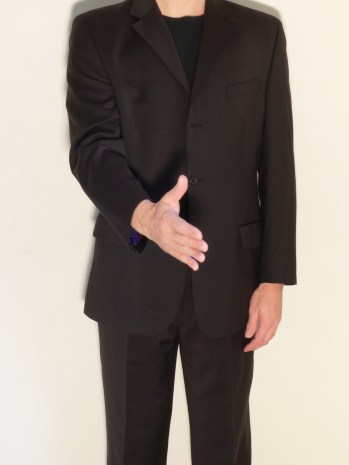 Practice handshaking with a friend before taking interviews. Avoid “the overly aggressive or death grip” as well as “the limp handshake.” Since you are going to shake with your right hand, arrange your belongings on your left side. “Offer your hand with you palm slightly up so that your interviewer’s hand covers yours,” a sign that “you’re giving them status.”
- Even the walk to the interview room is the perfect to time to use good body language: follow the hiring manager or assistant “to show you understand the protocol” (“I follow your lead”), mirroring that person’s tempo and demeanor, showing “you can easily fit into the environment.”
- Once in the interview room, it’s okay to place a slim portfolio on the table, “especially if you’ll be presenting its contents,” but place your other belongings on the floor beside you. “Holding a briefcase or handbag on your lap will make you seem as though you’re trying to create a barrier around yourself.” Again, it is recommended you sit a slight angle to offer your profile, avoiding creating a defensive barrier.
- Sit up straight and display your neck, chest, and stomach area, a signal to the interviewer that you’re open. “Avoid leaning forward, which makes you appear closed off.”
- Sit about a foot away from the table and keep hand gestures at a level above the desk (or slightly lower) and below your collarbone. Your goal is to communicate that “you’re centered, controlled, and calm – and that you want to help.”
- The final advice at the end of interview: “Gather your belongings calmly, rise smoothly, smile, and nod your head. If shaking hands with everyone in the room isn’t convenient, at least shake hands with the hiring manager and the person who brought you to the interview space.”
Another interesting online resource is Forbes, “10 Body Language Interview Mistakes” at http://www.forbes.com/pictures/lml45lide/10-body-language-interview-mistakes-2/#76cf48105767. Eleven slides illustrate suggestions about eye contact, the way you fix your hair, crossing your arms, and other “physical slip-ups in your next interview.”
Finally, Yohana Desta offers “9 Simple Body Language Tips for Your Next Job Interview” on Mashable at http://mashable.com/2014/11/17/body-language-job-interview/#UZoXdE1FEsqB.
“Job interviews are notorious tightrope walks. You want to be confident, but not obnoxious; intelligent but not a know-it-all. Trying to find a balance and also explain why you deserve a job is hard enough. But what if your body language could help you out?” – Yohana Desta
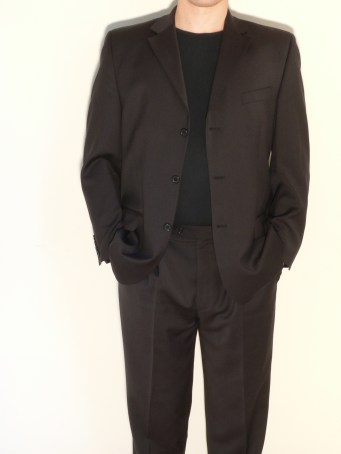 Although “the experts” are not always in consensus, especially on the subjects of eye contact and leaning posture, Desta’s tips summarized below provide additional enlightenment on how to use body language to promote a positive image:
- Sit all the way back in your seat.
- Don’t go for direct eye contact.
- Use hand gestures while speaking.
- Show your palms.
- Plant your feet on the ground.
- Work on your walk.
- Nod your head while listening.
- Lean in.
In a challenging job market with limited openings for public/private school music educators in many geographical areas of the country, there is great competition in the screening and evaluation of the applicants. Hopefully these suggestions from “the experts on body language” will help you better prepare for employment interviews… and land that job you always wanted!
PKF
© 2017 Paul K. Fox
Picture credits: Photographers John Evans and Henk L. at http://www.freeimages.com


 what your image (and “personal brand”) say about you on all the social media platforms?
 Instead, your profile information should reflect integrity and responsibility, so you should expand or add content that:
 Streamline your selfies.
 If you need more than ten suggestions or a lot more detailed instructions based on the specific social media platforms, check out “30 Quick Tips to Spring Clean Your Social Media Presence” by Yvonne Dutchover.

 paulfox.blog