Admins Helping Teachers

This is an introductory blog-post perusing my early research and resources on supporting educator health/wellness in advance to my presentation Self-Care Cookbook 2.0 – Recipes and Resources for School Leaders for the PA Department of Education’s SAS Institute 2025 state conference scheduled for December 8-10, 2025 in Hershey, PA. Here is the summary description for the workshop:
“Do you find the harried pace of our profession overwhelming and at times crushing when buried beneath decades of keeping our noses to the grindstone and putting everyone else’s needs above our own? Do some of your staff members say they are stressed out, constantly tired, plagued by one ailment after another, or wondering how they’re going to “keep up?” If health is interfering with your colleagues’ abilities to do their jobs and find success, balance, and meaning in their lives, then it is time for change. The purpose of this session is to empower school leaders and teachers with skills and attitudes needed to make informed decisions to promote self-improvements in their lifelong health and wellbeing, to LEARN tools for better time management and to help remediate fatigue, stress and burnout, CONNECT and collaborate with your staff to inspire unique strategies for better personal self-care, and ACTIVATE creative new approaches to foster an improved workplace environment.”

Actually, previous articles at this site have dived into this subject of educator stress, burnout, and the development of a health and wellness self-care plan to build resilience, work/life balance, and reignite our motivation and passion for teaching. For a complete overview, I recommend you revisit these:

Always start with “THE WHY”

(Inspired by keynote speaker/author Simon Sinek): Why is this discussion so important now?
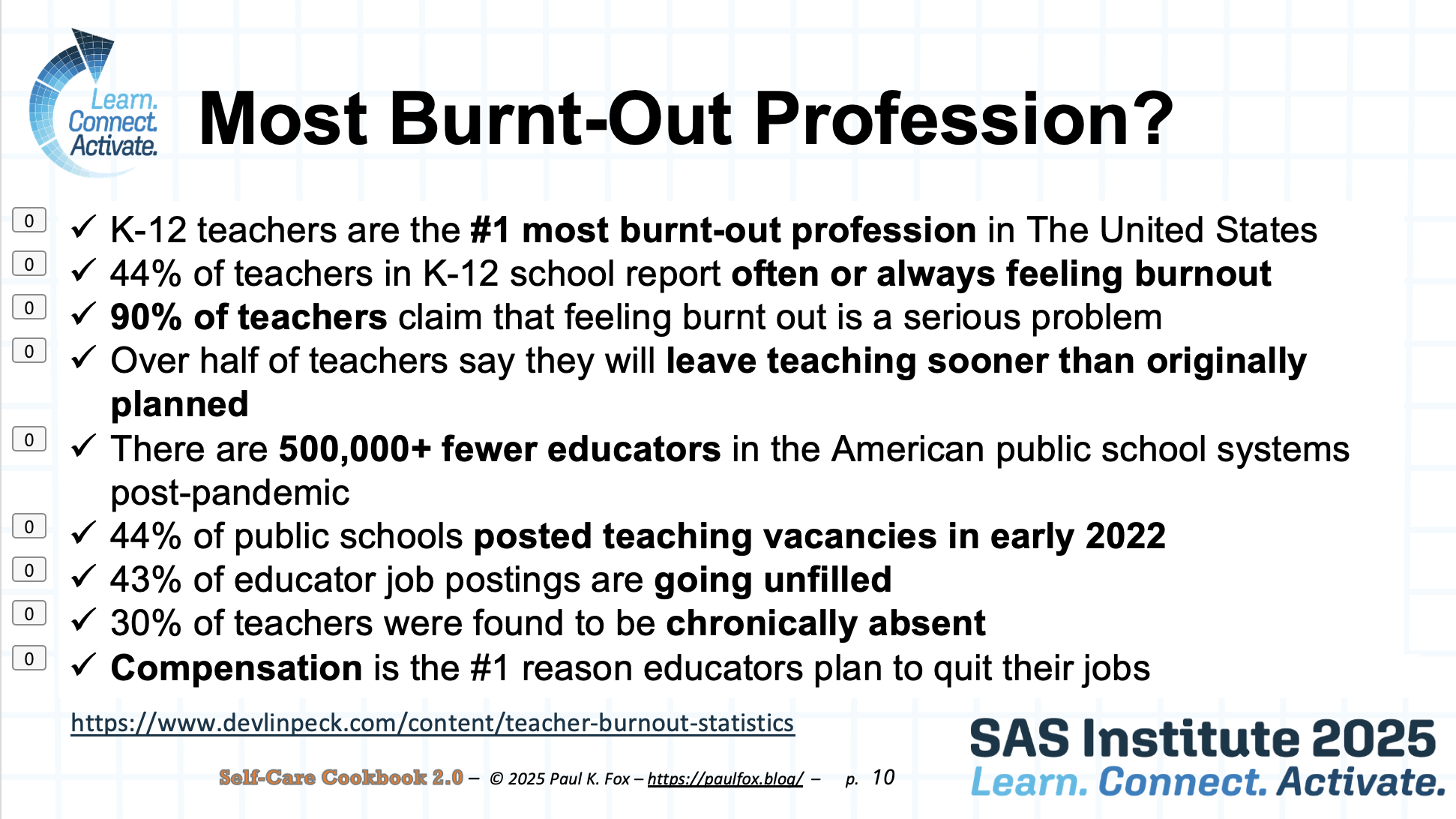
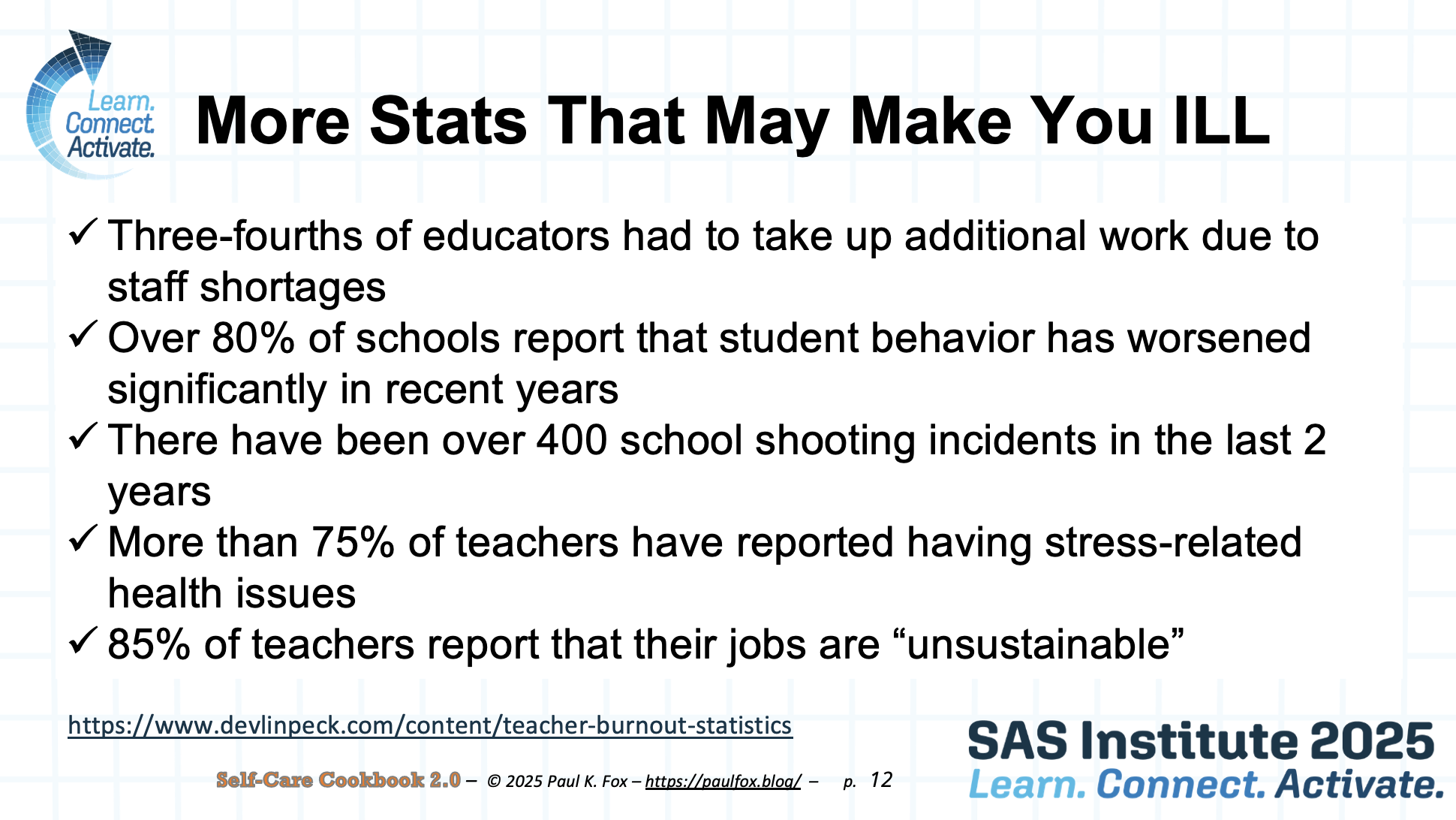
When I mentioned my research to my colleague (and former student) Dr. Timothy Wagner, Principal, Upper St. Clair High School (my former placement for full-time employment), he mentioned that this topic was timely and highly relevant, and suggested that perhaps there might be more statistics and resources “out there” on the stress of health-care workers and first-responders, which I found to be true. However, early looks have shown numerous parallels to the information in my 2023 Self-Care session.

My PDE SAS Institute session will become a “two-for-one” presentation, including the opportunity for school/system leaders, building administrators, and directors of school district professional development to also download my original “Self-Care Cookbook” (1.0) slides, recently updated for the DCMEA Annual State Conference (January 20, 2026). This self-help workshop is geared for educators to “on-their-own” explore strategies, implement use of individualized tools/remedies, and formulate new goals to improve health and wellness. Both sessions hope to cover these key questions:

  • Why is it essential to personal health to achieve balance in our lives, and how can we achieve it?
  • How does dedication to wellness lower the risk of illness, injury, and the quality of a person’s life?
  • What are the consequences of our choices in terms of time and stress management?
  • How do effective decision-making skills and goal setting influence healthier lifestyle choices?
  • What are suggestions, strategies, and samples for the development of a personal self-care plan?
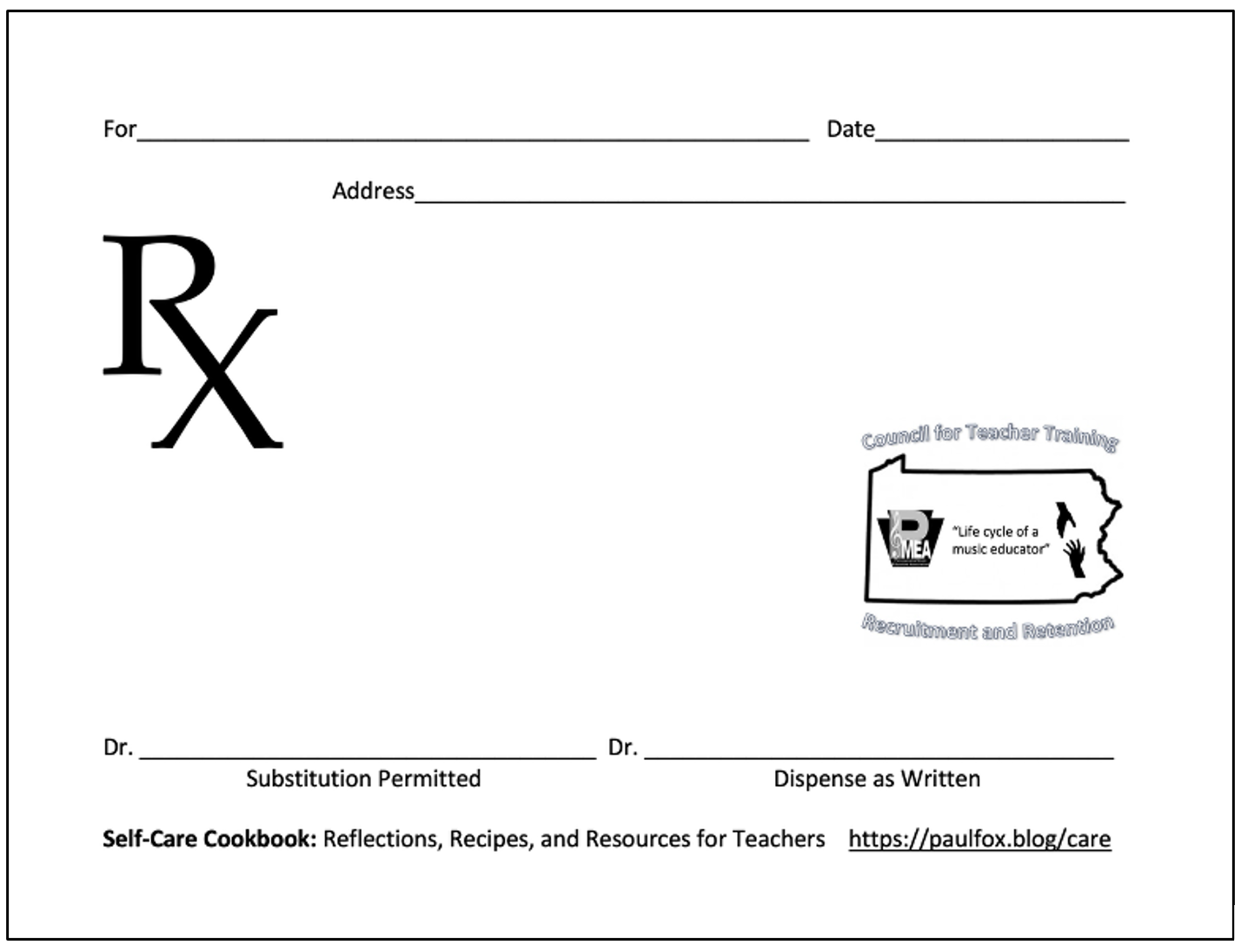
Using a facsimile of a prescription pad in Self-Care 1.0, I posed these personal reflections:

  1. How do I usually feel daily throughout the school year?
  2. What are the emotional and physical tolls of my job?
  3. What specific self-care activities do I need to incorporate to recharge and prevent burnout? 
  4. What boundaries do I need to set around my work to honor personal time?
  5. What support systems can I build and/or professional help should I seek to create a sustainable practice?
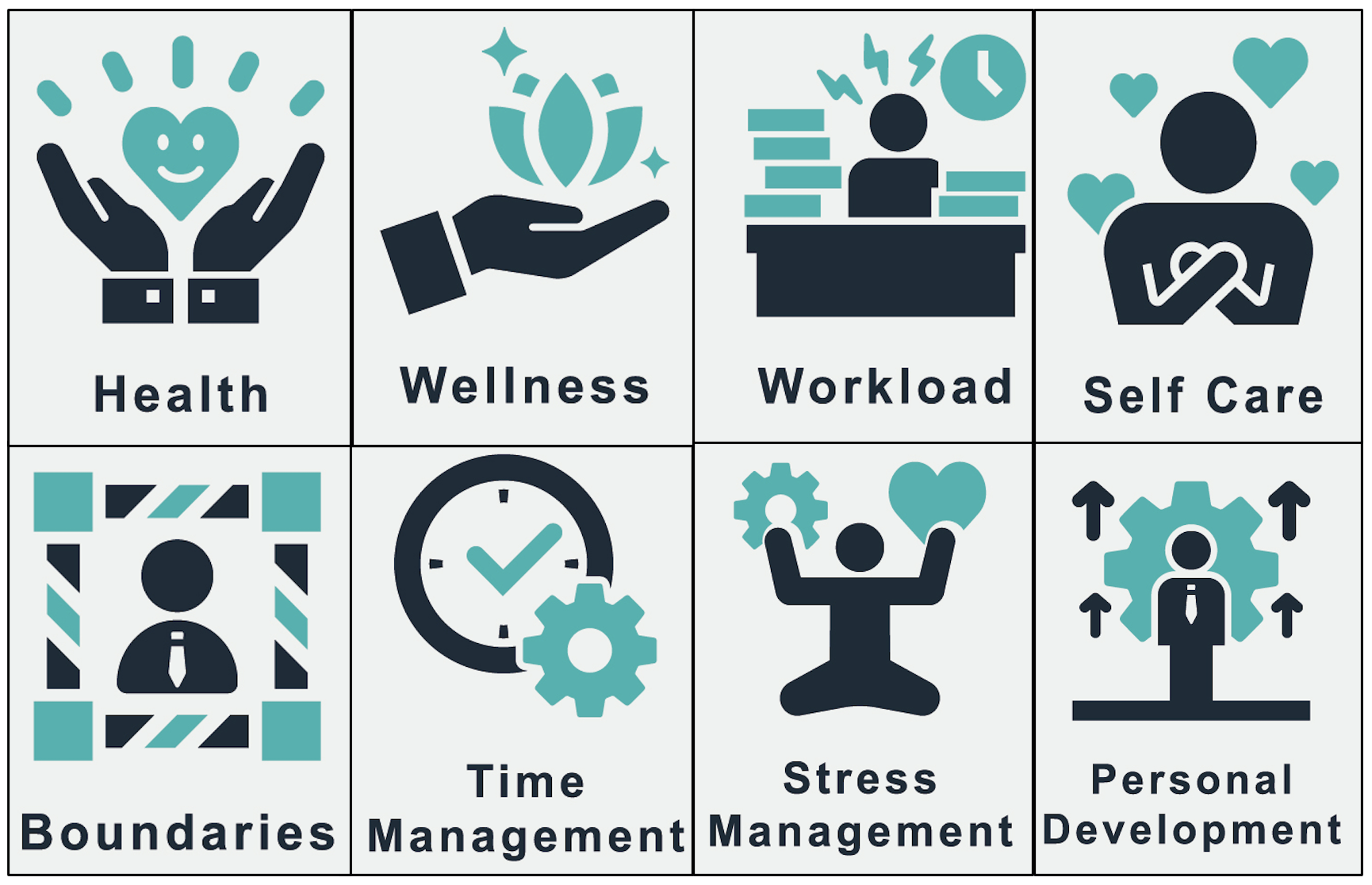
Good ideas…

How can school admins support their staff in dealing with the climbing incidences of health problems, teacher exhaustion, call-offs, evidence of burnout, and high turnover rate? Sorting through a compendium of online research, these recommendations for school leaders occur repeatedly:

  1. Probably should go without saying: Show high visibility (“be seen by all”), recognition, and know everybody’s name. This goes a long way in building a sense of belonging of the staff and students.
  2. Provide more time for breaks and planning. Engage teachers in problem solving teams to identify and implement substantive ways to give them more time. Examples: cutting back on testing and data analysis; holding fewer and shorter meetings; putting a hold on new academic initiatives while increasing mental health initiatives conducted by school-based mental health professionals; hiring individuals who can assist with administrative tasks; compensating teachers for extra work; protecting classroom time by minimizing interruptions; reducing teaching hours to allow for more prep time and follow-up time.
  3. Foster a supportive community through mentorship programs.
  4. Distill high-impact strategies into a handful of manageable priorities. Once the goals are set, give teachers specific time within the school day or week to focus solely on them.
  5. Communicate directly, clearly, and frequently. “Supportive administrators know that a teacher’s time is valuable and that administrative meetings compete with individualized education programs, data teams, professional learning committees, cross-curricular planning meetings, and much more. So if a meeting is only for sharing straightforward information, it can be an email instead. It’s not necessary to have a meeting simply because the schedule says that faculty meetings are in the cafeteria on Mondays.” – Edutopia: “4 Practical Ways Administrators Support Teachers”
  6. Treat teachers with respect like the professionals they are, increasing mutual trust by decreasing micromanagement or reducing unnecessary accountability documentation.
  7. Shadow multiple teachers to experience first-hand the reality of their typical day.
  8. Allow educators the option to attend meetings and professional development activities virtually.
  9. Involve teachers in the creation of targeted professional development activities that are the most meaningful for them.
  10. Ask teachers about what specific help they need to improve classroom management.
  11. Develop a plan (with the Board of Education?) to increase teacher compensation over time, taking into account that many administrative and clerical tasks that are now required of teachers might ultimately be delegated to less highly compensated individuals.
  12. Address staff performance issues on an individual basis rather than issuing global reprimands that don’t apply to most teachers.
  13. Implement policies that encourage work-life balance. For example, recognize measurable indications of quality teaching rather than behaviors that signal a “more is better” approach (always coming in early and staying late, volunteering for everything, talking about working all weekend to catch up, etc.).
  14. Support educators by acknowledging stress, providing professional development on self-care, and creating a culture where asking for help is normalized.
  15. Ask teachers what mental health or other supports they need to cope with their own distress. Research has demonstrated the effectiveness of introducing trauma-informed strategies, including an emphasis on compassion fatigue and secondary trauma, as well as mindfulness strategies that are part of institutionalized wellness routines.
  16. Provide “safe spaces” (SEL) where educators can express themselves without fear of being judged, and practice “Mindful Leadership” to connect with and listen to them. “Getting to know your teachers on a more personal level makes it easier to identify the best thing you can do to support them, even if teachers aren’t sure what they need. The goal should be making sure everyone made it to work okay and that they’re in good spirits and ready to tackle the day.” – 7 MINDSETS: “5 Ways Administrators Can Support SEL for Teachers”
  17. Counteract “toxic positivity” by acknowledging that teachers are hurting and need space to grieve the continued losses associated with the pandemic.

Bad ideas…

These strategies cited by Effective School Solutions will NOT help teachers in the long-term:

  1. While “wear your jeans to work” days and offering coffee and donuts occasionally are nice employee appreciation efforts, they do nothing to address the underlying issues.
  2. Offering one-shot seminars or newsletters with suggestions about individual self-care activities (breathing exercises, physical exercise, time for self, etc.) can inadvertently place further burdens on teachers, conveying the impression that they are responsible for both creating and addressing the stress that is structural in nature.
  3. Don’t conduct teacher surveys or focus groups about how to reduce teacher stress and then proceed to ignore their suggestions about what would make things better.
  4. Don’t assume that short bursts of extra time (e.g., ending a meeting early to give teachers more time) is useful. Small, unexpected pieces of free time do not help teachers catch up with work that requires concentration and focus.
  5. Don’t avoid difficult conversations to address the performance problems of individual teachers by making blanket statements/warnings to all teachers, most of whom are not engaging in the problem behavior.

“Be careful not to adopt a stance of “Toxic Positivity,” that is, a stance that accentuates the positive (“we are all in this together,” “we are strong,” “it could be worse,” “look on the bright side”) while invalidating the very real pain that everyone is experiencing. Denying or ignoring unpleasant emotions tends to make them worse, not better.
Effective School Solutions

Free Downloads

I am putting on the final touches to the SAS INSTITUTE 2025 Self-Care Cookbook 2.0 session, but have already assembled a huge bibliography of resources for your review (see below). For a “sneak preview” of my slide summary, click here. Future updates will be posted here: https://paulfox.blog/care/.

Better yet, register for the SAS Institute 2025 to see everything in person.

Sample Books

  • 180 Days of Self-Care for Busy Educators by Tina H. Boogren, Solution Tree Press (2020)
  • Awakened – Change Your Mindset to Transform Your Teaching by Angela Watson, Due Season Press & Educational Services (2023)
  • The Balanced Band Director – Productivity and Wellness Tips to Amplify Your Impact, Not Your Workload by Lesley Moffat, Morgan James Publishing (2025)
  • Demoralized – Why Teachers Leave the Profession They Love and How They Can Stay by Doris Santoro, Harvard Education Press (2018)
  • Exhausted – Why Teachers Are So Tired and What They Can Do About It by Paul Murphy, CreateSpace Independent Publishing Platform (2017)
  • Fewer Things, Better by Angela Watson (2019)
  • The Happy Teacher Habits by Michael Linsin, JME Publishing (2016)
  • Love the Job, Lose the Stress: Successful Social and Emotional Learning in the Modern Music Classroom by Lesley Moffat (2022)
  • Positive Mindset Habits for Teachers by Grace Stevens, Red Lotus 2018
  • Rekindle Your Professional Fire – Powerful Habits for Becoming a More Well-Balanced Teacher by Mike Anderson, ASCD (2024)
  • The Teacher’s Guide to Self-Care – Build Resilience, Avoid Burnout, and Bring a Happier and Healthier You to the Classroom by Sarah Forst, The Designer Teacher (2020)
  • The Teacher’s Guide to Self-Care – The Ultimate Cheat Sheet for Thriving Through the School Year by Melanie J. Pellowski, Skyhorse Publishing (2020)
  • Upbeat – Mindset, Mindfulness, and Leadership in Music Education and Beyond by Matthew Arau (GIA Publications (2022)
  • The Weekend Effect: The Life-Changing Benefits of Taking Time Off and Challenging the Cult of Overwork by Katrina Onstad, HarperOne (2024)

Sample Websites

PKF

© 2025 Paul K. Fox
Social Media – Revisited

Before you begin reading this article, please take a moment and peruse these past blog posts:

Although several of the cited research links may have expired (for example, PA Department of Education modified most of their website’s URLs), these provided the foundations of background information and references for the presentation I prepared for the DCMEA Virtual Conference in 2020 (during COVID) and serve as the starting point for the workshop I will share in-person at the DCMEA Winter Conference in January 2026. This blog provides updates and additional perspectives. Taken in combination with the above sources, you will be able to identify the benefits, positive models, precautions, and dangers of social media, social networks, professional learning networks, and sample emerging technologies as they apply to teachers’ professional development and education of students.


“THE WHY”

Before every clinic or publication I develop, I always try to spotlight the theme of “THE WHY” as preached by one of my favorite authors and motivational speakers – Simon Sinek! According to him, for organizations and individuals alike, “THE WHY” (rationale and priority) is more important than “THE WHAT” and “THE HOW.” (See this video.)

WHY is a collaborative discussion on social media essential? Why now?

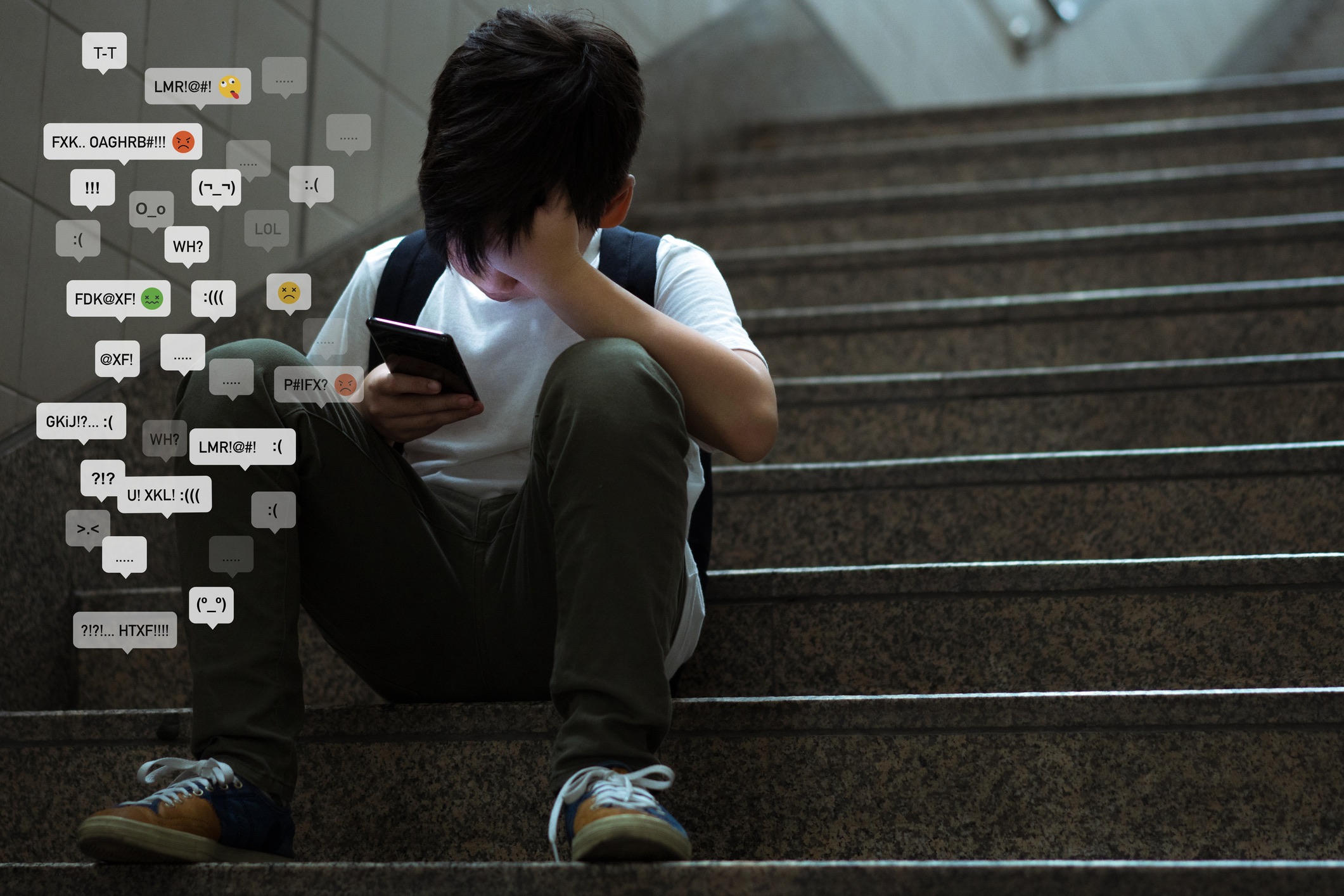
 ”There’s a growing body of evidence suggesting that educators are facing increasing scrutiny regarding their social media use. Concerns include unprofessional conduct, inappropriate interactions with students, and the potential for cyberbullying and other negative impacts on student well-being.”

“Educators are increasingly concerned about how social media influences students’ social-emotional development and their interactions with others.” 
NEA Member Polling on Social Media…
NEA Impact on Social Media and Personal Devices on Mental Health
HHS Youth Mental Health and Social Media

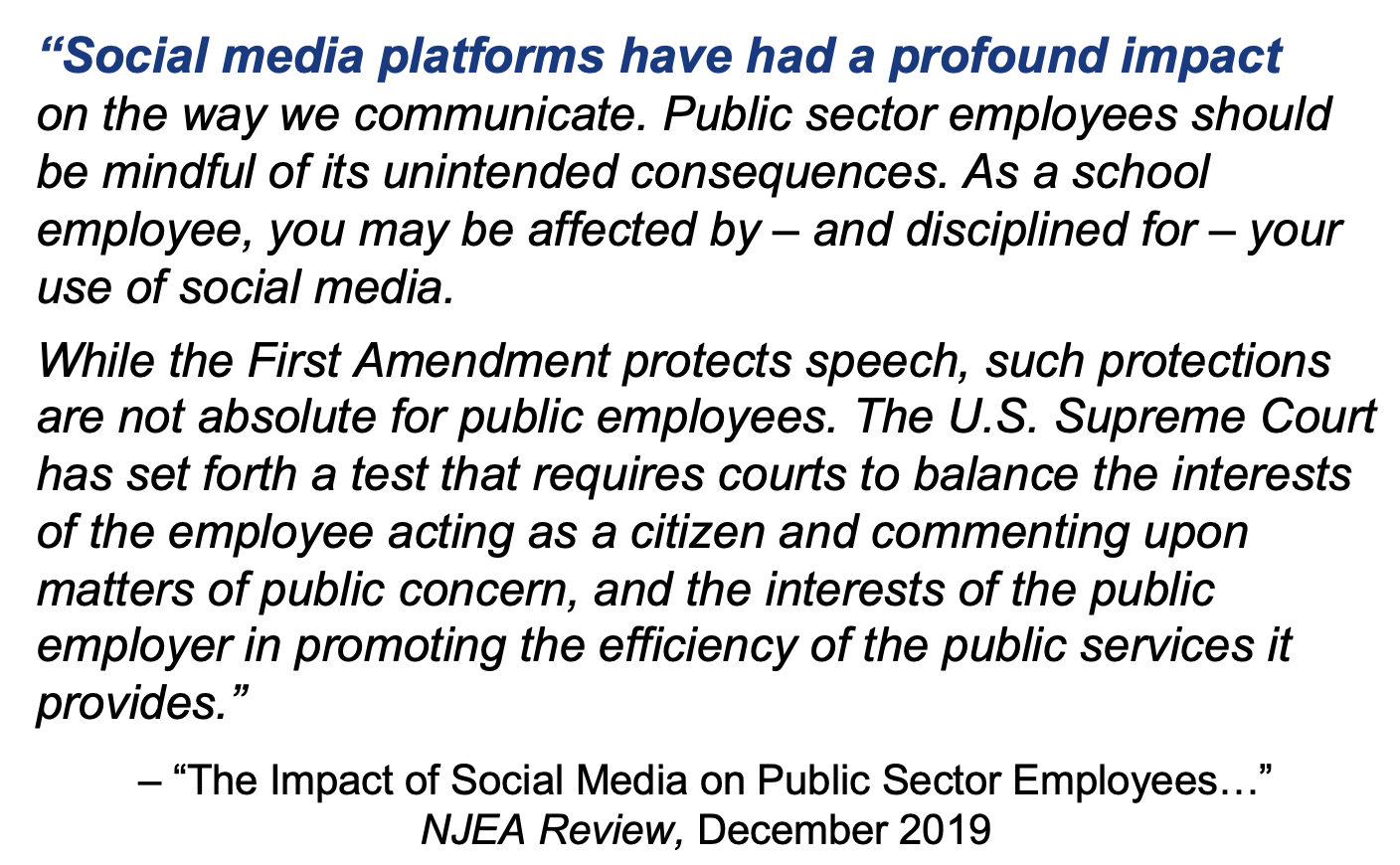
Frankly, there is still a lot of confusion about the dangers of social media, social networking, and other technology integrations into education. In Social Media – Boon or Nemesis, we mentioned that teachers should “debunk the free speech myth.” We demonstrated how the improper application of social media could get educators in trouble. Check out these sites for more info and corroborative stats:
Teacher Student Misconduct and the Critical Role of Social Media Screening
NCBA Social Media for School Employees
Social Media Hazards and Tips for Teachers

As always, our goal is to promote ethical practices in maintaining professionalism in the digital world.


“THE WHAT” Review of Definitions

“Social Media”

Social media are “websites and applications that enable users to create and share content or to participate in social networking.”
— Oxford Lexico.com online dictionary

“Social Network”

A social network is, 1. a network of social interactions and personal relationships.; 2. a dedicated website or other application which enables users to communicate with each other by posting information, comments, messages, images, etc.
— Oxford Lexico.com online dictionary

Professional Learning Community” (PLC)

A PLC is “a group of educators who meet regularly…” (usually in-person) “…to strategically enhance their teaching skills and improve student outcomes.”

versus “Professional Learning Network” (PLN)

A PLN is “a group of educators who gather more informally…” (usually in online communications) “…to problem-solve and generate ideas to enhance classroom practices. A PLN… often takes the form of an open forum, where participants can ask and answer questions based on their experiences.”
https://edtechmagazine.com/k12/article/2024/08/pln-vs-plc-perfcon


“THE HOW” Ethos of Care

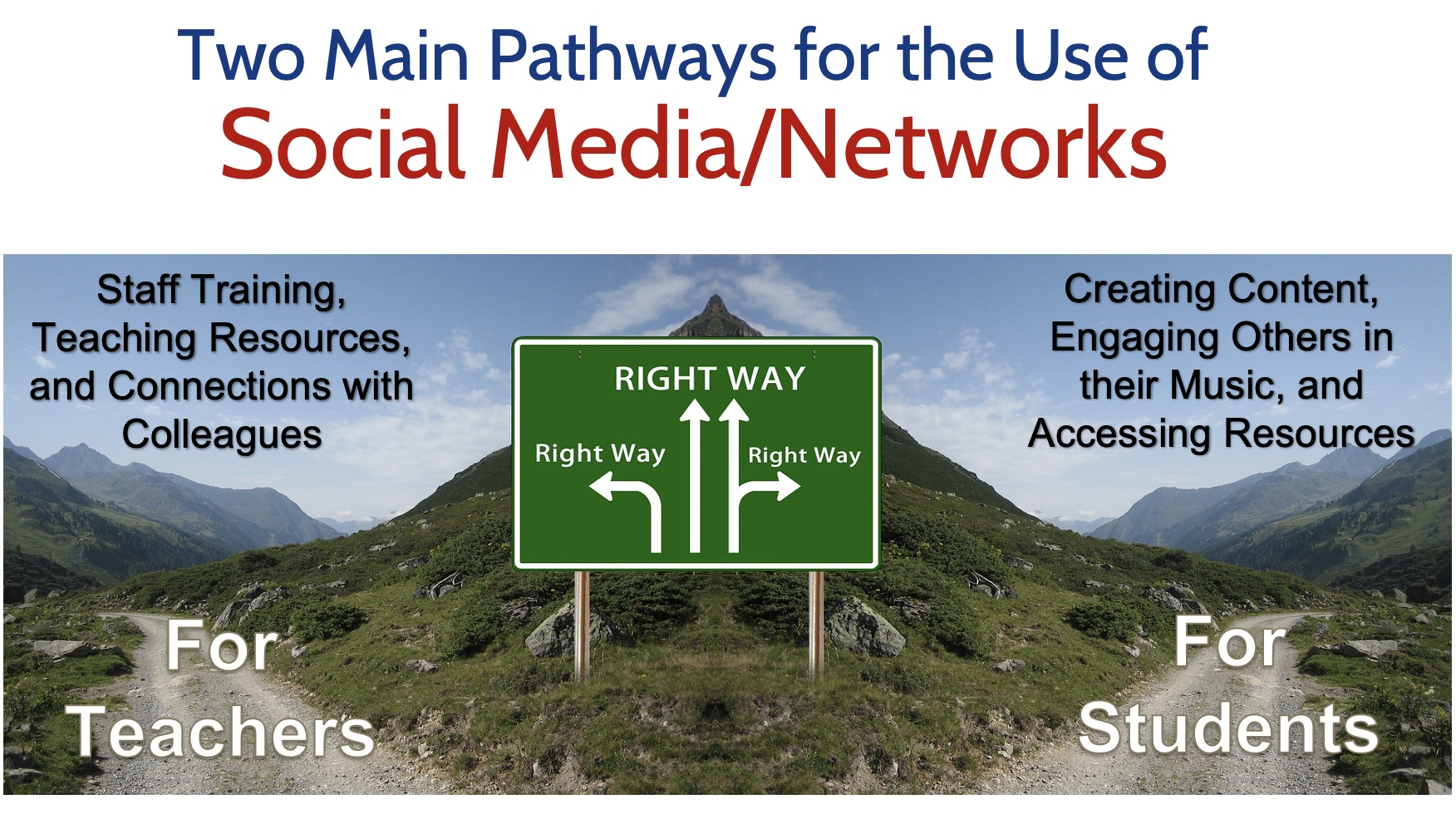
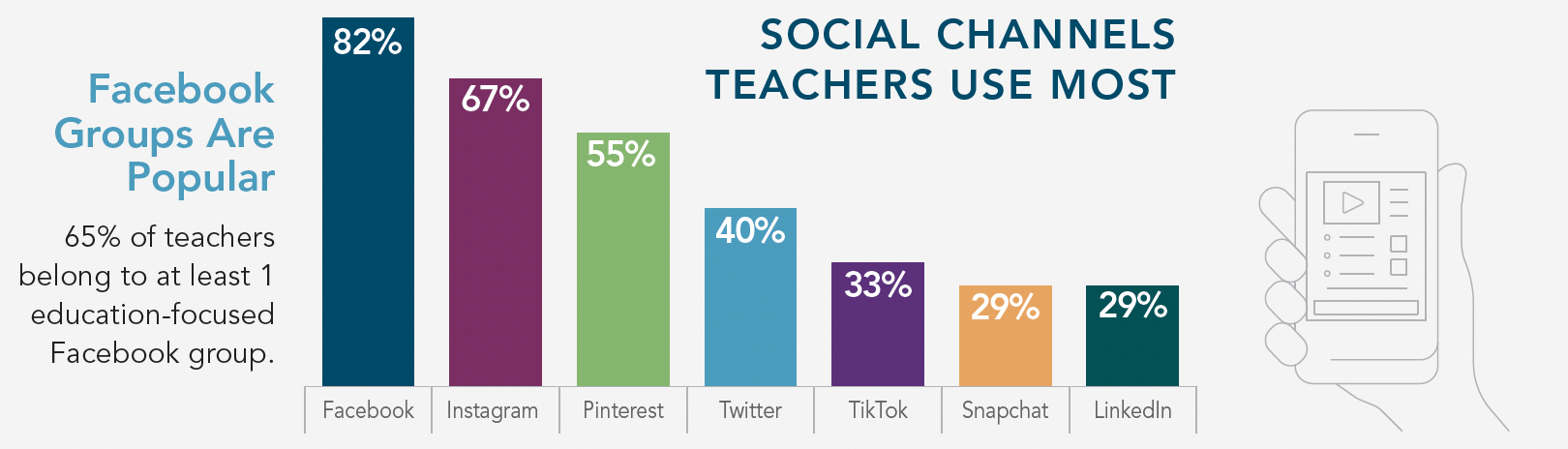
Teachers use social media to…

  • Get inspired with new teaching ideas
  • Find resources for the classroom
  • Connect with other educators
  • Stay on top of trends and news
  • participate in an online community
  • Find teacher discounts and deals
  • Follow education companies and organizations

How Teachers Use Social Media
Teachers Social Media Use

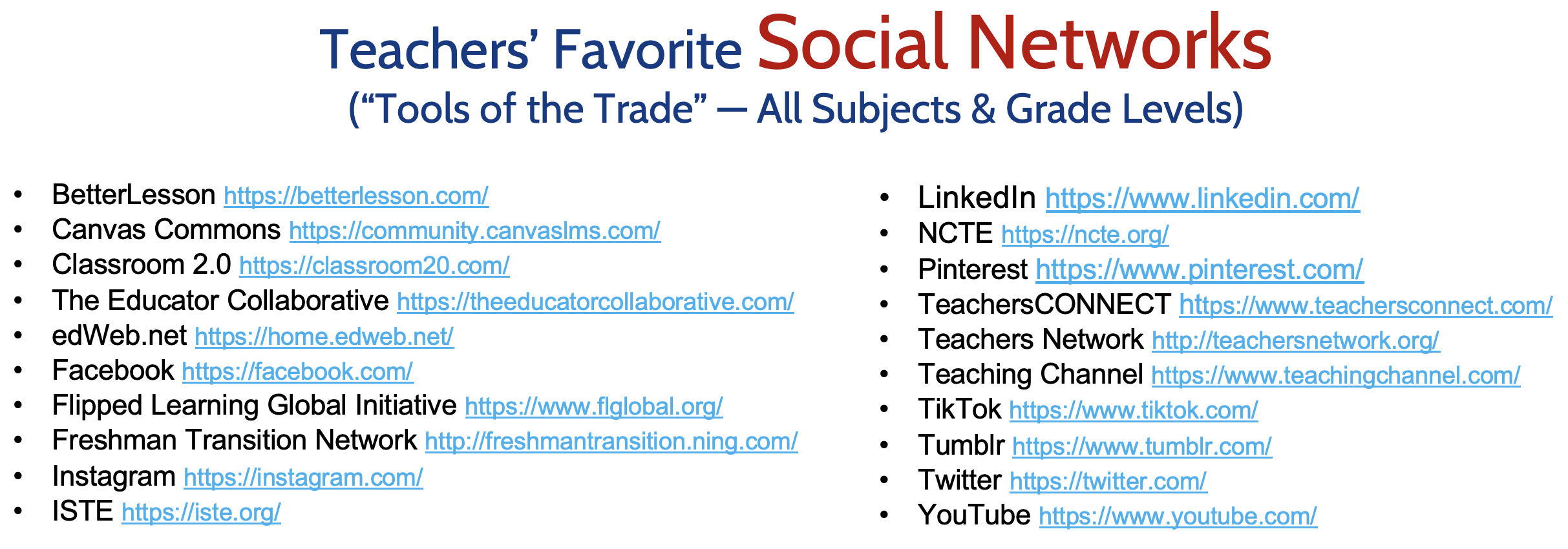
Social Networks for Teachers

We acknowledge that the benefits of social networking for educators are numerous by promoting professional collaboration and connections, including:

  1. Acquiring information to enhance understanding
  2. Keeping informed about latest developments in education
  3. Enhancing communications with students, parents, and the school community
  4. Fostering connections with colleagues in the field to expand an educator’s professional network.

Benefits of Social Media as an Educator

However, educators must exercise “sound judgment” and proper professional boundaries when using social media/networks with students. While the introduction of new technology provides many opportunities for teaching and learning, it is important to establish clear rules for appropriate student-teacher communication. In order to promote safety and appropriate boundaries while transitioning to a virtual teaching and learning environment, the Pennsylvania Professional Standards and Practices Commission offers suggestions to help educators protect themselves and their students.

  1. All technological resources and applications should be school entity-approved and only used in the manner prescribed. Ensure that you are familiar with the tools you are using in order to use them properly. 
  2. Communication with students should occur at designated times, consistent with traditional school day hours. Maintain transparency and protect yourself by keeping a record of all communications with students. 
  3. Clearly communicate when and how students should contact you and provide a timeframe for when students should expect responses to questions. 
  4. Avoid one-to-one interactions with students in chatrooms, FaceTime, Skype, or any other online space. School psychologists, school counselors and others providing one-to-one services to students should consult with school administration about the best mode of communication. 
  5. Use approved forms of communication by your school entity to connect with students and parents (i.e. Remind), use only your school email to communicate, and copy administration when communicating with parents or students. 
  6. When creating content or interacting in an online space with students, conduct yourself as you would if you were in school. If appearing on camera, dress professionally and be mindful of your surroundings and the camera’s view. 
  7. Do not “friend” or follow students on social media and do not allow students to “friend” or follow you on your personal social media. Remember, you do not have a “social” relationship with your students. 
  8. Keep your personal and professional lives separate. Do not share overly personal information about yourself with students.

PSPC Digital Tips for Educators

While exercising responsibility to maintain a respectful, safe, online environment, there are many benefits for the application of social media for students in the classroom:

  • Real-time communications can increase student engagement, collaboration, communication and overall participation
  • Many students may find it easier to participate in online discussions that in the classroom
  • Students can easily ask each other or their teacher questions about assignments outside of class
  • Students & teachers can quickly share resources at any time.
  • Teachers can easily share class announcements.
  • Social media can provide a contingency plan for last minute remote learning scenarios.
  • Students can organize school events with each other or with the help of a teacher.
  • Teachers can augment an online-only class by establishing a social media page or account simply for building community.
  • Students can practice using social platforms responsibly, including maintaining a respectful online discourse.
  • Teachers can communicate directly with parents as needed, and parents can stay informed of school news via a convenient, easily accessible platform.

However, please watch out for these potential drawbacks:

  • Social media can be a major distraction, especially if students are accessing their personal accounts independently.
  • If students primarily use social platforms to participate in class discussions, they can miss out on practicing face-to-face conversations and respectful in-person discourse.
  • Some students may see social media assignments as an opportunity to cyberbully their classmates, and there is always a risk of someone posting inappropriate content or language.

Social Media in Education


“THE WHAT” Several Success Stories

Balancing the positives and negatives and taking into account all of these precautions in order to maintaining professional boundaries, the integration of new technology into the classroom may offer excellent enrichment and increase student motivation for advanced learning. This may take many forms. Here are a few interesting models.

Prior to preparing for the DCMEA online session in 2020, I stumbled upon a truly inspiring post from Derek Muller, a gifted teacher, physicist, filmmaker, and founder of the YouTube channel Vertiasium which has captured millions of subscribers. He offers one of the BEST models of using social media to enrich the understanding of learning math and science (applicable to all fields of study), while at the same time, provides warnings against unbridled use of so-called “innovation for innovation’s sake.”

“I feel like people over the years are invariably drawn to use these words:  revolutionize and education. And there’s this sort of amnesia that we’ve had a hundred years’ worth of these predictions, worth of really groundbreaking technologies that have transformed other areas in our lives but have failed to fundamentally change the way we do education. So, I stand here today as a voice of caution, to think that the future of education is not one of revolutions…”

You need to watch this: How is Social Media Transforming the Future of Education? (2016)
Derek Muller

Say what you want about how COVID significantly disrupted our educational programs, evidence of learning loss, problems in socio-emotional development, decline of student engagement and self-motivation, rise in mental health struggles, decreased instructional time, and the effects of a new digital divide of under-served students (Annie E. Casey Foundation), happily there were surprisingly a few positive advancements the results of exploring new tools and methodologies we had to employ to tread water and cope with the catastrophe. (“When life hands you lemons, make lemonade!”)

As one example, in the middle of preparing music for my community orchestra, we were shut down in 2020. No in-person rehearsals at the school. I then pivoted to creating my own online platform called SHJOOLA (South Hills Junior Orchestra Online Academy) in 2021 using MusicFirst. For a nominal yearly subscription fee, I was able to continue my Saturday morning classes (synchronous) as well as asynchronous (on-their-own time) learning using excellent applications in a virtual environment: MusicFirst Classroom, Focus on Sound, PracticeFirst, Sight-Reading Factory, Musition, Auralia, a web-based music notation program, and a huge library of method books and ensemble music. Several past blogs showed how we rolled out SHJOOLA:

The latter link above also provided a comprehensive list of supplementary resources (at the time) for online music education. Please peruse these even though some of them may have now gone inactive. We will provide supplemental links at the bottom of this article.

Another direction accented by the onslaught of the pandemic was digital streaming performances, incorporating technology in both the solo and ensemble settings. The following are two of my favorite examples of these to be viewed on YouTube:

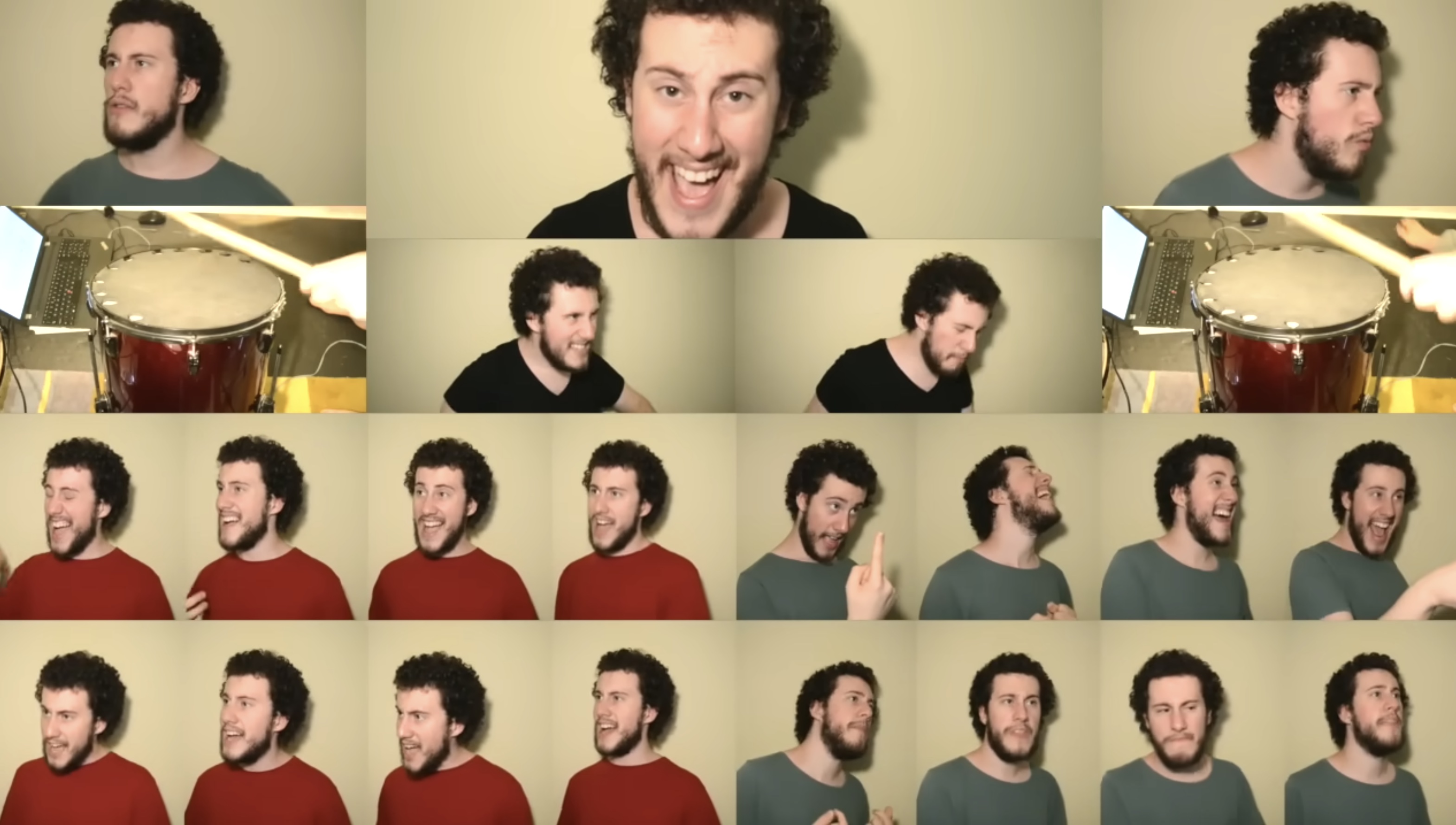
Circle of Life from Disney’s Lion King (2015-18) by Sam Robson, arranger, innovator and performer using multitrack recording of a single performer mixing as many as 50 voices at one time.

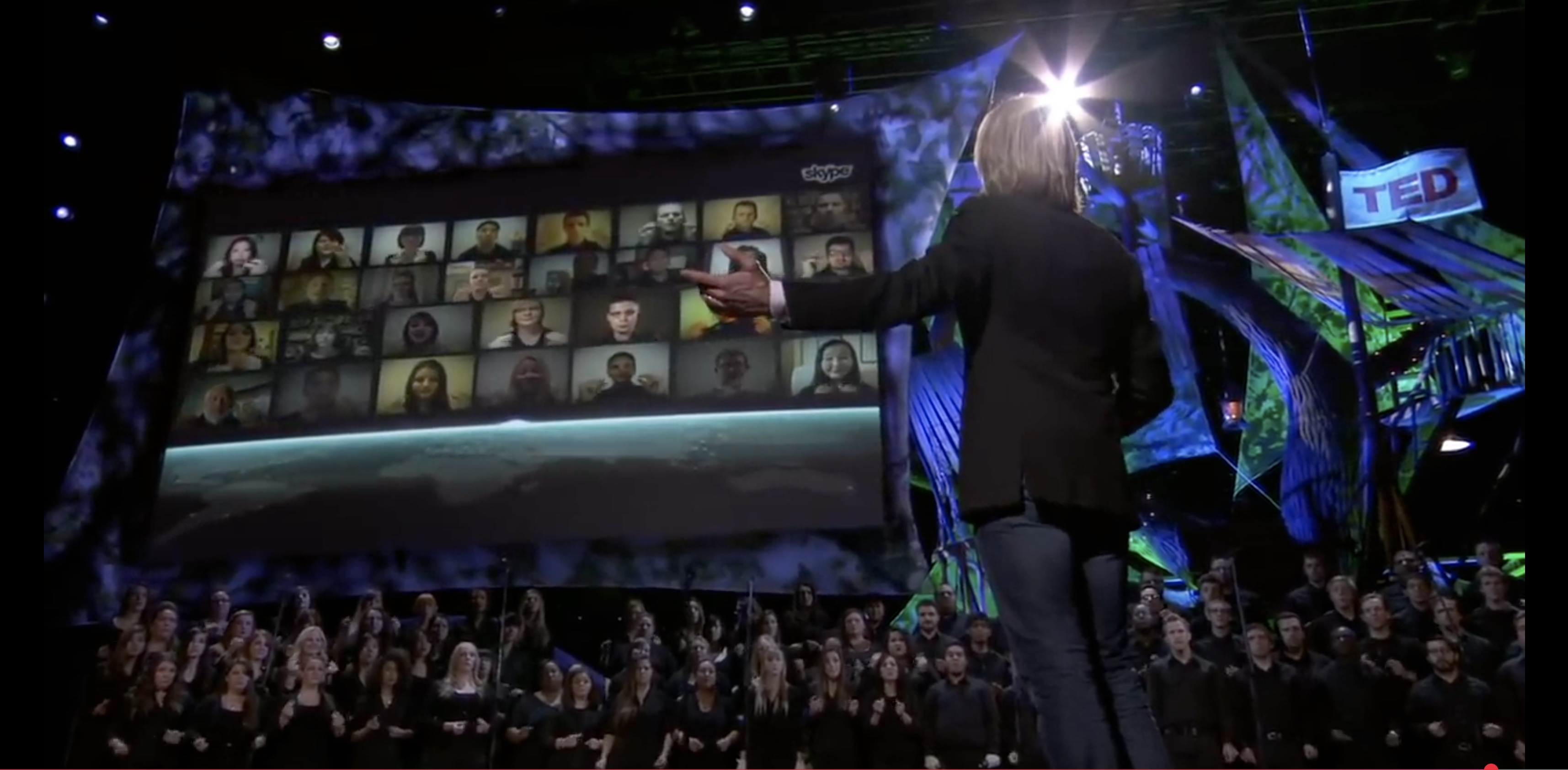
Cloudburst, a Virtual & Live Choir and TEDTALK (2013) by Eric Whitacre

Well… sorry this blog has grown to be so large! If you admit to understanding the potential hazards of and precautions for integrating social media, social networks and other technologies into education, we’ll close with the following bibliography of additional resources for further study. If that is not enough to whet your curiosity, stop back in several months to download a copy of my slide summary for the session I will present at the DCMEA Winter Conference on January 30, 2026.

Be careful stay safe and professionalbut ENJOY!

Sample Blogs

Several Major Platforms

Examples of Music Applications/Websites

PKF

© 2025 Paul K. Fox

Teachers – Take Charge of Your Wellness

The Five C’s of Self-Care

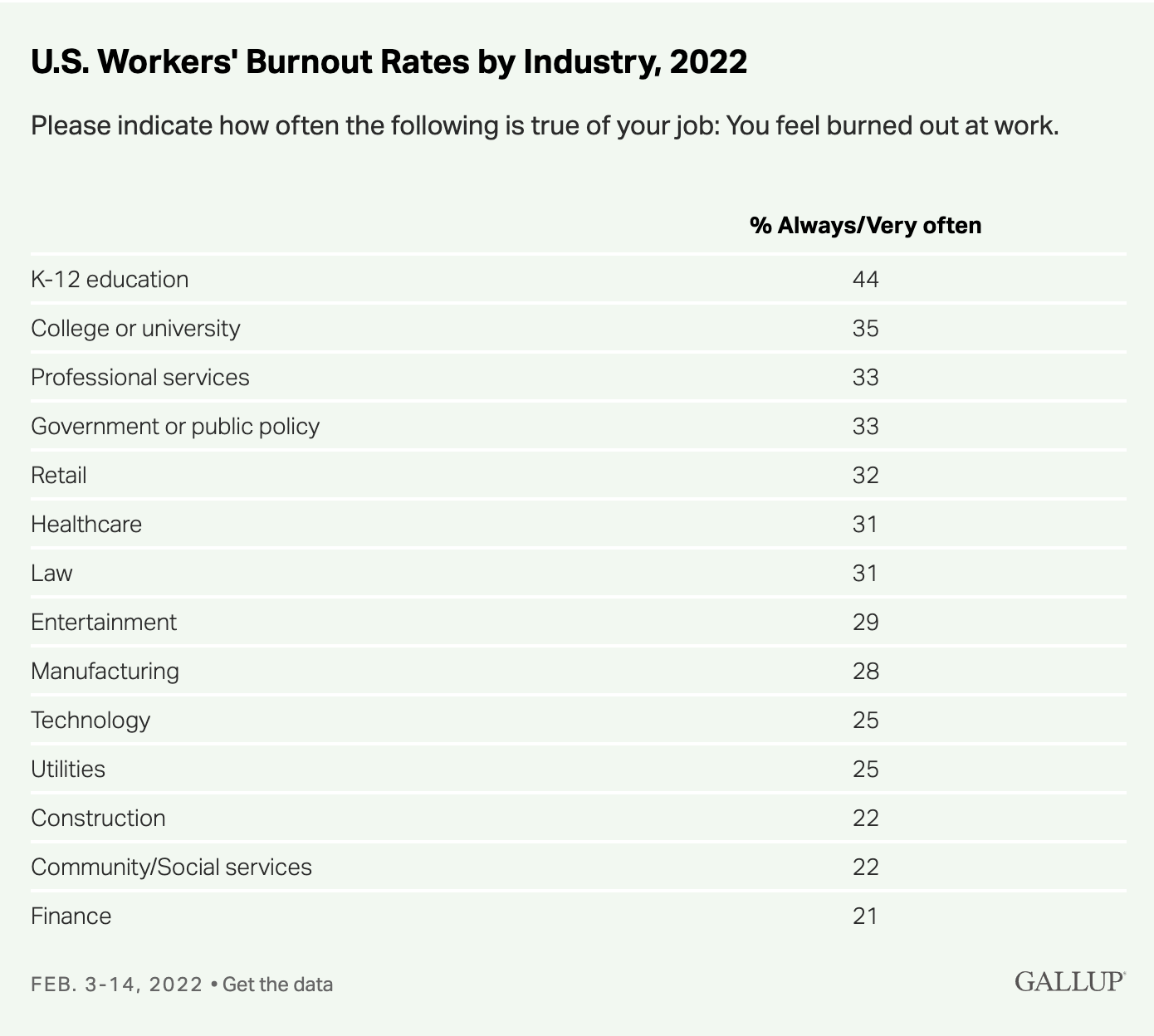
What profession has the highest rates of stress and burnout?

The answer is… educators of grades K to 12. NO FOOLIN’ ⏤ yes, even though today is April Fool’s Day!

The Crisis

Citing a 2022 Gallup Poll at Purdue Global’s website here, “K-12 teachers are the most burned out profession in the U.S.” They go on to say:

In fact, teachers have higher-than-average stress levels compared to other client-facing professionals. This kind of stress can lead to physical and mental health concerns for teachers and negatively affect students’ well-being and achievement.

“Being an educator requires so much of us,” says Carol Laman, faculty member at Purdue Global. “It is emotionally, physically, and mentally demanding.”

Self-care practices can help. According to the National Comprehensive Center, self-care can aid educators in both improving their overall wellness and being more effective for their students. ⏤ https://www.purdueglobal.edu/blog/education/self-care-for-educators-guide/

According to the National Education Association, we have a MAJOR problem!

A study by the advocacy group, Alliance for Excellent Education, reports that 40-50% of new teachers leave within their first five years on the job. Many factors contribute to the high dropout rate, a severe lack of work-life balance and the inevitable high stress levels teachers feel on the job, to name a few. Because of this, self-care is extremely important for teachers. However, it’s hard for teachers to take care of themselves when their career is taking care of students. ⏤ https://www.nea.org/professional-excellence/student-engagement/tools-tips/importance-self-care-teacher

This statistics are overwhelming, as documented in the Teacher Wellbeing Survey by Panorama Education.

Teacher wellness has a significant impact on school climate and student learning. Yet teacher stress and burnout continue to present retention and turnover challenges in districts: 85 percent of teachers have reported that work-life imbalance affects their ability to teach. More than one in five new teachers leave the profession within their first five years of teaching—and this attrition is substantially worse in high-poverty schools. ⏤ https://www.panoramaed.com/products/surveys/teacher-well-being-survey

The Concern – What is “Self-Care?”

The online Oxford dictionary defines “self-care” as “the practice of taking action to preserve or improve one’s own health,” or “the practice of taking an active role in protecting one’s own well-being and happiness, in particular during periods of stress.”

The National Institute of Mental Health (NIMH) provides even more clarification:

Self-care means taking the time to do things that help you live well and improve both your physical health and mental health. This can help you manage stress, lower your risk of illness, and increase your energy. Even small acts of self-care in your daily life can have a big impact.
https://www.nimh.nih.gov/health/topics/caring-for-your-mental-health.

The National Wellness Institute (NWI) further defines wellness as a “conscious, self-directed, and evolving process of achieving one’s full potential… [It] is positive, affirming, and contributes to living a long and healthy life.” NWI addresses six dimensions of wellness, the combination of which “enables us to thrive amidst [life’s] challenges.”

  • Emotional
  • Physical
  • Intellectual
  • Occupational
  • Spiritual
  • Social

In our profession, the defining concerns also involve other major “C’s” within the school workplace – climate and culture – and that “actions speak louder than words!” Edutopia dove into this topic in their blog, “Leaders Must Address Teacher Well-Being With Action, Not Just Self-Care Talk” here.

By listening to educators and building supports that reflect their genuine needs and concerns, these leaders are shifting school cultures in ways that go beyond lip service.
https://www.edutopia.org/article/leaders-teacher-wellbeing-action

The Causes

That leads us to THE WHY – why is this such a crisis?

In my educator self-care workshops (e.g., this example), I bring up the research of Paul Murphy from his book Exhausted – Why Teachers Are So Tired and What They Can Do About It. Consider his litany of possible culprits that may cause burnout in some teachers:

  • Lack of autonomy
  • Dysfunctional work environment
  • Inadequate social support
  • Extremes of activity
  • Poor work/life balance

Another excellent read on the subject is Demoralized – Why Teachers Leave the Profession They Love and How They Can Stay. Author Doris Santoro takes a closer look at these issues:

  • Teachers feel frustrated from accomplishing good work that benefits students, communities, and the profession.
  • Problem is external and does not indicate a “weakness” or lie within the individual teachers themselves.
  • Dissatisfaction in education is due to moral and ethical conflicts.

Only by addressing the moral sources of teacher’s anguish might we stem the tide of teacher exodus. ⏤ “The Problem with Stories About Teacher Burnout” by Doris Santoro in Kappan December 2019/January 2020

What are the symptoms of “burnout?” From the Mayo Clinic and other sources, we learn the following. Do you display any of these on a regular basis?

  • Disillusionment over the job
  • Cynicism at work
  • Impatience with co-workers, administrators, and students
  • Lack of satisfaction in accomplishments
  • Dragging themselves to work and trouble getting started once they’re there
  • Lack of energy
  • Unexplained aches/pains 
  • Self-medicating with food, drugs, or alcohol
  • Changes in sleep/eating patterns

Are these striking close to home? If you said, “Yes, that’s me!” more than a couple times, it is time to seek help. Please consider this a “wake-up call” to visit your health care professional.

The Courses-of-Action

If you Google search “teacher self-care” in your browser, the following comes up from the (experimental?) Google-generative AI Overview, otherwise a good starting point summarizing possible solutions for stress remediation and improving over teacher mental health.

Key Self-Care Strategies for Teachers

Paul Murphy added these “remedies” for improving teacher time management, promoting better work/personal life balance, and de-stressing:

  • Work less/fewer hours
  • Realize that time before school is worth more than twice as much as time after school (so plan accordingly)
  • Use class time to check work
  • Leverage technology
  • Don’t grade everything
  • Stop assigning things

The Courage to Change!

The bottom line – We are our own worst enemies!

Our negative thoughts, self-doubt, and destructive behaviors often hinder our own progress and happiness, making us our own biggest obstacles. ⏤ Google Generative AI and other sources including https://lorimilner.medium.com/the-art-of-being-your-own-worst-enemy-c393e9032d27, https://markmanson.net/when-you-are-your-own-worst-enemy, and https://letherspeakusa.org/why-are-we-our-own-worst-enemies/.

The research suggests that many “bad habits” may disrupt our ability to take care of ourselves and seek change, such as these:

  • Self-Sabotage
  • Negative Self-Talk
  • Lack of Self-Compassion

My insightful Washington-state music teaching colleague Lesley Moffat has written an excellent book, I Love My Job But It’s Killing Me – The Teacher’s Guide to Conquering Chronic Stress and Sickness, and in my opinion, she hits the nail squarely on the head embracing Shakespeare’s “to thine own self be true” in a renewed motivation on self-help:

You must take care of yourself first. This is the hardest lesson of all, yet it is so important. Chances are you got where you are because you ran yourself ragged taking care of other people’s needs. I bet you never said no to requests to be on one more committee, drive carpool, watch a friend’s kids, and every other favor someone made of you, yet I’d also bet there’s a good chance you never take the time to take care of your own needs. When was the last time you read a book for fun? Or went to a movie you wanted to see? Or pursued a creative endeavor that made you happy? Or any one of a million things you want to do? I bet it’s been a long time. ⏤ Lesley Moffat   

It is time to take the plunge towards better personal health, wellness, and balance in your life. There are plenty of resources out there for you to peruse, but don’t just sit there and read them! DO THEM!

Get started today!

PKF

© 2025 Paul K. Fox

Exceptional Ethics Training

A Follow-up to the Pennsylvania Educators E-TRAIN

SCHOOL SYSTEM LEADERS, CTC DIRECTORS, & OTHER ADMINISTRATORS:
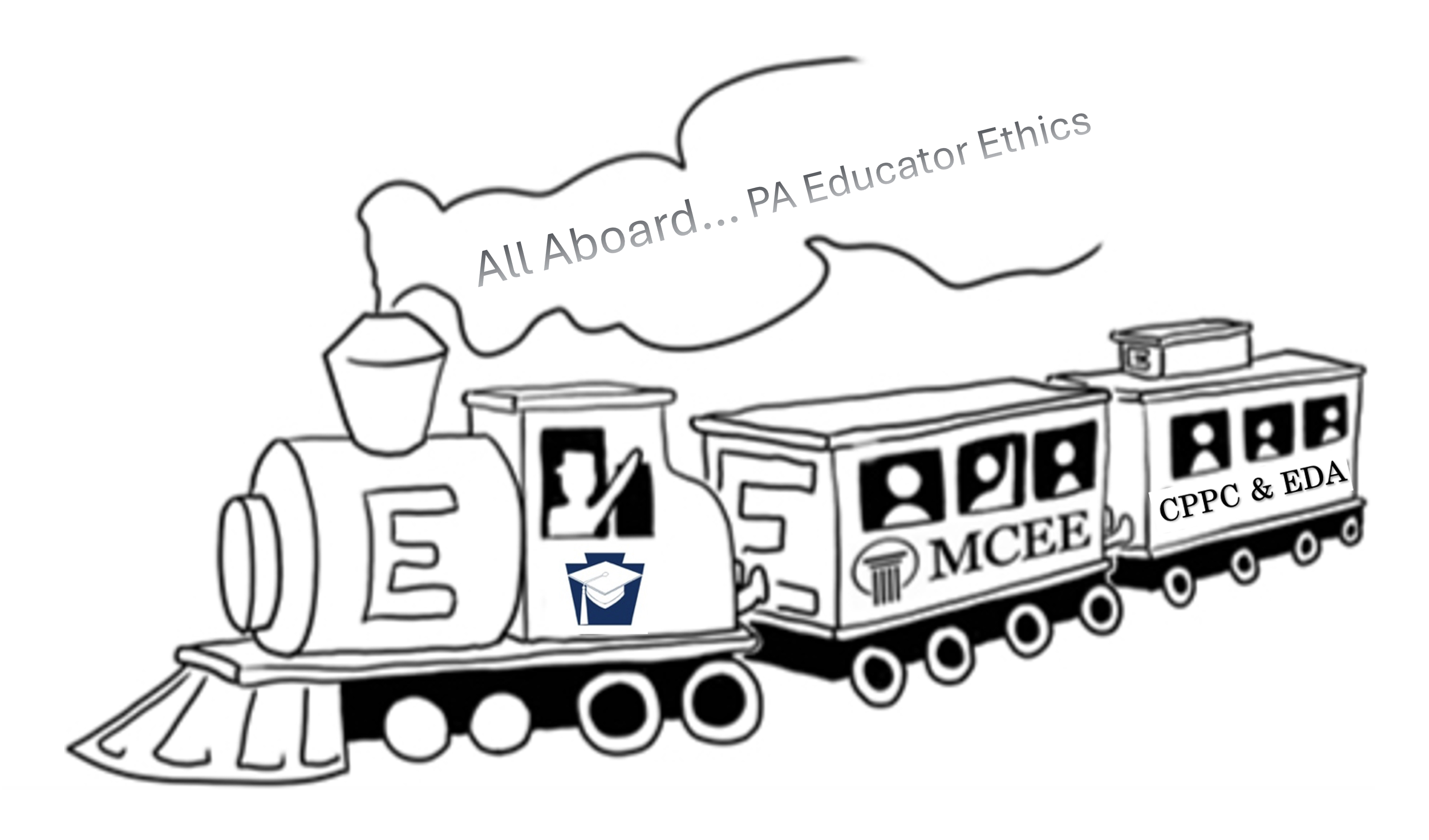
In case you missed my last update here in September 2024, this “express car” blog post will help you “catch-up” on the PDE “company line,” “supply new freight” to your continuing professional development and induction programs, get back “on track” and avoid being “sidetracked” or “derailed” for meeting the newly revised PA Chapter 49 “guard rails” of professional ethics training competencies.

THE ETHICAL WHEELS GO ROUND & ROUND…

You may have noticed that due to compliance regulations, the PDE website was revised with many of its former URL “tracks” leading to “train wrecks.” This “propelled” us towards making an “overhaul” to “connect” the new references (research “destinations”) in my slide presentations. Please use the following index (substituting old “routes”) and travel to our renovated “union station” with the new schedules.

Okay… I will stop “conducting” any more train “puns!”

Recent Ethics Sessions

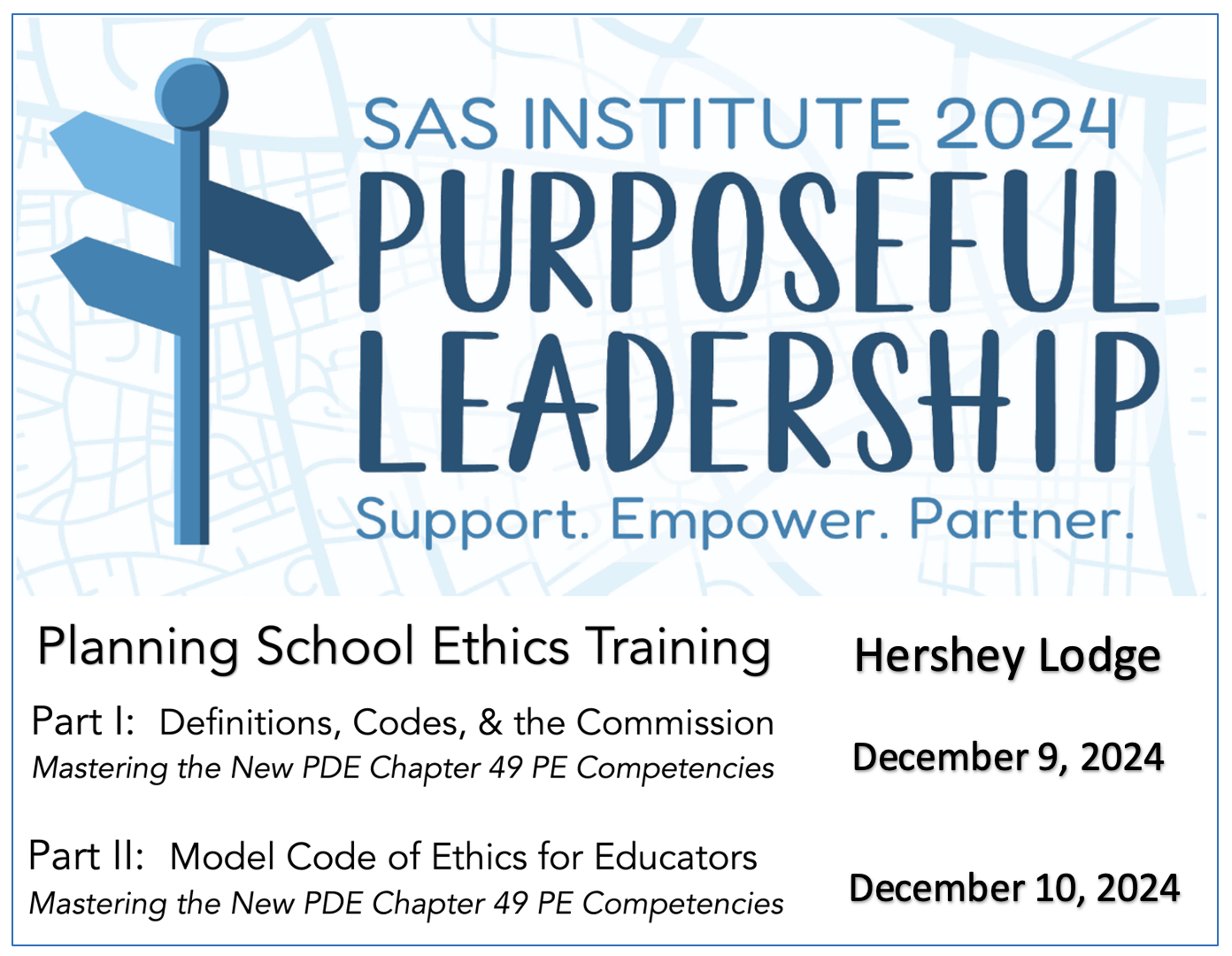
Slide Summaries for the PDE Purposeful Leadership Conference (if you attended) are available from the SAS Institute’s conference app: Eventsquid.

Upon completion of the 25-hour course, the PowerPoints for all four sessions of the Thomas W. Bailey Act 45 class series were emailed to the participants.

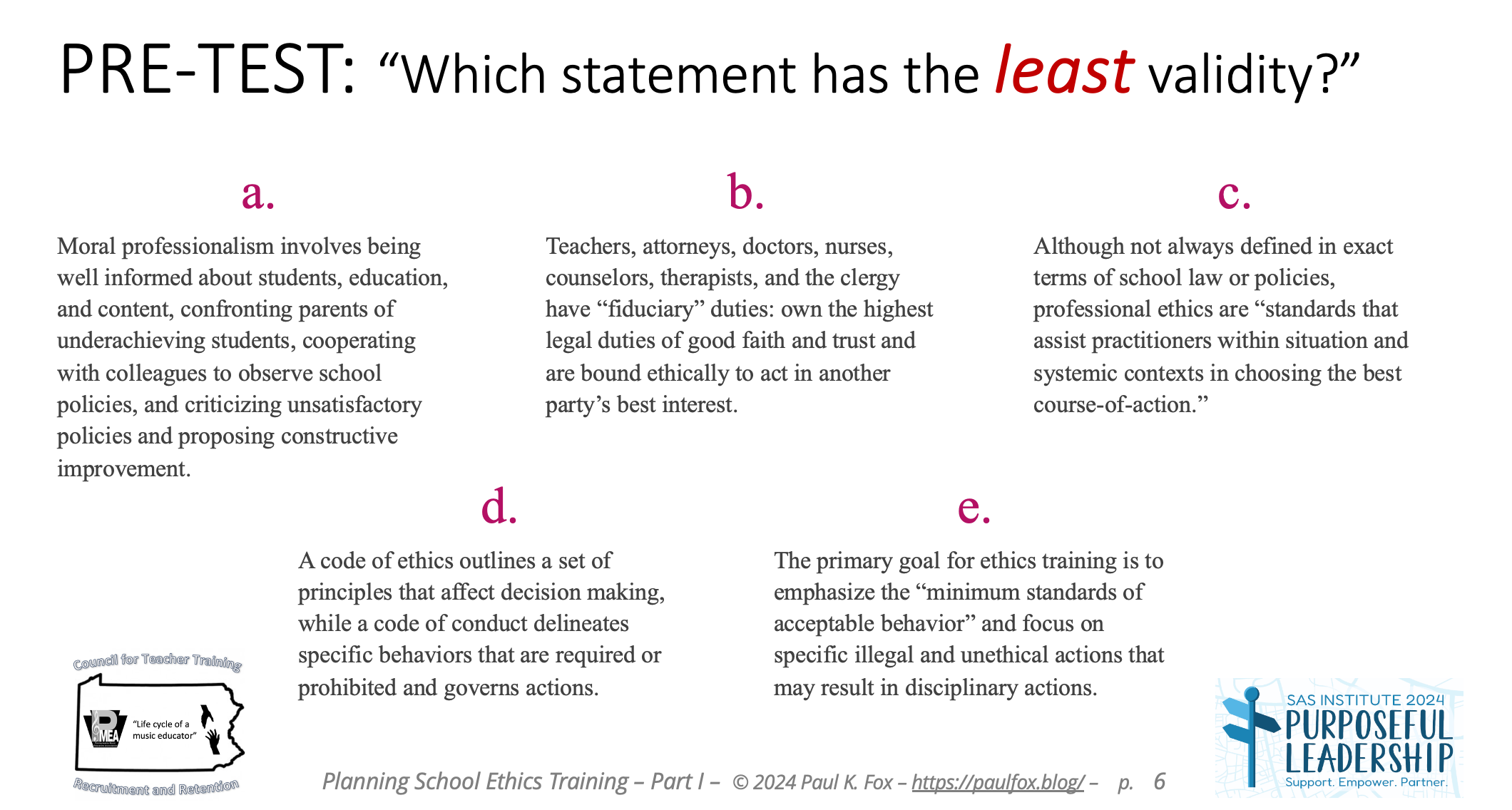
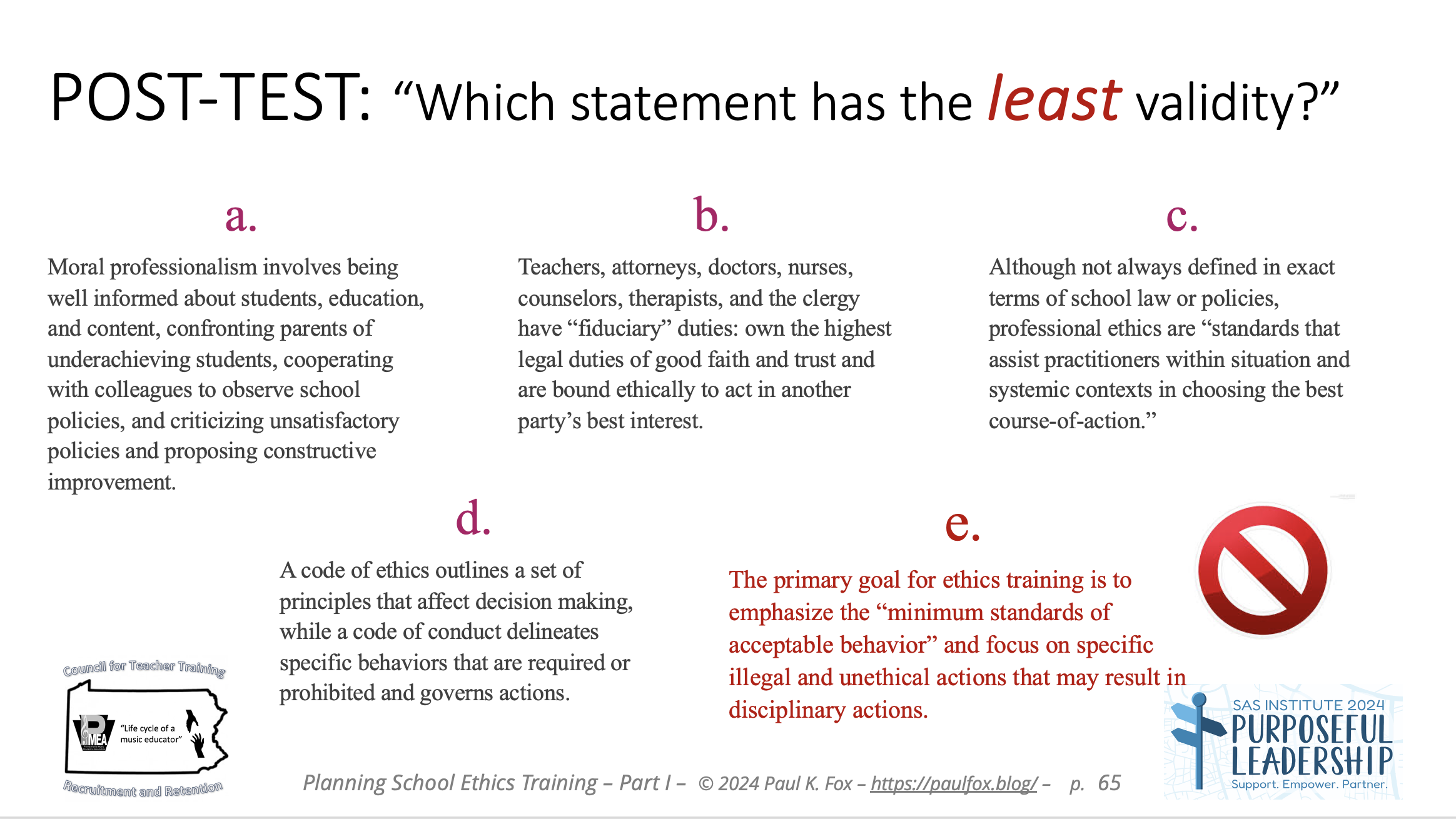
Here is the PRE-TEST for both events.

What is your “best guess?”

UPDATES TO RESEARCH LINKS

Act 126 Child Abuse and Reporting Training
https://www.pa.gov/agencies/pspc/content-pages/outreach/act-126-training.html

Adjudications & Orders (PA Certificate Actions)
https://www.pa.gov/agencies/education/programs-and-services/educators/educator-misconduct/certification-actions.html

Attorney (PA) Rules of Professional Conduct
https://www.padisciplinaryboard.org/for-attorneys/rules

California BTES – Overview of the Ethnographic Study by David Berliner and William Tikunoff
https://journals.sagepub.com/doi/abs/10.1177/002248717602700107?journalCode=jtea

Certificate Actions (Adjudications & Orders)
https://www.pa.gov/agencies/education/programs-and-services/educators/educator-misconduct/certification-actions.html

Chapter 49 Ethics Training
https://www.pa.gov/agencies/pspc/resources/chapter-49-ethics-training.html

Cleveland Board of Education v. James Loudermill (US Supreme Court 1985)
https://www.twbaileylaw.com/blog/educator-court-case-blog-1/may-a-school-district-employee-be-dismissed-without-prior-opportunity-to-respond-to-allegations-of-wrongdoing-4

Code of Professional Practice and Conduct
https://www.pacodeandbulletin.gov/Display/pacode?file=/secure/pacode/data/022/chapter235/chap235toc.html&d=reduce OR
https://paulfox.blog/wp-content/uploads/2024/12/code-of-conduct-revised.pdf

Codes (Conduct vs. Ethics), Types of
https://www.amazon.com/Music-Education-Your-Hands-Introduction/dp/0415800900

Commission Publications (Professional Standards & Practices Commission)
https://www.pa.gov/agencies/pspc/resources/commission-publications.html

Connecticut State Department of Education TEAM Program Manual
https://portal.ct.gov/sde/team/teacher-education-and-mentoring-team-program/documents

Contract Termination 11-1122 Public School Code of 1949
https://govt.westlaw.com/pac/Document/NB5B9C950342F11DA8A989F4EECDB8638?viewType=FullText&originationContext=documenttoc&transitionType=CategoryPageItem&contextData=(sc.Default)

Criminal History 1-111 Public School Code of 1949
https://govt.westlaw.com/pac/Document/NB6D6E91007EE11EA8D85D136C641FF9C?viewType=FullText&originationContext=documenttoc&transitionType=CategoryPageItem&contextData=(sc.Default)

The Danielson Group
https://danielsongroup.org/

Digital Tips (Online Boundaries) for Educators (Professional Standards and Practices Commission)
https://www.pa.gov/agencies/pspc/resources/commission-publications/digital-tips-for-educators.html

Educator Discipline Act
https://www.pa.gov/content/dam/copapwp-pagov/en/pspc/documents/statutes-regs-forms/educator%20discipline%20act.pdf and
https://www.pspc.education.pa.gov/Statutes-Regulations-Policies-Forms/Educator-Discipline-Act/Pages/default.aspx

Educator Misconduct
https://www.pa.gov/agencies/education/programs-and-services/educators/educator-misconduct.html

Ethical Dilemmas of In-Service Music Educators by Joelle L. Lien
https://act.maydaygroup.org/articles/Lien11_1.pdf

The Ethical Educator (Frequently Asked Questions)
https://www.pa.gov/content/dam/copapwp-pagov/en/pspc/documents/ethical-practices/publications/the%20ethical%20educator%20and%20professional%20practices.pdf

Ethical Equilibrium – Troy Hutchings’ work
https://slideplayer.com/slide/12243050/ and
https://vimeo.com/126979216

Ethics Toolkit – Teacher Preparation Programs (missing from revised PDE website?)
https://www.pa.gov/agencies/pspc/resources/information-for-school-administrators/teacher-preparation-programs.html
Web archive: https://web.archive.org/web/20240807121601/https://www.pspc.education.pa.gov/Promoting-Ethical-Practices-Resources/Ethics-Toolkit/Pages/default.aspx

General Assembly (PA)
tps://www.legis.state.pa.us/

Iowa Board of Education Examiners (Moral vs. Ethical Standards)
https://slideplayer.com/slide/12203932/

Loudermill Hearings – Court Case Blog (US Supreme Court 1985)
https://www.twbaileylaw.com/blog/educator-court-case-blog-1/may-a-school-district-employee-be-dismissed-without-prior-opportunity-to-respond-to-allegations-of-wrongdoing-4

Model Code of Ethics for Educators
https://www.nasdtec.net/page/MCEE_Doc and
https://www.nasdtec.net/page/MCEE_Video_Series

Moral Development Philosophy by Lawrence Kohlberg
https://archive.org/details/essaysonmoraldev0000kohl

Moral Professionalism (Wynne, E. A. (1995). The moral dimension of teaching)
https://www.itejournal.org/wp-content/pdfs-issues/spring-2013/08bergman.pdf

Moral v. Ethical Standards (Iowa Board of Educational Examiners)
https://slideplayer.com/slide/12203932/

National Association of State Directors of Teacher Education and Certification
https://www.nasdtec.net/ and
https://www.nasdtec.net/page/MCEE_Video_Series

Pennsylvania Code & Bulletin (Title 22 Education)
https://www.pacodeandbulletin.gov/Display/pacode?titleNumber=022&file=/secure/pacode/data/022/022toc.html&searchunitkeywords=&operator=OR&title=null

Pennsylvania Code (Title 23 Child Protection Services)
https://govt.westlaw.com/pac/Document/NAD136501756B11E88795828A65D8C1A1?viewType=FullText&originationContext=documenttoc&transitionType=CategoryPageItem&contextData=(sc.Default)

Professional Ethics Program Framework Competencies
https://www.pa.gov/content/dam/copapwp-pagov/en/education/documents/educators/certifications/professional%20ethics%20program%20framework%20guidelines.pdf

Professional Standards and Practices Commission
https://www.pa.gov/agencies/pspc.html and
https://www.pacodeandbulletin.gov/Display/pacode?file=/secure/pacode/data/022/chapter233/chap233toc.html and
https://www.pa.gov/agencies/pspc/resources/commission-publications.html

Public School Code of 1949
https://www.legis.state.pa.us/WU01/LI/LI/US/HTM/1949/0/0014..HTM or
https://govt.westlaw.com/pac/Document/NB5B9C950342F11DA8A989F4EECDB8638?viewType=FullText&originationContext=documenttoc&transitionType=CategoryPageItem&contextData=(sc.Default)

Rules for Teachers (1872 & 1915)
https://www.openculture.com/2013/09/rules-for-teachers-in-1872-1915-no-drinking-smoking-or-trips-to-barber-shops-and-ice-cream-parlors.html

Simon Sinek
https://simonsinek.com/

Slater v. PDE Case Citation
https://caselaw.findlaw.com/court/pa-commonwealth-court/1465107.html

Statutes, Regulations, Policies and Forms (Department of Education)
https://www.pa.gov/search.html#q=Statutes%20Regulations&f-copapwpagency=Department%20of%20Education,Department%20of%20Health or
https://www.pa.gov/agencies/education/programs-and-services/educators.html

Teacher Preparation Programs
https://www.pa.gov/en/agencies/pspc/resources/information-for-school-administrators/teacher-preparation-programs.html

Thomas W. Bailey Court Case Blogs
https://www.twbaileylaw.com/blog

Thomas W. Bailey PDE-Approved Act 45/PIL and Act 48 Courses
https://www.twbaileylaw.com/

If you missed the SAS Institute 2024 in Hershey and still need help in designing your own educator ethics training in-service or mentor/mentee induction programs, check out the Thomas W. Bailey website here. Consider registering for our next 25-hour PDE-approved Act 45 online course.

Finally, the answer to the above PRE-TEST is letter “D” (NOT):

Please reach out to Paul Fox (click here) if you find any of the above links have gone inactive or have suggestions/updates to this blog-post.

PKF

© 2024 Paul K. Fox
Launching PA Educator Ethics Training

Implementing the NEW PDE Chapter 49 “PE” Competencies – “The WHO, WHAT, WHY, & HOW!”

Blogger’s Note: We will return to Part II of “Bookends” next month to explore:

  • Stage 3: Inservice/Growing Years
  • Stage 4: Veteran/Sustaining Years
  • Stage 5: Next Chapter/Living the Dream

Instead, our November blog will share methods, modes, media, and other materials to provide meaningful professional development on ETHICS for EDUCATORS in the Commonwealth, resources from my upcoming presentation to school administrators at the Pennsylvania Department of Education’s SAS Institute – Successful Leadership – Shaping Your School’s Story to be held in the Hershey Lodge and Convention Center on December 11-13, 2023. Click below for my handouts.


PKFox

Interested in joining us at the Hershey Lodge on December 11-13, 2023? Please click here for more information or to register.

A Summary of My SAS Institute Ethics Session

To paraphrase the wisdom of one of my favorite recent visionaries and online workshop presenters, Simon Sinek, “Every organization should begin with “the WHY!” According to SmartInsights, Sinek’s Golden Circle theory explains “how leaders can inspire cooperation, trust and change in a business based on his research into how the most successful organizations think, act and communicate if they start with why.” On his website, he declares his own WHY: “We are here to inspire people to do the things that inspire them so that, together, each of us can change our world for the better.” I love his mission!

https://www.smartinsights.com/digital-marketing-strategy/online-value-proposition/start-with-why-creating-a-value-proposition-with-the-golden-circle-model/

“Your WHY is your purpose, cause, or belief. WHY does your company exist? WHY do you get out of bed every morning? And WHY should anyone care about the work you do?” – Simon Sinek

So… lets ask the questions that define our own golden circle, my session, and this article:

  • WHY should we be so concerned about professional development in ethics for PA educators?
    (Why should you even be reading this blogpost?)
  • HOW should we train our staff?
  • WHAT should be introduced and reinforced over the long term?

And, I will add one additional question: WHO is responsible for all of this?

Well, the quick response to that last query is EVERYONE in the profession. However, this blog is particularly geared to school system leaders, career and technical center directors, and administrators charged with the responsibility of continuing education/professional development and induction programs for their PA educators.

The “WHY!”

Quick. Calling on all PA teachers! Without looking on the Internet, can you identify the exact title of your “code of conduct” (1)? Do you know the PA agency responsible for writing this code and adjudicating its rules (2)? Can you name the “code of ethics” recently adopted by PDE and the Board of Education which provides school staff comprehensive guidance in professional decision-making based on context (3)?

Hints? How about a few acronyms?

  1. CPPC
  2. PSPC
  3. MCEE?

Don’t you think “we” should at least be familiar with the commission that grants us the license to teach in PA as well as the document that “governs” our behavior, violations of which could remove us from our job or revoke our certificate?

Of course, six years ago, even I didn’t know we had a PA “code of conduct!” (I started teaching in the public schools in 1978 and it wasn’t written until 1992!) After retiring from full-time teaching in 2013, I was asked to present my first ethics workshop back in 2017 for a Pennsylvania Music Educators Association (PMEA) Regional In-Service Program. Already scheduling me for two other sessions, the organizer came to me, “Could you add a presentation on educator ethics?” My first reaction was, WHY? Why would this be necessary? I promised him I would do a little research before getting back to him… and found these (now updated) statistics. Here’s the WHY in a nutshell!

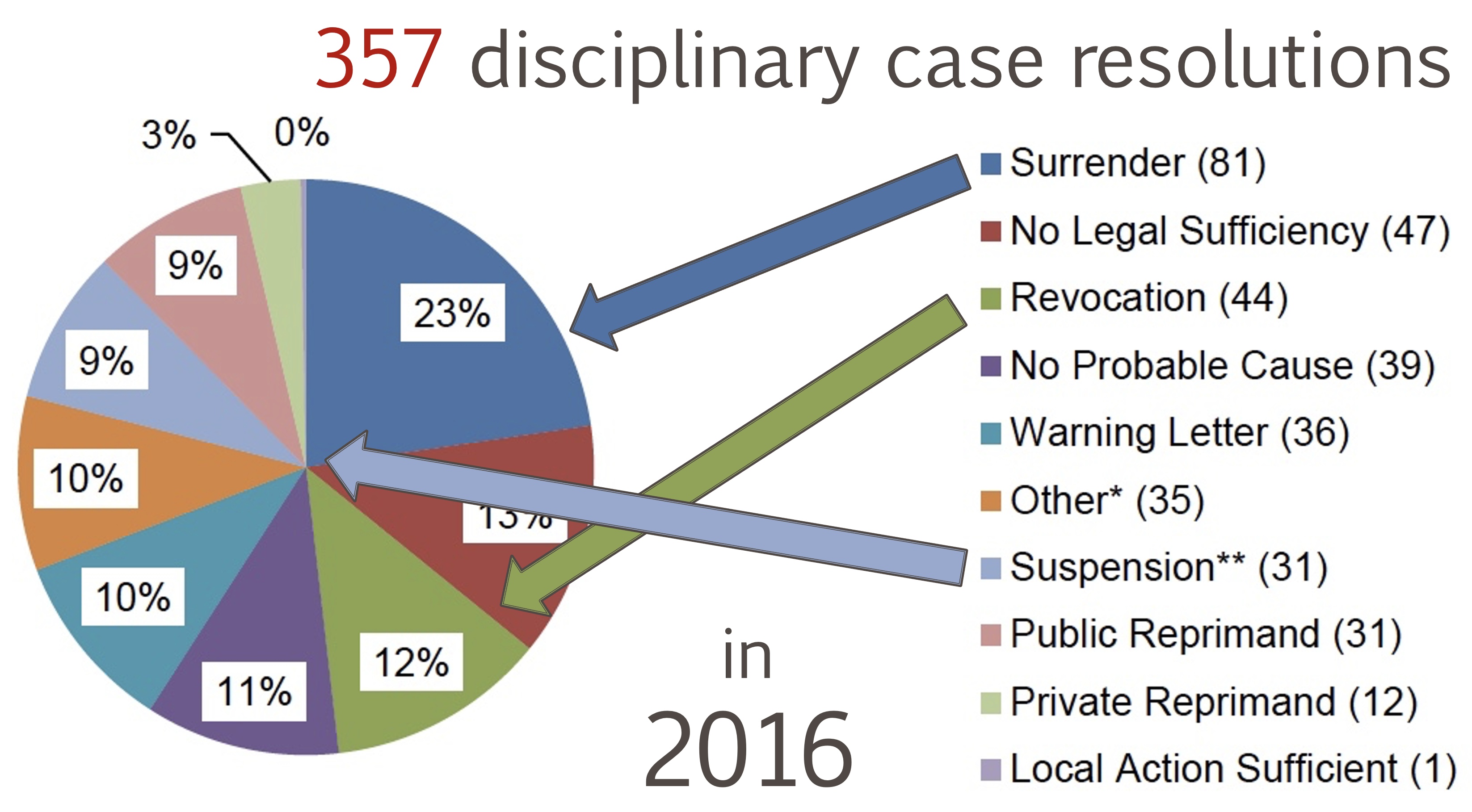
HORRIBLE! These are the number of PA educators by year who had misconduct complaints filed against them. Sure, a majority of their cases were not always fully prosecuted nor did they all result in a “guilty” verdict or plea, as this glimpse of educator disciplinary resolutions for 2016 (out of 672) for comparison shows (statistics from PDE):

But, if you can read the above graphic, that means that in 2016, 156 educators surrendered their license or had their certificate suspended or revoked! Obviously, no matter how you interpret the stats, this is a SERIOUS PROBLEM! And it may be due to a lack of training or understanding of the regulations and principles of ethical decision-making!

Why is this topic crucial for all pre-service, “rookie,” AND experienced professional educators? It is essential… not so much to serve as a reminder of the penalties for ethical infractions or spotlighting the occurrences you read or hear about in the news… but, because ETHICS are what we all stand for, the values we exhibit in our day-to-day decision-making, the integrity of the profession, and our “making a difference” in the lives of the students.

Ignorance of the law is no excuse for breaking it.

(Oliver Wendell Holmes)

The “WHAT!”

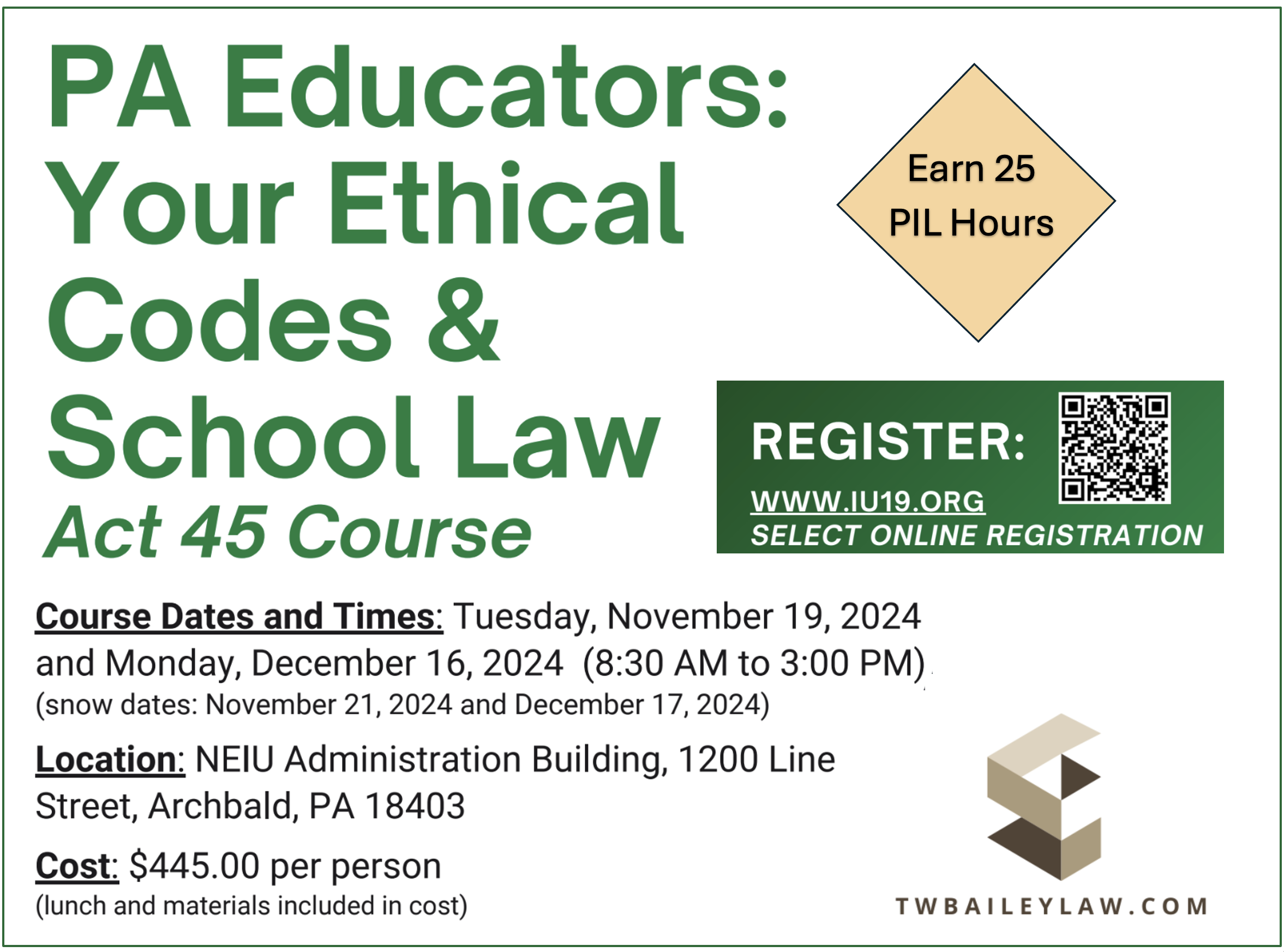
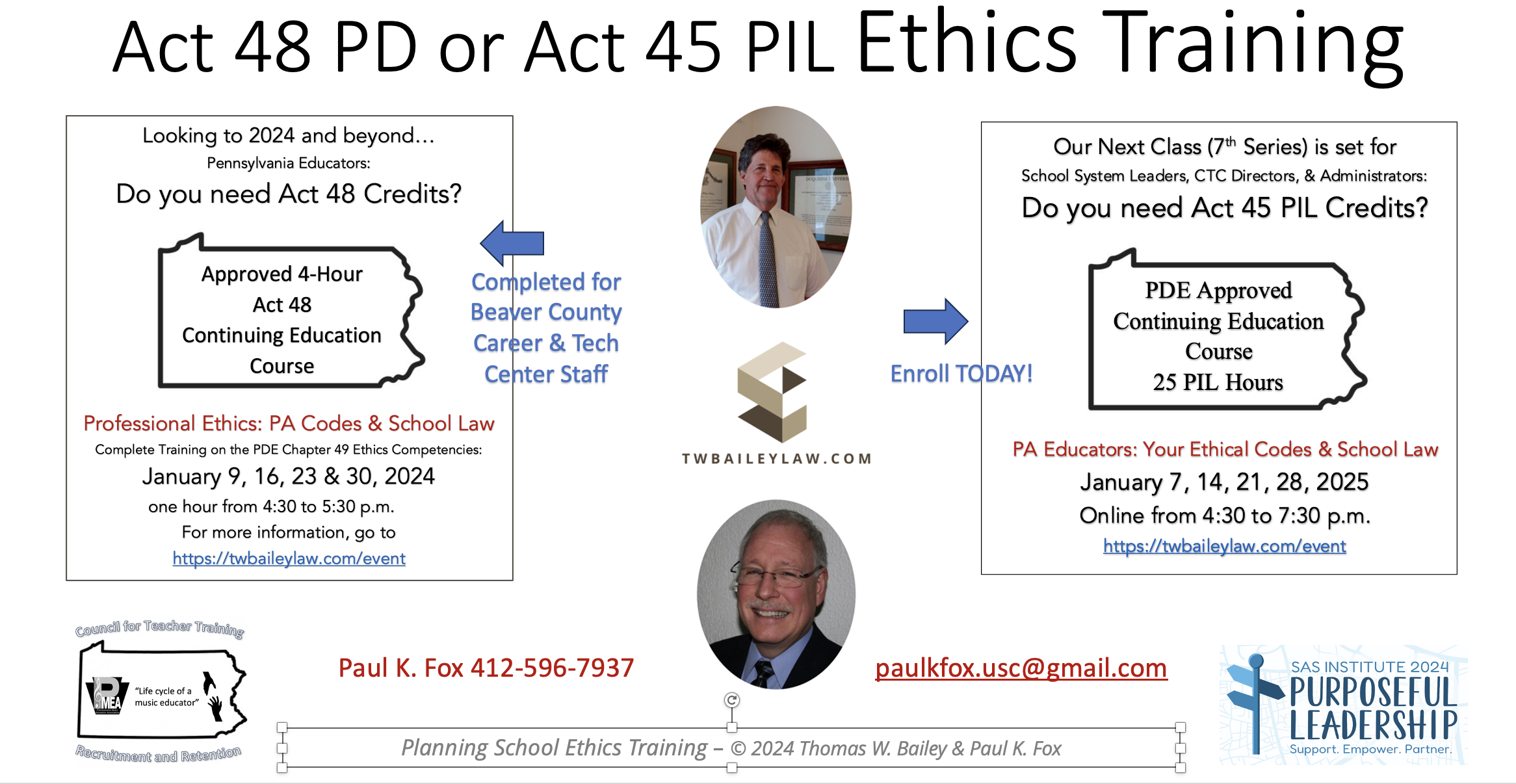
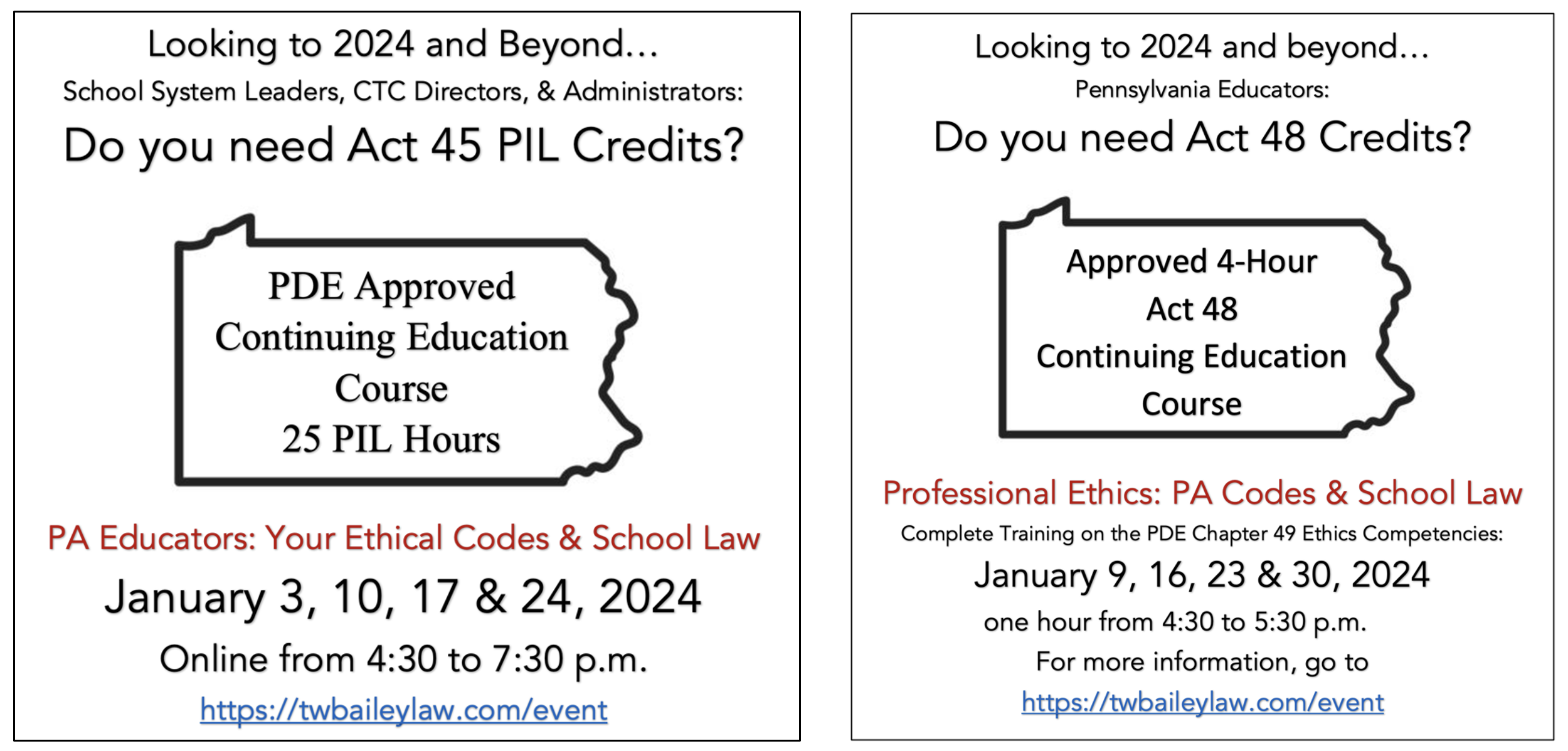
My colleague Thomas W. Bailey, a retired social studies teacher who reinstated his law license, and I set ourselves the goal of creating continuing education courses to provide REAL ethics training for PA educators. Thomas applied to the Pennsylvania Department of Education and received approval for a four-hour online Act 48 continuing education course for all PA educators (earning credits in PERMS) and a 25-hour online Act 45 PIL continuing education course for school system leaders, career and technical center directors, and other administrators responsible for planning the professional development of their school staff. The dates for our next two series of classes with open for enrollment in January 2024 are:

To register for either course, please go to Tom’s website: https://www.twbaileylaw.com/event.

Both of our courses satisfy the recently revised PDE Chapter 49 requirements of learning the “professional ethics” program framework guidelines:

For school system leaders and other administrators, PDE has set high expectations with the release of the following DEADLINES in April 2022:

“Chapter 49 requires instruction in professional ethics to be integrated in educator preparation, induction, and continuing professional development programs as follows.

  • Continuing professional development programs must integrate the professional ethics competencies no later than the 2023-24 academic year.
  • Educator preparation and induction programs must integrate the professional ethics competencies no later than the 2024-25 academic year.

Our Act 45 and Act 48 courses cover the following subjects, definitions, and applications of these terms:

  • Fiduciary
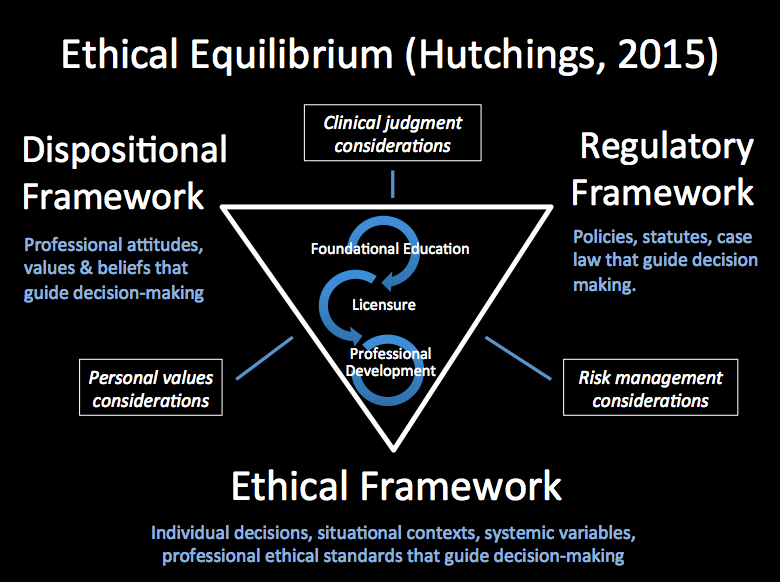
  • Ethical Equilibrium
  • Personal Morality
  • Regulations of Law
  • Professional Ethics
  • Professional Dispositions
  • Moral Professionalism
  • Differences Between Moral and Ethical Standards (with Examples)
  • Codes of Conduct (Examples)
  • Codes of Ethics (Examples)
  • Differences Between a Code of Conduct and a Code of Ethics
  • PA Professional Standards and Practices Commission
  • Paths of Educator Discipline in PA (Local and State)
  • Loudermill Hearings
  • State Discipline System (from Misconduct Complaint to Appeals)
  • PA Code of Professional Practice and Conduct
  • The Educator Discipline Act
  • National Association of State Directors of Teacher Education and Certification
  • Model Code of Ethics for Educators

The “How!”

I know this will sound a lot like bragging, but what makes the Thomas Bailey + Paul Fox ethics courses truly effective and different from everyone else in the game (albeit there are few “classes on the codes” sponsored in our geographic area) is the process – a focus on top-down training (administrator to teacher to student), interactive discussion, and a major emphasis on borrowing from the research of “Principled Teaching” in Domains 4a, 4d, 4e, and 4f of the Charlotte Danielson Framework for Teaching, the Teacher Education And Mentoring (TEAM) Module 5 Guide of the Connecticut State Department of Education, and the Facilitators Guide of the Iowa Board of Educational Examiners.

In my SAS presentation, I review several different modes of case study analysis, from simple to comprehensive, modeling small group interactive peer review, encouraging healthy discussions of diverse opinions in an “open,” non-threatening environment. The following approaches could be adapted to your setting of in-service programs or inductions:

MOCK JURY

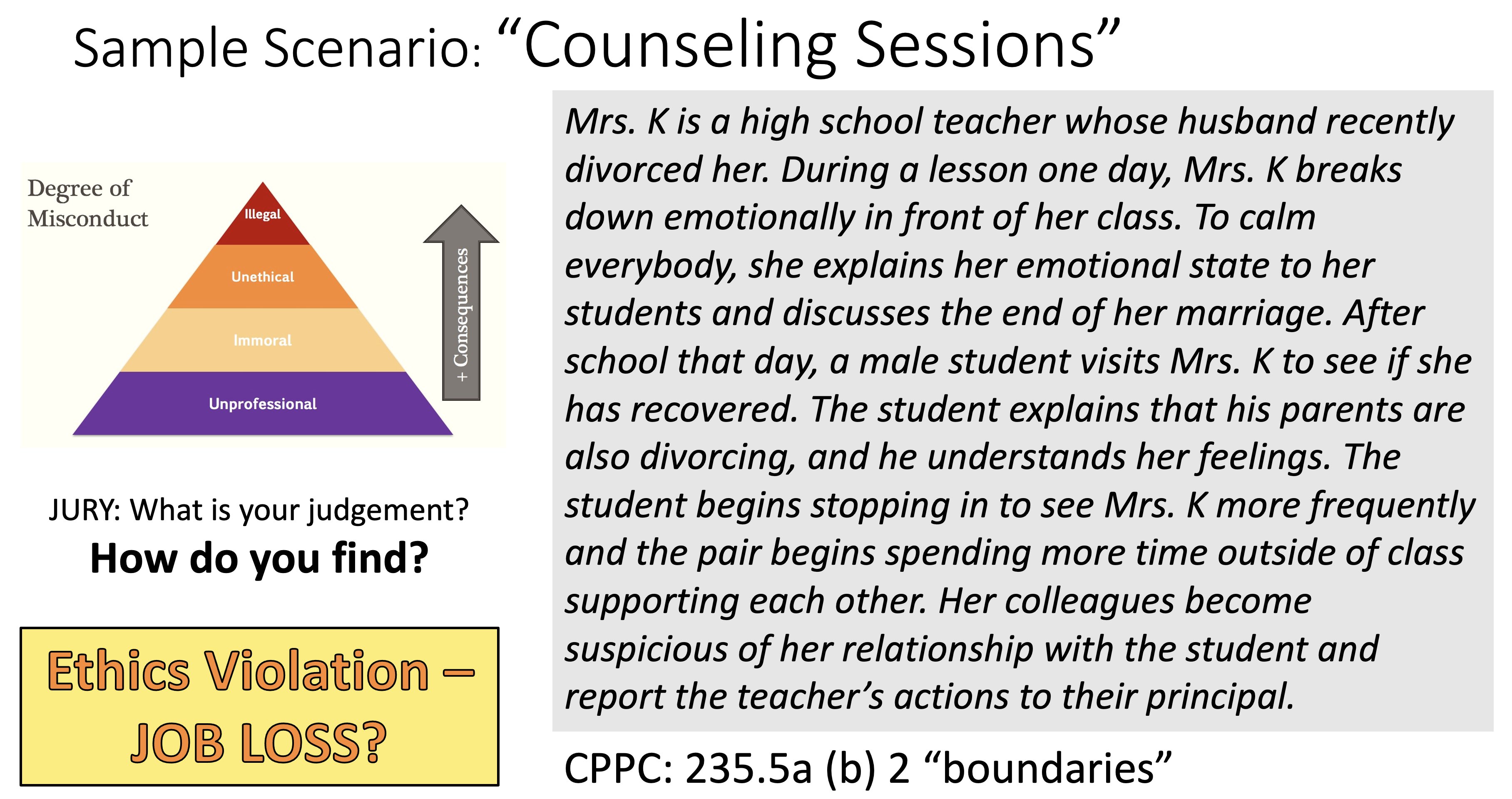
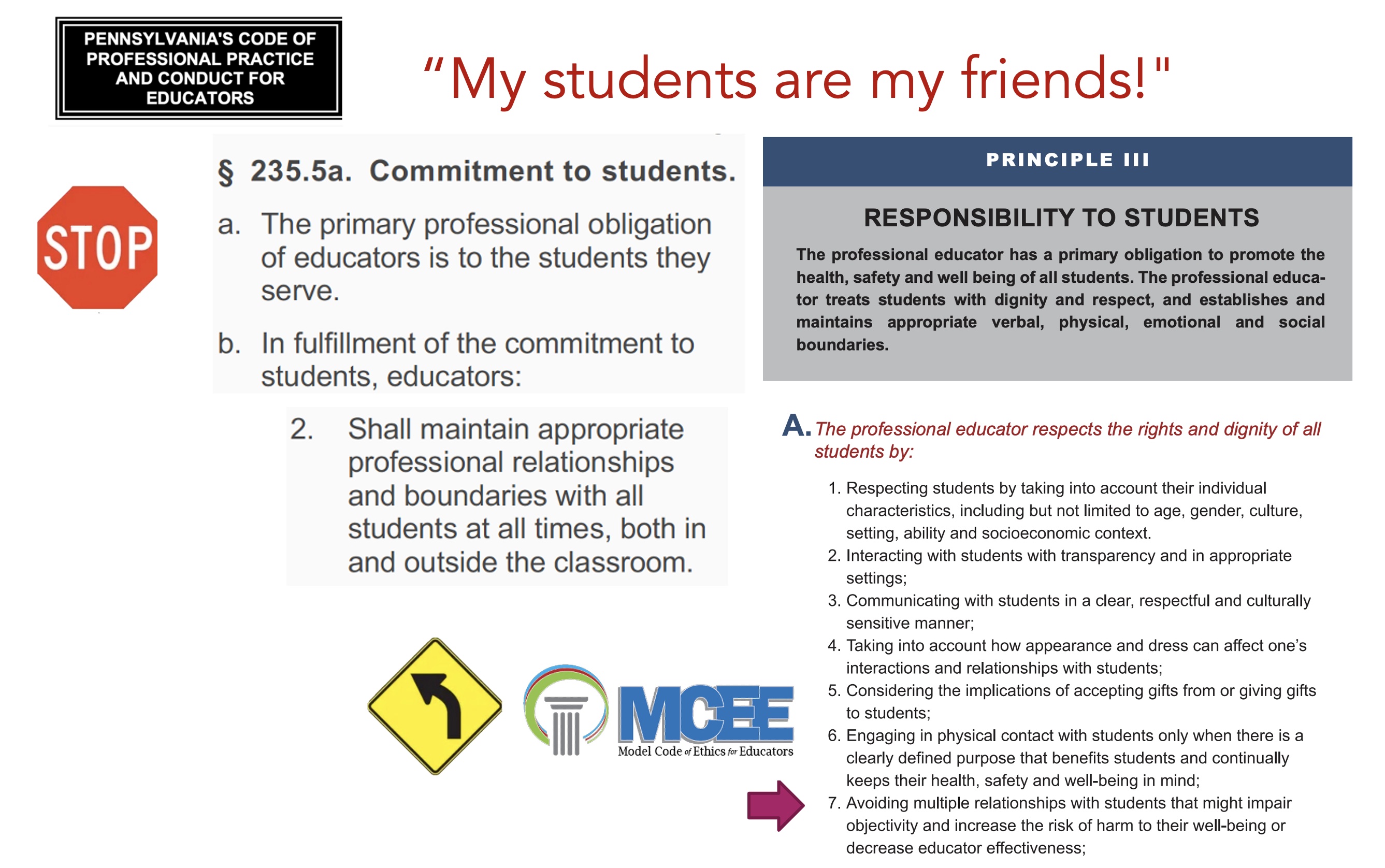
Degree of Misconduct, scenarios for learning the PA Code of Professional Practice and Conduct (CPPC): For more details, revisit the application of my misconduct rubric and explanation in the blog “Ethical Scenarios” here.

In collegiate sessions, I have used color-coded popsicle sticks and handouts of different hypothetical case studies for “the jury” to evaluate the behavior and “find the relevant code” in the CPPC.

VOICES IN MY HEAD

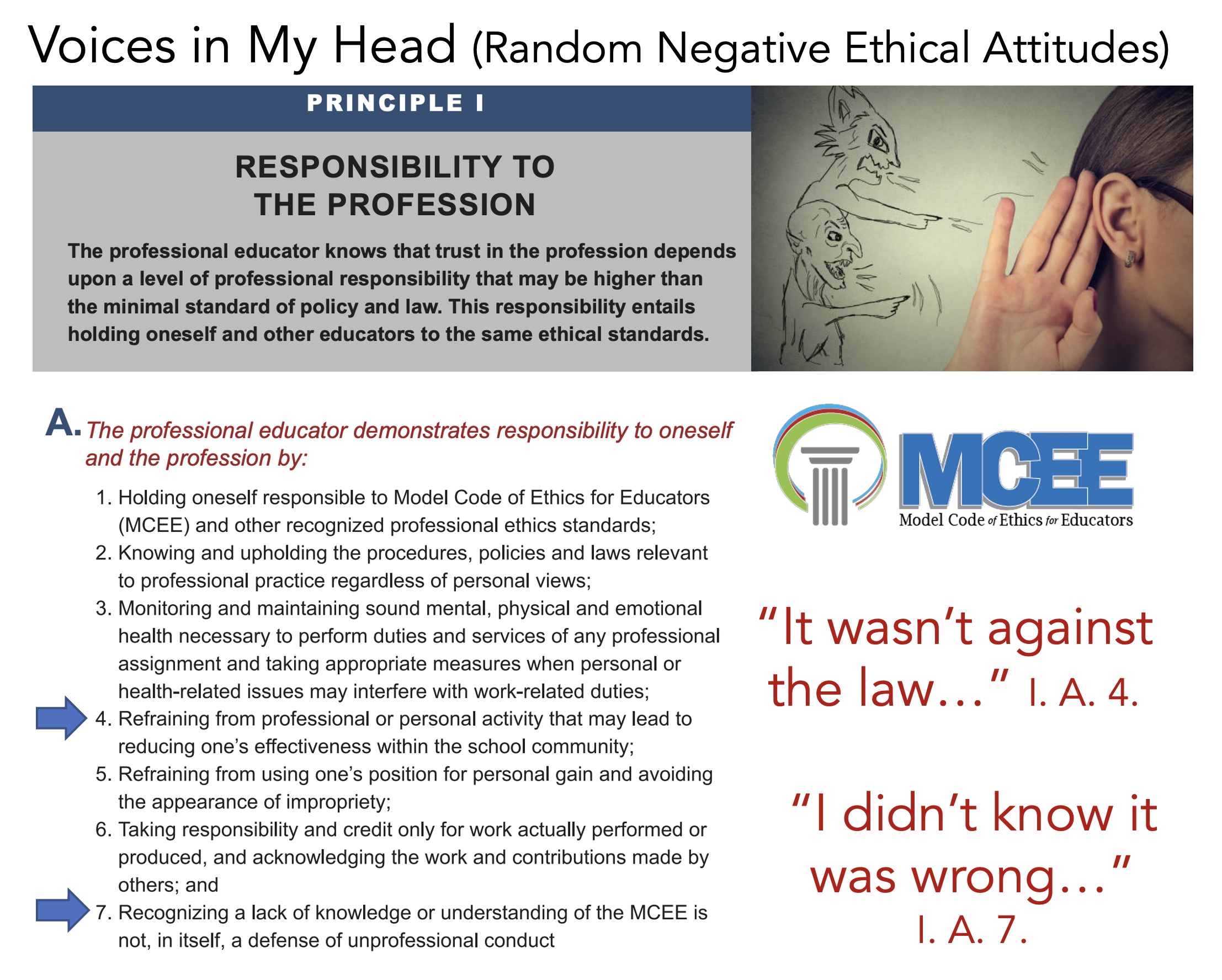
Random Bad Attitudes for review of the standards in the Model Code of Ethics for Educators: I doubt (or sincerely hope) you would not hear too many of these directly from the school staff, but comments like, “Don’t ask for permission, beg for forgiveness” are NOT ethical precepts! Let’s dissect these bad boys!

SEARCH FOR THE STANDARDS

Hybrid Approach for using “the negative voices” and researching appropriate provisions in both the CPPC and MCEE: Select a single bad attitude and break off into two or three teams, each focused on corroborating related ethical principles in CPPC, MCEE, and even the PA Educator Discipline Act (EDA).

ALL CODES

Deep Dive” Case Study Analyses in small group break outs for comprehensive interactive discussions using an adaptation of the questions in the Connecticut State Department of Education TEAM Manual:

  1. What possible issues/concerns might this scenario raise?
  2. How could this situation conflict with school policy, CPPC, EDA, MCEE, or case law?
  3. In this situation, what are some potential negative consequences for the educator’s students, fellow educators, and the school community-at-large?
  4. What responses/actions will result in a more positive outcome and/or what proactive measures might be considered?

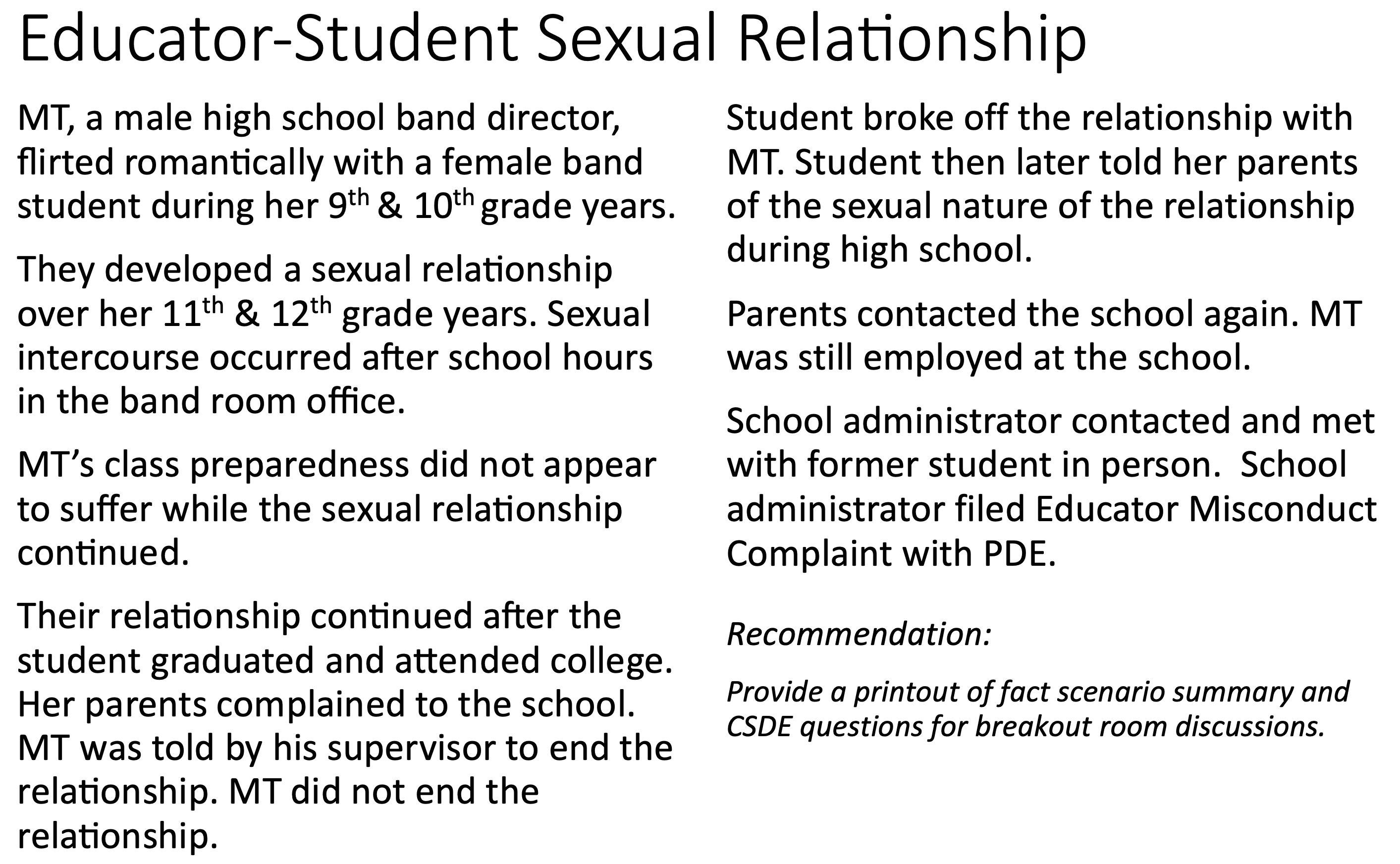
A single hypothetical scenario would first be presented to the full group, and then the educators would break off into 4-6 smaller groups to review these questions. Individuals may or may not all agree. A group leader is usually appointed to record their responses and then upon reconvening, report back to “the whole.” Here is a sample case study (painful reading; fictitious but based on actual past incidents):

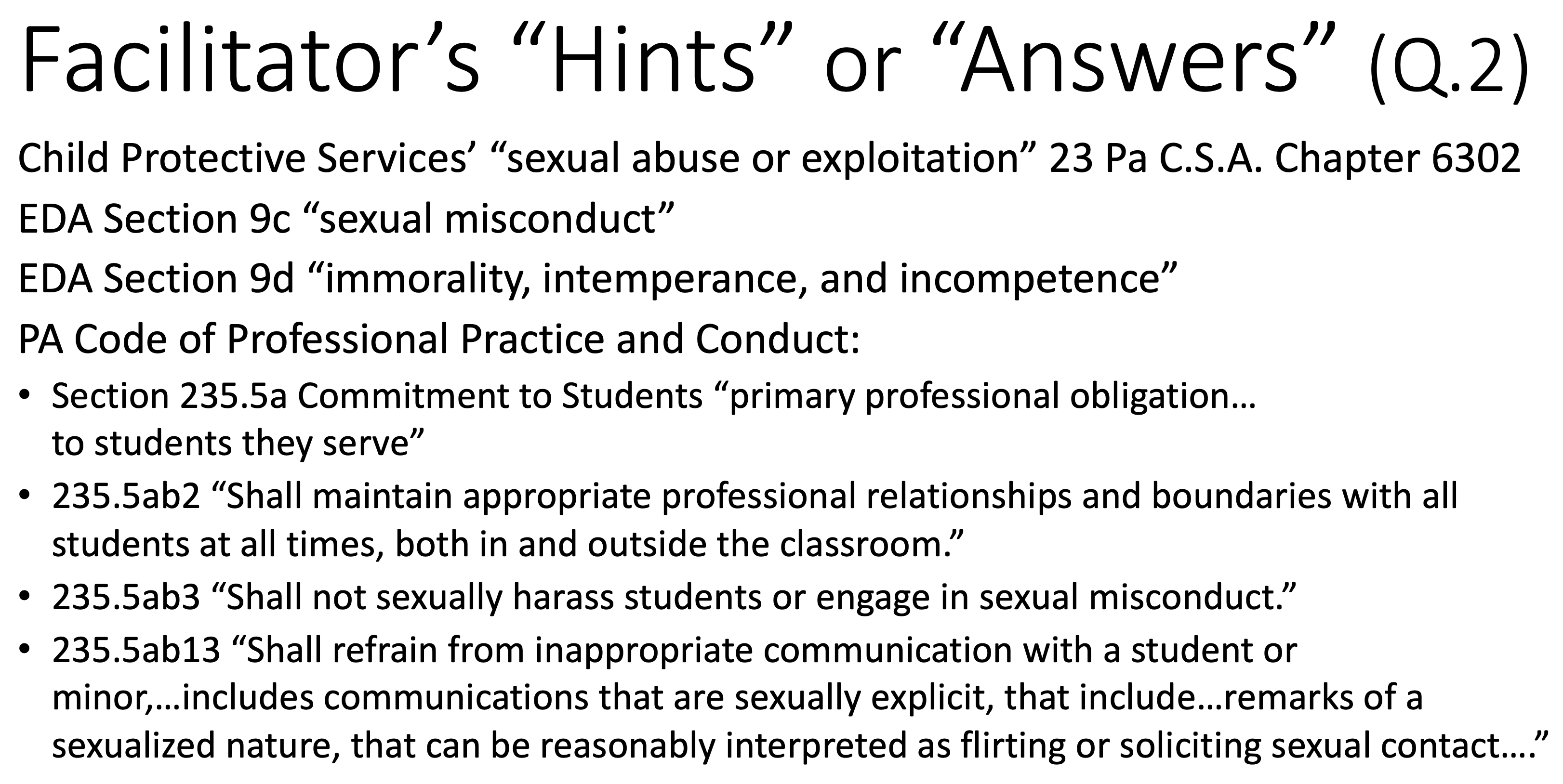
The moderator may promote further discussion (sample answers below) and even pose additional questions like the following:

  1. What if the relationship was always of mutual consent?
  2. What if the teacher never taught the student while she was enrolled in his school?
  3. What if the relationship did not start until after the student graduated?
  4. What if his student was over the age of 18 during the time of the relationship?

It deserves mention here that this final training mode, representing perhaps the highest degree of scaffolding of the learning for the ethics training of your staff, proposes the establishment of a permanent school district Professional Learning Community (PLC) or ethics committee. We know from our past experiences in providing continuing professional development of educators that promote free, open, healthy sharing of potential professional decision-making conflicts or ethical “conundrums” – “what would you do” scenarios – will foster lasting long-term benefits. Danielson Framework for Teaching (Domain 4) and CSDE reinforce this philosophy of peer collaboration.

“Teachers must engage in district-facilitated conversations that focus on ethical and professional dilemmas and their professional responsibility to students, the larger school/district educational community, and to families.”

Connecticut State Department of Education

My educator ethics mentor and “hero” Troy Hutchings, Senior Policy Advisor to the National Association of State Directors of Teacher Education and Certification, admitted that in his early years of teaching, he felt a little reticent about going to his principal for advice in handling a situation of a student developing a “romantic crush” on him. To paraphrase his remarks during his webinar, “I was concerned that my supervisor might think I was encouraging the girl… Who could I turn to?” Sharing these anecdotes and talking informally with other faculty members will go far in building teamwork, mentor-mentee relationships, and intra-building trust in allowing more peer review towards enhanced educator decision-making.

If you need a resource on PLCs, my colleague (PA Principal of the Year to be honored at the upcoming 2023 SAS Institute) Dr. Tim Wagner recommended the handbook Learning by Doing by Richard DuFour, Rebecca DuFour, Robert Eaker, Thomas W. Many, and Mike Mattos (Solution Tree Press, 2016).

The authors’ summary of reasons to implement a PLC in your school building(s) are to:

  1. Improve staff’s individual and collective practice
  2. Build on staff’s “shared knowledge and experiences”
  3. Build clarity and understanding in the use of a common vocabulary
  4. Develop a library of accessible tools, templates, and protocols (i.e., ethical scenarios)
  5. Promote non-threatening, thought-provoking discussion on ethical decision-making

Wrapping It Up with More Resources

Every school setting is different, and your application of these staff ethics training ideas will be unique. Hopefully I have given any interested PA school system leader, CTC director, professional development or building administrator, or department chair some “food for thought.” For example, if you wanted to set up a PLC to meet regularly to discuss ethical issues, many of you may need to involve your teacher’s professional association and/or review their contract… or perhaps on-your-own implement a rotation of educators to experience these case study discussions during pre-scheduled inservice or induction days.

For “the keys to the car” to build your own local ethics professional development programs, we encourage you to sign-up for one of our classes here. For our PIL series, Thomas Bailey shares the native files of his PowerPoint presentations so that they can be turned around and taught to other educators, and then even students who are studying their own discipline code or online anti-bullying school policies. Here is an image of our PIL brochure which will be offered beginning on January 3, 2024.

I also suggest perusing Thomas Bailey’s free videos on this topic, slide #61 (page 31) from the handouts to my SAS Institute presentation (above), and these links to other blogs on paulfox.blog.

NOW YOU HAVE IT… the entire toolkit and rationale… the “who, what, how, and why” of educator ethics training and satisfying the new PDE Chapter 49 “PE” competencies.

© 2023 Paul K. Fox

Bookends – Part One

The Life Cycle of a Successful & Happy Music Educator

“There are no secrets to success. It is the result of preparation, hard work, and learning from failure.”

Colin Powell

I feel blessed to have spent five decades in the field of music education. No other career has offered so much personal satisfaction, discoveries and growth of hidden potentials and skills I never knew I had, sharing my love of creative self-expression, and facilitating others to seek their own connections to music. I am trying to follow my own “retirement” advice, remaining active in the profession in ways that matter, helping others find their own success, and embracing author Ernie Zelinski’s mantra to “find purpose, structure, and community” throughout my years as a retiree.

Parallel to the mission of the Pennsylvania Music Educators Association Council for Teacher Training, Recruitment, and Retention, serving “the life cycle of a music educator,” this blog site is my “gift” to future and current music educators and those contemplating retirement. Recently, I presented a workshop on this topic for student teachers in music education at Seton Hill University (Westmoreland County, Greensburg, PA), summarizing a framework for “professional development for life” in order to foster these goals and nurture meaningful successes of pre-service music educators. No “road map” (or to retain the analogy in my title, “library” of resources) is applicable to everyone nor will the journeys/readings be the same… but since my collections of past blogs over ten years are now vast, I offer this simplified checklist for any “newbie” interested to seek their own pathway. Happy travels!

  1. Preservice/Training Years: Marketing, Interviewing, & Networking
  2. Rookie/Practicing Years: Ethics & Professionalism 101
  3. Inservice/Growing Years: Career Development (next blog post)
  4. Veteran/Sustaining Years: Time Management & Self-Care (next blog post)
  5. Next Chapter/Living the Dream Years: Retirement Prep & Mastery (next blog post)

The slides to the entire presentation are open to anyone to view below.

However, here’s a shamelessly offered advertisement. It would make more sense to see this “in-person” or online with my moderation. I would be happy to present this session (giving me at least an hour to allow for more interactive discussion) to collegiate members, a music education methods class, a regional workshop, or festival meeting via Zoom or in-person (in PA). If interested or to inquire, please send me an email here.

Now… the checklists. Depending on your current status and interests, peruse the following resources. It is possible a few of the links contained within these blogs have gone inactive, but I believe enough is there for you to gain the insight, tools and motivation to achieve “professional development for life.”

Stage 1 – Preservice/Training Years

The focus during our early years in any profession is learning the “shtick” and getting ready for the job search and interviewing. Probably before anything, we revisit our inspiration and what Simon Sinek directs us to “the why” of any organization… in this case, “the why” of becoming a music educator – our philosophy, mission, vision, and understanding of the purpose/role of music education n the schools.

[ ] 1. The Meaning of Pro: Are you a professional? Do you have the skills, habits, and attitudes of a professional in the field of education?

[ ] 2. Marketing Yourself and Your Pre-K to 12 Music Certification: What is your professional “brand?” Do you plan to “sell” yourself as a specialist, e.g., “band director” or “elementary general music teacher, etc.? To those potential job candidate screeners, promote the image of being proficient – “a total music educator” – and don’t emphasize your major/emphasis or perceived skill or experience limitations. The only thing that really matters is whether you are the “right fit” for a particular opening, and of course, deciding whether or not to accept the offer. Your license (certification) implies that you do indeed have the necessary training to teach all K-12 music classes. Don’t sell yourself short!

[ ] 3. Criteria for Selection of the “Ideal” Teacher Candidate: The best way to prepare for a job interview is to become aware of how you will be judged in comparison with your peers. What are the standards (or behaviors or criteria) of outstanding teachers? For what are administrators looking to fill the vacancies and build/maintain a quality staff?

[ ] 4. “S” is for Successful Storytelling: The number one method to land a job is “SHOW, don’t TELL!” Stories are up to 22 times more effective than facts alone. Identify the key impressions you want to convey. Pick interview stories that will “sell” the right message. Learn how to share unique personal examples of your interactions with children, colleagues, and music programs. These additional resources can be shared about “strategic storytelling” and how to prepare (a.k. practice) telling your anecdotes:

[ ] 5. The Ultimate Interview Primer for Pre-Service Music Teachers: This super-packet has a collection of more tips on marketing yourself and mastering the “science” of finding a job, interview strategies and sample questions, evaluative rubrics, follow-ups, “bad habits” to avoid, etc. Take the time to download and explore these excellent tools!

Homework for Stage 1 – Developing a Marketing Plan

  • Standards: Define your personal mission, goals, and philosophy for teaching music, modeling the highest ideals of professionalism, and becoming the “total music educator.”
  • Marketing: Design and distribute a “state-of-the-art” résumé, e-portfolio, website, and business card.
  • Skills: Compile a list of anecdotes and true stories of you overcoming challenges, solving problems, and demonstrating  “best practices” of professionalism and self-improvement.
  • Assessment: Practice, record, and evaluate yourself answering job interview questions.

Stage 2 – Rookie/Practicing Years

[ ] 6. Ethics for Music Educators – Part I, Part II, and Part III: You may think that the primary focus for our early years as a novice teacher would be the reinforcement of what we learned about education – curriculum, content, methods, classroom management, and assessment, but something else trumps all! Before we ever step foot in a classroom, rehearsal room, or stage, it is essential we first review those ethical standards in education, terminology, philosophy, and “the codes” that bind us. We should be able to show in depth understanding of these concepts:

  • Fiduciary
  • Moral Standard
  • Ethical Standard
  • Ethical Equilibrium
  • Moral Professionalism
  • Differences Between a Code of Conduct and a Code of Ethics
  • Student-Teacher Boundaries and the Slippery Slope of Ambiguous Relationships
  • Function/Relevance of “The Codes” to Daily Teacher Decision-Making

For nearly every presentation I do on “ethics for pre-service music educators,” I hold up a fifty dollar bill and ask, “Who wants this? Can you name the exact title of your state’s code of conduct for educators and the government agency that enforces it?” So far, no one has made me $50 poorer. Indeed, few active teachers “in the trenches” have read their “codes,” and frankly, that is surprising. Violation of any major provision in our code of conduct will result in a serious reprimand, being fired, losing one’s certificate to teach anywhere, and/or criminal/civil prosecutions. Wouldn’t you think all of us would be intimately familiar with the “rules” of our professional?

For my Pennsylvania colleagues, please download and READ these:

[ ] 7. Ethical Scenarios (and More): The study of morality in professional decision-making is essential to pre- and in-service training of music teachers. Our goal should be to reinforce recommendations for the avoidance of inappropriate behavior (or even the appearance of impropriety), and defining and modeling the “best practices” of a serving as a “fiduciary” by promoting trust, fostering a safe environment for learning, acting in the best interests of our students, and upholding the overall integrity of the profession.

One of the best ways to accomplish this is to discuss ethical scenarios in small peer groups, an interactive exchange of opinions – “what would you do?” – in analyzing hypothetical case studies. Perhaps in a college methods class, student teaching seminar, department meeting, faculty committee, or PLC (Professional Learning Community), the following thought-provoking questions from the Facilitator Guide for Professional Responsibilities – Module 5, written by the Connecticut State Department of Education T.E.A.M. (Teacher Education & Mentoring) manual should be discussed in an open, reflective, nonthreatening setting:

  1. What possible issues/concerns might this scenario raise?
  2. How could this situation become a violation of the law, the “Code” or other school/district policies?
  3. In this situation, what are some potential negative consequences for the teacher, students, parents, and/or school staff?
  4. How would this episode affect a teacher’s efficacy in his/her classroom, demean the employing school entity, or damage her position as a moral exemplar in the community?

Please visit link #7 (above) for sources of ethical scenarios to study, including my “conundrum series.”

Homework for Stage 2 – Are you an Ethical Educator?

  1. Self-assess your own habits of professionalism, and identify goals for at least two “personal improvement projects.”
  2. Read “cover-to-cover” any documents relating to your own state’s code of conduct and the NASDTEC Model Code of Ethics for Educators.
  3. Discuss the ramifications of “choices” and teacher decision-making in context by reading a few of the fictitious scenarios highlighting ethical precautions, disputes, and “conundrums.”

Coming Soon…

Bookends Part Two

PKF

© 2023 Paul K. Fox
Teacher Self-Care During the Pandemic

We thought our next article in this series on music teacher health and wellness was going to center around burn-out. But then… COVID-19 struck (was this really only 3-4 months ago?), we were forced into self-isolation, and all “brick and mortar” schools closed. In the ensuing panic, we all scurried about seeking solutions to reconnect and engage our students from afar in compliance with strict shelter-in-place restrictions.

“Seemingly overnight, the world changed. Teachers and school leaders have had to revamp their entire instructional systems with, in many instances, only a day’s notice. To say many of us are experiencing whiplash, disorientation, and anxiety is an understatement.”

virus-4928021_1920_HoagyPeterma“Our students are feeling it too. Typically, nationwide, one in three teenagers has experienced clinically significant anxiety in their lifetime (Merikangas et al., 2010). It’s probable that during a pandemic that heavily impacts everyday life, levels of anxiety in children and teens are even higher, and the possibility of subsequent trauma greater.”

“In these unprecedented times, teachers are rising to the occasion creatively and quickly to shift to remote learning amidst school closures. Even in a traditional classroom, it can be a challenge to support students with anxiety and trauma histories to stay calm and learn. With distance learning, this difficulty is magnified. However, there is much teachers can do to reduce anxiety in students even while teaching remotely. During this crisis, we need to prioritize students’ mental health over academics. The impact of trauma can be lifelong, so what students learn during this time ultimately won’t be as important as whether they feel safe.”

“Maintaining Connections, Reducing Anxiety While School Is Closed” by Jessica Minahan in ASCD Educational Leadership, Summer 2020

My opinion? The Internet and other forms of media can be a godsend or a contributing factor to our feelings of malaise. The 24/7 nature and immediacy of news programs and web posts updating the statistics of new coronavirus cases, hospital admissions, deaths, shortages of personal protection equipment and respirators, unemployment numbers, and the stock market’s roller-coaster ride, have added fear, stress, and “noise” to the real problem… our ability to cope with the ramifications of this pandemic!

Well, at least a lot of dialogue has been generated “out there” about recommended remediation and “success stories.” The purpose of this blog-post is to share some of this “advice from the experts.” Many of you (I hope) may say, “This is just common sense.” True, but however “common” it is, more people than you think are not applying these principles to their own personal lives. And like the one online post that caught my eye the other day, “Teachers Are Breaking” by Jessica Lifshitz, all of us should share our anecdotes… the trials, internal struggles, and tribulations… to make it through this emergency.

Together, we are stronger!

books-4843726_1920_Myriams-Fotos

I have been accused of being a little too emotional and I should not “feed into the negativity,” as one reader complained in reaction to one of my blogs. However, according to this article by Christina Cipriano and Marc Brackett, “emotions drive effective teaching and learning, the decisions educators make, classroom and school climate, and educator well-being.”

“At the end of March, our team at the Yale Center for Emotional Intelligence, along with our colleagues at the Collaborative for Social Emotional and Academic Learning, known as CASEL, launched a survey to unpack the emotional lives of teachers during the COVID-19 crisis.”

“In the span of just three days, over 5,000 U.S. teachers responded to the survey. We asked them to describe, in their own words, the three most frequent emotions they felt each day.”

“The five most-mentioned feelings among all teachers were: anxious, fearful, worried, overwhelmed and sad. Anxiety, by far, was the most frequently mentioned emotion.”

Navigating Uncertain Times: How Schools Can Cope With Coronavirus

Almost in unison, the strategies that seem to be echoed most often by medical and mental health professionals, educators on the front line, and even technology specialists, are outlined by this “wellness map of to-do’s!”

  1. Don’t obsess. Calm yourself. Set priorities.
  2. Connect and communicate often with your family members and your students.
  3. Set and maintain boundaries.
  4. Practice mindfulness.
  5. Take the necessary steps to maintain your own physical and mental health!

burnout-4778253_1920_Tumisu

Avoiding Becoming Overwhelmed

As a retiree, I “only” lost the spring season of my community youth orchestra to this crisis. In my position as state chair of the PMEA Council Teacher Training, Recruitment, and Retention (PMEA Council TTRR), I tried to soothe the “hysteria” of many of my still-working friends and colleagues who were grappling with the instantaneous roll-out of distance learning. After researching online music education resources, we were able to place countless links on the PMEA Council TTRR website (here). After 7+ weeks, one of our “omnibus Google Docs” has grown to 15+ pages and more than 225 separate sources of virtual, remote, and alternative music learning media and methods.

computer-768608_1920_free-photosFor some, this has made matters worse… an “overload of abundance!” The multitude of venues and opportunities (too many unexplored “new technologies” for many of us baby-boomers!) included information about virtual ensembles, YouTube libraries, music games, lessons plans and platforms for synchronous and asynchronous e-learning, video-conferencing techniques, hardware and software reviews, etc.

Take a deep breath! Focus! Prioritize your goals. What are you trying to accomplish? Don’t try to consume all of the available resources “out there,” nor use every application or online lesson that you find on Facebook groups like https://www.facebook.com/groups/mecol/. What was it my mother used to say at the dinner table? “Sip and chew slowly… don’t gulp!” Take away what might help your situation, but approach anything brand new in moderation!

online-5059831_1920_TumisuGo ahead and sign-up for a webinar or planned learning community meeting or two. Many professional development workshops are provided with “no extra fees” right now, like the NAfME library here, the aforementioned Facebook group and others, and if you already have a membership in PMEA, this website.

BUT… plan to take away ONLY one or two new “teaching tools” from each session… maybe consider trying-out one new app or lesson idea every other week?

As if to anticipate our needs, more than a year ago, Elena Aguilar published the in-depth piece “How to Coach the Overwhelmed Teacher” in Education Week blog, summarizing excellent stress-reduction treatments. (Share these if you think they will help you or some else! Read the entire article for more detail!)

desperate-5011953_1920_Peggy_MarcoFive tips for coaching overwhelm:

  1. Describe it.
  2. Recall previous experiences.
  3. Identify one tiny next step.
  4. Listen.
  5. Plan for action.

“When coaching someone experiencing strong emotions, it’s important to know the signs and indicators of depression and anxiety disorders. Emotions can turn into moods, and if moods hang around long enough, they may become depression or an anxiety disorder. People who feel overwhelmed a great deal may be experiencing depression, whereas those who are ‘stressed’ a lot may be experiencing anxiety. This resource, AppD Depression_Anxiety.pdf, can be offered to your coachees or used to consider whether someone may need professional help.”

“When coaching any strong emotion, it’s useful to remember that emotions can be guides to self-understanding. They are a normal part of being a human being, and strong emotions show up to get us to pay attention to what’s going on. We can welcome strong emotions—in ourselves and in our coachees—and explore them to gain insight into ourselves and humans and educators.” — Elena Aguilar

coronavirus-4991979_1920_enriquelopezgarre

Making Connections

Your loved-ones and friends probably need you now more than ever!

And, a myriad of research supports the assertion that social connections significantly improve our own physical and mental health and emotional well-being, such as published by the “Center of Compassion & Altruism Research & Education” of the Stanford Medical School:

“Strong social connection leads to a 50% increased chance of longevity, strengthens your immune system (research by Steve Cole shows that genes impacted by loneliness also code for immune function and inflammation), helps you recover from disease faster, [and] may even lengthen your life!”

“People who feel more connected to others have lower levels of anxiety and depression. Moreover, studies show they also have higher self-esteem, greater empathy for others, are more trusting and cooperative and, as a consequence, others are more open to trusting and cooperating with them. In other words, social connectedness generates a positive feedback loop of social, emotional and physical well-being.” — Dr. Emma Seppala

There’s even evidence that “human touch” and close connections with other people increase our body’s levels of the beneficial hormones serotonin and cortisol.

Just more common sense? Right? Probably!

human-2944064_1920_geralt

The first thing I did during that initial announcement of school/activity closures was to reach-out to my “musical kids.” Many music directors told me they quickly sponsored a Zoom/Google Hangout meeting of their ensemble members, mostly just to check-in with their players or singers and get everyone “on board” for future online interactions.

Perhaps COVID-19 has made me a better “citizen,” too. Much more frequently, I now call or text a friend, colleague, volunteer co-worker, or neighbor to see how they are doing. It’s terrible to admit that it took a world disaster to improve my interpersonal communications skills!

Finally, here’s a good “recap.” In spite of the need for social distancing, these examples of “safe connections” are suggested by Jennifer Wickham from The Mayo Clinic:

  • Use electronics to stay in contact with friends, neighbors and loved ones. This could include using video-conference programs, making voice calls instead of sending texts, or talking with a neighbor through windows while maintaining a safe distance.
  • Spend quality time with the people you live with, such as playing board games or completing an indoor project.
  • Make a family meal or dessert recipe that reminds you of friends or family you are unable to visit, and then call them to tell them about it. This way, you get an experience of internal and external connection.
  • Write in a journal about your experiences during this time of social distancing. Not only will this help you sort out what you are thinking and feeling, but also it can be shared going forward as a way for future generations to connect with the past.

timetable-2467247_1920_Comfreak

Setting Boundaries

Something else I admit to NOT doing!

“Going Google,” “exploring e-learning,” or “doing digital” –  it is easy to get carried away and not notice you just spent 12 hours in-a-row of “screen time” participating in online meetings or creating new remote learning opportunities for your music students. Exactly when are your classroom and office hours? You are likely pushing yourself too hard, even in your pajamas! This insane pace will only promote other health concerns!

The foresight of Elisa Janson Jones was evident for writing this in her blog “7 Self-Care Strategies to Prevent Burnout” back in September 2018 before the pandemic:

bulletin-board-3233653_1920_geralt“It’s hard to create a work-life balance when life is filled with work. Teachers are known for working long hours off-the-clock for no additional compensation. This is even more prevalent in music education. We add performances, competitions, musicals, individual lessons, fundraising, data entry, and even music composition and arranging to our task list.”

“We may find pride in saying we worked 60 hours this week, flaunting to our friends that we got to school in the dark and left in the dark. Perhaps we find self-importance in their pity and admiration.”

“However, to thrive in our profession, we must remember that teaching music is our career, not our entire life. Hobbies, families, volunteering, and other ways we contribute to our communities and our homes are also aspects of who we are.”

“Setting clear boundaries between when we are working for our paycheck and when we are working for ourselves helps us carve out space where we offer ourselves time to be free of obligations and burdens of our career. Whether it’s a few hours per day, a full day per week, or both, setting strict boundaries for when you’re on-the-clock and when you’re off is essential.” — Elisa Janson Jones

yoga-4595164_1920_laurajuarez

Mindfulness and “Living” in the Present

Another concept that Elisa Janson Jones covered in her Smartmusic blog: mindfulness.

Now is the time for a little nonjudgmental “free reflection,” or what the psychologists call the best practice of “mindfulness” – a focus with full attention on your thoughts, feelings, and sensations “in the moment.” I think the “Teaching with Orff” website really nailed it in the article “7 Self Care Tips for Quarantined Music Teachers.”  Read co-author Zoe Kumagai’s examples of affirmations: “How do I want to feel today?”

  • I allow myself time and space to reflect.
  • My mind is aware of the present.
  • My heart feels compassionate and is full of love.
  • My mind is stimulated by books, stories, art, scholarly articles, music that inspire me to be my best self.
  • I maintain boundaries with technology and intake of the news.
  • My body is free to dance.
  • My voice is clear to sing, laugh and converse authentically.

According to this Harvard Medical HelpGuide, the habits and techniques of mindfulness can improve well-being, physical health, and mental health:

“There is more than one way to practice mindfulness, but the goal of any mindfulness technique is to achieve a state of alert, focused relaxation by deliberately paying attention to thoughts and sensations without judgment… Allow thoughts to come and go without judgment and return to your focus on breath or mantra.” — HelpGuide

Band director, best-selling author, and acclaimed clinician Lesley Moffat devoted an entire chapter to mindfulness in her book I Love My Job But It’s Killing Me. You know what they say, “What’s good for the goose is good for the gander.” After learning the techniques for herself, she adopted mindfulness practice at the beginning of each band rehearsal for her students, a 4-5 minute routine of guided breathing and relaxation exercises leading up to the daily warmup chorale.


snowglobes-437383_1920_jojokejohn

I love the symbolism in her “snow globe” analogy:

“Just like a snow globe that’s been shaken up, it takes time for your mind and body to settle down. If you try to get the snow globe to settle down while you’re still holding it and carrying on with your regular activities, the snow may fall slower, but it won’t completely stop and allow you to see the objects in the snow globe. You must allow it to be completely still long enough for the water to stop swirling and the glitter to follow the pull of gravity and settle on the bottom. It only takes a matter of minutes until it settles, revealing the magical scene inside, and the very glitter that was covering up the view when it was moving around has become a lovely blanket of snow that grounds the scene in the snow globe. But without a few minutes of stillness, it is impossible for it to become completely settled. So it goes with a mindfulness practice. Your mind and body needs time to go from hyper-speed to a pace that serves you well, a place where you have space to think – and space to not think. That begins by bringing stillness to your body and to your mind. Easy to say – hard to do… until you practice it every day and it becomes habit.” Lesley Moffat

Love the Job, Loss the StressHer book should be required reading for all music teachers, even retirees who want to remain active in the profession. (Read my previous review here.) It serves as a true treasure-house of practical applications for de-stressing and re-centering your life. Her “mPower Method of Meals, Movement, Music, and Mindfulness” may be the solution to improving your situation.

FYI, her next book, Love the Job, Lose the Stress, is on the way. You can request an advance e-copy here.


“Do as I Say… Don’t Do as I Do!”

The worst part of this? We seldom take our own advice. Hey teacher, “heal thyself,” and “practice what you preach.” Taking care of our children or elderly relatives, we are probably the last to comply with the tenets of our own sermons on health and wellness.

Lesley Moffat also devoted a chapter in her book to the airline safety bulletin “Put On Your Own Oxygen Mask First.” You cannot take care of someone else (your family members or your music students) unless you first take care of yourself!

salad-374173_1920_stevepbMake self-care PRIORITY ONE for YOU! I know, you have heard all of these before:

  • Eat a balanced diet.
  • Hydrate.
  • Get enough sleep.
  • Exercise daily.
  • “Flex your brain.”

The latter “exercising your mind” is referenced in the Teaching with Orff website, and is a frequent emphasis on my blog-site (with examples here, here, and here). Pursue your own avenues of creative self-expression, and grow and learn something new every day!

According to charitable organization Waterford.org, the definition of “self-care” is “any action that you use to improve your health and well-being.” They cite extensive research from the National Institute of Mental Illness (NAMI), corroborating the statement that there are six elements to self-care:

  • Physical
  • Psychological
  • Emotional
  • Spiritual
  • Social
  • Professional

self-care-4899284_1920_Wokandapix

And, as explained in the article “Why Teacher Self-Care Matters, and How to Practice Self-Care in Your School,” self-care is not about selfishness.

“Self-care is an important component of a teacher’s mental health, but there are misconceptions about what it is. It’s common for educators to dismiss the self-care movement as ‘selfish’ or ‘superficial.’ But for teachers, self-care is so much more than breakfast in bed or treating yourself to a spa day. It’s about taking care of your health so that you’re prepared to be the best teacher you can be for yourself and your students.”

Waterford.org

These endorsements probably represent just “the tip of the iceberg!” Peruse all of the resources listed below. In addition, perhaps we should take a close look at Alex Wiggin’s ASCD article,  “A Brave New World: A Teacher’s Take on Surviving Distance Learning” (Educational Leadership, Summer 2020), considering the adoption of these four lessons learned from the past four months:

  1. Relying on a team reduces work and stress.
  2. Connecting with students boosts morale.
  3. Learning new technology isn’t so bad.
  4. Model being a life-long learner

I predict that the hardest part, coming to the end of May and the completion of our first-ever “virtual spring semester,” is coming to grips with our “fear of the unknown!” At the date of this writing, no one really knows when “we” are going back to “in person” schools, how we will resume large group music instruction like band, choir, or orchestra rehearsals, and what will the “new normal” look like to successfully “move on!”

Summer break is just around the corner… a good time to stop and reflect! And yes, we will make it through this.

Please stay safe! PKF

park-5040260_1920_Queven


References


© 2020 Paul K. Fox
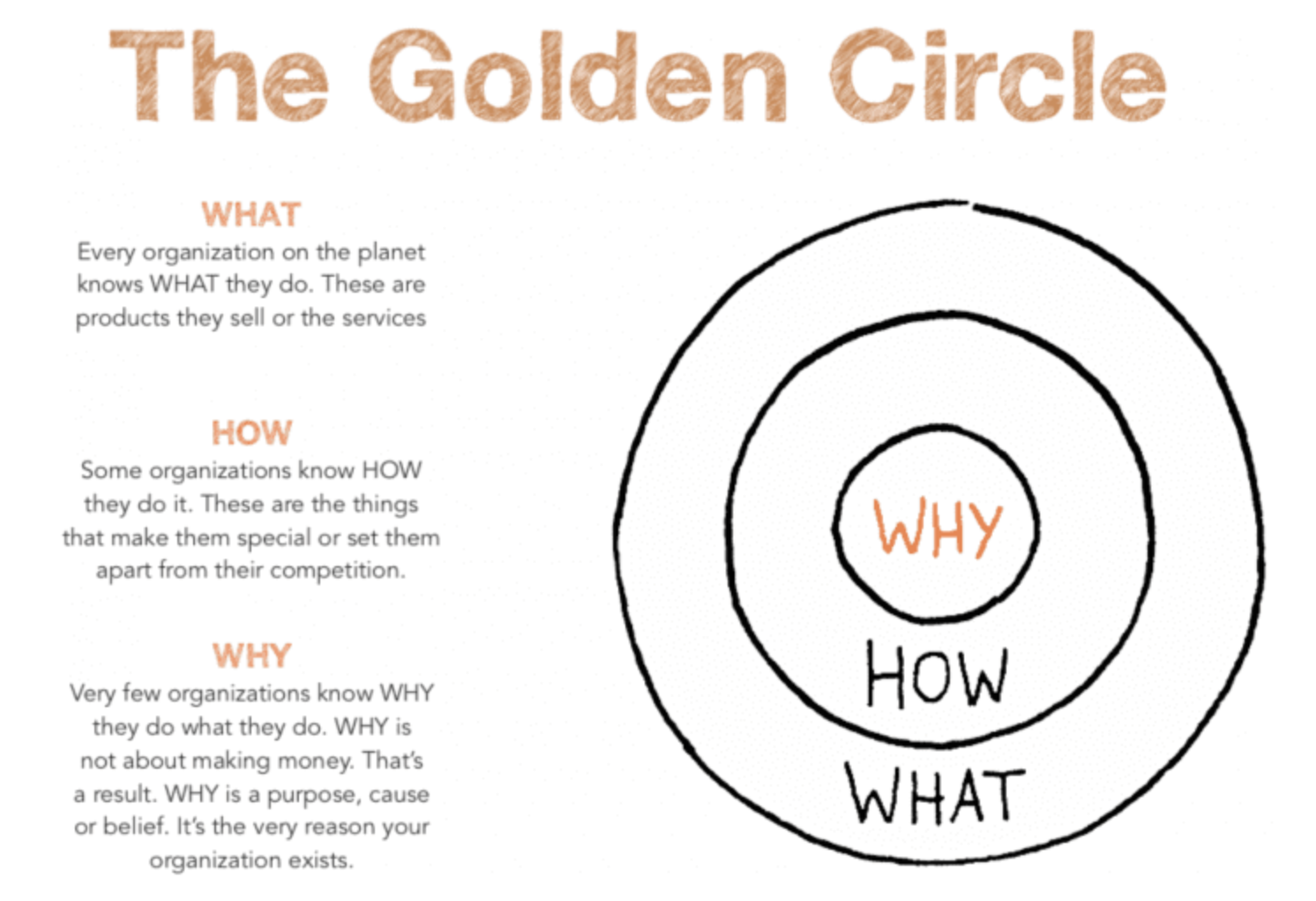
 

Photo credits (in order)

From Pixabay.com


Ethics for Music Educators III

Part III: Case Studies

If you have not previously read them or need a review, please revisit Part I: “Back to Basics” and Part II” “The Nitty Gritty” in this series on Ethics for Music Educators.

Like professionals in other disciplines, music educators are expected to observe certain behavioral standards. In addition to teaching musical skills, concepts, and context, music educators are also expected to protect the welfare of children, serve as trustworthy stewards of public property, and generally behave responsibly and professionally within the context of the school and local community. Despite these expectations, many music educators have engaged in unprofessional, unethical, or illegal conduct.

― Joelle L. Lien, “Ethical Dilemmas of In-Service Music Educators” in Action, Criticism, and Theory for Music Education, 2012.

colourful-xylophone-1424837 0 14 Henk L

Music teachers often have busy professional lives, many spending large amounts of time back at school for extra-curricular activities, individual practices, ensemble rehearsals, events from marching band to musicals, and travel to/from festivals, conferences, concerts, adjudications, and itinerant school assignments. Also unique is the fact that some music educators participate in after-school programs and see their “charges” as much or more often their parents. These once-in-a-lifetime musical opportunities inspire the growth of student artistry, leadership, creative self-expression, and teamwork. They also expose music teachers to more frequent contact with potential ethical issues ― inconsistencies, dilemmas, and problems.

ethics 27

From a “crisis of conscience” to political nightmares, there are no easy right or wrong answers to many of these ethical “conundrums!” Full discussion and disclosure with the goal on addressing “the needs of the students” are mandatory with the quick educational sketches depicted in the following scenarios.

Pedagogical Problems

  • kids-listening-to-music-1374340 Ted HortonAdministrators, parents and public’s interpretation of “separation of church and state” or “perceived emphasis” on Holiday vs. Christmas music (with sacred text) at December concerts e.g. Handel’s Hallelujah Chorus, Hatikvah, and/or John Rutter’s Oh Come All Ye Faithful & Joy to the World as the finale
  • Defending a music educator’s grading criteria: daily performance evaluation vs. lesson or concert attendance (pass/fail?) and other non-musical requirements
  • Identification of the poorest singers or instrumentalists in our ensembles and limiting their enrollment or participation in ensembles that regularly attend adjudications or competitions: “Do the needs of the few less proficient performers out-weigh the benefit of the many?” or “Are our ethical obligations met if a large non-auditioned ensemble is open to all and an auditioned group is provided for exclusive use of the best students?”
  • Rationale for the unbiased selection of solos, leadership positions, drum majors, leads in the musical, etc. for the music program: perception of teacher favoritism or the “rights of seniority” vs. “best one for the job!”
  • Incidents relating to a music teacher’s struggle over whether to be “blatantly honest” regarding a student’s chances at a music career: “Is it ethical to allow a private music student to continue the study of music performance based on their desire, when it is clear they do not have the talent, work ethic, or overall aptitude to succeed in the music profession?” The other side of this issue, can we ever say, “You do not have enough talent to go into music.”
  • Maintaining balance between the pursuit of competitive performance excellence (repetitive programming of a limited number of major works) with appropriate teaching practice (survey, reading, and performance of a wide variety of selections in the folder)

Enforcement Problems

  • Quandary whether it is ever in the students’ best interest to ignore an existing policy or rule, for example, staff noncompliance of “no smoking on campus” or other school regulations.
  • Holding a student accountable for breaking a law or rule, when doing so would jeopardize a musical group’s performance: “My drum major was suspended because she smoked pot and was caught. I needed her to run the half time show we had been practicing for months and so I convinced administration that she had to participate because it was part of my curriculum and part of her grade. I decided the other kids shouldn’t be punished because of her idiocy so I worked hard to keep her in the show. In my heart, I would have preferred she not participate, but not at the expense of the other kids’ performance.”
  • “Fair use doctrine” and photocopying music

DCF 1.0

It should be mentioned here that there are a number of misconceptions regarding the Copyright Law:

  • Copyright law does permit copying music in the emergency of an imminent concert date, but it also requires that the same music be purchased regardless of whether it is needed after the performance.
  • The law prohibits purchasing music but then making copies to preserve the original scores.
  • The law does not permit photocopying more than 10% of a complete work, even for educational purposes.
  • Out-of-print music may not be photocopied without explicit permission granted by the publisher of the work.
  • Compositions with an expired copyright or that never had a copyright are considered “public domain” and are free to copy.


Finances and Resource Allocation Problems

  • Hundred Bill CornersCompetition for the enrollment of the same students (band/string/choir) within the music department
  • Private lesson prerequisite for participating in an honors ensemble, music director giving them, and charging a fee for his/her “off-school” time
  • (Lack of) equity in school budget allocation (inconsistencies within different academic areas and within the music department itself, not defending per-pupil costs and enrollments, etc.)
  • Receiving special favors or kickbacks from the music industry (touring companies, riser/music stand distributors, instrument rental companies, etc.): “If you choose our travel agency for the Orlando trip, we will throw-in the purchase of a new conductor’s podium and music stands for your band room!”

Scrutiny and sample audits of music educators and other school professionals in this category have included the following:

  • Accuracy of teachers’ absence reports and itinerant staff sign-ins to their daily building assignments: “I saw the music teacher eating lunch at a local restaurant.”
  • Balancing of school purchase orders and activity fund invoices with existing instrument, equipment, or music inventory
  • Management of school activity funds (tickets, marching band shoes/accessories, honorariums, and “under the table” compensations)
  • Inspection of music libraries for evidence of illegal photocopying


parade-band-1421028 Sarah DeVries

Problems in Relationships

  • Perception of “being knifed in the back“ by colleagues teaching other academic subjects (advising students to drop music)
  • Disagreements with administrators on “the right thing to do” (everything from grading to attending PMEA workshops)
  • Incidents involving gossip or divulging confidential information about students
  • THE BIG BOO-BOO: Dual or conflicting relationships and inconsistent maintenance of clear, responsible, and professional boundaries between teachers and students. Most of the incidents in violation of “crossing the line” of “student-teacher boundaries” would be complications that arose when the teacher-student relationships became “too close.”

Was Mr. Holland a hero or a villain in the 1995 movie Mr. Holland’s Opus? Certainly, many would agree that the acclaimed motion picture starring Richard Dreyfuss as “Glenn Holland” depicted a struggling composer who reluctantly becomes a teacher and eventually learns the value of his profession and his family. However, many say he is a model example of the “slippery slope” of blurred student-teacher boundaries and that he seriously breached the ethical standards of teachers.

It wasn’t Mr. Holland’s in-class performance that concerns Troy Hutchings, director of Student Services in Northern Arizona University’s College of Education and a faculty member in the college. It’s his relationship with Rowena, one of his students. In a famous scene at a bus stop, Mr. Holland and Rowena kiss.

“He should be fired,” Hutchings said. “That’s sexual misconduct—a violation of his fiduciary position.”

Mr. Holland’s situation isn’t atypical. The Richard Dreyfuss character had a troubled marriage and a difficult home life. “Right or wrong, he found something with his students that he felt he didn’t have at home,” Hutchings said.

http://www.newswise.com/articles/ethics-training-is-key-to-fighting-teachers-sexual-misconduct-professor-says32

Imagine if one of us drove our “star pupil” to the bus stop on her way to “make it big on Broadway” without the direct support of her parents!


Problems in Diversity

  • Sensitivity in meeting the needs of ALL students: no discrimination on the basis of race, gender & gender identity, ethnic origin, religious beliefs, socio-economics, etc.
  • Balanced representation of lesson targets and course material on multiculturalism
  • “Many of our students see music education as ‘white privilege’ and we have to do a lot of convincing to get the kids to participate…”

For all music teachers, it is recommended you peruse the position statement on the NAfME website: “Equity and Access in Music Education” https://nafme.org/about/position-statements/equity-access/.


More Issues in Music Education

Case Studies in Music EducationIf you have not had the occasion to read Case Studies in Music Education by Frank Abrahams and Paul D. Head, it would be a valuable aid to “facilitate dialogue, problem posing, and problem solving” among pre-service (and current) music teachers. Using the format of Introduction, Exposition, Development, Improvisation, and Recapitulation known by all music professionals, each chapter presents a scenario with a moral dilemma that many music educators face in the daily execution of their teaching responsibilities.

How should a music teacher balance learning and performing? What is the best way to handle an angry parent? What are the consequences of the grades teachers assign? What are the best ways to discipline students? How should teachers relate to the administrators and to other teachers? The emphasis here is not on the solution, but on the process. There are many viable approaches to nearly every obstacle, but before any meaningful long-term solutions can be made, teachers must identify their own personal philosophy of music education and recognize those traits that are admirable in another’s style.

―Excerpt from back cover of Case Studies in Music Education, Second Edition, by Frank Abrahams and Paul D. Head

Scenarios: How Would You Judge These “Misconducts?”

ethics 22For additional examples of ethical issues in education, try these links. Personally, many of these fictional video reenactments are hardcore and very painful to view… but may shed some light in any discussion of teacher (mis)behavior: actions from simply inappropriate, unwise, or “bad for appearances” to a range (from bad to worst) of unprofessional, immoral, unethical, and illegal conduct. Some of these stories you will agree should be instantly labeled as the highest degree of unethical practice ― actual “crimes against children” and should invoke punishment if found guilty ― while others may lack clarity and make it difficult in arriving to a consensus.

If you are sharing this article within a group (induction, staff meeting, in-service, etc.), besides selecting the degree of misconduct, you may also want to reflect on the following questions (and also peruse the “essential questions” following the conclusion below.)

  1. What possible issues/concerns might this scenario raise?
  2. How could this situation become a violation of the law, the “Code” or other school/district policies?
  3. In this situation, what are some potential negative consequences for the teacher and the student?

From the Pennsylvania Professional Standards and Practices Commission Ethics Toolkit:

PA PSPC logo

Other sources:


The Ethics Equilibrium Perspective

Keep in mind, discussions about any scenarios of possible educator misconduct should be viewed through the lens of an ethical framework for professional decision-making, not just violations of regulatory policies resulting in the consequences of disciplinary action, revocation of teaching certificate, and/or criminal penalties. As mentioned before (“Ethics for Music Educators – Part I and Part II”), please review Troy Hutchings work:

Screen Shot 2017-08-16 at 1.39.16 PM-1


Conclusion

After culling through a myriad of research (see below), I summarize with a few of my quick “common sense” recommendations which I offer at music teacher conferences or in-service workshop presentations. What are your thoughts on these?

  1. Never put anything in email, text, writing, or anywhere on the Internet that can come back to haunt you.
  2. Do not engage in gossip about other students or professionals.
  3. Avoid unofficial/unsupervised meetings or off-campus personal fraternization with students.
  4. Do not transport individual students.
  5. Do not share photos or personal information on social media (Facebook, Twitter, Instagram, Snapchat, Gab, etc.).
  6. Avoid physical contact with a student (never touch, hug, hold, push, etc.).
  7. In your presence, allow no harassment or speech/language that is of a sexual nature or can be misinterpreted.
  8. Do not provide closed-door counseling.
  9. Do not give gifts to your students.
  10. Report serious medical issues to the authorities (bulimia, abuse, alcohol-use).
  11. Report any suspected professional ethics violations of colleagues to administration.

The purpose of this three-part blog-post on “Ethics for Music Educators” and studies like “Ethical Dilemmas of In-Service Music Educators” by Joelle L. Lien in Action, Criticism, and Theory for Music Education, was to investigate the kinds of ethical problem-solving music educators face in their daily work and to promote thought-provoking discussion about these matters. Now it is your turn to face these critical issues and/or incidents, openly investigate and illuminate philosophical inconsistencies within your institutions, associations, schools, and/or colleagues, and develop your own “iron-clad” professional code of ethics that truly addresses the daily work of your music education practice.

Additional Discussion: Essential Questions for All Educators

  1. What are the ethical responsibilities of teachers?
  2. How do ethics inform a teacher’s personal and professional actions?
  3. How does the PA Code of Professional Practices and Conduct (or your state’s educator code of conduct) communicate standards for appropriate behavior for teachers?kids-singing-christmas-songs-1438089 Ned Horton
  4. What does it mean to be a “moral exemplar” or “role model” in the community?
  5. What are the expectations of educators with respect to accumulating either personal or financial gain or advantage (other than their contractual compensation package) through their work in the school system?
  6. How can a teacher foster positive, professional relationships with students?
  7. How is the appropriate teacher-student boundary defined?
  8. What are the professional expectations of teachers with regard to their “electronic” interactions with students?
  9. Why and how should teachers control their public “brand” or persona?
  10. How do teachers’ use of emerging technologies such as social networking, cell phones, etc., present challenges to maintaining appropriate student-teacher boundaries?
  11. What are the professional expectations for working with diverse populations of students, parents and colleagues?
  12. How does your classroom environment promote respect for your students’ individual needs and backgrounds?
  13. What are the professional expectations of teachers regarding their relationships with colleagues?
  14. How can a teacher foster positive, professional relationships with colleagues, parents, and the community?


Special Thanks and Credits for This Three-part Blog-Series

  • Pennsylvania’s Educator Ethics and Conduct Toolkit by Dr. Oliver Dreon, Sandi Sheppeard, PA State System of Higher Education, and the PA Professional Standards and Practices Commission
  • Nebraska Professional Practices Commission
  • Connecticut’s Teacher Education & Mentoring Program
  • Lien, Joelle L. (2012). Ethical Dilemmas of In-Service Music Educators. Action, Criticism, and Theory for Music Education

playing-harp-1563567 Gerrit Prenger

References for Further Research

  • Abrahams, Frank and Paul Head. (2005). Case studies in music education (2nd ed.). Chicago: G.I.A.
  • Allan, J. (2011). Responsibly Competent: Teaching, Ethics and Diversity. Policy Futures in Education, 9(1), 130-137.
  • Assaf, L., Garza, R., & Battle, J. (2010). Multicultural Teacher Education: Examining the Perceptions, Practices, and Coherence in One Teacher Preparation Program. Teacher Education Quarterly, 37(2), 115-135.
  • Barbieri, Susan M. (2002). An elegy for ethics? Strings 16(8): 62–67.
  • Bowman, Wayne. (2001). Music as ethical encounter. Bulletin of the Council for Research in Music Education 151: 11–20.
  • Brandenburg, Judith B. (1997). Confronting sexual harassment: What schools and colleges can do. New York: Teachers College Press.
  • Brooks, David (April 17, 2015). When Cultures Shift. New York Times.
  • Campbell, E. (2003). The Ethical Teacher.  Philadelphia:  Open University Press.
  • Dreon, Dr. Oliver, Sheppeard, Sandi, and PA State System of Higher Education. Educator Ethics and Conduct and Toolkit. Pennsylvania Professional Standards and Practices Commission. Online: http://www.pspc.education.pa.gov/Promoting-Ethical-Practices-Resources/Ethics-Toolkit/Pages/default.aspx
  • Ehrensal, P., Crawford, R., Castellucci, J., & Allen, G. (2001). The American Melting Pot Versus the Chinese Hot Spot. in J. Shapiro & J. Stefkovich (Eds.), Ethical Leadership and Decision Making in Education. Mahwah, NJ: Lawrence Erlbaum Associates.
  • Elliott, David J. (1995). Music matters: A new philosophy of music education. New York: Oxford University Press.
  • Fibkins, W. L. (2006)  Innocence Denied:  A Guide to Preventing Sexual Misconduct by Teachers and Coaches.  Lanham, MD:  Rowman & Littlefield Education.
  • Flusser, Victor. (2000). An ethical approach to music education. British Journal of Music Education 171(1): 43–50.
  • Gilligan, C. (1982). In A Different Voice.  Cambridge, MA:  Harvard University Press.
  • Golann, Stuart E. (1969). Emerging areas of ethical concern. American Psychologist 24: 454–459.
  • Goree, K., Pyle, M., Baker, E. & Hopkins, J. (2007). Education Ethics Applied. Boston:  Pearson Education.
  • Gregg, Jean W. (1997). From song to speech: On the ethics of teaching voice. Journal of singing: The official journal of the National Association of Teachers of Singing 54(1): 55–57.
  • Hutchings, Troy (2015). “Ethics in Education” Vimeo https://vimeo.com/126979216.
  • Hutchings, Troy and Thompson, David (2016). “Ethical Equilibrium.” AACTE Professional Development https://secure.aacte.org/apps/rl/res_get.php?fid=3005&ref=ets.
  • Johnson, L. S. (2012). Guidelines for Dealing with Educator Sexual Misconduct. National Association of Independent Schools. Retrieved from https://http://www.nais.org/Articles/Documents/Educator_Sexual_Misconduct_12_finaledits.pdf
  • Johnson, Tara Star (2008). From Teacher to Lover: Sex Scandals in the Classroom. New York
  • Jorgensen, Estelle R. (2003). Transforming music education. Bloomington, IN: Indiana University Press.
  • Kohlberg, L. (1981). Essays on Moral Development:  The Philosophy of Moral Development.  New York:  Harper Collins.
  • Krause, J., Traini, D., & Mickey, B. (2001). Equality versus Equity. in J. Shapiro & J. Stefkovich (Eds.), Ethical Leadership and Decision Making in Education. Mahwah, NJ: Lawrence Erlbaum Associates.
  • Lecroy, Hoyt. (1992). Imparting values: A challenge for educators. Music Educators Journal 79(1): 33–36.
  • Lien, Joelle L. (2012). Ethical Dilemmas of In-Service Music Educators. Action, Criticism, and Theory for Music Education. Online: http://act.maydaygroup.org/articles/Lien11_1.pdf.
  • Mark, Michael L. and Madura, Patrice (2010). Music Education in Your Hands. Routledge.
  • MENC. (2003). The United States Copyright Law: A Guide for Music Educators. Online: http://www.menc.org/resources/view/united-states-copyright-law-a-guide-for-music-educators. December 4, 2010.
  • MENC. (May 1973). Music Code of Ethics Music Educators Journal Vol. 59, No. 9.
  • Milner, H. (2010). What Does Teacher Education Have to Do with Teaching? Implications for Diversity Studies. Journal of Teacher Education, 61(1-2), 118-131.
  • Murray, Dave. (December 23, 2010). Are teachers role models outside the classroom? Unions, courts say educators deserve privacy. M Live Media Group. Online: http://www.mlive.com/news/grand-rapids/index.ssf/2010/12/are_teachers_role_models_outsi.html.
  • Myers, K (2005). Teachers Behaving Badly.  New York: RoutledgeFarmer.
  • National Association of State Directors of Teacher Education and Certification. Model Code of Ethics for Educators. Online: http://www.nasdtec.net/?page=MCEE_Doc.
  • Nourse, Nancy (2003). The ethics of care and the private woodwind lesson. Journal of Aesthetic Education 37(3): 58–77.
  • O’Neill, J., & Bourke, R. (2010). Educating Teachers About a Code of Ethical Conduct. Ethics & Education, 5(2), 159-172.
  • Pope, Kenneth S. and Valerie A. Vetter. (1992). Ethical dilemmas encountered by members of the American Psychological Association: A national survey. American Psychologist 47(3): 397–411.
  • Pring, R. (2001). Education As A Moral Practice.  Journal of Moral Education, 30(2): 101-112
  • Regelski, Thomas A. (2011). Ethical implications of music education as a helping profession. Nordic Research in Music Education. Yearbook Vol. 13 2011, 221-232.
  • Richmond, John W. (1996). Ethics and the philosophy of music education. Journal of Aesthetic Education 30(3): 3–22.
  • Roberts, Brian A. (2009). Ethics in Music Education. The Canadian Music Educator. Excerpt online: https://www.questia.com/magazine/1P3-1923294611/ethics-in-music-education.
  • Rodriguez, Carols Xavier. (2012). Ethics in Music Education. Action, Criticism, & Theory for Music Education. Online: http://act.maydaygroup.org/articles/Rodriguez11_1.pdf.
  • Simpson, R. Eric. (2010). An examination of the relationship of teacher certification area to sexual misconduct: Florida as a case study. Journal of Music Teacher Education 20(1): 56–65.
  • Staratt, R. (2004). Ethical Leadership. San Francisco:  Jossey-Bass.
  • Stein, Nan D. and Lisa Sjostrom. (1994). Flirting or hurting? A teacher’s guide to student-to-student sexual harassment in schools (Grades 6 through 12). Washington, DC: National Education Association. (ED 380 415)
  • Stufft, William D. (1997). Two rules for professional conduct. Music Educators Journal 84, 40–42.
  • Szego, C. K. (2005). Praxial foundations of multicultural music education. In Praxial music education: Reflections and dialogues, ed. David J. Elliott, 196–218. New York: Oxford University Press.
  • Volk, Terese M. (1998). Music, education, and multiculturalism: Foundations and principles. New York: Oxford University Press.
  • Woodford, Paul G. (2005). Democracy and music education: Liberalism, ethics, and the politics of practice. Bloomington, IN: Indiana University Press
  • Wynne, E.A. (1995). The moral dimension of teaching. In A.C. Ornstein (Ed.) Teaching: Theory into practice. (pp. 190-202). Boston: Alyn and Bacon

brass-tubas-1199098 Aron Kremer

Special thanks and credits go to Dr. Oliver Dreon, Associate Professor at Millersville University (in Pennsylvania), and one of the authors of the Pennsylvania’s Educator Ethics and Conduct Toolkit, the source of much of the research, quotes, and perspective of this three-part series.


PKF

© 2017 Paul K. Fox


Photo credits (in order) from FreeImages.com: “Ethics” by Olivier Le Moal, “Colorful Xylophone” by Henk L, “Listening to Music” by Ned Horton, “Music 3” by Carol Kramberger, “Music” by Ricardo Vasquez, “Parade Band” by Sarah DeVries, “Girl with Guitar” by Stacy Brumley, “Kids Singing Christmas Songs” by Ned Horton, “Playing Harp” by Gerrit Prenger, and “Brass Tubas” by Aron Kremer