The Life Cycle of a Successful and Happy Music Educator
Joyous Holidays, Season Greetings, and Happy New Year from “The Foxes!” This is a time for reflection and gratitude… and we feel blessed for all the opportunities allowing us to share our insights, gifts and experiences with other music education professionals.
We hope to inspire YOU and literally model the concepts in this blog series. We continue with our discussion first introduced a month ago in Bookends – Part One – The Life Cycle of a Successful and Happy Music Educator, exploring:
Stage 3: Inservice/Growing Years (this blog)
Stage 4: Veteran/Sustaining Years (future blog)
Stage 5: Next Chapter/Living the Dream (future blog)
This article is an abstract from a session presented to Seton Hill University music education student teachers on October 17, 2023. Click on this link to download the slide summary in PDF format.
“I have written a lot of articles in support of these topics… now compiling them for your easy access. Depending on your current status and interests, feel free to peruse the checklists (links) in this series. It is possible a few of the resources contained within these blogs have gone inactive, but I believe enough are there for you to gain the insight, tools and motivation to achieve professional development for life.”
– Paul Fox
Stage 3 – Inservice/Growing Years
[ ] 8. Becoming a Music Educator:For a review of Bookends – Part One, take a step backward and revisit what you have done to “get ready” for your “rookie years.” Take special note on the things-to-do list (“secrets”) as a first-year educator (perhaps completed during your student teaching semester):
Subscribe to a discounted NAfME + PMEA first-year membership (If you are a recent college graduate in your first year of teaching, or if you are the spouse of a current or retired NAfME member, contact NAfME at 800-336-3768 or email memberservices@nafme.org) to find out if you qualify for a reduced rate.
Hook up to PMEA Mentor or other state’s MEA support program for new teachers.
Need to fill in a few gaps missing from your college courses in skills and knowledge? Continue your “enrichment” viewing PMEA Webinars and the exhaustive video library in the NAfME Academy.
At some point you will be writing/editing curriculum, so research the awesome resource of Model Curriculum Framework (Have to be a PMEA member)
Too busy to participate in the PMEA Annual Conference or NAfME national events? Look into going to a PMEA summer conference (usually at a lower-cost!). Check out your own state’s MEA discounts and offers for collegiate members and new teachers!
[ ] 9. The Care & Feeding of Your Principal:Although not covered in any detail during the Seton Hill University presentation, it is recommended that you read in its entirety “The New Teacher’s Guide to Fostering Positive Relations and Good Interactions with School Administrators” offering a wealth of excellent recommendations from these trustworthy sources:
Enhancing the Professional Practice of Music Teachers: 101 Tips that Principals Want Music Teachers to Know and Do by Paul G. Young (my personal favorite, available from Amazon here)
A favorite question I pose to college music ed seniors is, “In what professional associations are you a member and actively involved?” For the price of consuming one fewer Starbucks latte a week, you can open up the Wonderful World of “C’s” – Contacts, Coachings, and other Connections, including research and resources that will benefit your Continuing Education. You can’t afford NOT to join groups like these.
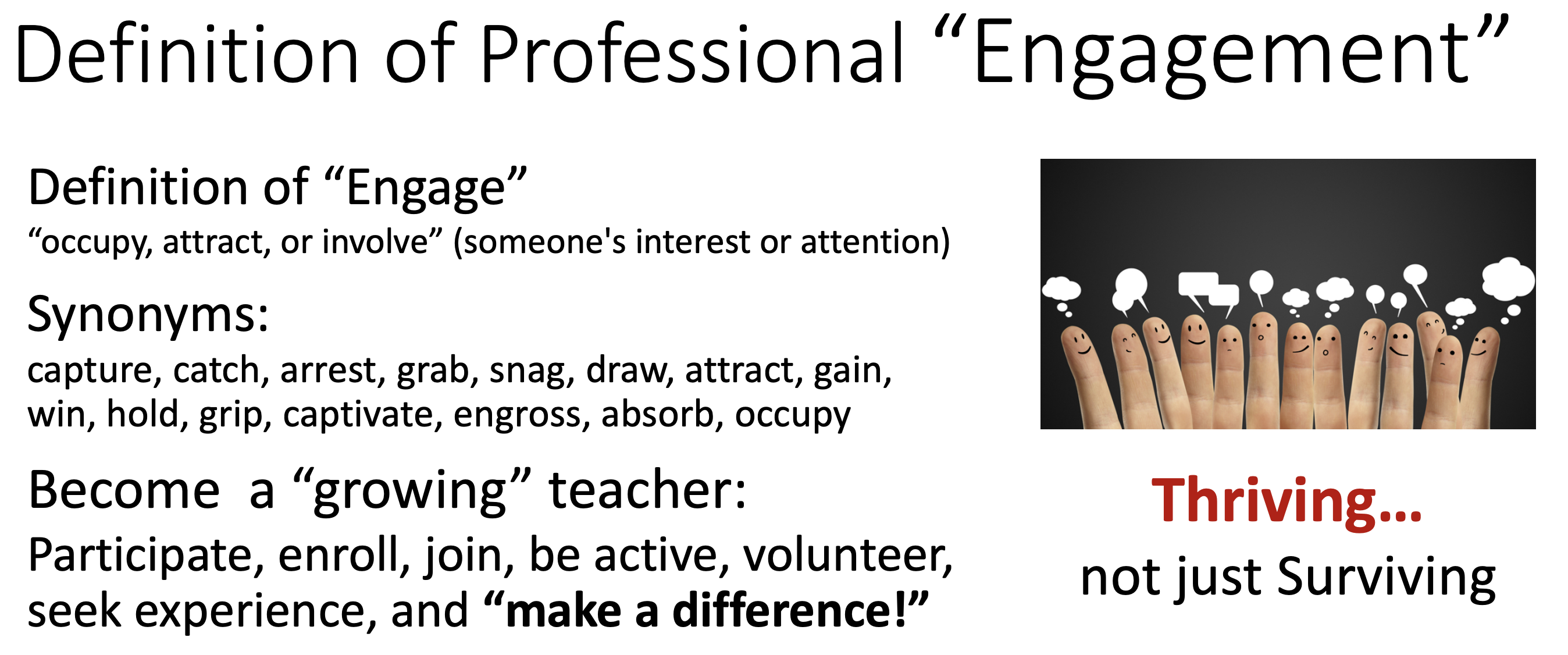
To help “nail down” a few related definitions critical to personal growth and career development in our profession, especially “engagement,” “professionalism,” “collaboration,” and “networking,” please take a little time to travel and consume the following archived blog postings.
[ ] 10. The Meaning of PRO:This is one of the oldest articles at the paulfox.blog site. How about a little soul searching? Are you truly a professional? Do you have the skills, habits, and attitudes of a professional in the field of education?
[ ] 11. Transitioning from Collegiate to Professional (Part II):New teachers have to move away from “book learning” or higher education research and emphasize “practical application,” and at the same time, assess the precise areas needed for immediate (re-)training… everything from new exposure to specialized teaching areas and grade level focus for the job to which you have been assigned, to the enhanced skills of classroom management, student assessment, curriculum writing, class or ensemble warm-up materials, music repertoire and programming, etc.
While we are on the subject, it is important to intentionally seek out mentors or consultants in your early years of becoming an educator. PMEA offers a mentoring program (read all about it here) and PMEA Retired Members are also an excellent resource to “phone a friend” for advice as needed (see their section on the PMEA website here). That leads us to the next most essential “habit” of attending professional conferences… #12 below.
[ ] 12. Getting the Most Out of Music Conferences:Our PMEA Annual Conference sites are cyclical. This article, written on March 5, 2017, showcased that year’s event at the Erie Bayfront Convention Center – coincidentally the same location for this year’s PMEA Annual Conference: April 17-20, 2023. For a sneak peek at the proposed sessions and guest performers, click here.
There are a myriad of conferences offered every year… something for everybody in just about every state. Make plans to go, “recharge your batteries,” and pick up new state-of-the-art ideas, lessons, music, technology, etc. Again, you cannot afford NOT to attend… or becoming stale in your teaching or “stuck in a rut!” Besides, going to your state’s or national conferences and regional workshops are FUN places to meet other like-minded, inspiring colleagues! This is how professionals network, collaborate, and share their “latest and greatest!“
Implementing the NEW PDE Chapter 49 “PE” Competencies – “The WHO, WHAT, WHY, & HOW!”
Blogger’s Note: We will return to Part II of “Bookends” next month to explore:
Stage 3: Inservice/Growing Years
Stage 4: Veteran/Sustaining Years
Stage 5: Next Chapter/Living the Dream
Instead, our November blog will share methods, modes, media, and other materials to provide meaningful professional development on ETHICS for EDUCATORS in the Commonwealth, resources from my upcoming presentation to school administrators at the Pennsylvania Department of Education’s SAS Institute – Successful Leadership – Shaping Your School’s Story to be held in the Hershey Lodge and Convention Center on December 11-13, 2023. Click below for my handouts.
Interested in joining us at the Hershey Lodge on December 11-13, 2023? Please click herefor more information or to register.
A Summary of My SAS Institute Ethics Session
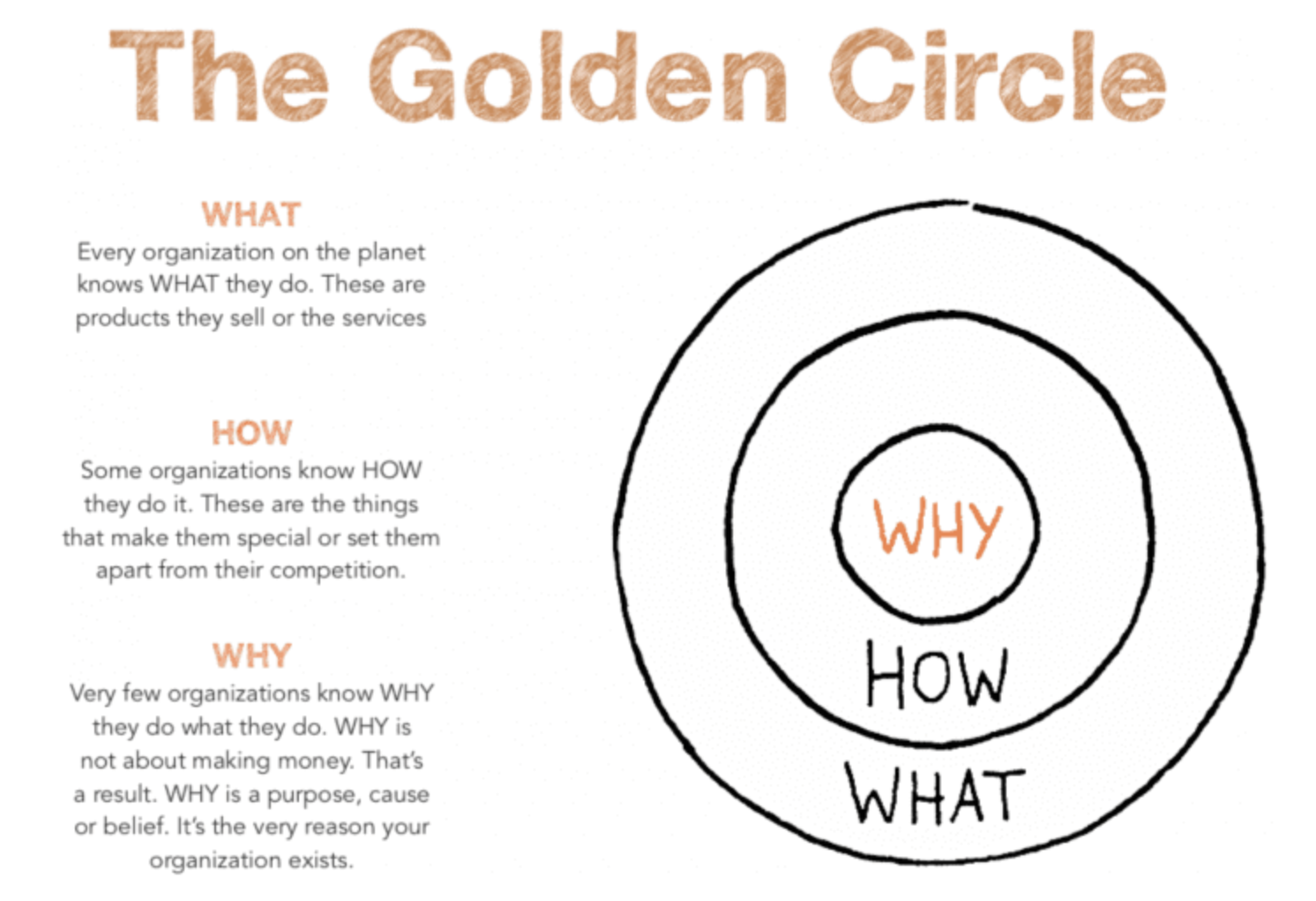
To paraphrase the wisdom of one of my favorite recent visionaries and online workshop presenters, Simon Sinek, “Every organization should begin with “the WHY!” According to SmartInsights, Sinek’s Golden Circle theory explains “how leaders can inspire cooperation, trust and change in a business based on his research into how the most successful organizations think, act and communicate if they start with why.” On his website, he declares his own WHY: “We are here to inspire people to do the things that inspire them so that, together, each of us can change our world for the better.” I love his mission!
“Your WHY is your purpose, cause, or belief. WHY does your company exist? WHY do you get out of bed every morning? And WHY should anyone care about the work you do?” – Simon Sinek
So… lets ask the questions that define our own golden circle, my session, and this article:
WHY should we be so concerned about professional development in ethics for PA educators? (Why should you even be reading this blogpost?)
HOW should we train our staff?
WHAT should be introduced and reinforced over the long term?
And, I will add one additional question: WHO is responsible for all of this?
Well, the quick response to that last query is EVERYONE in the profession. However, this blog is particularly geared to school system leaders, career and technical center directors, and administrators charged with the responsibility of continuing education/professional development and induction programs for their PA educators.
The “WHY!”
Quick. Calling on all PA teachers! Without looking on the Internet, can you identify the exact title of your “code of conduct” (1)? Do you know the PA agency responsible for writing this code and adjudicating its rules (2)? Can you name the “code of ethics” recently adopted by PDE and the Board of Education which provides school staff comprehensive guidance in professional decision-making based on context (3)?
Hints? How about a few acronyms?
CPPC
PSPC
MCEE?
Don’t you think “we” should at least be familiar with the commission that grants us the license to teach in PA as well as the document that “governs” our behavior, violations of which could remove us from our job or revoke our certificate?
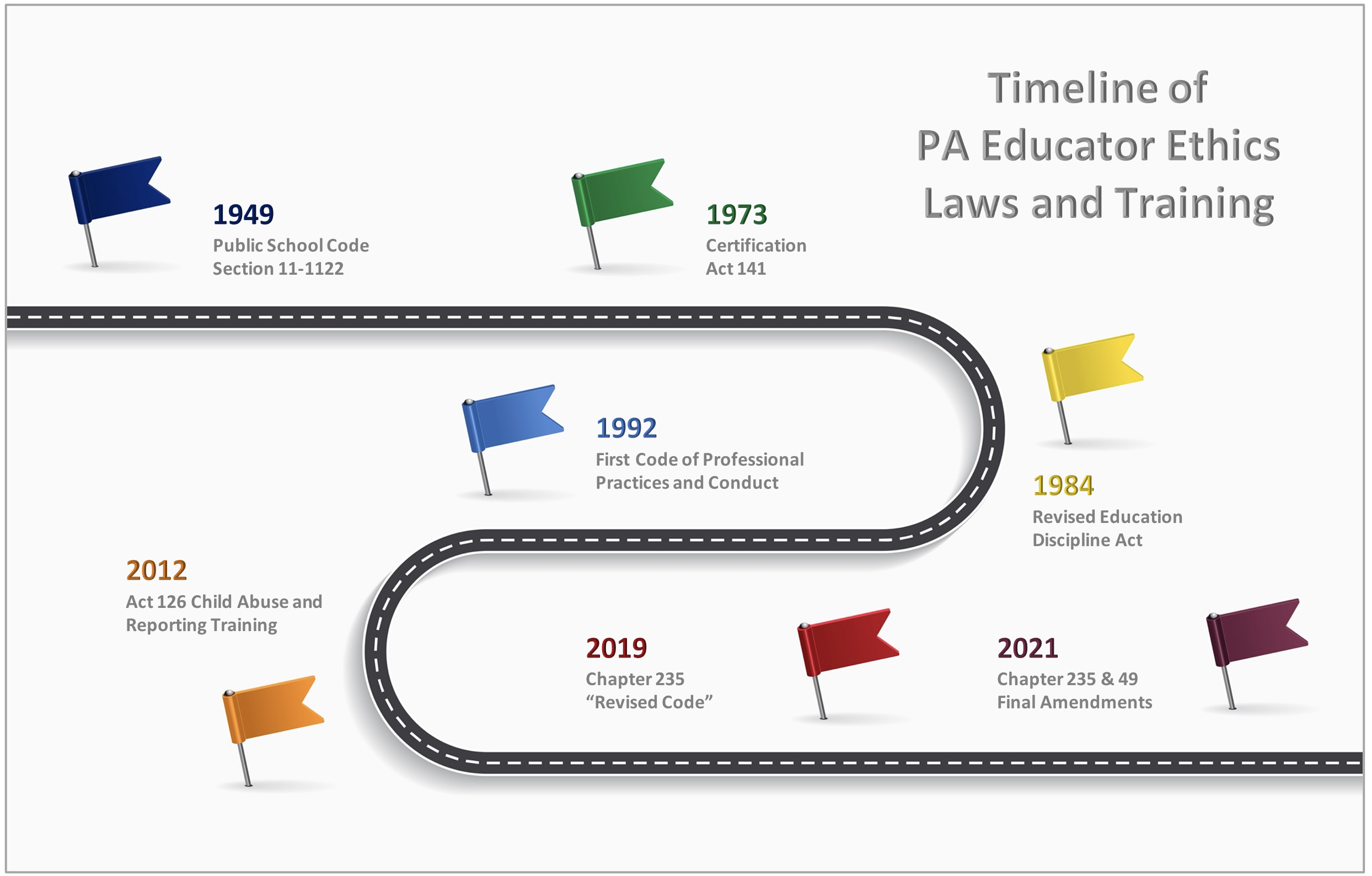
Of course, six years ago, even I didn’t know we had a PA “code of conduct!” (I started teaching in the public schools in 1978 and it wasn’t written until 1992!) After retiring from full-time teaching in 2013, I was asked to present my first ethics workshop back in 2017 for a Pennsylvania Music Educators Association (PMEA) Regional In-Service Program. Already scheduling me for two other sessions, the organizer came to me, “Could you add a presentation on educator ethics?” My first reaction was, WHY? Why would this be necessary? I promised him I would do a little research before getting back to him… and found these (now updated) statistics. Here’s the WHY in a nutshell!
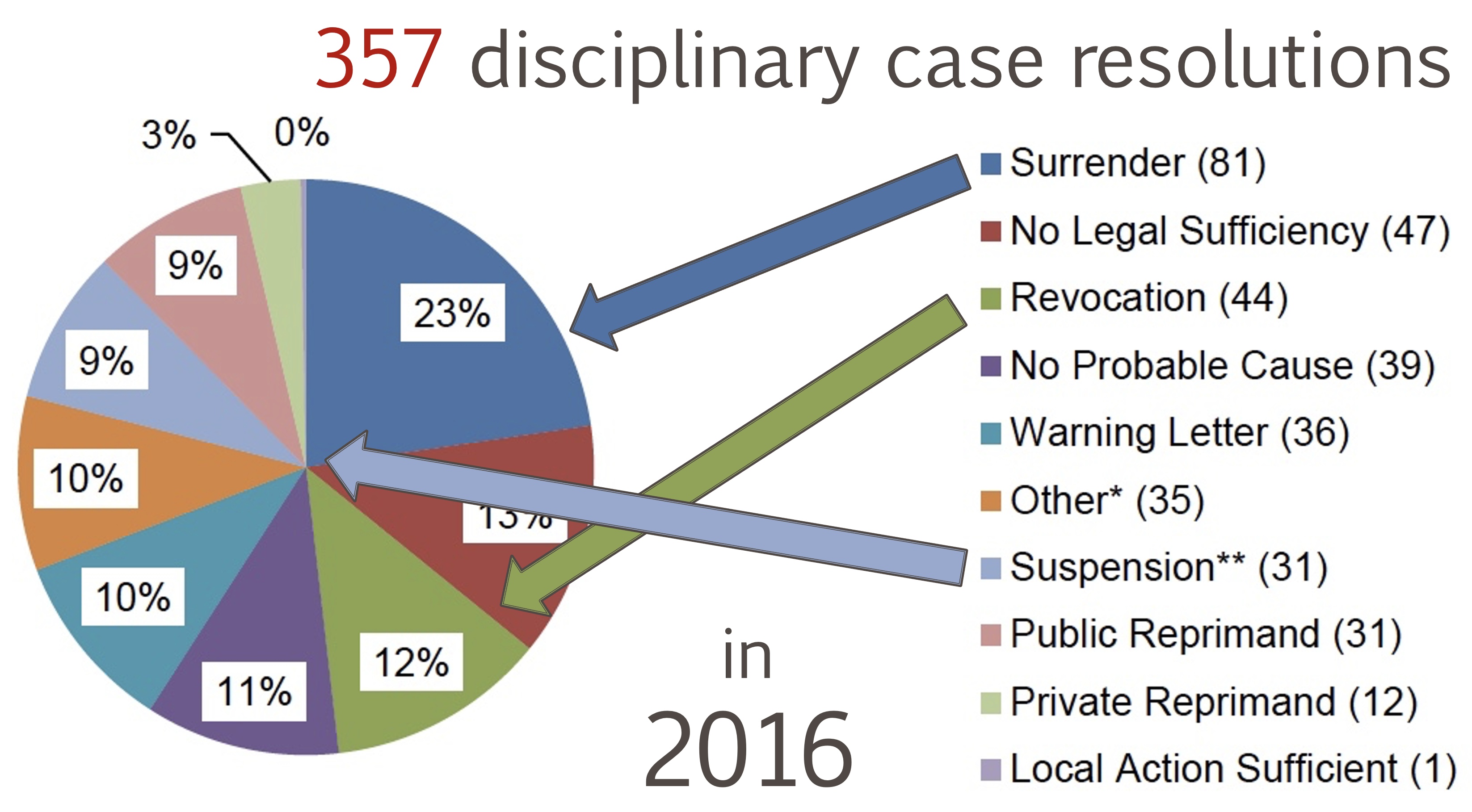
HORRIBLE! These are the number of PA educators by year who had misconduct complaints filed against them. Sure, a majority of their cases were not always fully prosecuted nor did they all result in a “guilty” verdict or plea, as this glimpse of educator disciplinary resolutions for 2016 (out of 672) for comparison shows (statistics from PDE):
But, if you can read the above graphic, that means that in 2016, 156 educators surrendered their license or had their certificate suspended or revoked! Obviously, no matter how you interpret the stats, this is a SERIOUS PROBLEM! And it may be due to a lack of training or understanding of the regulations and principles of ethical decision-making!
Why is this topic crucial for all pre-service, “rookie,” AND experienced professional educators? It is essential… not so much to serve as a reminder of the penalties for ethical infractions or spotlighting the occurrences you read or hear about in the news… but, because ETHICS are what we all stand for, the values we exhibit in our day-to-day decision-making, the integrity of the profession, and our “making a difference” in the lives of the students.
Ignorance of the law is no excuse for breaking it.
(Oliver Wendell Holmes)
The “WHAT!”
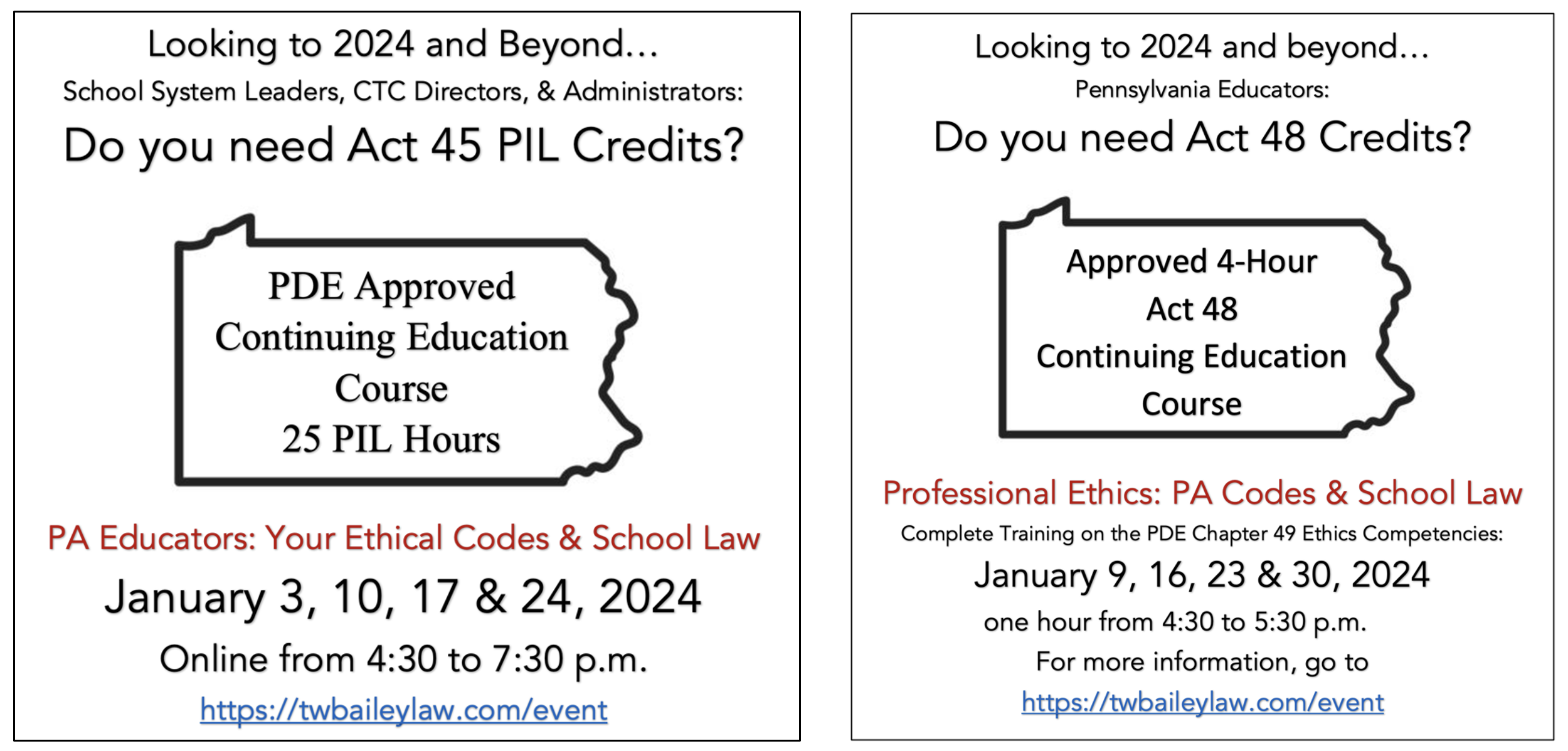
My colleague Thomas W. Bailey, a retired social studies teacher who reinstated his law license, and I set ourselves the goal of creating continuing education courses to provide REAL ethics training for PA educators. Thomas applied to the Pennsylvania Department of Education and received approval for a four-hour online Act 48 continuing education course for all PA educators (earning credits in PERMS) and a 25-hour online Act 45 PIL continuing education course for school system leaders, career and technical center directors, and other administrators responsible for planning the professional development of their school staff. The dates for our next two series of classes with open for enrollment in January 2024 are:
“Chapter 49 requires instruction in professional ethics to be integrated in educator preparation, induction, and continuing professional development programs as follows.
Continuing professional development programs must integrate the professional ethics competencies no later than the 2023-24 academic year.
Educator preparation and induction programs must integrate the professional ethics competencies no later than the 2024-25 academic year.“
Our Act 45 and Act 48 courses cover the following subjects, definitions, and applications of these terms:
Fiduciary
Ethical Equilibrium
Personal Morality
Regulations of Law
Professional Ethics
Professional Dispositions
Moral Professionalism
Differences Between Moral and Ethical Standards (with Examples)
Codes of Conduct (Examples)
Codes of Ethics (Examples)
Differences Between a Code of Conduct and a Code of Ethics
PA Professional Standards and Practices Commission
Paths of Educator Discipline in PA (Local and State)
Loudermill Hearings
State Discipline System (from Misconduct Complaint to Appeals)
PA Code of Professional Practice and Conduct
The Educator Discipline Act
National Association of State Directors of Teacher Education and Certification
In my SAS presentation, I review several different modes of case study analysis, from simple to comprehensive, modeling small group interactive peer review, encouraging healthy discussions of diverse opinions in an “open,” non-threatening environment. The following approaches could be adapted to your setting of in-service programs or inductions:
MOCK JURY
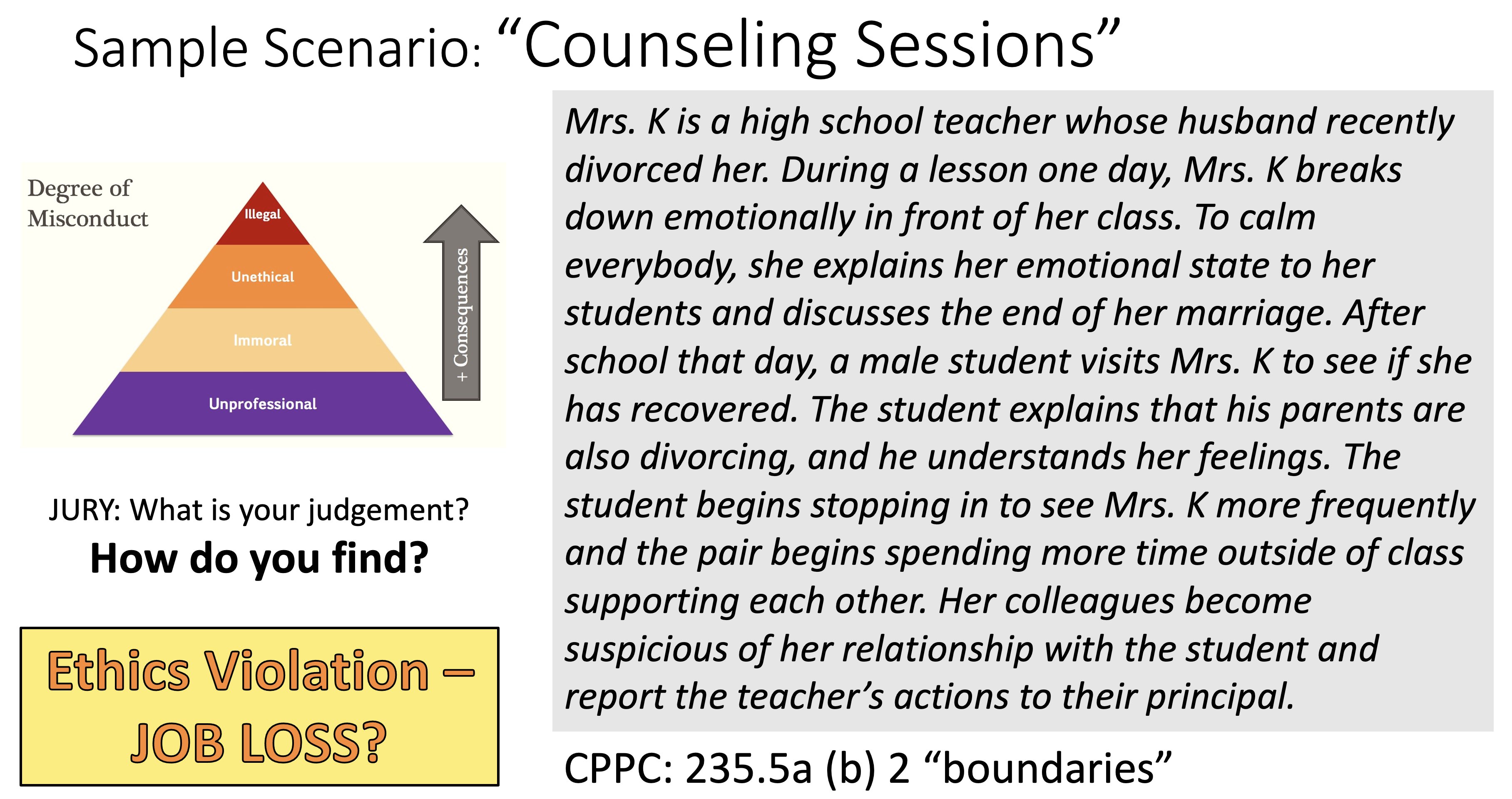
Degree of Misconduct, scenarios for learning the PA Code of Professional Practice and Conduct (CPPC): For more details, revisit the application of my misconduct rubric and explanation in the blog “Ethical Scenarios” here.
In collegiate sessions, I have used color-coded popsicle sticks and handouts of different hypothetical case studies for “the jury” to evaluate the behavior and “find the relevant code” in the CPPC.
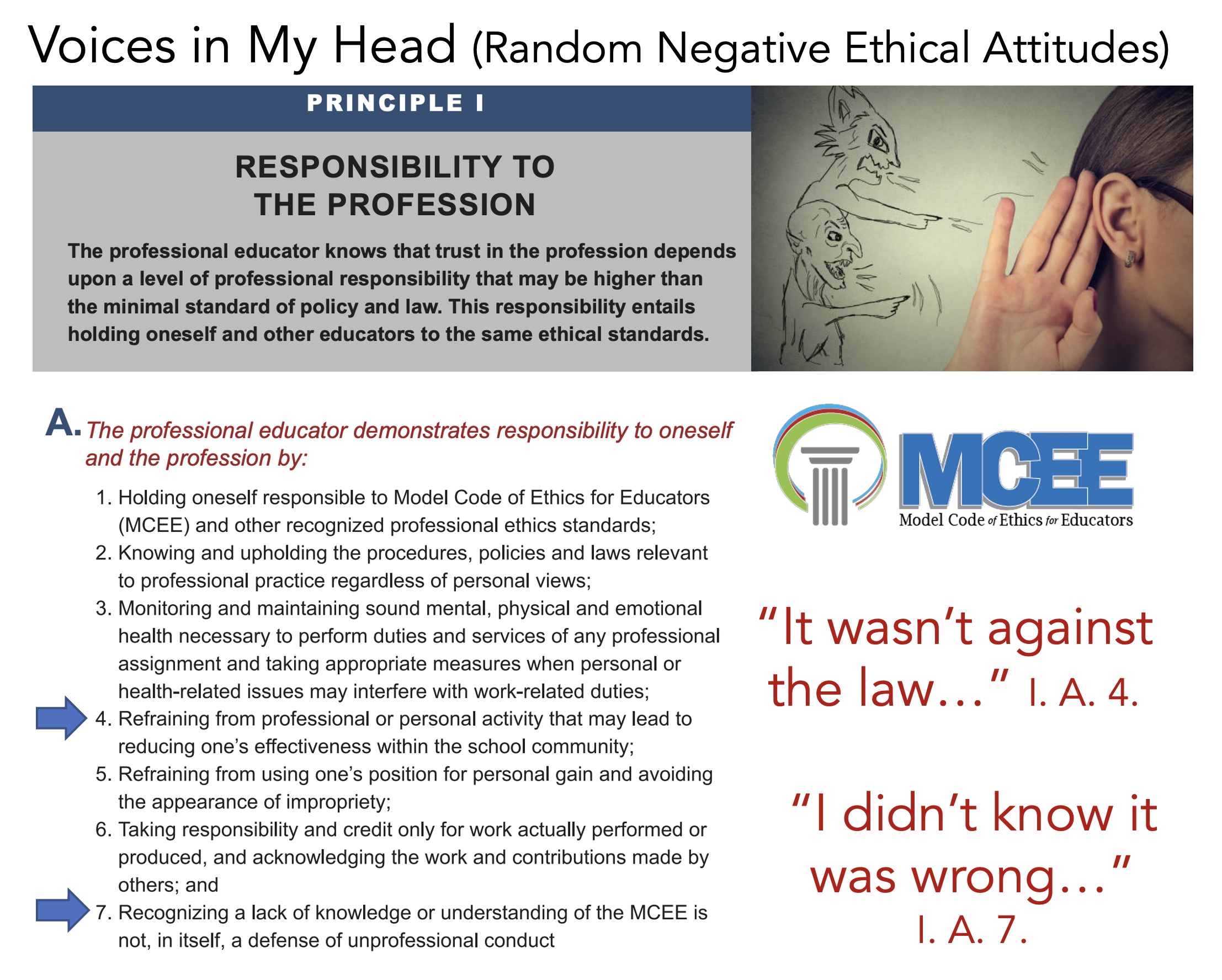
VOICES IN MY HEAD
Random Bad Attitudes for review of the standards in the Model Code of Ethics for Educators: I doubt (or sincerely hope) you would not hear too many of these directly from the school staff, but comments like, “Don’t ask for permission, beg for forgiveness” are NOT ethical precepts! Let’s dissect these bad boys!
SEARCH FOR THE STANDARDS
Hybrid Approach for using “the negative voices” and researching appropriate provisions in both the CPPC and MCEE: Select a single bad attitude and break off into two or three teams, each focused on corroborating related ethical principles in CPPC, MCEE, and even the PA Educator Discipline Act (EDA).
What possible issues/concerns might this scenario raise?
How could this situation conflict with school policy, CPPC, EDA, MCEE, or case law?
In this situation, what are some potential negative consequences for the educator’s students, fellow educators, and the school community-at-large?
What responses/actions will result in a more positive outcome and/or what proactive measures might be considered?
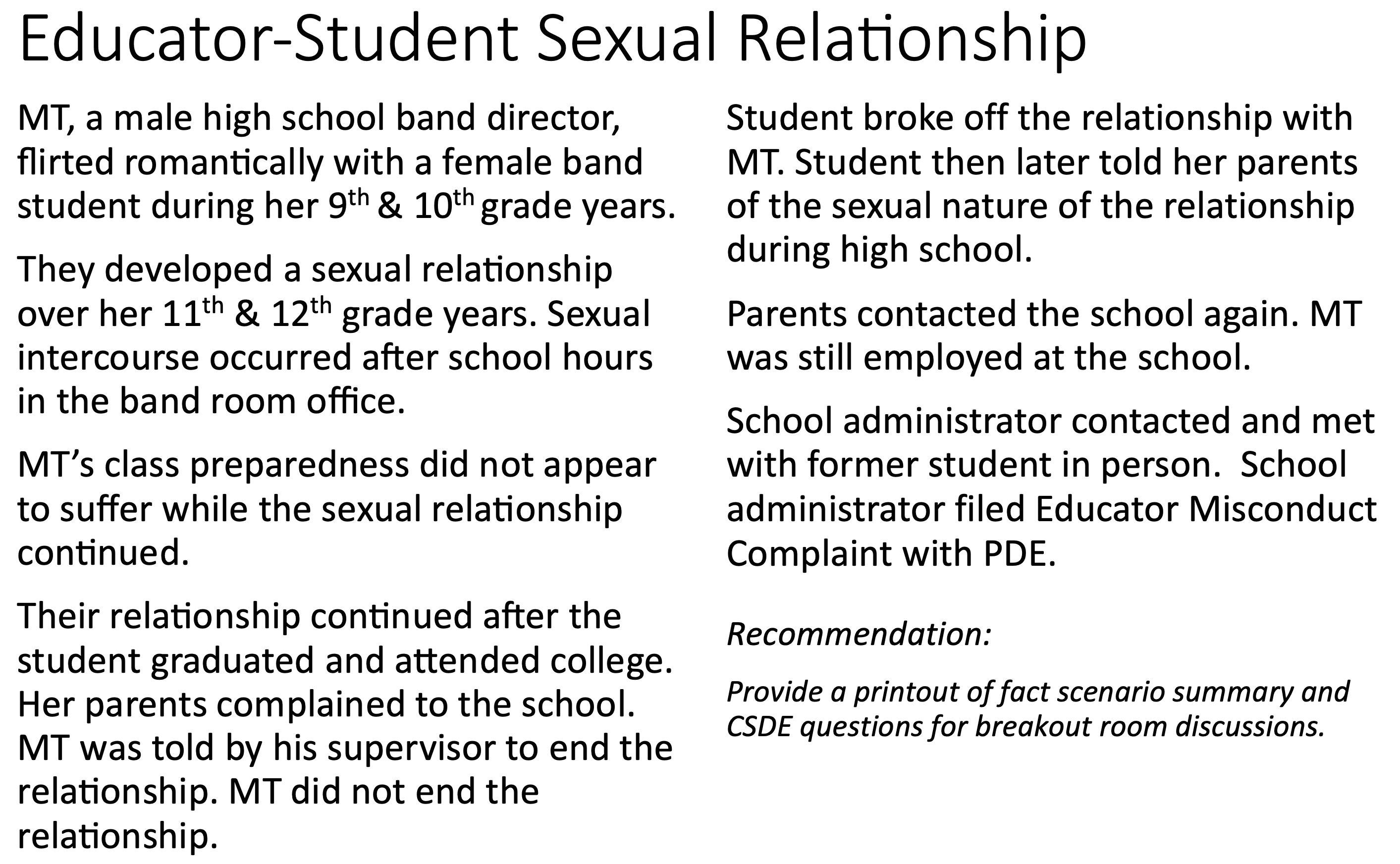
A single hypothetical scenario would first be presented to the full group, and then the educators would break off into 4-6 smaller groups to review these questions. Individuals may or may not all agree. A group leader is usually appointed to record their responses and then upon reconvening, report back to “the whole.” Here is a sample case study (painful reading; fictitious but based on actual past incidents):
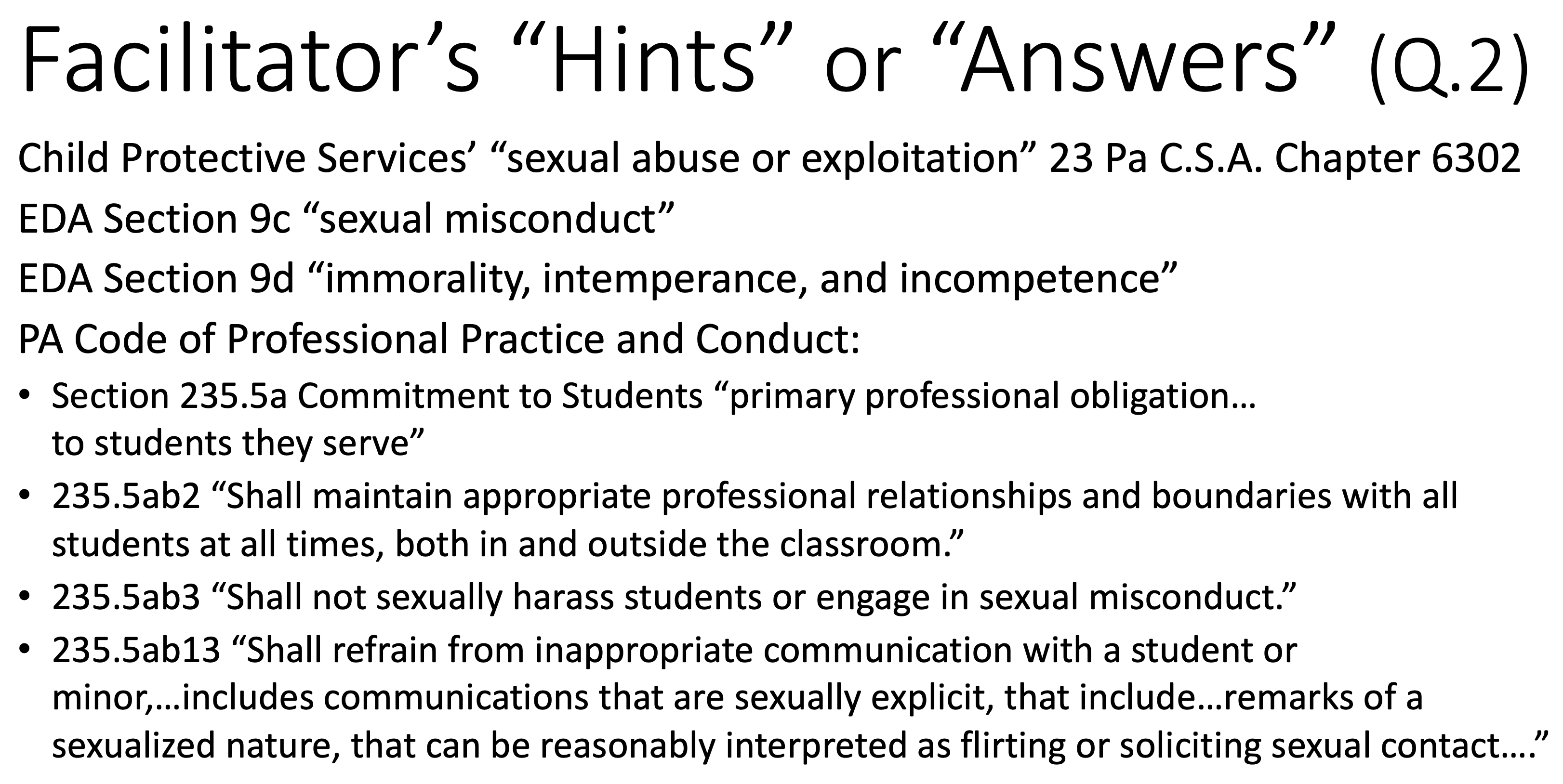
The moderator may promote further discussion (sample answers below) and even pose additional questions like the following:
What if the relationship was always of mutual consent?
What if the teacher never taught the student while she was enrolled in his school?
What if the relationship did not start until after the student graduated?
What if his student was over the age of 18 during the time of the relationship?
It deserves mention here that this final training mode, representing perhaps the highest degree of scaffolding of the learning for the ethics training of your staff, proposes the establishment of a permanent school district Professional Learning Community (PLC) or ethics committee. We know from our past experiences in providing continuing professional development of educators that promote free, open, healthy sharing of potential professional decision-making conflicts or ethical “conundrums” – “what would you do” scenarios – will foster lasting long-term benefits. Danielson Framework for Teaching (Domain 4) and CSDE reinforce this philosophy of peer collaboration.
“Teachers must engage in district-facilitated conversations that focus on ethical and professional dilemmas and their professional responsibility to students, the larger school/district educational community, and to families.”
My educator ethics mentor and “hero” Troy Hutchings, Senior Policy Advisor to the National Association of State Directors of Teacher Education and Certification, admitted that in his early years of teaching, he felt a little reticent about going to his principal for advice in handling a situation of a student developing a “romantic crush” on him. To paraphrase his remarks during his webinar, “I was concerned that my supervisor might think I was encouraging the girl… Who could I turn to?” Sharing these anecdotes and talking informally with other faculty members will go far in building teamwork, mentor-mentee relationships, and intra-building trust in allowing more peer review towards enhanced educator decision-making.
If you need a resource on PLCs, my colleague (PA Principal of the Year to be honored at the upcoming 2023 SAS Institute) Dr. Tim Wagner recommended the handbook Learning by Doing by Richard DuFour, Rebecca DuFour, Robert Eaker, Thomas W. Many, and Mike Mattos (Solution Tree Press, 2016).
The authors’ summary of reasons to implement a PLC in your school building(s) are to:
Improve staff’s individual and collective practice
Build on staff’s “shared knowledge and experiences”
Build clarity and understanding in the use of a common vocabulary
Develop a library of accessible tools, templates, and protocols (i.e., ethical scenarios)
Promote non-threatening, thought-provoking discussion on ethical decision-making
Wrapping It Up with More Resources
Every school setting is different, and your application of these staff ethics training ideas will be unique. Hopefully I have given any interested PA school system leader, CTC director, professional development or building administrator, or department chair some “food for thought.” For example, if you wanted to set up a PLC to meet regularly to discuss ethical issues, many of you may need to involve your teacher’s professional association and/or review their contract… or perhaps on-your-own implement a rotation of educators to experience these case study discussions during pre-scheduled inservice or induction days.
For “the keys to the car” to build your own local ethics professional development programs, we encourage you to sign-up for one of our classes here. For our PIL series, Thomas Bailey shares the native files of his PowerPoint presentations so that they can be turned around and taught to other educators, and then even students who are studying their own discipline code or online anti-bullying school policies. Here is an image of our PIL brochure which will be offered beginning on January 3, 2024.
I also suggest perusing Thomas Bailey’s free videos on this topic, slide #61 (page 31) from the handouts to my SAS Institute presentation (above), and these links to other blogs on paulfox.blog.
NOW YOU HAVE IT… the entire toolkit and rationale… the “who, what, how, and why” of educator ethics training and satisfying the new PDE Chapter 49 “PE” competencies.
A Family-Friendly Checklist to Plan Your Final Affairs
Four years ago, I wrote the blog Estate Planning: Final Instructions, and as I said at the time, “The Elephant in the Room” (rarely or awkwardly talked about) was “How to Prepare Your Family for the End” – sharing your final wishes and necessary financial, legal, and estate information.
Our guest author for this month, Charlie Baker from the law office of Travis R. Walker, recaps a more detailed listing of the needs to make your end-of-life transition as smooth and stress-free as possible for your heirs. Although you won’t be around to hear them thank you for this advance planning, no matter how busy you are right now (or how uncomfortable thinking about this eventual “final passage”), don’t put it off! PKF
Here is the summary the essential categories of TO-DOs:
Estate planning doesn’t have to be a grim affair. This 25-step checklist will make it easier for your family to settle your affairs after your passing. Even if you already have a will or trust in place, there may be additional steps you can take to give your family the peace of mind they need in the days after your death.
Assemble Necessary Information
[ ] 1. Itemize Inventory
Before you write out your will, take note of the material things you own. These may include:
Property
Physical investments
Precious belongings like jewelry or art
Expensive at-home equipment
It’s in your best interest to create an inventory of your belongings in an electronic spreadsheet, but you can also work with your family members to create a physical copy.
Make sure you share the finished copy of your inventory with your executor.
[ ] 2. Itemize Non-Physical Assets
You can also create a separate inventory detailing your intangible investments, including your:
Once again, share this document with your executor. You can also keep an additional physical copy with your tax returns and any documents regarding your insurance policies.
[ ] 3. Assemble Insurance Policies
Regarding your insurance policies, print out all information relevant to your life insurance, home/renters insurance, car insurance, and related coverage. It’s in your best interest to keep this information in a fire-safe or at a bank.
Your executor can receive instructions on accessing these documents if they don’t already have copies on hand.
[ ] 4. Note List of Debts
There’s a chance you’ll leave behind debts upon your passing. These can range from credit card debts to essential mortgage debts to unanticipated medical expenses.
You can work with trusted family members to take account of these debts. Your family can then address those expenses as painlessly and simply as possible.
[ ] 5. Make a Membership List
If you’re a member of an organization that offers life insurance benefits at no additional cost to you or your loved ones, note those institutions among your documents. Your loved ones may have the right to collect additional benefits after passing.
[ ] 6. Gather Titles and Deeds of Properties
While creating an inventory of your belongings, ensure that you produce any related proprietorial documents and include them in your estate planning kit. These documents can include vehicle titles and deeds of property.
You may want to retitle any relevant properties if you have a trust in place, so that said property falls under the trust’s protection at the time of your death.
[ ] 7. Gather Proof of Identity Documents
You can also find the original copies of your social security card, birth certificate, marriage certificate, divorce certificate, and any discharge papers. Consider making copies of relevant documents and storing them in a fire-safe or bank box.
Again, make sure your executor knows how to access these documents or comes into possession of relevant copies.
[ ] 8. List Digital Logins and Passwords
In this increasingly digital age, your death may see you leave behind a litany of online accounts. With this in mind, list your social media accounts, financial accounts, email addresses, and passwords. You could also invest in terabyte storage blocks so you can make copies of any pictures or relevant documents you may have stored on your computer(s).
Manage and Review Finances
[ ] 9. Consolidate Your Finances
If possible, ensure you can transfer your finances to a single bank or create a paper trail that your loved ones can later follow to consolidate your finances. You want to make it easy for your executor to distribute your applicable finances upon your passing.
[ ] 10. Review Retirement Account Beneficiaries
The beneficiaries you name in your retirement account will receive the benefits before anyone noted in your will. Make sure you’ve named the appropriate beneficiaries and add those parties you want to be protected. You can also remove certain parties from your retirement account after you first establish that account.
[ ] 11. Review Insurance Beneficiaries
Similarly, double-check your insurance beneficiaries and take the time to add any parties you want to benefit from your chosen protections.
[ ] 12. Prepare for Estate Tax Obligations
While you may not have the opportunity to get ahead of your loved ones’ tax obligations, you can work with a personal executor to prepare your loved ones for your state’s specific estate and inheritance taxes. You can also note any federal laws that might impact your loved ones’ inheritances.
[ ] 13. Take Advantage of College Funding Accounts
If you want to create a college fund for any children or grandchildren, you can establish a 529 account during estate planning. Establishing a 529 account comes with tax advantages you can discuss with an accountant or an estate planning attorney, depending on your circumstances.
Decide on Your Plan
[ ] 14. Talk with an Estate Attorney
Between the emotional stress and the sheer number of documents you need to establish a postmortem action plan, you may find you need a hand planning your estate. You can work with an estate attorney to gather the necessary documents and establish the appropriate support nets for your family.
[ ] 15. Choose an Executor or Administrator of Your Estate
Most estate planning attorneys prompt you to elect a personal estate executor when you first draft your will. If you have not elected this individual at this point, you must do so.
Your executor should be someone you trust to be responsible with your loved one’s feelings and your estate. Choosing an executor who is financially stable and mentally fit is also advisable.
[ ] 16. Assign Transfer on Death Designation
When you take the time to assign a transfer of your accounts upon the designation of your death — provided you can do so — you can prevent your loved ones from waiting through a lengthy probate process to take control of your assets.
You can work with an aide to connect with the relevant institutions and ensure your accounts are handled correctly. You have the right to ease the transference of your IRAs, retirement funds, 401ks, and insurance policies in addition to your bank accounts.
[ ] 17. Select Guardians for Children and Pets
Most people don’t forget to declare a guardian for their children in the event of their death. If there’s a specific party you want to watch over your loved ones — including your pets — you need to declare as such in your will.
You can connect with an estate planning attorney if you need to modify an existing will to account for a new family member or pet under your guardianship.
Complete Important Documents
[ ] 18. Last Will and Testament
Your last will and testament identifies your executor, giving them your instructions regarding how you want your property to be distributed. This document must be witnessed and notarized, ensuring you were of sound mind when you distributed control over your estate.
[ ] 19. Living Trust
You can use a living trust to distribute a portion of your estate to a specific designee. Living trusts come with explicit instructions about how portions of your estate should be distributed upon your passing.
You can choose to create either a revocable or irrevocable trust.
You retain control over a revocable trust until your death.
An irrevocable trust technically owns itself and thus places less of a taxable burden upon its recipient.
[ ] 20. Living Will
A living will specifies your desired actions in the event that you can no longer make medical decisions for yourself. You can also use a living will to issue “do not resuscitate” orders.
[ ] 21. Power of Attorney
The power of attorney title determines who wields control over your estate and affairs if you can no longer do so due to your death or a severe injury.
[ ] 22. Statement of Wishes
You can include a statement of wishes along with your will, but it’s not an essential document. Instead, it’s a statement of wishes outlining what you would like your loved ones to do upon your passing regarding your funeral arrangements and additional postmortem care. You can also use a statement of wishes to elaborate on decisions made in your will.
Updating and Managing Your Estate
[ ] 23. Store Documents in a Safe and Accessible Place
You must store your postmortem documents in a location safe from environmental harm and foul play. It’s best to store multiple copies of essential documents in a fire-safe or bank box.
[ ] 24. Make Copies of Your Documents
Having multiple copies of your postmortem documents is always a good idea. You can create physical copies of your estate plans to divide among the relevant parties. You can also make digital copies of these documents to store in the Cloud or on a personal storage drive.
If necessary, you can request that your executor distribute access to these documents to the relevant parties upon your death.
[ ] 25. Reassess Your Plan
There is always a chance your plans for the future may change after you’ve assembled your estate planning documents. With that in mind, make sure you revisit your documents after significant life changes, such as marriage, divorce, and the birth of a child.
You can also revisit your plan if the person you named as your executor or a beneficiary passes away. An estate planning attorney can help you rework your plan upon your request.
Visit this website for the Law Offices of Travis R. Walker based in Florida.
Teachers make as many as 1,500 decisions a day for their classes and students… that’s as many as four educational choices per minute for the average teacher given six hours of class time. Surprised? (Not if you are an educator!) Check out this corroborating research:
Of course it can be exhausting… and as fast as “things” happen, even mind-numbing at times!
What do educators rely on for guidance, a sort of internal “ethical compass” for making these decisions, many of which are snap judgments?
Educational background
Teacher “chops” (professional experience)
Peer and administrative support
Personal moral code (derived from one’s life experiences and upbringing)
Aspirations, values, and beliefs generally agreed upon by educational practitioners
State’s code of conduct and other regulations, statutes, policies, and case law
Professional ethics
Or all of the above?
At this juncture during my workshops on ethics, I usually quote Dr. Oliver Dreon, Assistant Professor and Coordinator of the Digital Learning Studio at Millersville University of Pennsylvania and one of the authors of the Educator Ethics and Conduct Tool Kit of the Pennsylvania Professional Standards and Practices Commission:
“From a decision-making standpoint, I tend to look at it from the perspective of Ethical Equilibrium (work by Troy Hutchings). Teachers weigh the moral (personal) dimensions with regulatory ones (the law) with the ethics of the profession… While focusing on consequences is important, I worry that teachers may interpret this to mean that as long as they don’t break the law, they can still be unprofessional and immoral.”
– Dr. Oliver Dreon
From college students participating in their first field observations to rookie teachers (and even veterans in the field), I recommend searching the term “ethics” on the website of your State Board of Education. In Pennsylvania, checkout the following:
Now enters probably the single most valuable document of our time, an all-encompassing philosophy for embracing the highest standards of what it means to be an ethical educator: the Model Code of Ethics for Educators (MCEE), developed under the leadership of the National Association of State Directors of Teacher Education and Certification (NASDTEC). With the collaboration of numerous development partners including the American Federation of Teachers, National Education Association, National Association of Elementary School Principals, National Association of Secondary School Principals, Council of Chief State School Officers, and American Association of Colleges of Teacher Education – to name a few – MCEE is comprised of five core principles (like spokes in a wheel – all with equal emphasis), 18 sections, and 86 standards.
“The purpose of the Model Code of Ethics for Educators (MCEE) is to serve as a shared ethical guide for future and current educators faced with the complexities of P-12 education. The code establishes principles for ethical best practice, mindfulness, self-reflection and decision-making, setting the groundwork for self-regulation and self-accountability. The establishment of this professional code of ethics by educators for educators honors the public trust and upholds the dignity of the profession.”
Although pre- and in-service training on both are essential, the differences between a “code of conduct” and a “code of ethics” are vast. Codes of conduct like the Code of Professional Practice and Conduct for Pennsylvania teachers are specific mandates and prohibitions that govern educator actions. A code of ethics is a set of principles that guide professional decision making, not necessarily issues of “right or wrong” (more shades of grey) nor defined in exact terms of law or policies. Codes of ethics are more open-ended, a selection of possible choices, usually depended on the context or circumstances of the situation.
“The interpretability of The Model Code of Ethics for Educators allows for robust professional discussions and targeted applications that are unique to every schooling community.”
The music teacher and administrator colleagues with whom I have been privileged to work for more than 40 years are highly dedicated and competent visionaries who focus on “making a difference” in the lives of their students, modeling “moral professionalism” and the highest ethical standards for their classes, schools, and communities, in support of maintaining the overall integrity of the profession.
However, let’s unpack some of “the wisdom” of MCEE as it addresses the rare “nay-sayers” and entrenched teacher attitudes, failing to understand “the difference between what you have a right to do and what is right to do…” (Potter Stewart) or “doing the right thing when no one else is watching – even when doing the wrong thing is legal” (Aldo Leopold).
Here are sample negative responses, MCEE “exemplars,” and proposed assimilations for thoughtful and interactive peer discussion. Bring these to your next staff meeting or workshop, and apply them to a few mock scenarios (like these from my past blog ).
Principle I: Responsibility to the Profession
The professional educator is aware that trust in the profession depends upon a level of professional conduct and responsibility that may be higher than required by law. This entails holding one and other educators to the same ethical standards.
“I didn’t know it was wrong…”
Section I, A, 1: Acknowledging that lack of awareness, knowledge, or understanding of the Code is not, in itself, a defense to a charge of unethical conduct;
My comment: The old adage, “ignorance of the law is no excuse for breaking it.” – Oliver Wendell Holmes
“What’s the problem? I didn’t break the law!
MCEE Section I, A, 5: Refraining from professional or personal activity that may lead to reducing one’s effectiveness within the school community;
My comment: Any on or off-duty conduct or inappropriate language that undermines a teacher’s efficacy in the classroom, damages his/her position as a “moral exemplar” in the community, or demeans the employing school entity may result in loss of job, suspension or revocation of license, and/or other disciplinary sanctions.
MCEE Section I, B, 2: Maintaining fidelity to the Code by taking proactive steps when having reason to believe that another educator may be approaching or involved in an unethical compromising situation;
My comment: As a professional with “fiduciary” responsibilities, we must look out for the welfare of our students, proactively protecting them from harm by embracing all provisions of “mandatory reporting.”
“What’s in it for me?”
MCEE Section I, C, 3: Enhancing one’s professional effectiveness by staying current with ethical principles and decisions from relevant sources including professional organizations;
MCEE Section I, C, 4: Actively participating in educational and professional organizations and associations;
Principle II: Responsibility for Professional Competence
The professional educator is committed to the highest levels of professional and ethical practice, including demonstration of the knowledge, skills, and dispositions required for professional competence.
“What’s the big deal about standards?”
Section II, A, 1: Incorporating into one’s practice state and national standards, including those specific to one’s discipline;
My comment: As professionals, we should volunteer to help write our school’s courses of study, content units, and learning goals for the subjects we teach, and take advantage of the National Core Arts Standards, the PMEA Model Curriculum Framework, and the state’s standards.
“Not another ‘flavor-of-the-month’ in-service program!”
Section II, A, 5: Reflecting upon and assessing one’s professional skills, content knowledge, and competency on an ongoing basis;
Section II, A, 6: Committing to ongoing professional development
My comment: Always “raising the bar,” being a member of a “profession” (like medical personnel, counselors, attorneys, etc.) requires the loftiest benchmarks of self-regulation and assessment, ongoing training, retooling, and self-improvement plans, revision and enforcement of “best practices,” and application of 21st Century learning skills.
“I needed to give him credit?”
MCEE Section II, B, 1: Appropriately recognizing others’ work by citing data or materials from published, unpublished, or electronic sources when disseminating information;
My comment: Especially during this period of online/virtual/remote education brought on by COVID-19, we must reference the owners of intellectual property (including sheet music) that we use and abide by all copyright regulations. In general, it is always “best practice” to cite research or authorship “giving credit where credit is due!”
“I’m just a music teacher! Don’t ask me to do anything else!”
MCEE Section II, C, 2: Working to engage the school community to close achievement, opportunity, and attainment gaps;
My comment: We teach “the whole child,” not a specialty or specific content area! I believe our ultimate mission is to facilitate our students’ capacity and desire to learn, inspire self-direction and self-confidence, and foster future success in life.
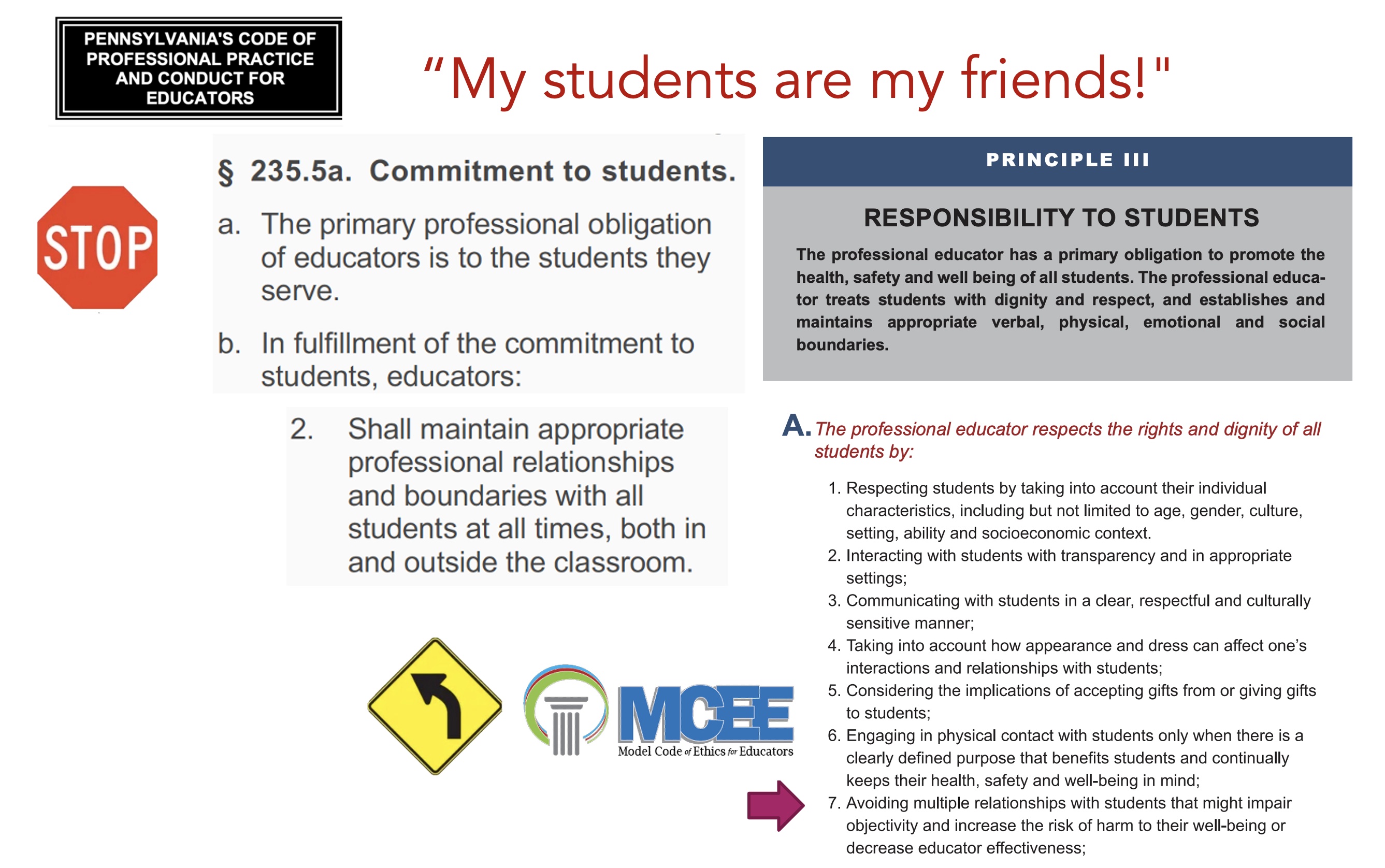
Principle III: Responsibility to Students
The professional educator has a primary obligation to treat students with dignity and respect. The professional educator promotes the health, safety, and well being of students by establishing and maintaining appropriate verbal, physical, emotional, and social boundaries.
“It’s just a gift…”
MCEE Section III, A, 5: Considering the implication of accepting gifts from or giving gifts to students;
My comment: It is not appropriate to give a gift to a student lacking an educational purpose. In some cases, this may be defined as a “sexual misconduct.” It begs the larger question: “Do you ensure that all of your interactions with students serve an educational purpose and occur in a setting consistent with that purpose?” Also from the PA Professional Standards and Practices Commission: “Teachers should refrain from accepting gifts or favors that might impair or appear to impair professional judgment.”
“You should never touch a student!”
MCEE Section III, A, 6: Engaging in physical contact with students only when there is a clearly defined purpose that benefits the student and continually keeps the safety and well-being of the student in mind;
My comment: We were told this warning in methods classes. However, as I mentioned in a previous blog here, this “rule” has little support in research or common “best practices.” It has been my experience that on occasion, most elementary instrumental teachers assist their students in acquiring the correct playing posture and hand positions by using some (limited) physical contact. Consoling an upset student with a pat on the shoulder is not out-of-line either. The factors that may contribute to the moment being judged “okay” vs. “inappropriate” boil down to:
MCEE Section III, A, 7: Avoiding multiple relationships with students which might impair objectivity and increase the risk of harm to student learning or well-being or decrease educator effectiveness;
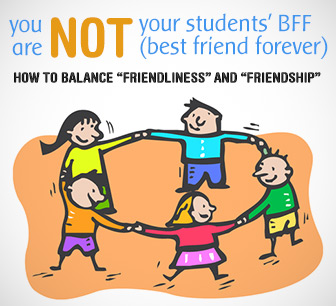
My comment: You cannot be their “friend.” You are their teacher, an authority figure that is looking out for them and doing what is necessary (“fiduciary” responsibilities) for their health and welfare… perhaps at times things they do not want you to do. Crossing the teacher/student boundary with familiarity, informality, and being their “confidant” or “friend” are more than just unprofessional acts – they can foster a dual relationship where roles are less defined, an ambiguity that may lead to additional inappropriate actions and educator misconduct.
“He’s weird…” or “He’s not one of us!”
MCEE Section III, B, 2: Respecting the dignity, worth, and uniqueness of each individual student including, but not limited to, actual and perceived gender, gender expression, gender identity, civil status, family status, sexual orientation, religion, age, disability, race, ethnicity, socio-economic status, and culture;
My comment: Check your prejudices and personal biases at the door. Being a teacher is all about sensitivity and caring of all individuals – students, parents, staff, etc. Embracing today’s focus on reprogramming community attitudes on “diversity,” an educator daily models the values of empathy, compassion, acceptance, and appreciation, not just settling with the “lower bar” of tolerance, allowance, and compliance!
“Wait ’til you hear what happened in class today!”
MCEE Section III, C, 1: Respecting the privacy of students and the need to hold in confidence certain forms of student communications, documents, or information obtained in the course of practice;
My comments: Gossiping about and “carrying tales” home or in the teachers’ room are serious breaches of the care and trust as well as your fiduciary responsibilities assigned to you on behalf of your students. As for “regulations,” your indiscretion may be a violation of your students’ confidentiality rights (“a federal crime” according to Family Educational Rights and Privacy Act, Grassley Amendment, Health Insurance Portability and Accountability Act, and Individuals with Disabilities Education Act). You are only permitted to share information about a student with another teacher, counselor, or administrator who is on a “needs-to-know” basis or is actively engaged in helping this student.
Principle IV: Responsibility to the School Community
The professional educator promotes positive relationships and effective interactions with members of the school community while maintaining professional boundaries.
“Don’t tell my parents!”
MCEE Section IV, A, 1: Communicating with parents/guardians in a timely and respectful manner that represents the students’ best interests;
My comment: I wish I had a nickel every time a student plead with me, “Don’t call my mom!” It is part of “moral professionalism,” your “code,” and good ethical standards to originate meaningful two-way dialogue, and if necessary, confront the parents of underachieving children. I also believe it goes on long way to nurture your relationships in the community if you notify parents when their kid has done something remarkable… “I caught him being good” or “The improvement has been extraordinary!”
“Did you hear what a staff member said about you… in front of the kids?”
MCEE Section IV, B, 1: Respecting colleagues as fellow professionals and maintaining civility when differences arise;
MCEE Section IV, B, 2: Resolving conflicts, whenever possible, privately and respectfully, and in accordance with district policy;
My comment: Before you bring up the matter with your supervisor or building administrator (which you have the right and even responsibility to do, especially if the students hear any improper speech first-hand or that the incidents rise to the level of bullying or aggressive behavior), first confirm the story. Talk to the unhappy team member one-on-one. Be calm and sensitive, but hold your ground: you must assert that his/her behavior/language is unacceptable and will not be tolerated in the future.
“Not another TEAM meeting?”
MCEE Section IV, B, 4: Collaborating with colleagues in a manner that supports academic achievement and related goals that promote the best interests of students;
My comment: We work together to insure that all educational goals are met. Open and interactive peer partnerships are helpful in the review, design, and application of new lessons, methods, media, and music.
“I was just teasing her…”
MCEE Section IV, B, 8: Working to ensure a workplace environment that is free from harassment.
My comment: Be extremely careful in the practice of any behavior or language of a kidding, sarcastic, cynical, or joking manner. It can be misinterpreted regardless of your intentions… and it can hurt someone’s feelings. And it is never appropriate or “professional” to “put down” another person.
“Don’t ask for permission… beg for forgiveness.”
MCEE Section IV, C, 3: Maintaining the highest professional standards of accuracy, honesty, and appropriate disclosure of information when representing the school or district within the community and in public communications;
My comment: Yes, I have heard this “view” a lot, advocates of whom will tell you to go ahead and stick your neck out to do something “for the good of the order,” and if needed later, “beg for forgiveness” if you decision is met with disapproval from administration. My advice? Less experienced teachers, run everything through your fellow colleagues (informally) and principal (formally). Don’t fall back on the lame “oops” and “beg for forgiveness.” I may have felt differently when I had three times as many years of experience under my belt than the supervisors who were assigned to “manage” me… but, even then, “venturing out without a paddle” usually did not serve the best interests of the students. There’s no reason to place “the teacher’s convenience” over the safety/welfare of the students. Besides, why not take advantage of the legal and political backup of your bosses if they are kept “in the loop?”
“He’s our preferred dealer and always takes care of us.”
MCEE Section IV, D, 4: Considering the implications of offering or accepting gifts and/or preferential treatment by vendors or an individual in a position of professional influence or power;
My comment: Formerly called “sweetheart deals” with music companies, you are on “shaky” ethical ground (and may also have “crossed the line” violating state laws/statutes) if you negotiate the rights of exclusive access to your school’s or booster’s purchasing. If you have any questions about your school’s policy on outside vendors, seek advice from your district’s business manager.
Principle V: Responsible and Ethical Use of Technology
The professional educator considers the impact of consuming, creating, distributing, and communicating information through all technologies. The ethical educator is vigilant to ensure appropriate boundaries of time, place, and role are maintained when using electronic communication.
“Isn’t use of social media forbidden?”
MCEE Section V, A, 1: Using social media responsibly, transparently, and primarily for purposes of teaching and learning per school and district policy. The professional educator considers the ramifications pf using social media and direct communications via technology on one’s interactions with students, colleagues, and the general public.
My comment: Professional educators’ use of a dedicated website or other social network application enables users to communicate with each other by posting information, comments, messages, images, etc. and “learn” together. However, using social media for sharing social interactions and personal relationships with your students, parents, and staff is unethical and dangerous. As they say, “a post (or snap) is forever.” Communicating digitally or electronically with students may lead to the blurring of appropriate teacher-student boundaries and create additional challenges to maintaining and protecting confidentiality.
The Final Word
In Pennsylvania (as well as the rest of the country), the statistics on school staff misconduct reports are rising alarmingly. Your own state’s “code of conduct” and the MCEE should help to clarify misunderstandings, but it has been my experience that the majority of educators do not receive regular collegiate, induction, or in-service training on educator ethics or moral professionalism. Luckily, we are fortunate to have access to many mock scenarios (see below) from state departments of education to review/discuss among ourselves common ethical conflicts and “conundrums” dealing with pedagogy, enforcement, resource allocation, relationships, and diversity. We all need to “refresh” our understanding of these issues from time to time and revisit “our codes” frequently to help “demagnetize” (and re-adjust) our decision-making compass.
Please peruse the ethics category of this blog-site for other articles and sample references below.
PKF
Resources
Website of Thomas W. Bailey, retired social studies teacher and attorney-at-law https://twbaileylaw.com/
American Association of Colleges for Teacher Education webinar presentation Beyond the Obvious: The Intersection of Educator Dispositions, Ethics, and Law by Troy Hutchings and David P. Thompson https://smackslide.com/slide/ethical-equilibrium-aacte-2evrqb
New Teachers’ Guide for Fostering Positive Relations & Good Interactions with School Administrators
Conventional wisdom suggests that the initial school staff you should get to know immediately on a first-name basis in your new teaching job are 1) the building secretary, 2) head custodian, and 3) cafeteria workers. (The first one keeps you out of trouble, the second cleans up your messes, and the last group makes sure you’re well-fed!)
However, even more influential, the principal “assigned to you” will literally “make or break” a smooth transition and orientation into the workplace. Especially if this person was partially responsible for hiring you (a member of the screening committee which chose you out from all of the other qualified candidates), he/she should be your penultimate “mentor!” To validate the administrator’s judgment (and you continuing to be the “hero”), he/she will likely be highly motivated to foster your success!
So… once you land your new position, your first move should be to learn everything you can about “your champion!” Find out his/her goals, needs, and “pet-peeves,” and while you’ll at it, get off on the right foot with relations with all of your school supervisors.
Here are some tips for “rookie” or new music teachers to cultivate these relationships.
According to the article, “The Principal’s Role in the Music Program” by Orville Aftreth in the Music Educators Journal (Vol. 46, No. 3, January 1960, pp. 41-44), “A successful music program requires a principal who enables the following basic attitudes:
A belief in the value and importance of music;
A desire to grow his ability to enjoy, appreciate, and produce music;
A willingness to vitalize school activities through music.”
But, unfortunately, it seems that few administrators have significant and ongoing experiences in making music.
A principal’s musical background influenced their view of music as a key part of a quality education. Most of the principals’ formal experience in the arts ended early in their life, and none took classes on how to be an effective administrator for an arts program. Principal certification courses typically deal with finance, special education, and general leadership and administration.
—D. Benjamin Williams
My own history (35 years of teaching in the public schools with 30+ administrators) was to serve with only one principal who was a former music teacher, and perhaps 10% of the remaining administrators had any real arts education experience (or even regularly played an instrument or sang in a choir).
Williams shared the purpose of his case study: “to gain an understanding of school administrators’ thoughts on their school’s music program in regards to music’s role and value.” He documented the comments of five principals in their advocacy of the arts.
The research questions posed in this study centered on the following:
What are common values and/or themes among administrators when it comes to music in their schools?
Are there common points of advocacy administrators find themselves making in support of their school’s music program?
What do administrators see as benefits of having a music program in their schools?
Where does music fit in the overall vision of a school?
What is music’s role in a quality education?
They mentioned how the arts are an opportunity to plug in, be engaged, and earn scholarships; that they create an identity for the individual and for the school; that they make a whole student and contribute to a whole education; and that they provide opportunities for higher-order thinking, such as critical or creative thinking and problem solving, that are encouraged in core-content areas as well. The pressure placed on education institutions in the 21st century are focused on these concepts, and the principals saw that music helped and encouraged students to develop these abilities. This is why they chose to support, advocate, and build up their school’s music programs.
—D. Benjamin Williams
I repeat: the first advice we give to newcomers to the profession is know your bosses! And, intentionally invite, “educate,” include, and engage them in your music classes and ensembles’ activities! Draw a circle around him/her to become a member of your team!
He drew a circle to shut me out,
heretic rebel, a thing to flout.
But love and I had the wit to win,
we drew a circle that took him in.
Learn techniques to make your principal work for you and your program.
Learn how to think like a principal.
Each year when I return from honor bands or other music related field trips, I make it a habit to purchase my administrators a small token of appreciation to let them know the trip was a great success. Students must write an essay, and they present the administrators with the gift. In the essay, students are required to write what they learned, what the field trip meant to them, and how they will use this experience to make the school better. Praise is effective.
Coming together is a beginning; keeping together is progress; working together is success.
— Henry Ford
Remember that even though you are not taking the role of administrator, you are a leader. You lead a program. You lead a musical family. You are the leader of a superior sound. You are the leader of inspiration for your community. In the most genuine way, lead your administrator to a music education crescendo.
— Lori Schwartz Reichl
After a little brainstorming, I recalled my own working “top-ten list” of techniques for building harmonious interactions and collaborations with your school leaders.
Be the first to arrive and the last to leave, and you will earn their respect! Professionals, especially music teachers who participate in co- and extra-curricular activities, are not “clock watchers” and need to “put in the time” before and after school to prepare and achieve meaningful learning experiences for their students.
Learn what makes them tick! Is your principal a site-based manager? Is he/she a stickler for “chain of command.” I had an administrator who would go bonkers if he thought you back-copied a memo to the superintendent or called a central office manager first. Be sure you conform to the management style of your chief. This is a way of showing him/her respect and cooperation, which in all likelihood, will be returned to you in spades.
Keep your principal “in the loop” and “in your corner,” and make sure you communicate any serious disputes that come up (especially with unhappy parents) that could blow up in your/his/her faces in the future. This also which means you don’t subscribe to the philosophy, “Don’t ask for permission, beg for forgiveness.” Proponents of this belief will tell you to go ahead and stick your neck out, perhaps do something “for the good of the order,” and later declare “oops!” if it goes south and your administrators disapprove. I cannot vouch for the ethics of this position, and “venturing out without a paddle” usually did not serve the best interests of the students. There’s no reason to place “the teacher’s convenience” over the safety and welfare of the children, and you should first try to obtain the legal and political endorsement of your boss(es) as you keep them appraised about what you are doing. Don’t be a nag, just “cc:” when appropriate, and “ask,” don’t “tell!”
Give them credit! Publicly, you make it clear: you and your students’ awards and accomplishments are also your administrators’ awards and accomplishments. If it is possible, have your principal join you on stage to accept any ensemble honors.
Serve on a non-music related committee or project. Principals are always looking for volunteers to help fulfill the overarching goals of the district. This might mean signing up for the strategic planning committee, Middle States accreditation evaluation team, school renovation planning meetings with the architect, etc.
Engage your principal as a participant in your program: concert appearances as guest conductor or solo/ensemble performer, featured narrator or announcer, limited-engagement as a walk-on part in the musical, judge of talent show, etc.
Model professionalism and good time management skills. Be prompt in the completion of all deadlines assigned by administration. Don’t turn your principal (or his secretary) into a “nag” requiring numerous follow-up reminders.
Understand the importance of public perceptions and “appearances.” Many school leaders spend an inordinate amount time trying to defend the sometimes questionable actions of their staff. Don’t make this necessary! Be responsible for your “public brand.” If it looks bad, it is bad… and that’s always up to you!
Don’t just bring up problems, have answers! At odds with an existing policy or practice? Suggest a solution and a Plan B to an issue you would like to address. Upholding “moral professionalism,” tactfully but firmly point out what is not working (and why). But, do your homework first. Share the “facts and stats” and try to propose several different directions to consider (even a Plan C and a Plan D). You will impress the “head honcho” by modeling the traits of flexibility, creative problem solving, and sensitivity to the needs of other staff and programs.
Think long term and back-up your requests with numbers! When you submit your budget for the next school year, include the “tangibles” and statistics that your principal could use to “fight for you.” Include data on and percent changes in student enrollments, per-pupil costs, history of past purchases, etc. and separate your proposals into one, two, three, and/or five-year “plans” to spread out the expense for big-ticket items. Be specific and prioritize! When asked to “cut” my sheet music amounts, I assembled a set of sample folders with all of the music I used in the current year and broke down each selection’s current (replacement) price, each concert’s overall value, percentage of the repertoire used from my library, projected losses, etc. In one case, I predicted that if the district went through with its reduction of the music budget by 20% and (at the time) the cost of sheet music was rising 15%, I would be forced to schedule one fewer public performance in the school year. (It never happened!)
If you have an apple and I have an apple and we exchange apples, then you and I will still each have one apple. But if you have an idea and I have an idea and we exchange these ideas, then each of us will have two ideas.
— George Bernard Shaw
Another resource worth reading is “A Teacher’s Guide to Working With Your Principals” by Kristy Louden. She reflects: “But aside from the obvious factor that your principal is your boss, and you want your boss to think well of you, I have found my relationship with my principal has helped in more ways than I probably realize. Here’s why:
They’ll think of you… (when an opportunity comes up that you might want).
Tip #41: Continuously improve classroom management
Tip #62: Make ethical decisions
Tip #80: Write notes, return phone calls, reply to email
Tip #93: Perform (satisfy your own pursuit of creative self-expression)
Tip #97: Improve your leadership skills (quotes from the book Leadership 101 by John Maxwell)
This final point is an excellent one. You are “in charge” of your own self-improvement projects and professional development. Administrators want to see staff members who seek growth experiences. Don’t wait for the annual implementation of the district’s “latest flavor of the year” in-service program (as it is sometimes referred to by teachers) or your supervisor’s year-end conference. Do your own self-assessment and plan specific and measurable goals and tasks to fulfill them. Always strive to do your best and be harder on yourself than anyone else (even administration) can ever be. Model the concepts of focus, cooperation, self-discipline, and a positive attitude in the workplace.
Now, take a deep breath. It’s all about one step at a time. Soak up these ideas. You can and will nurture happy and productive relationships with your principal and other school administrators, enhance your professional image and effectiveness, and foster opportunities of achievement and self-fulfillment for you and your music students!
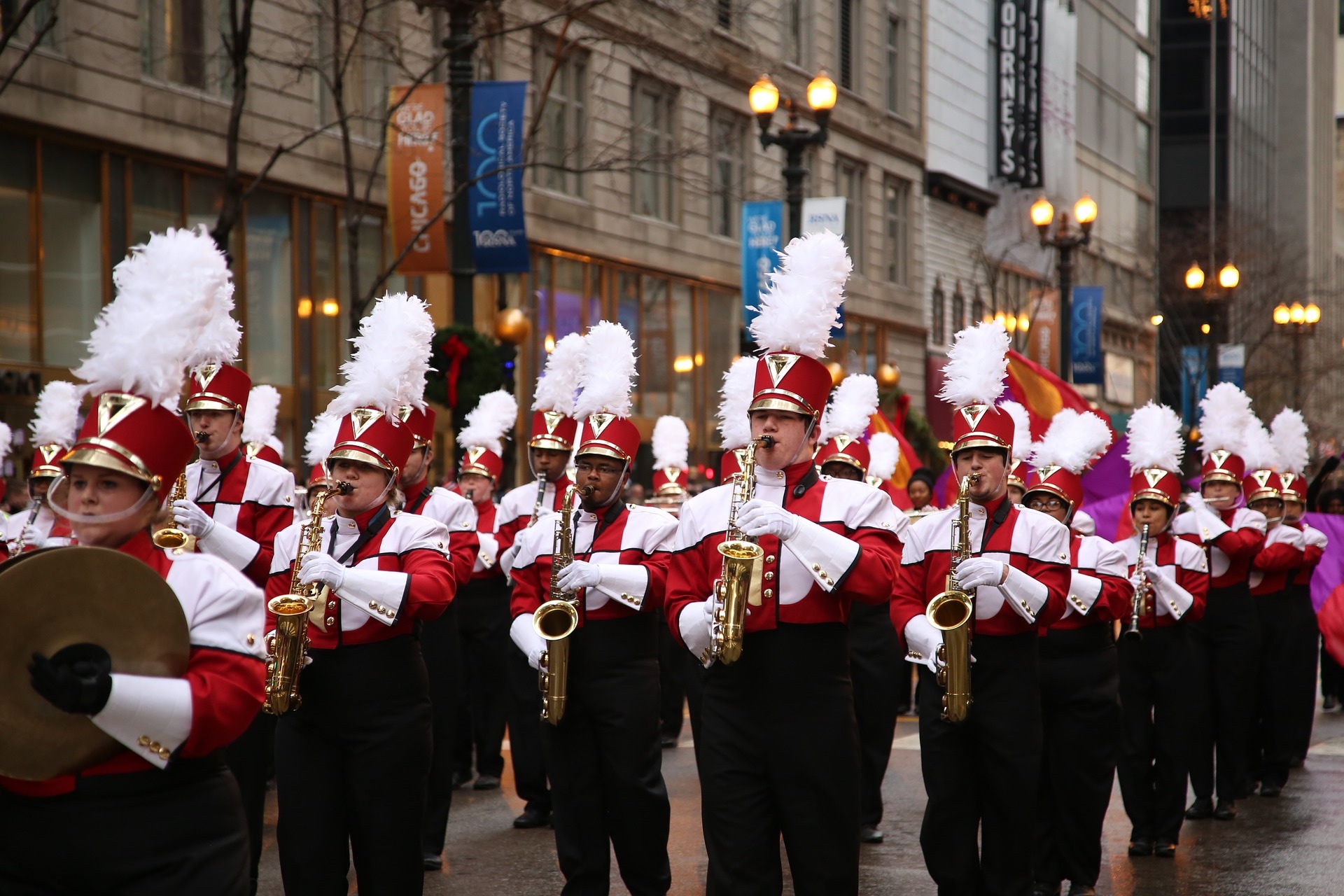
Photo credits in order from Pixabay.com: “handshake-regard-cooperate-connect” by johnhain, “laptop-office-hand-writing” by Aymanejed, “marching-band-chicago-thanksgiving” by sam99929, “violin-flute-music-classic” by horndesign, “woman-business-woman-boss” by anna2005, “people” by Russell_Clark, and “wooden-train-toys-train-first-class” by Couleur.












































 can about “your champion!” Find out his/her goals, needs, and “pet-peeves,” and while you’ll at it, get off on the right foot with relations with all of your school supervisors.
 Williams shared the purpose of his case study: “to gain an understanding of school administrators’ thoughts on their school’s music program in regards to music’s role and value.” He documented the comments of five principals in their advocacy of the arts.
 Also, you should check out an even more recent NAfME blog,
  Learn what makes them tick! Is your principal a site-based manager? Is he/she a stickler for “chain of command.” I had an administrator who would go bonkers if he thought you back-copied a memo to the superintendent or called a central office manager first. Be sure you conform to the management style of your chief. This is a way of showing him/her respect and cooperation, which in all likelihood, will be returned to you in spades.
 looking for volunteers to help fulfill the overarching goals of the district. This might mean signing up for the strategic planning committee, Middle States accreditation evaluation team, school renovation planning meetings with the architect, etc.
 practice? Suggest a solution and a Plan B to an issue you would like to address. Upholding “moral professionalism,” tactfully but firmly point out what is not working (and why). But, do your homework first. Share the “facts and stats” and try to propose several different directions to consider (even a Plan C and a Plan D). You will impress the “head honcho” by modeling the traits of flexibility, creative problem solving, and sensitivity to the needs of other staff and programs.
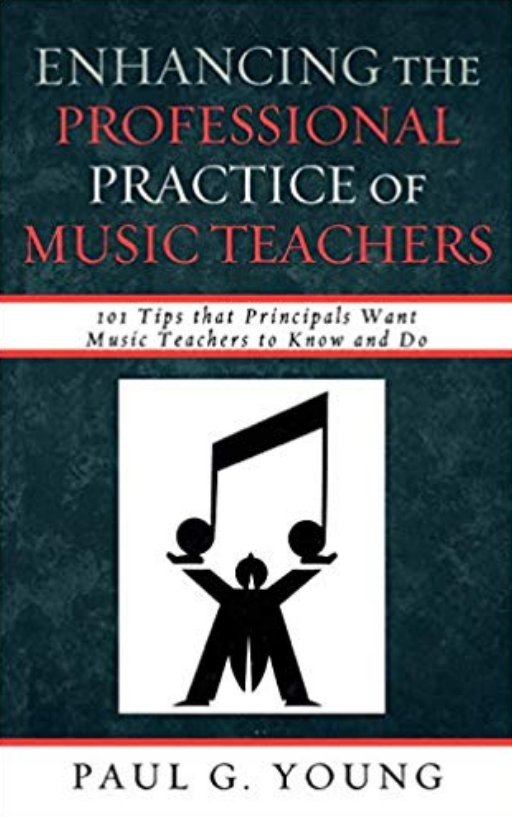 Finally, the most comprehensive manual I have ever read on this subject should be a “required read” for every music educator:
 paulfox.blog