
The Final Leap from Pre-Service to In-Service:
The Metamorphosis and Integration of Philosophy, Maturity, and Teacher Preparation
 To “wrap-up” our final segment, we will review the development of a professional “marketing plan.” This is blog #3 out of 3. (Be sure to also check out #1 and #2, too.)
These are three critical skills you need to foster in the search for a school music position, marketing yourself, interviewing, and landing a “good” job:
- Personal branding (who are you, what makes you unique, and what do you have to offer?)
- Story telling (anecdotes) of your positive attributes and personal brand, including a record of your habits of “engagement” in music education, and
- Networking (associating with other professionals and getting your positive stories “out there”).

Personal Branding
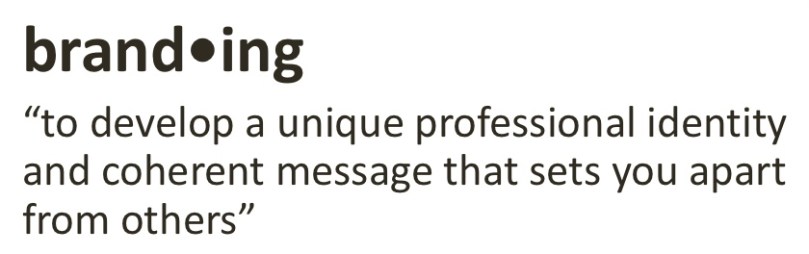
“Personal branding is the practice of people marketing themselves and their careers as brands. While previous self-help management techniques were about self-improvement, the personal-branding concept suggests instead that success comes from self-packaging… Personal branding is essentially the ongoing process of establishing a prescribed image or impression in the mind of others about an individual, group, or organization.”
– Wikipedia: https://en.wikipedia.org/wiki/Personal_branding
What is the difference between marketing and branding? According to some, “marketing is what you do, branding is what you are.” (www.tronviggroup.com/the-difference-between-marketing-and-branding/)
 Shama Hyder posted “7 Things You Can Do to Build an Awesome Personal Brand” at http://www.forbes.com/sites/shamahyder/2014/08/18/7-things-you-can-do-to-build-an-awesome-personal-brand/, including the following outlined summary:
- Start thinking of yourself as a brand
- Audit your online presence
- Secure a personal website
- Find ways to produce value
- Be purposeful in what you share
- Associate with other strong brands
- Reinvent
During these waning months for college music education seniors, now is the time to finalize the preparations for personal branding and beginning the employment search! Personal branding is critical to help you “stand above the rest,” showing that you have what it takes and would be a major asset to a prospective employer, and defining and marketing your own unique qualities that would make you “a good fit” for the specific job openings.
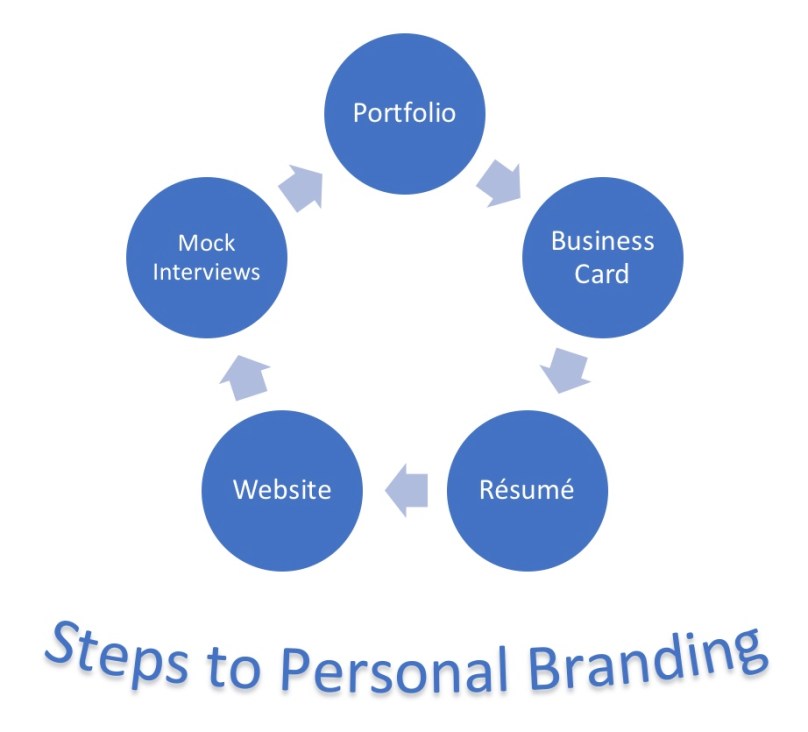 The branding process involves first developing your philosophy of music education, archiving your awards and accomplishments, documenting your grades and
  experiences, and collecting stories/personal anecdotes of your strengths. The next steps include the creation of a written and electronic portfolio, business card, resume, and website. Finally, you must compile/assemble everything together and practice (and self-assess) your “story-telling skills” to answer those important questions at well-rehearsed “mock interviews.”
You will likely not have enough time to complete all of these tasks during methods classes or student teaching seminars. That’s okay. If you are serious about prepping yourself to find a great music teaching job, the valuable links (see below) and articles are out there… just manage your time and start reading.

Networking
According to the article “Network Your Way to Secure a Teaching Job” at https://resumes-for-teachers.com/job-search-help/teacher-network/, many people are unaware of the basics of networking and how to use them it to their advantage in securing a job:
“Networking simply refers to finding job-related contacts. Most teachers who are just beginning their careers may feel that they have few, if any, networking contacts in the teaching field. It is important to consider the many different areas of networking as you create your own group of networking contacts to help you secure a teaching job. It is interesting to note that many of the teaching positions that are filled each year are filled by those who came to the attention of personnel managers by recommendation.”
“Always think about adding to your teaching network. When meeting new people, be certain to add them to your network. Talk to them about your skills, education, experience, and learn about their jobs. Make sure that you always ask for a business card.”
Do you have a business card? Is your résumé updated and available online on your professional website?
 As I laid out in a previous blog “Networking Niceties: The ‘How-To Schmooze’ Guide for Prospective Music Teachers” at https://paulkfoxusc.wordpress.com/2016/04/04/networking-niceties/, the concept of networking is two-way communications. Just like collective sets of nerve synapses, two-way connections are expected to fire repeatedly in all directions. That’s actually the science behind memory. For professional networking, it is your “charge” to create multiple pathways to/from school HR managers and secretaries, administrators, music supervisors and department heads, and music teachers… and YOU – your skills, accomplishments, unique qualities, experience, education, and personality traits.
 The above blog-post also explores setting up a good organizational system to manage your professional contacts.
If you are a Pennsylvania collegiate member (PCMEA), I heartily recommend the article “Networking 101” by Dr. Kathleen Melago, PCMEA State Advisor and Associate Professor of Music Education at Slippery Rock University, published in the Summer 2017 issue of the state journal PMEA News (pages 40-42). Here are several quotes from her work:
“One of the most common ways music educators can plan to network is at conventions. First, try to avoid interacting only with people from your school or people you already know from other schools. Go to sessions that interest you and look for opportunities to meet people there. Before the session starts, introduce yourself to people sitting around you. Use your social skills to assess whether they seem like they want to engage in a conversation or not. After the session, go up and meet the presenter.”
“Of course, social media is another great way to build your network. Networking with professionals already in the field can help you see what they are doing and help you build ideas of what you would like to do in your program someday.”
“Sometimes, you might find yourself networking unexpectedly. For example, you might go into school to work with their clarinet section during band camp and just happened to meet the choir teacher. That is networking!”
“To help your networking be most effective you need to have good communication skills. When interacting with others in a networking situation, be sure to focus on the person with whom you are speaking. Avoid looking off into the distance as if you were to anticipating someone else more important coming by. But your cell phone away and be present to the conversation.”
“Be yourself in your networking interactions. If you pretend that you are someone you are not, you will either end up unhappy or you’ll be discovered is someone who is not genuine.”
Dr. Melago goes on to provide a myriad of excellent examples of networking skills and opportunities.
Another resource specifically for networking at music teachers conferences is posted at https://nafme.org/getting-music-conferences/.
Engagement
Here is an excellent definition of “professional engagement” from “Domains of Teaching” of the Australian Institute for Teaching and School Leadership at https://www.aitsl.edu.au/teach/understand-the-teacher-standards/domains-of-teaching.
Teachers model effective learning. They identify their own learning needs and analyze, evaluate and expand their professional learning, both collegially and individually.
Teachers demonstrate respect and professionalism in all their interactions with students, colleagues, parents/carers and the community. They are sensitive to the needs of parents/carers and can communicate effectively with them about their children’s learning.
Teachers value opportunities to engage with their school communities within and beyond the classroom to enrich the educational context for students. They understand the links between school, home and community in the social and intellectual development of their students.
Engagement for prospective music teacher may include synonyms like “participate,” “enroll,” “join,” “be active,” “volunteer,” “seek experience,” and “make a difference!”
Are you a member of your professional music education associations?
- NAfME National Association for Music Education
- PCMEA Pennsylvania Collegiate Music Educators Association, or another state’s local NAfME collegiate chapter
 PMEA Pennsylvania Music Educators Association, or another state’s NAfME-affiliated MEA
- ACDA American Choral Directors Association
- ASTA American String Teachers Association
- NBA National Band Association
Did (or will) you attend your state music teachers’ conference and local workshops on music education and professional development?
To prove you are “professionally engaged,” I would expect to see a consistent record of modeling in the following areas:
 Self-reflection of the professional’s teaching practices and modification of these as needed to match changes in the environment and circumstances
- Self-assessment of the professional’s methods and approaches, as well as the progress of the students’ learning, using both formative and summative methods for constant and ongoing improvement
- Identification and planning of professional learning needs.
- Unsupervised (or unplanned by school administration) goal-setting and self-guided implementation of opportunities for professional development
- Association with professional learning communities, school and community meetings, and other collaborative projects
- Volunteer service in music and music education
- Membership and subscription to music education journals and participation in online professional community discussion groups
Many have said that aspiring to be a music educator is a lot like a calling. One school superintendent I know said he expected prospective new recruits to show high energy, enthusiasm, sense of purpose, and dedication during the interview… even a supposed willingness to “lay down in front of a school bus” or “do what ever it takes” to make the students (and the educational program) successful. That’s engagement!

In summary, becoming a music educator is about finding your inner confidence, a mindset that you know what you’re doing, and that you’re ready for that real world experience. You’ve learned those essential skills in conducting, piano accompaniment, arranging, student behavior modification and discipline, music diagnosis and remediation, and even how to market your professionalism. Now… drum roll, please! Here’s… a master music teacher!

In closing, here are supplementary materials to help you to “get your feet wet,” all free and available online. The following lists, although not comprehensive, are a good place to start (courtesy of https://www.pmea.net/wp-content/uploads/2012/10/Collegiate-Communique-No11-022218-2.pdf):
Good luck!
Personal Branding, Marketing, and Networking
- https://paulkfoxusc.wordpress.com/2015/12/16/tips-on-personal-branding/
- https://www.aicpa.org/interestareas/youngcpanetwork/resources/career/fivetipstobrandingyourself.html
- https://paulkfoxusc.wordpress.com/2015/07/04/marketing-yourself-and-your-k-12-music-certification/
- https://www.quicksprout.com/the-complete-guide-to-building-your-personal-brand/
- https://paulkfoxusc.wordpress.com/2016/04/04/networking-niceties/
- https://www.workitdaily.com/hate-networking-tips/
Business Cards
- https://paulkfoxusc.wordpress.com/2016/04/04/networking-niceties/
- https://www.huffingtonpost.com/2011/11/12/designing-a-business-card_n_997449.html
- https://www.entrepreneur.com/article/159492
- https://www.webdesignerdepot.com/2010/06/how-to-design-your-business-card/
Résumés
- https://paulkfoxusc.wordpress.com/2016/01/12/music-teacher-resumes-revisited/
- https://www.wikihow.com/Make-a-Resume
- https://www.thebalance.com/guidelines-for-what-to-include-in-a-resume-2061035
- https://www.resume.com/blog/5-simple-tips-when-building-a-resume/
- http://www.powerful-sample-resume-formats.com/index.html
- https://iml.esm.rochester.edu/careers/resume/
- https://www.cmu.edu/career/students_and_alumni/write_a_resume_or_cover_letter/index.html
Portfolios and Websites
- https://paulkfoxusc.wordpress.com/2018/01/14/the-professional-website/
- https://nafme.org/do-i-need-a-digital-teaching-portfolio/
- https://paulkfoxusc.wordpress.com/2015/11/15/planning-the-perfect-professional-portfolio/
- http://www.theeduedge.com/top-five-must-haves-top-five-could-haves-your-teacher-interview-portfolio/
- http://langwitches.org/blog/2009/07/17/digital-teaching-portfolios/
- http://www.learnnc.org/lp/pages/6437?style=print
Interview Questions, Techniques, and Skills of “Story-Telling”
- https://paulkfoxusc.wordpress.com/2015/08/02/when-it-comes-to-getting-a-job-s-is-for-successful-storytelling/
- https://paulkfoxusc.wordpress.com/2015/10/11/the-dos-and-donts-of-interviewing/
- https://paulkfoxusc.wordpress.com/2016/02/27/interview-questions-revisited/
- https://paulkfoxusc.wordpress.com/2015/09/01/a-blueprint-for-success-preparing-for-the-job-interview/
- https://www.theguardian.com/teacher-network/teacher-blog/2014/jan/29/teacher-job-interview-questions-top-ten
- https://www.thebalance.com/teacher-interview-questions-and-best-answers-2061223
- https://theinterviewguys.com/teacher-interview-questions-and-answers/
PKF
© 2018 Paul K. Fox
 The Common Core
 Behavior management, disciplinary procedures (especially preventive practices) and posting class or ensemble rules
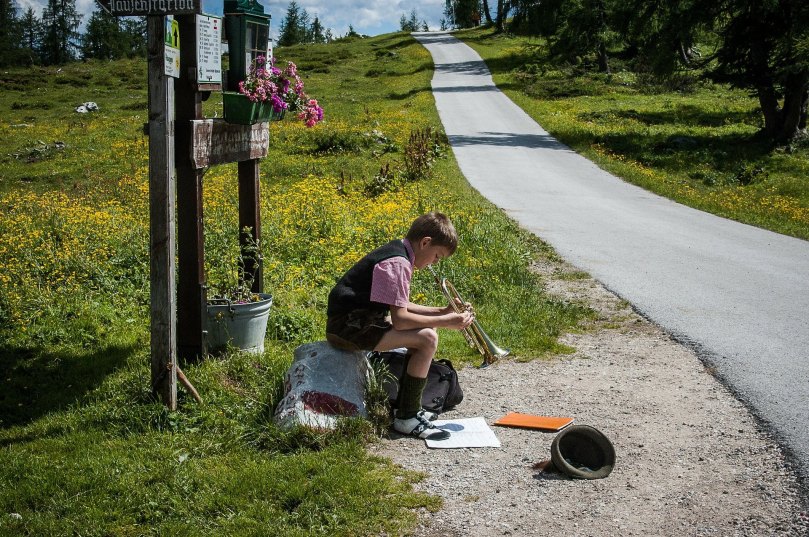
 However, in the methods classes that come later (perhaps in the second through fourth year?), the basics of “how-to teach” will come. Of course, as you sit in a class teaching you to “cross the break” on a clarinet or play a scale on the flute with good tone, you must also absorb (and remember) the finite steps required in the lesson to pass on this knowledge and skill, not just honk or squeak a few times to master the proficiency exam for yourself.
 You will be required to seek additional research, study, and at times “re-tool” outside what was presented in your methods courses. Some of these new “best practices” will be presented by the induction or in-service training of your school district. When I was hired by the Upper St. Clair School District, a big three+ year professional development program was the Madeline Hunter Model of Mastery Learning. Grudgingly (at first I did not see the purpose), I came to realize that labeling and defining the “eight steps of effective lesson plan design” improved my overall skills as an educator, especially in many of her strategies of “anticipatory set,” “modeling,” “checking for understanding,” and “guided practice…” none of which were ever mentioned even briefly in my five-and-a-half years in college.
  Of course, these are “trick questions.” The answer should be “I want to teach music,” or even better, “I want to teach children.” In most of the school districts across the country (with a few exceptions in the Midwest and places that accept teaching specialty certification by grade level or subject area), you are licensed to teach music in grades Pre-K to 12. At no point in any conversation with a potential administrator (or colleague who may become a member of the screening committee for a music opening) do you want to be “pigeon-holed,” or give the impression “I can only teach_____.”
 Accompany, direct/teach the drama, and choreograph the middle school musical.
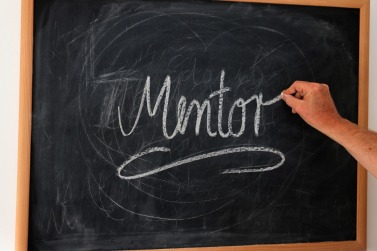 Ego and arrogance has no place in the teaching profession. Where did I hear this saying? “The more you think you know, the less you actually know.” Joining a mentoring program or finding a formal or informal veteran teacher “buddy” will go far to insuring your professional success and dodging those first-year teacher “pot holes” (dumb but common blunders) and “rookie blues.”

 Retired music teachers are another excellent resource. For example, if you live or work in Pennsylvania, many post-employed PMEA members have placed their name and contact information on the Retiree Resource Registry to serve as willing, capable, and informal consultants for pre-service, novice, or other members recently transferred into a non-major specialty “outside their comfort zone.”
 Please feel free to comment on this blog-post. What are your thoughts?
 Before long, you will shed the label and function of a “college student” (although still remaining a life-long learner… and never stop the quest for new knowledge and self-improvement!). The focus will shift from YOU to YOUR STUDENTS. The prerequisites for a career in education are unique and do not resemble the same challenges as success in business, manufacturing, retail, service industry, or becoming an entrepreneur, blue-collar worker, or even a composer or professional musician. The sooner you realize these are world’s apart, the better, and now is the time to finish your major and life-changing transformation to… a professional music educator.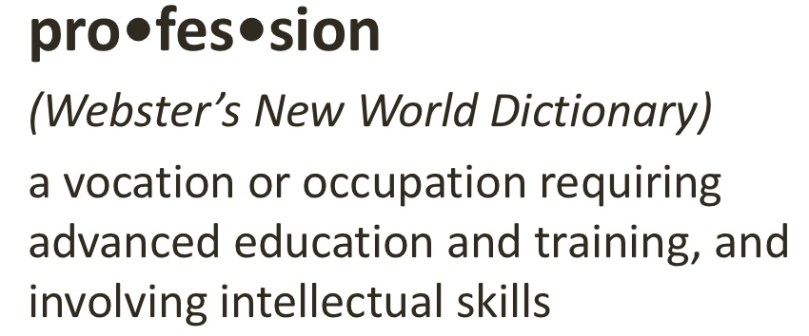
 Updates self with “constant education” and retooling
 Cooperation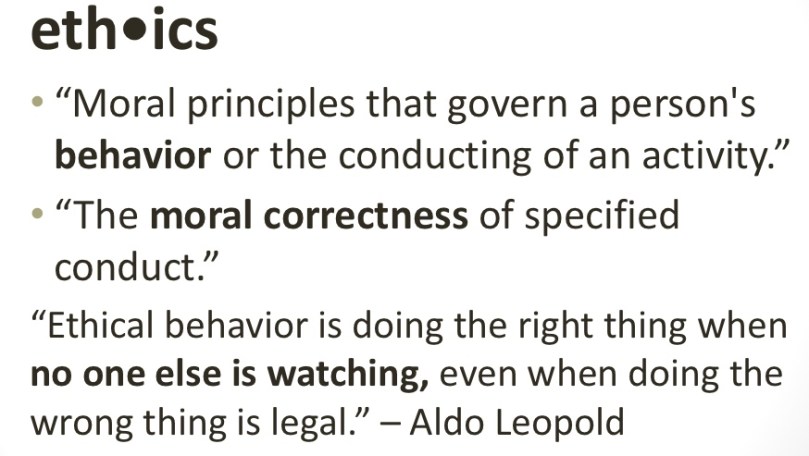
 National Association of State Directors of Teacher Education and Certification proposes these principles:
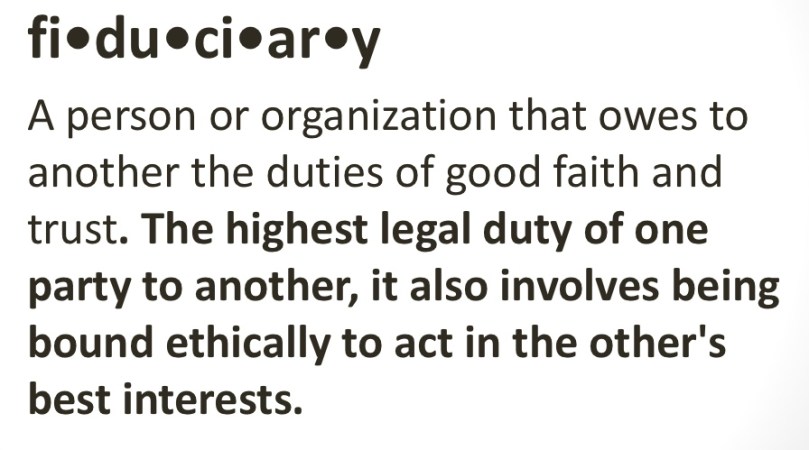 Here’s another query. What five groups of people are both “professionals” and “fiduciaries…” and have a legal responsibility to serve the best interests of their “clients?” The answer is… doctors/nurses, lawyers, counselors (both mental health and investment), the clergy, and… teachers.
  Although teachers seem to be the only one of these who DO NOT have formal pre- or in-service ethics training, and our “charges” represent a “captive audience,” our duty is clear: to act as a fiduciary for our students’ best interest, and to create and maintain a safe environment for them at all times.
 What do you believe about teaching?
 Take time to peruse these and others. Most of these sites also offer excellent examples of personal branding and marketing of the prospective job hunters’ experiences, skills, and achievements… material for our next blog on this topic.

 Even though it is from a book on post-employment transitioning (Purposeful Retirement: How to Bring Happiness and Meaning to Your Retirement), the author Hyrum W. Smith suggests several thought-provoking questions on prioritizing time:
 Yours truly, a “late baby boomer,” never enjoyed that prophesied and romanticized revolution of a “paperless society.” Did you? PM recommends the creation of a “future reading” file, a subcategory of “date it.” Experts on Google Mail will extol the merits of creating a folder and categorizing/storing messages such as emailed issues of MEJ, Kappan, SB&O, and other digital editions of professional newsletters. I have found that this doesn’t work very well, even in retirement. The file folder just fills up, and I never seem to get around to reviewing the things I thought were so important to save. Nor did the practice of our grandmothers’ generation clipping articles (and coupons) out of newspapers. You would think you could solve this media overload by just printing a small excerpt of what you want to peruse later and putting it in a letter tray near your desk? Nope. It just piles up! However, probably the ideal solution would be to designate a specific 15 minutes or more every day for something they used to give to the middle school students I taught: “silent and sustained reading.”
 How many times have you heard it? Make your plans and goals “intentional!” Besides all of the upcoming deadlines and appointments to which you are committed, include in your daily and weekly schedule opportunities for individual reflection and growth.
 in response to feeling a little “stressed over the schedule” could be to “get used to the 24/7 nature of the job.” A music teacher works from sun-up (and before) to sun-down (and after), and constantly has to juggle multi-tasking on a wide variety of to-do’s, all landing at the same time: writing lesson plans, arranging music or drills, preparing scores or accompaniments, planning and rehearsing ensembles, managing the grade book and attendance records, attending faculty meetings and parent conferences, writing curriculum, student assessments, and lesson targets, preparing for extra-curricular activities like marching band, chorus, or the musical, finishing your own homework for graduate courses, district inductions, or professional development assignments, ETC.
 Educators are among the singular professions which have a “fiduciary” responsibility. The term “fiduciary” can be defined as “a person or organization that owes to another the duties of good faith and trust, the highest legal duty of one party to another, and being bound ethically to act in the other’s best interests.” Joining doctors, lawyers, clergy, and mental health therapists, educators ascribe to the highest standards of training, moral decision-making (“code of ethics”), behavior (“code of conduct”), and self-regulation and assessment of the “best practices” regarding the mastery of skills and subject areas necessary to their field. However, unlike these other professionals, teachers do not receive regular and systematic pre- and in-service training on ethics, and our “clients” are a “captive audience.” Regardless, the duty of all teachers is to act as a fiduciary in their students’ best interest and to create and maintain a safe environment for them at all times.
 Always looking for the signs of…
 Health Insurance Portability and Accountability Act (HIPAA) of 1996 provides data privacy and security provisions for safeguarding medical information.
 Proponents of this belief will tell you to go ahead and stick your neck out, feel free to do something “for the good of the order,” and later “beg for forgiveness” if/when it goes south and your administrators say they do not approve.
 My advice: “Forget your rights” and be more aware of your image and how your actions will look to the public. Reputations are hard to restore. Being an effective teacher is all about trust and integrity, and (sorry, one more cliche) “your actions speak louder than words!”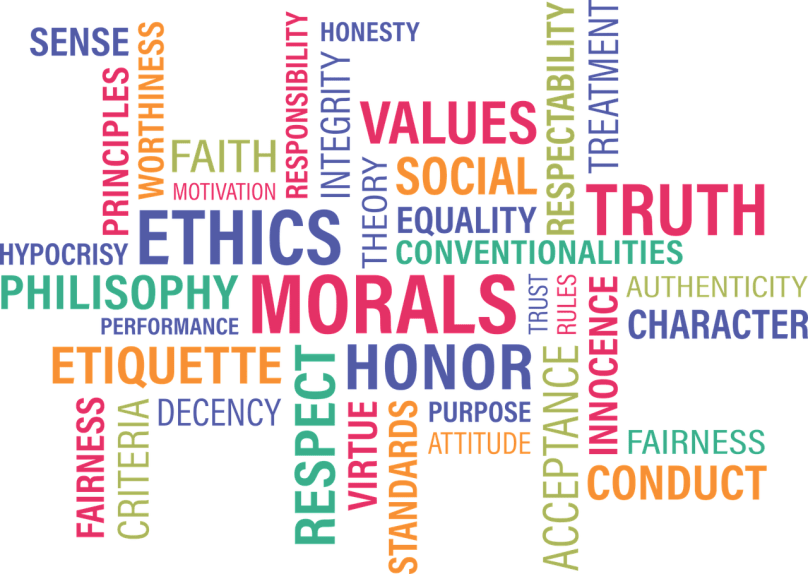

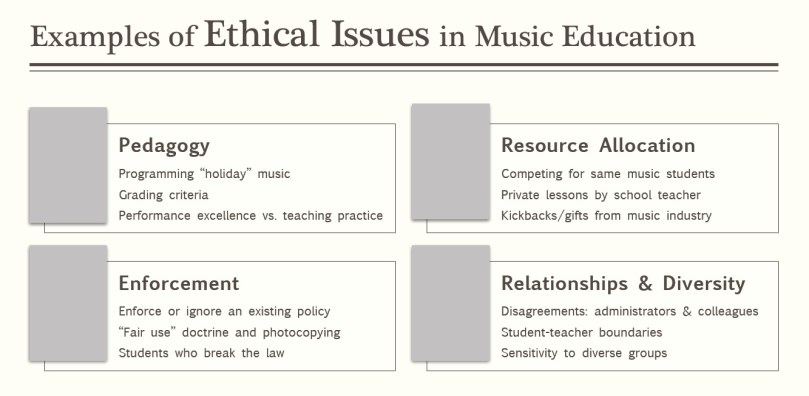
 Administrators, parents and public’s interpretation of “separation of church and state” or “perceived emphasis” on Holiday vs. Christmas music (with sacred text) at December concerts e.g. Handel’s Hallelujah Chorus, Hatikvah, and/or John Rutter’s Oh Come All Ye Faithful & Joy to the World as the finale
 Competition for the enrollment of the same students (band/string/choir) within the music department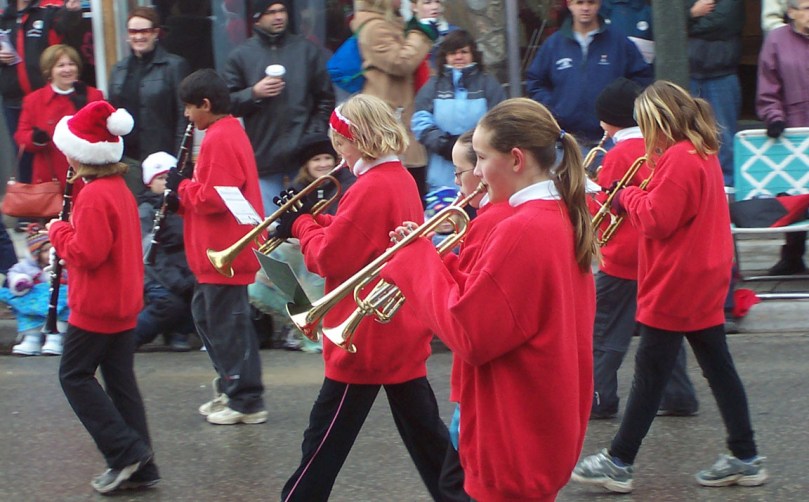
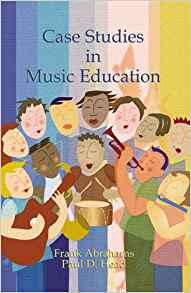 If you have not had the occasion to read Case Studies in Music Education by Frank Abrahams and Paul D. Head, it would be a valuable aid to “facilitate dialogue, problem posing, and problem solving” among pre-service (and current) music teachers. Using the format of Introduction, Exposition, Development, Improvisation, and Recapitulation known by all music professionals, each chapter presents a scenario with a moral dilemma that many music educators face in the daily execution of their teaching responsibilities.
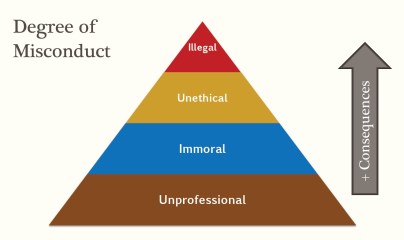 For additional examples of ethical issues in education, try these links. Personally, many of these fictional video reenactments are hardcore and very painful to view… but may shed some light in any discussion of teacher (mis)behavior: actions from simply inappropriate, unwise, or “bad for appearances” to a range (from bad to worst) of unprofessional, immoral, unethical, and illegal conduct. Some of these stories you will agree should be instantly labeled as the highest degree of unethical practice ― actual “crimes against children” and should invoke punishment if found guilty ― while others may lack clarity and make it difficult in arriving to a consensus.



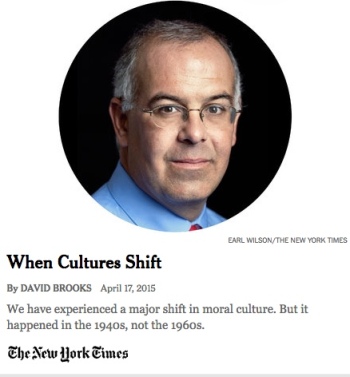 Many have suggested that there has been a decline in moral standards that have contributed to ethical disputes in modern society (and in the public schools). Some say that this is attributed to a breakdown or lessening of the influence of organized religion and family values. “When Cultures Shift,” an excellent article in the New York Times (April 17, 2015), David Brooks explores some of causes and effects of this “slip” to our value systems, ethics, and renewed focus on self:
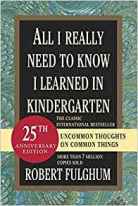 Do schools, not necessarily families, serve as the “safety net” for socializing its citizens, and teaching morality, manners, and the values of human relationships? Are teachers held to a higher standard of behavior in order to model these principles and charged with the responsibility of indoctrinating the meaning of “right and wrong” and how to get along with each other? Many would seem to agree, including sample codes of ethics for teachers and this from Robert Fulghum
  In Essays on Moral Development: The Philosophy of Moral Development (New York: Harper Collins 1981), Lawrence Kohlberg illustrates his “Six Stages of Moral Development” from ethical decisions based on adherence to rules/regulations and avoidance of punishment to acceptance of universal principles of justice and respect for human life.
 As I said in Part I of this blog series, one of the first acts of a new or transferred teacher upon being hired to a specific school district is to visit the website of his/her state’s education department, and make a thorough search on the topic of “code of ethics” or “code of conduct.” There is no defense for ignorance of the codes and statutes relevant to the state you are/will be employed.

 In addition, in almost every state education system, there are “mandatory reporting” regulations. Teachers are held responsible to ensure that their colleagues conform to the appropriate standards of ethical practice as well. In other words, if you know something is wrong and you do not report it to an administrator, you could also be liable and subject to hearings, discipline, and even prosecutions for negligence of your duty to protect the best interests, health, and safety of the student(s) involved.
 A sense of invulnerability
 It is the responsibility of the teacher to control his or her “public brand” – how he or she wants to be perceived by students, parents, colleagues, and the public. One’s public brand can and does impact perceptions, which in turn can impinge upon effectiveness.
 However, the disclaimer is that I am not an attorney, human resource manager, nor scholar on school ethics, nor was I ever trained in a single workshop, college class, teacher induction or in-service program on this subject. After reading this article, you should immediately visit the website of your state’s education department, and search on the topic of “code of ethics” or “code of conduct.” A few examples of the “real deal” are listed below, and yes, you must study “every word of” the entire document and applicable rules from the state you are/will be employed.
 According to Snopes
  Achievement of higher education, constant training and retooling, specific goals, and self-improvement
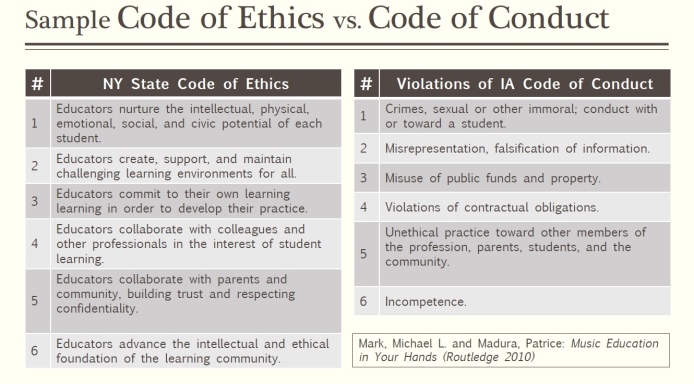
 a “violation of ethics” is usually associated with significant consequences or punishment, like charges of medical malpractice or lawyers facing an “ethics committee” hearing. Confirmed unethical behavior may result in censure, suspension of license or certification, or other discipline action. Most state education governing entities post legally-binding “educator discipline acts” or codes of professional standards, ethics, and/or behavior, with extensive penalties.
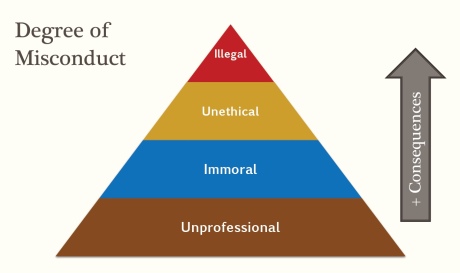 defines misconducts.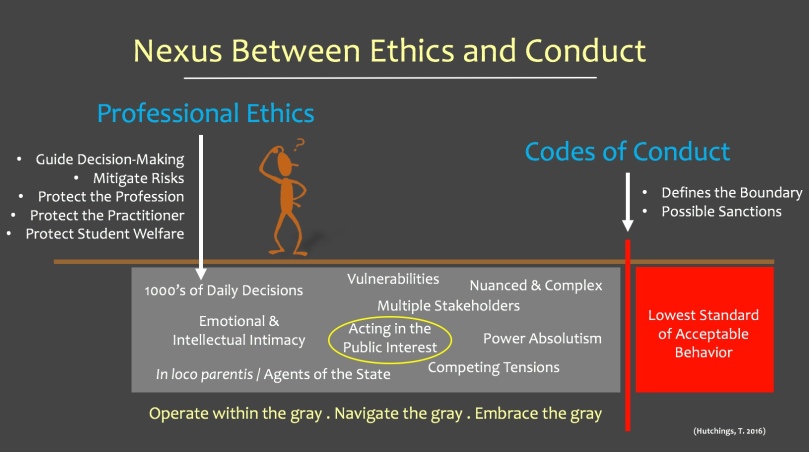
 One of the best examples endorsed by many states, college education methods programs, and other institutions, the National Association of State Directors of Teacher Education and Certification has published its

 The annual PMEA Spring Conference will be held on April 19-22, 2017 at the Erie Bayfront Convention Center. These sessions may be “perfect for PCMEA!”
 First things first! Prepare yourself in advance. Grab your winter or spring issue of PMEA News. Review the program of sessions which is usually laid out in chronological order and also by content strands (e.g. advocacy, choral, classroom music, collegiate, curriculum development/assessment, higher education research, instrumental, music technology, World Music, and special interest topics), as well as the list of keynote speakers, guest clinicians, showcase (music industry) demonstrations, association meetings (like PCMEA), and performances. Using an “old-fashioned” 20th century tool, mark up the conference schedule with two different colors of highlighter marking pens, first targeting “high interest” areas in yellow, and then “must attend” events in hot pink or other favorite color.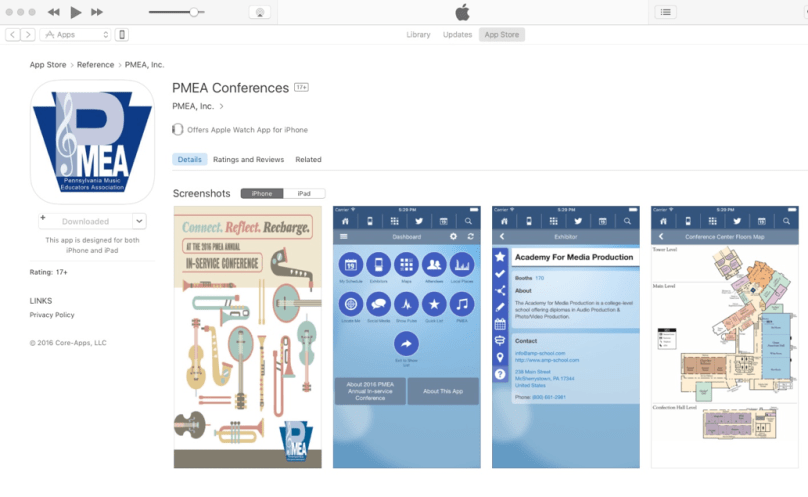
 DON’T focus exclusively on attending sessions or concerts in your specialty or most proficient areas, such as band if you’re a woodwind, brass or percussion major, orchestra if you are a string player, general music/choral if you are a vocalist or pianist. DO go to sessions that are not directly related to your major. You might be surprised at the connections you discover or the new interests that arise. Imagine “they” want to hire you next year as the next middle school jazz coach, HS marching band show designer, choreographer for the elementary musical, conductor of the string orchestra, teacher of AP music theory, etc. Could you select music for an elementary band (or choral) concert, create a bulletin board display for a middle school general music unit, set-up a composition project, or lead folk dancing at the kindergarten level?
 DON’T be shy! A conference is no place for being timid or afraid to start up a discussion with a more experienced music teacher. PMEA is all about circulating and introducing yourself, exhibiting your “charming self,” exploring resources and who are the experts/leaders in music education, getting the “lay of the land,” and adding as many names and emails to your professional contact data base as possible. Of course, DO follow-up with anyone who suggests that there may be a future employment posting from their school district!
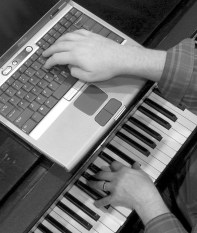 elf and ask a thoughtful question on some issue about which you are curious or found interesting.

 Music is one of life’s greatest treasures!
 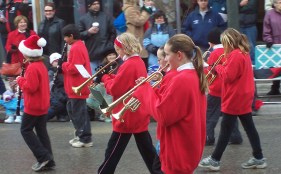 Your joy of creative self-expression and “making music” will sustain you through almost anything… and will transfer to your students’ success in life.
 r mistakes (and there will be many) will be forgiven. Besides, there are usually no “single right answers” in music and art – only opportunities for divergent and flexible thinking, adaptability, and personal expression.
 Music For All:
  someone else, or sing solos at a local nursing home or senior center.
 Spend a lot of time sight-reading… especially on the piano. To take your ear-training training a step further, pull out your old folk-song sight-reading series or Hindemith’s Elementary Training for Musicians and practice musicianship exercises.

 paulfox.blog