Stressed Out?

More Remedies for Reducing Teacher Stress & Burnout

stress-1837384_1920_johnhainWelcome back to our series on music teacher (and other professionals) self-care.

First, as presented in this insightful article by Chris Mumford, we confirm the notion that “stress is inevitable,” but “how you respond to it can spell the difference between a long, rewarding career or one cut short by burn-out.” Based on new research, he offers some surprising (and even counter-intuitive) techniques to better deal with it, including these “9 Stress Management Strategies Every Teacher Needs to Know.”

  1. Breathe (properly)… When you’re experiencing intense levels of stress, breathe in deeply (put your hands on your stomach and feel it expand out), for four seconds, then exhale evenly for four seconds. Keep this up for two-three minutes for maximum effect. 
  2. Embrace the stress… Viewing your stress in constructive ways [reframing] will actually cause your body to respond to it differently and prevent long-lasting physical damage.
  3. Be imperfect… Teachers are often prone to perfectionism and its ill effects: they often feel that they aren’t doing enough, or that their mistakes are magnified because of the importance of their job. If you find yourself feeling this way, fight back.
  4. stress-2379631_1920_DavidqrPractice emotional first aid… Do you beat yourself up when you experience failure or make a mistake? [Find] ways to break the negative patterns of thought.
  5. Be grateful… We have to stop, quiet our minds, and create “stop signs”—little reminders of things that we should be grateful for every day.
  6. Limit “grass is greener” thinking… You will have challenges anywhere you go.
  7. Work smarter, not harder… Find ways to delegate some of your work, or invest in tools or technologies that will make your life easier. 
  8. Ask for help… doesn’t make you weaker, it makes you better at your job.
  9. Make a connection… When you connect with another person, your body produces oxytocin, which is a chemical that helps repair the heart. If you help your neighbors, family, etc., you’re much less likely to experience the negative effects of stress. 


boat-647049_1920_skeeze

Just Breathe… According to the Navy SEALS!

The calming, deep-breathing practice (#1 above) can be learned by reviewing a host of resources, including the book Maximizing Your Human Potential and Develop the Spirit by former Navy SEAL Mark Divine, as well as these websites:

Examples of two different NAVY SEALS breathing exercises advise us on how to reach a more relaxed state:

TACTICAL BREATHING (to alleviate “fight or flight” tension)

Place your right hand on your belly, pushing out with a big exhale. Then breathe in through your nostrils, slowly drawing the breath upward from your belly to your upper chest.

Pause and exhale, starting from your chest and moving downward to the air in your belly. Imagine your belly button touching your spine.

Once you’re comfortable with a full, deep breath, repeat it, this time making the exhale navy SEALStwice as long as the length of the inhale. For example, inhale to the count of four, pause briefly, and exhale to the count of eight. Repeat three times.

Stephanie Vozza

BOXED BREATHING (to help ground you, sharpen concentration, and become more alert and calm)

Expel all of the air from your lungs
Keep them empty for four seconds
Inhale through your nose for four seconds
Hold for a four count (don’t clamp down or create pressure; be easy)
Exhale for a four count
Repeat for 10-20 minutes

Reuben Brody


mental-health-2019924_1920_Wokandapix

Mind Over Matter

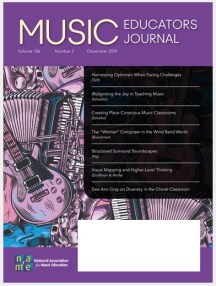
Our own minds may be our own worst enemies. Have you read the insightful article “Sustaining the Flame – Re-Igniting the Joy in Teaching Music” by Karen Salvador in the December 2019 issue of Music Educators Journal? She offers research-supported strategies for nurturing courage, peace, and resilience as well as suggested habits of thinking and action. Samples of “cognitive distortions,” a term of which I had never heard previously defining “irrational beliefs,” is addressed by “reframing” our inner voice during specific incidents of emotional distress.

MEJ December 2019Her common examples of cognitive distortions include the following. Do any of these sound familiar?

  • Disqualifying (discounting) the positive events
  • Jumping to conclusions
  • Filtering (focusing entirely on the negative elements of a situation)
  • Double standard (placing unreasonable/unattainable expectations for ourselves)
  • Personalizing (or “taking something personally”)
  • Polarized (placing people or situations in unrealistic “either or” categories)

Additional recommendations by Nicole Stachelski for combating stress and burnout are listed in the article:

  1. Laugh with your students
  2. Eat your lunch (take a break or enjoy social time)
  3. Schedule regular physical activity
  4. Drink more water (and visit the bathroom as needed!)
  5. Prioritize your work and set boundaries
  6. Keep a consistent bedtime
  7. Delegate – don’t be afraid to ask for help
  8. Focus on what’s really important

stress-1277561_1920_TheDigitalArtist

More Ideas — Just Pick One!

Take a gander at this excellent Scholastic.com teacher blog-post by Nancy Jang summarizing “15 Ways to Reduce Teacher Stress.” Can you try at least one new strategy this week that resonates with you and your life?

  1. Close the door during prep time.
  2. Make a SHORT and DOABLE “Must Do” and “May Do” lists.
  3. Delegate items to parent volunteers.
  4. Lay out your outfit and prepare your healthy lunch the night before.
  5. Get a full eight hours of sleep.
  6. Don’t correct every piece of paper.
  7. Work out!
  8. Get up early!
  9. Stay away from negativity.
  10. Don’t take things home.
  11. Plan time every week/day to enjoy something that is not remotely related to teaching.*
  12. meditate-1851165_1920_PexelsLearn something new.
  13. Plan a trip.
  14. Don’t over-commit.
  15. Take ten minutes a day and mediate.

*Probably one of my own worst habits was not modeling number 11 above. No matter how busy you are with your daily in-school teaching and extra-curricular music/coaching activities, the full recommendations are important to consider:

Spend time with your family and friends, travel, work on your garden, read for pleasure, take a hike. Learn how to turn off being a teacher. Balancing your time to just be YOU (not the teacher you) allows you to be renewed and have more mental energy for your students.

Nancy Jang

A few more ideas are offered by Jennifer Gunn in her blog-post from Concordia University “How Educators Can (Really, Honestly) Unplug – And How Stress Affects Us.” As always, it is suggested that you read the entire article at the link provided.

  • Practice mindfulness
  • Get a change in scenery
  • Focus on some serious self-care
  • Make plans with friends
  • LOL
  • Unplug, literally
  • Schedule your work time and your fun time


handstand-2224104_1920_MatanVizel

Balance

Work Life Balance ZelinskiIn almost every health and wellness article, we hear the emphasis of prioritizing and seeking a more equitable use of personal time, achieving what Ernie Zelinski, author of the best-selling book How to Retire Happy, Wild, and Free, refers to as “work/life balance.” Future blogs on samples of “super stress reducers” in “setting boundaries,” time management, and innovative organizational tools will be forthcoming.

Several books are also recommended readings for addressing the issues of teacher health and wellness. We have already reviewed several of these. More to come.


Our next journey to an in-depth look at music educator self-care will explore more fully TEACHER BURNOUT. To stay up-to-date on past and future articles, publications, and workshop presentations on this topic, be sure to revisit the “Care” section of this blog-site.


Resources


PKF


Photo credits (in order) from Pixabay.com

  • “laptop-woman-education-study-young” by Jan Vašek
  • “stress” by johnhain
  • “stress-despair-burden” by Davidqr
  • “boat-teamwork-training-exercise” by skeeze
  • “mental-health-wellness-psychology” by Wokandapix
  • “stress-relief-help-sign-relax” by Pete Linforth
  • “meditate-meditation-peaceful” by Pexels
  • “handstand-beach-sea-ocean-sand” by MatanVizel
  • “wooden-train-toys-train-first-class” by Couleur

wooden-train-2066492_1920_


© 2020 Paul K. Fox

Success = How Many Hours?

Fox’s Fireside article for adult learners


What Does It Take to Master Your Craft?

Practice with your fingers and you need all day. Practice with your mind and you will do as much in 1 1/2 hours. — Leopold Auer

Mastering music is more than learning technical skills. Practicing is about quality, not quantity. Some days I practice for hours; other days it will be just a few minutes. Practicing is not only playing your instrument, either by yourself or rehearsing with others — it also includes imagining yourself practicing. Your brain forms the same neural connections and muscle memory whether you are imagining the task or actually doing it. — Yo-Yo Ma

If I don’t practice for a day, I know it. If I don’t practice for two days, the critics know it. And if I don’t practice for three days, the public knows it. — Louis Armstrong

It is a mistake to think that the practice of my art has become easy to me. I assure you, dear friend, no one has given so much care to the study of composition as I. There is scarcely a famous master in music whose works I have not frequently and diligently studied. — Wolfgang Amadeus Mozart


practice-615657_1920_johnhain

How much practice is enough? 2 hours? 4 hours? More or less? What constitutes too much practicing?

To grasp this essential question, a tug-a-war of time vs. attentiveness, Noa Kageyama quotes Arthur Rubinstein, Leopold Auer, Jascha Heifetz, Donald Weilerstein and others in his article “How Many Hours a Day Should I Practice?” He centers around the basic premise that deliberate practice is more efficient, engaging, and builds self-confidence.

When it comes to understanding expertise and expert performance, psychologist Dr. K. Anders Ericsson is perhaps the world’s leading authority. His research is the basis for the “ten-year rule” and “10,000-hour rule” which suggest that it requires at least ten years and/or 10,000 hours of deliberate practice to achieve an expert level of performance in any given domain — and in the case of musicians, often closer to 25 years in order to attain an elite international level. Note that the real key here is not the amount of practice required (as the exact number of hours is debatable) but the type of practice required to attain an expert level of performance. In other words, just practicing any old way doesn’t cut it.Kageyama

recycle-1000785_1920_johnhainThe famous “10,000 Hour Rule” was described in the book Outliers: The Story of Success written by Malcolm Gladwell, Based on studies in elite performance, Gladwell contended that it’s “an extraordinarily consistent answer in an incredible number of fields… you need to have practiced, to have apprenticed, for 10,000 hours before you get good.”

Gladwell’s message — “people aren’t born geniuses, they get there through effort” — was seized upon by popular culture.

There is a lot of confusion about the 10,000 rule that I talk about in Outliers. It doesn’t apply to sports. And practice isn’t a SUFFICIENT condition for success. I could play chess for 100 years and I’ll never be a grand-master. The point is simply that natural ability requires a huge investment of time in order to be made manifest. Unfortunately, sometimes complex ideas get oversimplified in translation.Gladwell

View his explanation on YouTube about his “metaphor for the extent of commitment that’s necessary for cognitive-complex fields” (how long mastery takes) here: https://www.youtube.com/watch?v=1uB5PUpGzeY.

nikola_tesla_napoleon-sarony-public-domain-via-wikimedia-commonsThe 10,000 hour rule was also cited in a book by Sean Patrick: Nikola Tesla – Imagination and the Man That Invented the 20th Century:

The rule’s premise is that, regardless of whether one has an innate aptitude for an activity or not, mastery of it takes around ten thousand hours of focused, intentional practice. Analyzing the lives of geniuses in a wide range of intellectual, artistic, and athletic pursuits confirms this concept. From Mozart to Bobby Fischer to Bill Gates to the Beatles, their diverse journeys from nothing toward excellence in their respective fields shared a common denominator: the accumulation of ten thousand hours of unwavering “exercise” of their crafts. — Patrick


orchestra-2817188_1920_ernestoeslava

To be fair, many have taken exception to the 10,000 hour rule, in articles like “The Great Practice Myth: Debunking the 10,000 Hour Rule” by Michael Miller.

According to Ryan Branstetter in his November 2019 “The Ultimate Guide to Teaching Habits of Mind,” creating or reforming “patterns of thinking” and habits may instead take anywhere from 21 days to a year:

Have you ever heard someone tell you that it takes 21 days to form (or break) a habit? Well, scientific studies have found that to be unfounded. When it comes to something easy, such as grabbing a coffee at your local Starbucks on your way to school, it might take only a few days for a habit to form. But if it is a habit that is challenging, studies have shown that the 21-day myth may actually more like 66 days. Or for very challenging habits, it could take up to a year!Branstetter

drummers-642540_1920_skeeze2.jpg

How about translating this prescription of 1-10 years to a weekly figure of five hours? With reading being the major focus for any stellar success in a profession, review the blog-post by Michael Simmons in Accelerated Intelligence: “Bill Gates, Warren Buffett, and Oprah All Use the 5-Hour Rule”

If 10,000 hours isn’t an absolute rule that applies across fields, what does it really take to become world class in the world of work?

…I’ve explored the personal history of many widely-admired business leaders like Elon Musk, Oprah Winfrey, Bill Gates, Warren Buffett and Mark Zuckerberg in order to understand how they apply the principles of deliberate practice.

…Many of these leaders, despite being extremely busy, set aside at least an hour a day (or five hours a week) over their entire career for activities that could be classified as deliberate practice or learning. Simmons

piano-286036_1920_crystalleHere are the “three buckets” (principles) of Simmon’s 5-hour rule:

  1. Read
  2. Reflect
  3. Experiment

Specific to number one above, apparently billionaire entrepreneurs like to read a lot, quantities of time, frequency, and number of sources (quoted in the article):

guitar-869217_1920_RyanMcGuire

By the way, how many books do YOU read a month? What publications do you have sitting on the coffee table or bed stand awaiting to be started/finished? A quick glance at my own collection of recent nonfiction acquisitions includes these titles:

  • Fewer Things Better – The Courage to Focus on What Matters Most by Angela Watson (Due Season Press and Educational Services, 2019)
  • UnSelfie – Why Empathetic Kids Succeed in Our All-About-Me World by Michele Borna (Touchstone, 2016)
  • The 100-Year Life – Living and Working in an Age of Longevity by Lynda Gratton and Andrew Scott (Bloomsbury, 2016)
  • The Microbiome Solution – A Radical New Way to Heal Your Body from the Inside Out by Robyn Chutkan (Penguin Random House, 2015)
  • The Weekend Effect – The Life-Changing Benefits of Taking Time Off and Challenging the Cult of Overwork by Katrina Onstad (Harper Collins Publishers, 2017)

(You see, I do not exclusively survey the current best-sellers or today’s fads/trends… ideas, insights, and innovations can come from anywhere and any time frame. Now that I am retired, I can “catch-up!”)

singer-1047531_1920_quimuns

Back to musical preparation. You may have heard that saying “practice makes perfect,” generally debunked in several of my “Fox’s Firesides” for music students. I revise this concept to “perfect practice makes perfect performance” promoting “the ten times rule” in applying focus, problem solving, and repetitive drill. Check these out:

Finally, citing the initial reference in this blog-post by Noa Kageyama, here are five tips for deliberate practice by which we should all abide:

  1. Keep practicing limited to a duration that allows you to stay focused.
  2. Utilize times during the day when you tend to have the most energy.
  3. Write down and keep track of your performance goals and what you discover during your practice sessions.
  4. Work smarter, not harder.
  5. Apply various techniques of problem-solving to practicing.

He also recommends this 6-step general “problem-solving model” as adapted from various problem solving processes online:

  1. problem solving chart
    asq.org

    Define the problem (what do I want this note/phrase to sound like?)

  2. Analyze the problem (what is causing it to sound like this?)
  3. Identify potential solutions (what can I tweak to make it sound more like I want?)
  4. Test the potential solutions to select the most effective one (what tweaks seem to work best?)
  5. Implement the best solution (make these changes permanent)
  6. Monitor implementation (do these changes continue to produce the results I’m looking for?)

More ideas can be researched by reading The Talent Code by Daniel Coyle or The Practice of Practice by Andrew Mason, or visit these links for further study:

saxophone-546303_1280_schuetz-mediendesign

The bottom line? Working “brainlessly” does not promote significant improvement. However, use of sufficient repetition, exploration, problem solving, and mindful and deliberate practice will stimulate your success in the pursuit of anything worthwhile… especially the self-realization of creative self-expression.

PKF


Photo credits (in order) from Pixabay.com:

wooden-train-2066492_1920_

© 2019 Paul K. Fox

Do You Always Feel Exhausted?

Our second in a series on publications and other resources for self-care, health, wellness, and remediation of stress and burnout of music educators addresses one of the core issues for all of us — chronic fatigue.

french-bulldog-4443329_1920_Mylene2401

The medical definition is comprehensive:

Fatigue is a lingering tiredness that is constant and limiting. With fatigue, you have unexplained, persistent, and relapsing exhaustion. It’s similar to how you feel when you have the flu or have missed a lot of sleep. If you have chronic fatigue, or systemic exertion intolerance disease (SEID), you may wake in the morning feeling as though you’ve not slept. Or you may be unable to function at work or be productive at home. You may be too exhausted even to manage your daily affairs. — WebMD

In the NAfME community forum Amplify, another colleague turned me on to the book Exhausted — Why Teachers Are So Tired and What They Can Do About It by Paul Murphy (2017). Most of this blog will focus on a review of this work. I also recommend you visit his very informative website of blog-posts: Teacher Habits.

If you’re like most teachers, being tired at the end of the day is a way of life. We’ve become so accustomed to it that it’s hard to imagine how things could be any different. We get through out mornings with coffee, our afternoons with Diet Coke, and the ends of our school days with the iron strength of our will. We leave the building exhausted, having so much at work that there’s little left over for our families or even ourselves.Paul Murphy

So, what is the scope of the problem? What can we do about it?


What Is a Teacher?

Are you a teacher? If so, are you also a classroom work foreman, logistics manager, guide, drill sergeant, disciplinarian, cheerleader, data entry clerk, cultural advocate, or analyst?  Maybe you are all of these things and more.  Maybe, we need to look at educators in a new context of what teaching really is in most schools, and whether it should be given cultural, economic and technological change.

Merriam-Webster’s says “teach” is a verb, with several simple definitions that repeat themselves but ideologically are these five things:

  • to cause to know something
  • to guide the studies of
  • to make known and accepted
  • to impart the knowledge of
  • to conduct instruction regularly.

LeiLani Cauthen

Personally, I have always glorified the mission and “calling” of becoming an educator.

Teachers model the “habits” of

  • ornament-1899065_1920_xsonicchaosFocus
  • Self-discipline
  • Self-motivation
  • Self-assessment and self-improvement
  • Work ethic
  • Highest standards of behavior, appearance, and ethics

We serve as

  • Fiduciaries, looking out for the welfare of students
  • Model exemplars, both on and off school time
  • Self-starters, intrinsically motivated and goal-oriented
  • Professionals 24/7 – always “on the job”

This bar is further raised by the public’s and our very own highest expectations of the “nine characteristics of a great teacher” by Maria Orlando in Faculty Focus:

  1. A great teacher respects students.
  2. A great teacher creates a sense of community and belonging in the classroom.
  3. A great teacher is warm, accessible, enthusiastic and caring.
  4. A great teacher sets high expectations for all students.
  5. A great teacher has his own love of learning.
  6. A great teacher is a skilled leader.
  7. A great teacher can “shift-gears…”
  8. A great teacher collaborates with colleagues on an ongoing basis.
  9. A great teacher maintains professionalism in all areas…

I wouldn’t have it any other way! But these standards must take a toll on our health, wellness, and work/life balance!

 

lion-3317670_1920_Alexas_Fotos

Stress and Data on Teacher Exhaustion

Do you find yourself tired most of the time? Quoted in Exhausted by Paul Murphy, does this sound like YOU?

  • “I’m exhausted, and every weekend, I spend at least one day in my pajamas.”
  • “I feel like work never ends.”
  • “I love my students, and I have a really good class this year, but I’m done and ready for a break.”
  • “I was so tired that I ended up missing out on family’s holiday dinner.”

Why is this so prevalent? According to Paul Murphy, “the answer, in a word, is STRESS! Teachers are incredibly stressed-out people, especially when they are at work.”

He shares some scary statistics:

Because our culture tendency to demand more of educators, that stress is on the rise. In 1985, 36% of teachers reported feeling great stress at least several days a week. Today, that number is 51%. Only doctors report higher levels of stress on the job.

The costs are high. A recent study of the U.S. Department of Education found a 10% of new teachers don’t return for second year. Nearly 185 new teachers are gone within five years. Many young people, perhaps persuaded by on his federal and Teacher should buy what they see on social media, won’t even entertain the thought of teaching. Between 2009 and 2014, enrollments in teacher preparation programs fell about 35% in the U.S., reducing the supply of available teachers by nearly a quarter-million. — Paul Murphy

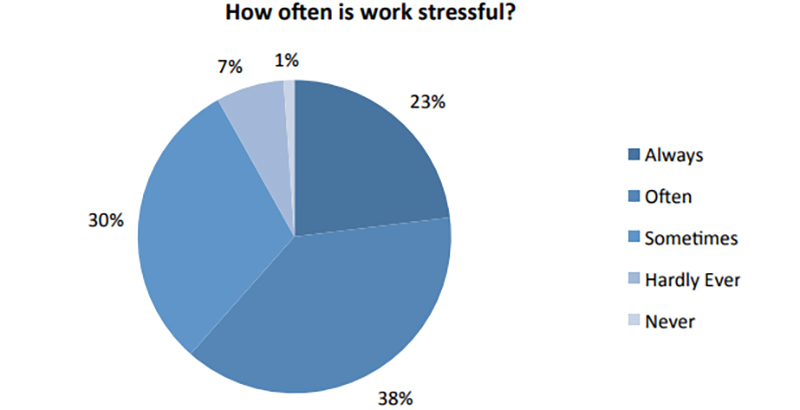
These figures are supported by other sources as well. The American Federation of Teachers reported here that “61% of educators say their work is always or often stressful,” and, worse yet, “50% say they don’t have the same enthusiasm as when they started teaching.”
Teacher-stress-lede

In addition, according to James Anthony in “7 Conclusions from the World’s Largest Teacher Burnout Survey” posted here, 75% of teachers complained of health problems such as shortness of breath, dizziness, heart palpitations or chest pain, or regular headaches or stomach aches — symptoms often associated with a failure to deal with stress. His conclusion? “This is a worrying sign that pressure and workload of many teaching jobs is having a very real physical impact on many teachers.”


From the Back Cover of the Book

You should definitely grab a copy of Exhausted. Paul Murphy promises you will learn:
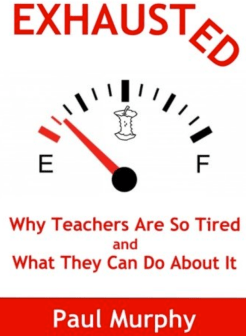
  • Exhausted by Paul MurphyWhy even good days with your students leave you drained.
  • What tired teachers have in common with doctors, major league baseball managers, and interview committees.
  • How Jeb Bush’s failure in the 2016 presidential primaries is related to your own fatigue.
  • What long distance runners, one of history’s greatest weightlifters, and a Stanford psychologist can teach you about the powerful influence of your mind.

He says you will find solutions to these problems and understand:

  • What teachers can learn from baristas and airline agents.
  • What supermarket layouts can teach us about the dangers of decision making.
  • Why AC/DC doesn’t belong in your classroom.
  • What an insurance agent’s plane crash can teach us about belief.

Who is this Paul Murphy guy? His own bio, the last section of the book, is unique:

Paul Murphy is a third-grade teacher in Michigan. This fall, he started his 20th year in the classroom. His writing focuses on improving the lives of teachers, both inside the classroom and out. He enjoys reading, writing, travel, exercise, craft beer, and Cheetos. His feet are perpetually cold, he bites his nails, and he regularly (and almost instinctively at this point) changes the lyrics to songs to make them inappropriate, much to the chagrin of his wife and daughter.

cat-3623703_1920_ Susanne Jutzeler, suju-foto


The Science of Exhaustion

The best way to review the innards of a publication and get to the nitty-gritty may be to frame a few guiding questions, to follow an outline summary on which to reflect while reading many of the early chapters:

  1. How many decisions do you make before you ever teach a single class every morning? What effect do they have on you?
  2. What is the link of willpower (ego depletion* and delayed gratification) to exhaustion?
  3. What do doctors say about the constant exercise of self-control and blood glucose levels, and why is the time of the day critical?
  4. What is “morning morality” and what does it have to do with planning your day as a teacher?

*Psychologist Roy Baumeister coined the term “ego depletion” after he found that humans have a limited supply of willpower.  He compares willpower to a muscle, which can strengthen but also wear out with use. Ego depletion has a general effect, meaning that using self-control in one area of your life erodes your ability to self-regulate in other parts of your life. Baumeister found that exerting self-control results in a significant drop in blood-sugar levels.  Low blood sugar leads to physical fatigue, which is why you’re so tired, even though the heaviest thing you lifted was a textbook. Paul Murphy

A few of my observations. Willpower is actually “won’t-do-power,” and represents the chronic stress teachers and other professionals place on themselves everyday: saying “NO” to such things as sleeping-in an extra 10-15 minutes, staying on your diet by passing by that Dunkin Donuts shop on the way to school, forgoing the idle chit-chat from the teacher’s room on the way to the photocopier, not allowing yourself to be distracted by a TV program instead of doing your own homework, delaying an update of your social media sites or reading personal email instead of finishing your lesson plans, grades, or the forms the principal requested for completion by the end of the week.

In other words, facing up to all of those grown-up expectations that grown-ups must do! There’s no room for youthful indulgences or “goof-off time” as an adult!

chihuahua-809588_1920_Didgeman

Paul Murphy says, “Whatever you call it… resisting temptation, will power, self-control, self-discipline, grit, perseverance, self-regulation, or determination, science has proven that it exhausts us.”

Teachers endlessly self regulate. We hold back sarcastic rejoinders, walk away from lazy students when we what we really want to do is lecture them, keep her honest thoughts about the principles latest he’ll conceive ideas to ourselves, respond professionally to disrespectful emails from parents, work with students when we want to do anything but, plan the next day one would rather check Facebook, and bite our tongues when we’d like to drop F-bombs. We force ourselves to work when we feel like taking a break. We redirect students when we’d rather just let the behaviors go and avoid the resultant excuses and conflicts. We keep teaching even though we really, really have to pee. Teachers use a lot of willpower. — Paul Murphy

Couldn’t say it better myself!

Another personal observation also seems to be supported by Paul Murphy. I have found that “earlier is better” for doing creative tasks, solving problems, or completing highly detailed work. Most mornings (in retirement), I reserve my first two hours for writing. Others say that the AM is best for practicing or composing, when you feel the freshest! The closer to having a meal or having slept all night (which revitalizes our supplies of self-regulation and blood sugar), the better for tackling something hard… which for a teacher might mean facing the challenge of a “difficult parent” phone call, student discipline report, or conference with an “unhappy” administrator.

 

fuchs-4434858_1920

Strategies for Releasing/Postponing Tension

Paul Murphy recommends that, instead of using up your willpower reserves to fight off the urge to snap at someone or suppressing your anger, “simply notice something else that requires less willpower” or distract yourself. Postponing can also be effective: Have your tantrum “not now, but later.” (Schedule your nervous breakdown for another day?) Often, once some time has passed, you may find your frustration has abated.

Another technique for alleviating stress is to actually do a deliberate exercise to release your emotions and desires… in a more controlled and constructive way.

I sometimes receive an email from a parent or supervisor that angers me. My instinct is to return fire. That’s a bad instinct, but it doesn’t mean I have to hold in those feelings. It also doesn’t mean I should vent to other teachers or my wife. They’ve got their own problems, and nobody really wants to hear mine. What I do instead is write my honest, no-holds-barred rebuttal. I let it all out, hammering the keyboard and plastering my screen with vitriol. I read it and re-read until it effectively conveys the righteous indignation I so strongly feel.

Then I don’t send it!

It released my anger, and it’s there for me to revisit. On those few occasions when I have gone back to reread these unsent missives, my anger is gone. I wonder why I was so outraged at the time. They’re actually embarrassing to read. If you do this a few times, you begin to realize that your initial feelings are often an overreaction (and also the result of depleted willpower and low blood sugar) and it becomes easier to avoid indulging them.Paul Murphy


zoo-4508682_1920_edmondlafoto

Intense Emotions = Model Teacher?

Who is a better teacher? An energetic, passionate, and always “fired-up” one, or a professional who exerts a calm, introspective, and less intense attitude? Some studies do show that an enthusiastic, engaging teacher who is passionate about his subject is more effective than a “dull” or less dynamic teacher who seems to dislike his job, but what of the costs? Again, in Murphy’s book, we have more research to the rescue: “…Science has proven that intense emotions tire us out!”

I’ll explain why teachers should aim for a feeling of inner calm for large chunks of their day. I’ll argue that the expectation we have for ourselves and other teachers to be constantly enthusiastic is counterproductive in the short-term and ultimately damaging to the education system in the long-run. And I’ll explain how being calm will not only conserve your energy, but will make your classroom a better learning environment for your students.Paul Murphy

Another reason to buy his book!

brain-2062057_1920_ElisaRiva2.jpg

The Mind Is a Terrible Thing to Waste!

Finally, our very own thoughts are amazingly powerful tools. Our brain can either help or make things worse! “If you believe a task is going to be difficult, it will be.” We all know that “positive talk” can alleviate the effects of stress, and can inspire greater levels of achievement. But, what about the relationship of negative thoughts to fatigue?

Almost every distance runner talks of hitting a wall. In 2012, Spanish researchers wanted to know what went through runners’ minds as they neared exhaustion, and they found exactly what you’d expect: the harder the runners work and the longer they run, the more negative their thoughts become. No surprise there.

runner-808932_1920+skeeze.jpgBut then a group of British and dutch researchers asked an interesting question. They wondered if everyone had it backwards. Did the discomfort of physical fatigue cause the runners to think negatively, like everyone assumed, or did the runners negative thoughts make them more physically tired and sore? It was a chicken and egg question.

The researchers found 24 healthy adults and had each complete a grueling ride on a stationary bike until they were exhausted. Then they were sent home for two weeks. During that time, half of the subjects were trained in positive self talk, a technique many sports psychologist coaches teach athletes to combat negative thinking that can lead to poor performance. The other 12 subjects were left alone. Then the researchers called them all back to hop on the bikes again.

On average, those who receive positive self talk training performed more than 17% better on their second ride than they had on their first. There was no improvement among members of the control group.Paul Murphy

He goes into great detail that the driving force behind our exhaustion may not even be the hours we work, the challenges we face in the classroom, or the lack of support we perceive from administration or parents. It may rest in our thoughts. And, he analyzes the negative effects of “worrying” and the concept of “mind over matter!”

 

dog-4607655_1920_DrawnByShaun

The Schedule That Doesn’t Help

Tiger Woods was known for so many “firsts” and breaking numerous golfing records in his early career. Many credited his success to his extreme focus, perseverance, and self-discipline. It was documented that he practiced golf 7-8 hours every day and worked out two or three hours more:

  • tiger-woods-79694_1920_ David Mark6:30 a.m. an hour of cardio
  • 7:30 a.m. one hour of lower-body weight training
  • 8:30 a.m. high protein/low-fat breakfast
  • 9:00 a.m. two hours on the driving range
  • 11:00 a.m. practicing putting
  • 11:30 a.m. playing nine holes
  • 2:00 p.m. healthy lunch
  • 2:30 p.m. two to four more hours on the golf course
  • 6:00 p.m. back in the gym working on upper-body
  • 7:00 p.m. dinner and relaxation

Then we learn about his personal “crash of 2009” when everything seemed to unravel:

  • Extra-marital affairs
  • Personal calls to escort services
  • Wife, discovering his “extra-curricular” activities, assaulting him
  • DUI arrest
  • Divorce
  • Destruction of his reputation
  • Injuries
  • Poor golf play

Certainly, Tiger had some deep-seated psychological issues. But I can’t help wondering if his remarkable self-discipline left him depleted to the point that he was unable to fight off his most distracted urges at the close of his ego-depleting days. Yes, he only had to focus for five hours during a round of golf, but Tiger Woods used will power from the time he woke up to the time he started texting port stars. His is a cautionary tale for anyone who spends large parts of the day exercising self-control. As teachers, there are lessons to be learned. Paul Murphy

Your own strict daily regiment may also contribute to your feelings of “total exhaustion.” Music teachers are usually their own worst enemies. We take on responsibilities for the hurry-2119711_1920_TeroVesalainensake of the music program, add a new ensemble, schedule after-school time to teach a solo or instrumental part, and plan more weekend and evening “learning activities” or events beyond the scope of most other academic subject teachers. It was not unusual for me to be at school by 6:45 a.m., eat lunch in my car on the way to my second or third assignment as an itinerant, stop for a quick “date” and dinner out with my wife, return to school for band, orchestra, or musical practices, and not get home until 9 or or 10 p.m. As a retiree, I now ask, “What ever happened to all of this stamina and endurance?” Pushing wheel chairs only four hours a day three times a week at a local hospital, I sometimes find myself wanting to take a “power nap” when I get home! Never you fear: the healthy “calendar of a retired music teacher” is as busy (and hectic) as full-time employment… We always say, “I wonder how I ever had the time to do all of these things and work at the same time!”

However, to put it in perspective, here is a copy of my former professional schedule that I was (mostly self-) assigned to teach grades 5-12 strings in three buildings, manage the fall play and spring musical, assist the marching band, work with the superintendent on school district public relations projects, prepare for PMEA and NAfME music festivals, and serve as my district’s Performing Arts Curriculum Leader.
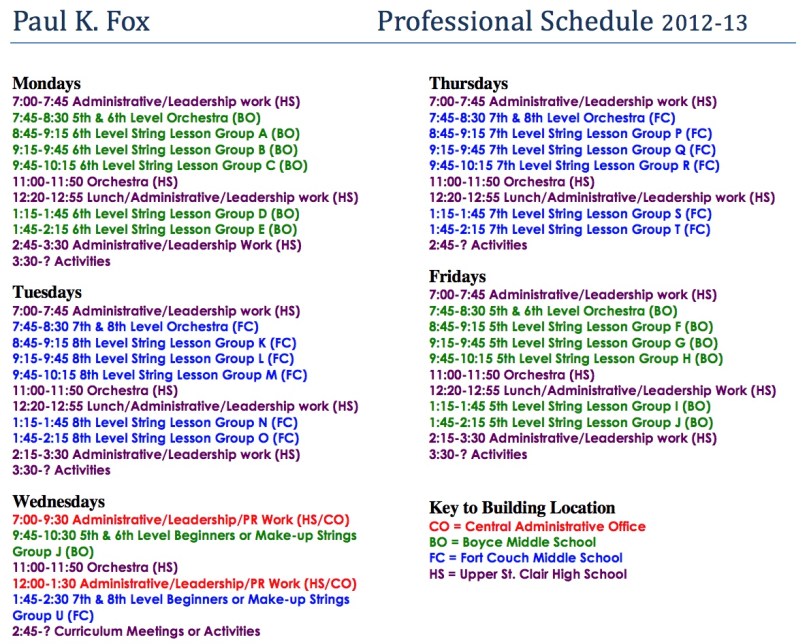
Schedule 2013

As an administrator, the number of “contact hours” over the maximum was irrelevant; it was never an option to submit a grievance to the teacher’s union. Actually, I accepted the responsibility of planning what I thought was necessary for the success of my program, my students, and my music staff… no matter what the cost! Sound familiar?

 

monkey-1171394_1920_kachi

Other Remedies to Lower Tension and Exhaustion

This is just “the tip of the iceberg” for an analysis of the book Exhausted. Part two which we have not covered here is entitled “What To Do About It.”

More recommendations for better time management, remediation of teacher burnout, development of a self-care plan, and techniques for stress reduction will be addressed in future blogs. At this point, from three excellent sources, these tips may steer you towards improved rest, personal life/work balance, and general health/wellness. Stay tuned for more at https://paulfox.blog/care/.

Numbers 1-6: Paul Murphy: Exhausted: Why Teachers Are So Tired and What They Can Do About It http://teacherhabits.com/about/

Numbers 7-15: Raphailia Michael: “What Is Self-Care, and What It Isn’t” at PsychCentral https://psychcentral.com/blog/what-self-care-is-and-what-it-isnt-2/

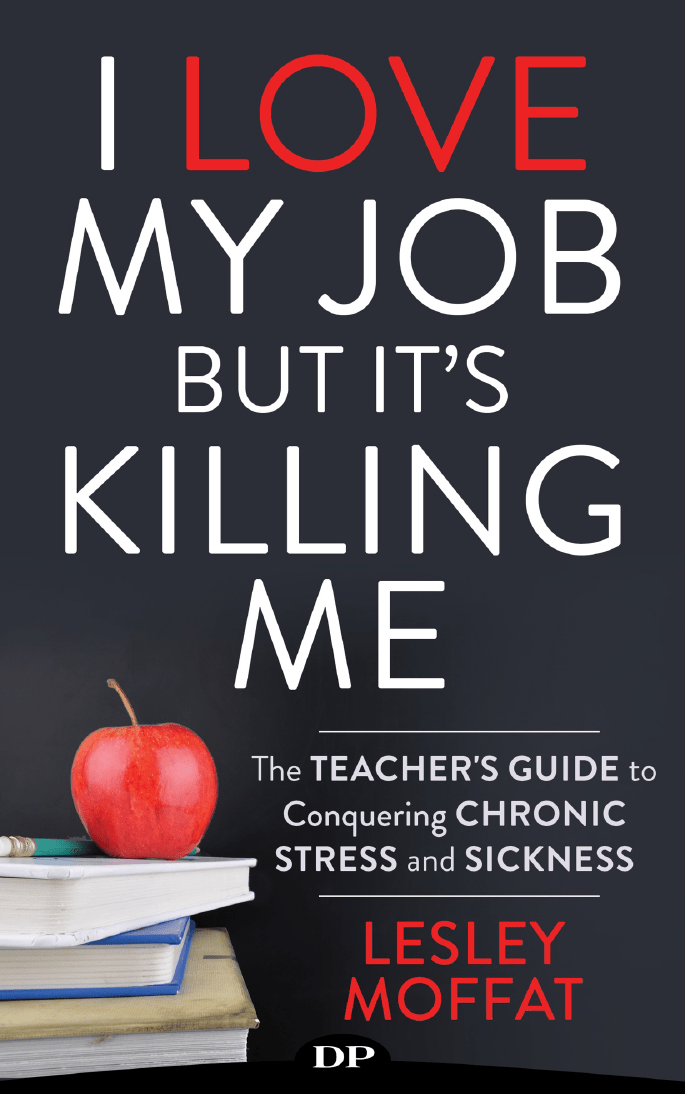
Numbers 16-22: Lesley Moffat: I Love My Job But It’s Killing Me https://squ.re/2TaXoAr and (also see this blogpost)

  1. Work less/fewer hours
  2. Time before school is worth more than twice as much as time after school
  3. Use class time to check student work
  4. Leverage technology
  5. Don’t grade everything
  6. Stop assigning things
  7. Create a “NO” (I will not do) list
  8. Promote a nutritious, healthy diet
  9. Get enough sleep
  10. Follow-up with medical care as needed
  11. Use relaxation exercises and/or practice meditation
  12. Spend enough time with loved ones
  13. Do at least one relaxing activity every day, whether it’s spending 30 minutes unwinding, listening to music, or taking a walk
  14. Do at least one pleasurable activity every day, from going to the cinema, cooking, or meeting friends
  15. Make opportunities to laugh
  16. Take a break from social media
  17. Seek out ways to compliment others
  18. Allow someone to go ahead of you in line at the store
  19. Set your alarm for nine minutes earlier and use those nine minutes to listen to an inspiring song
  20. Turn off notifications on your phone and/or avoid electronic devices for the first hour of your day
  21. Take deep breaths when you encounter spped bumps and stop signs/lights during your daily commute
  22. Stay hydrated

PKF


Photo credits (in order) from Pixabay.com

© 2019 Paul K. Fox

Is Your Job Killing You?

Book Review: I Love My Job But It’s Killing Me – The Teacher’s Guide to Conquering Chronic Stress and Sickness by Lesley Moffat

Have you read this “International Bestseller” written by a band director?

Where was this when I was still teaching full-time, managing a crazy 24/7 schedule of music teaching and administration, fulfilling a myriad of self-assigned extracurricular activities like band, choir, strings, fall play, spring musical, adjudications and festivals?

bloodshot-1294920_1280_OpenClipart-Vectors

How many of you struggle to

  • Fall and stay asleep?
  • Avoid “brain fog” and exhaustion brought on by stress?
  • Alleviate (or ignore) aches and pains or illnesses that interfere with your work?
  • Reclaim and maintain enough energy to support your work and family life.
  • Resolve feelings that your life is falling apart or you are “burned-out?”

Well, instead of sitting around and whining about your hectic schedule or other challenges in your life, ruining your health, mood, and relationships with your family, friends, and students, or “throwing in the towel” and giving up altogether… take a look at this comprehensive guide to walk you through the problem — “baby steps” towards a complete self-care plan — providing assessments and action plans towards better personal health and wellness.

This blog provides a few highlights from Lesley Moffat’s work.  You owe it to yourself to break down and buy this inexpensive and easy-to-read paperback! Although it is meant for individuals who are serious about starting a comprehensive self-improvement project, this book is not long nor laborious! With a supposed “read time” of 132 minutes (according to the back cover), I would devote probably a couple weeks to thoroughly consume it. For even more clarity, I have even taken to reading sections of it to my wife, also a retired music teacher! Both of us have “been there” in coping with many of the issues of job-related stress and life-style choices.

emergency-mask-159701_1280_OpenClipart-Vectors

The Why — Chapter 12: “Put on Your Own Oxygen Mask First” (Page 109)

After a quick scan of the first couple chapters, I recommend jumping to Chapter 12 to absorb the priority of “me first” in order to be able to care for others. I love the airline safety announcement analogy about “place the oxygen mask on yourself before helping others.”  The central focus of her book, this is something I ignored for 35+ years.

You must take care of yourself. First. You can’t give what you haven’t got.

This is perhaps the hardest lesson of all, yet it is so important. Chances are you got where you are because you ran yourself ragged taking care of other people’s needs. I bet you never said no to requests to be on one more committee, drive carpool, watch a friend’s kids, and every other favor someone made of you, yet I’d also bet there’s a good chance you never take the time to take of your own needs. When was the last time you read a book for fun? Or went to a movie you wanted to see? Or pursued a creative endeavor that made you happy? Or any one of a million things you want to do? I bet it’s been a long time. —  Lesley Moffat


Moffat2.png
Lesley Moffat’s website where you can order the book: https://squ.re/2TaXoAr

The Who — Chapter 3: “My Journey” (Page 15)

What an incredible story! Lesley Moffat gets personal and tells her own tale of total exhaustion, lack of mental focus (she calls ADHD), numerous aches and pains, arthritis, weight gain, bouts of illnesses like pneumonia, restless leg syndrome (a sleep disorder), and migraines, needed medical procedures like back surgery, hip replacement, bunion removal, etc. At times, her narratives are explicit and most graphic.

This profession is hard. Until my generation, women weren’t high school band directors, so there were no role models for me to look up to when I struggled with finding a balance between raising a family and having this career path. I had to learn things the hard way and make up my own solutions when there weren’t resources for me to use. My peer group is primarily men. How could my male band directing colleagues relate to my struggles? They may have kids, but they didn’t have to spend nine months making those babies while teaching (an exhausting combination that cost me a miscarriage during a band trip), and then pump breast milk during their planning periods to feed each of those babies for the first six months of their lives. And how many of them had to ask a spouse to make a ninety-minute drive with their newborn baby in the car behind the school buses where the band had to play for basketball playoffs so they could nurse the baby in the bathroom when they weren’t directing the band? — Lesley Moffat

The good news? Moffat reports that after a long and often discouraging search to restore her health and vitality and “to get back to the job I love,” today she has found peace, health, and happiness, and is back in the classroom with a renewed vigor, on her way to fulfilling her personal and professional goals.


checklist-1266989_1280_

The What — Chapter 4: “Let’s Get Started!” (Page 23)

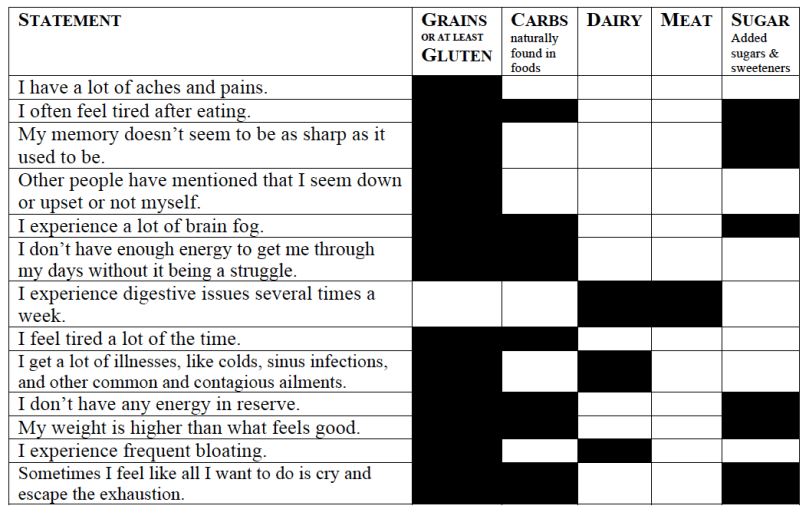
Lesley Moffat introduces her mPower Method (and a perfection alliteration) of four key components: meals, movement, music, and mindfulness. She says it all starts with administering a self-evaluation called the Mojo Meter (sample of the 40 questions below):

  1. I have a lot of aches and pains. T F
  2. I often feel tired after eating. T F
  3. My memory doesn’t seem to be as sharp as it used to be. T F
  4. Other people have mentioned that I seem down, upset, or not myself. T F
  5. I experience a lot of brain fog.* T F
  6. etc.

*She describes examples of “brain fog” more than a dozen times throughout the book. Do you experience any of these symptoms?

Brain fog isn’t a medical condition itself, but rather a symptom of other medical conditions. It’s a type of cognitive dysfunction involving:

  • memory problems
  • lack of mental clarity
  • poor concentration
  • inability to focus

Some people also describe it as mental fatigue. Depending on the severity of brain fog, it can interfere with work or school. But it doesn’t have to be a permanent fixture in your life. https://www.healthline.com/health/brain-fog

In her Mojo Meter assessment, if you answered “true” to 11 or more of these statements, then Moffat responds, “I know why you are here… It’s time to reclaim your health and energy, so get ready to amaze yourself.”


poster-316690_1280_PublicDomainPictures

The How — Chapter 9: “SNaP Strategies” (Page 79)

If you want to change your life, first change your mindset. You can’t find opportunity when you are looking for excuses. — Anonymous

Moffat’s “My SNaP Strategies” (Start Now and Progress) will give the reader examples of ways to develop new skills by changing habits one step at a time. Some of my favorites:

  • Take a break from social media.
  • Seek out opportunities to compliment others.
  • Allow someone to go ahead of you in line at the store.
  • Set your alarm for nine minutes earlier and use those nine minutes to listen to an inspiring song.
  • Turn off notifications on your phone.

In addition, she urges you to “do the homework” and dive into her Action Plans at the end of most chapters.


Mojo Meter on Meal Planning
I Love My Job But It’s Killing Me Page 47: “mPower Method Mojo Meter for Meals”

More Sneak Peeks

  • Using the observations you made in the self-administered Mojo Meter forms, the end of Chapter 5 offers an extensive “plan” for evaluating and removing the foods to which you may be allergic. (See above assessment form.)
  • I can heartily endorse her suggestion of using a food journal in Chapter 5, keeping track of every food choice and “how it makes you feel.” My wife discovered her sensitivity to gluten, and removing it from her diet has made all the difference!
  • One of her funniest anecdotes described her first-days participating in a yoga class! (Chapter 6)
  • Do you have on-hand and regularly use specific self-designed music playlists for meals, exercise sessions, and getting ready for bed? (Chapter 7)
  • A simple definition (but not so easy acquisition) of “mindfulness” — “being fully present in the here and now.” (Chapter 8)
  • Check out her “advice for driving during rush hour” (Chapter 11), tips for staying calm during all stressful moments: slow down, simplify, sense, surrender, self-care.
  • On Pages 9 and 10, there are amazing “before” and “after” photos of the author!


dialog-148815_1280_OpenClipart-Vectors.png

Coda: Summary of Advice for Better Self-Care (Chapter 10)

  1. Take deep breaths when you encounter speed bumps and stop signs during your daily commute.
  2. Write a cover page to your syllabus outlining appropriate times and methods for parents and students to contact you.
  3. Have a work space that is exclusively yours, including a “do not disturb” sign, closed door, and/or noise-cancelling headphones.
  4. Talk to your boss about reasonable expectations, including how many after-school and evening events are anticipated.
  5. Enlist the help of others (volunteers, boosters, etc.).
  6. Start your mornings in a way that charges you up for the day.
  7. Re-evaluate your work space and make changes changes that will be conducive for more efficiency.
  8. Plan meals and make time to eat them.
  9. Stay hydrated.
  10. Incorporate time to upgrade yourself.
  11. Ask yourself, “Does this choice align with who I am?”
  12. Come up with a self-care plan that is sustainable.

practice-615644_1920_johnhain


This is just the “tip of the iceberg” analyzing pathways for improved health and wellness. We are thankful that Lesley Moffat was so bold and open about sharing her own journey. Everyone can “take home” the causation of being “sick and tired of being sick and tired” and wrap their arms around implementing new strategies towards a happier living!


Author’s Bio (excerpts from the book)

Moffat authorNow in her fourth decade as a high school band director, Lesley Moffat has worked with thousands of people, helping them not only achieve musical goals (including repeated performances at Carnegie Hall, Disney Theme Parks, Royal Caribbean cruise ships, and competitions and festivals all over the US and Canada), but also teaching them how to develop the long-term life skills they need to be successful in the world.

Lesley has been a presenter at the National Association for Music Education (NAfME) and WMEA Conferences, served on the board for the Mount Pilchuck Music Educators Association, and has been an adjudicator and guest conductor in the Pacific Northwest.

After completing her undergraduate degree at Indiana University, she returned to her roots and moved back to the Pacific Northwest, where she and her husband, George, raised their three daughters, all of whom were students in her high school band program. Fun fact: Lesley, George, all three of their daughters, and Lesley’s dad have performed at Carnegie Hall.

PKF


Photo credits (in order) from Pixabay.com


© 2019 Paul K. Fox

Becoming a School Music Educator

[A quick summary, portions reprinted from the April 17, 2019 posting on LinkedIn: https://www.linkedin.com/pulse/becoming-school-music-teacher-paul-fox/]

One of my goals after retiring from 35 years as an educator and administrator in the public schools was to reach-out to college music education majors and offer some tips and techniques for preparing for this honorable career.

I have assembled a library of blog-posts on a variety of topics at my website (https://paulfox.blog/), and invite you to peruse the section “Becoming a Music Educator” at https://paulfox.blog/becoming-a-music-educator/.

If you are a junior or senior in college, assigned to field experiences or student teaching, or a recent graduate or transfer looking for a job or otherwise unemployed, I hope I can help you!

Please review the following categorized outlines of links to articles and other resources.

big-band-1608691_1920_KeithJJ


Student Teaching

First stop: Tips on Student Teaching.

Also check out these past issues of PMEA Collegiate Communique:


“Secrets” for that First Year

  1. maestro-3020019_1920_mohamed_hassanDiscounted NAfME + PMEA first-year membership: only $90. (If you are a recent college graduate in your first year of teaching, or if you are the spouse of a current or retired NAfME member, contact NAfME at 800-336-3768 or email memberservices@nafme.org) to find out if you qualify for a reduced rate.
  2. PMEA Mentor or other state’s MEA support program for new teachers.
  3. R3 = Retiree Resource Registry for PA music teachers.
  4. PMEA Webinars.
  5. NAfME Academy of numerous videos (only a $20 annual subscription).
  6. Professional development credits just for reading an article in NAfME Music Educators Journal
  7. Model Curriculum Framework (Have to be a PMEA member)
  8. What a deal! PMEA summer conference  as little as $30/person. Check out your own state’s MEA discounts and offers for collegiate members and new teachers!
  9. Numerous helpful blog posts from NAfME Music in a Minuet and paulfox.blog.


logo 2

Everything… Including the Kitchen Sink

Check out the online resources on the PMEA Council for Teacher Training, Recruitment, and Retention website, free/open to all music teachers. Especially take note of the supplemental links on a variety of topics posted here.


Job Seekers

A summary of my re-occurring themes on marketing your professionalism and a few “pet peeves” include the following:

  1. Create a multi-media digital portfolio, video recording excerpts of your memorable solo, chamber, and ensemble performances, teaching experiences, and other opportunities you have had in working with children of all ages. To the interviews, bring both a printed version and jump drive (the latter to leave with the screening committee) of these artifacts and a list of your other activities, awards, accomplishments, mission/vision, transcripts, music education and class management philosophies, recommendations, etc.
  2. Take the time to assemble “the stories of your life, work, and teaching experiences” (both successes and the “glitches” or “snags” along the way which you had to resolve) that demonstrate your competencies, relationships with students, personality traits, acquired skills, problem-solving, and maturity.
  3. woman-613309_1920_jsotoBring to any employment screening your resume, business card, and an e-portfolio referencing a professional website which archives everything in #1 and #2 above.

  4. Avoid one-word responses or short answers to most interview questions. Instead, seek ways to incorporate the anecdotes you have made ready at your fingertips (#1 above) that model those characteristics a prospective employer is seeking in a music teacher.
  5. If you want to be the one “in control” of the possible jobs that may come your way, avoid marketing your skills as a “music specialist” (e.g. band director or elementary music teacher). Most degree programs prepare the students for teaching certification in “Music Grades Pre-K to 12.” If you are looking to expand your opportunities, don’t limit your capabilities or options upfront. You CAN teach all forms and levels of music!
  6. music-818459_1920-thedanwClean-up and curate your social media sites, treating your Facebook pages as another “personal branding resource.” Experts recommend that “your profile information should reflect integrity and responsibility… You should expand or add content that projects a professional image, shows a friendly, positive personality, demonstrates that you are well-rounded with wide range of interests, and models… great communication skills.” Source: https://paulfox.blog/2019/03/01/collegiates-clean-up-your-social-media/.

  7. How to your get to Carnegie Hall? Practice, practice, practice! How do you ace your interview? Practice, practice, practice! Put yourself through “mock interviews” and record and later assess your “performance.” Sample questions are posted at my blog-site.

choir-458173_1920_intmurr

 Collegiates, welcome to the profession!

“Break a leg” at your employment interviews!

PKF


Photo credits in order from Pixabay.com:


wooden-train-2066492_1920_Couleur

© 2019 Paul K. Fox

Care of Music Teachers

Something New is a-Coming

You cry and you scream and you stomp your feet and you shout. You say, “You know what? I’m giving up, I don’t care.” And then you go to bed and you wake up and it’s a brand new day, and you pick yourself back up again.Nicole Scherzinger

Wellness seeks more than the absence of illness; it searches for new levels of excellence. Beyond any disease-free neutral point, wellness dedicates its efforts to our total well-being – in body, mind, and spirit. Greg Anderson


key-2114313_1920

What is that saying? “When you point at someone, there are three fingers pointing back at you.” Or if you prefer the biblical reference (Jesus), “Don’t focus on the speck in your brother’s eye while ignoring the log in your own eye.”

Increasingly common, I find that our colleagues in music education do not model habits of good health and work/personal life balance. All fingers point at both my wife and I, as when we were at the pinnacle of our full-time careers (prior to retiring in 2013), teaching strings grades 3-12 in multiple buildings, preparing for concerts and festivals, designing curriculum, producing musicals, running marching bands, etc. often felt like a “runaway train ride” — a stressful 24/7 schedule with the two of us squeezing in time to meet for dinner in between our after-school rehearsals, and later “falling into bed” to snatch 5-6 hours of sleep, three to four days per week, ten months a year.

That said, I “see” little research, pre-service, in-service, post-service training, or even online dialogue about the wellness problems associated with our profession:

  • Overwhelming workload, long hours, and challenging classroom situations
  • Inconsistent hydration and consumption of a balanced diet
  • Irregular amounts of daily aerobic physical exercise
  • Insufficient quantities (length, depth, and frequency) of rest and sleep
  • Infrequent use of sick days or vacations as needed for restorative health
  • Misuse of the voice at work
  • Inadequate hearing conservation and protection from over-exposure to sound
  • Deficient scheduling of opportunities for mindfulness, meditation, and/or reflection
  • Deprivation of personal outlets for creative self-expression (not related to the job)
  • Lack of time to explore hobbies, interests, and socialization with family, friends, and loved ones

With the simplistic title of “Care,” blogs archived within the new section of this blog-site here will dive into these issues, remedies towards fostering a better “life balance,” and suggestions for the development of a self-care plan. Quoting from the timely article in the June 2019 issue of NAfME Music Educators Journal, “Health and Wellness for In-Service and Future Music Teachers” by Christa Kuebel, “Those in our profession need to increase awareness of the prevalence of stress and mental health concerns in music education.” We need to address methods for reducing job-related depression, anxiety, stress, loneliness, feelings of impotency, and “burnout,” which can lead to negative student outcomes, lowered professional standards, absenteeism, illness, and teacher attrition.


model-pillow-sleep-sleepwalking_2373534_1920_Engin_Akyurt

Definitions of Wellness

A state of complete physical, mental, and social well-being, and not merely the absence of disease or infirmity. — The World Health Organization

A conscious, self-directed and evolving process of achieving full potential. — The National Wellness Institute

According to the Student Health and Counseling Services of the University of California, Davis Campus, “wellness” is an active process of becoming aware of and making choices toward a healthy and fulfilling life. Wellness is more than being free from illness; it is a dynamic process of change and growth.”

8 dimensions of wellness

Further elaboration of their eight dimensions of wellness is provided here:

  • Occupational
  • Emotional
  • Spiritual
  • Environmental
  • Financial
  • Physical
  • Social
  • Intellectual

They conclude: “Each dimension of wellness is interrelated with another. Each dimension is equally vital in the pursuit of optimum health. One can reach an optimal level of wellness by understanding how to maintain and optimize each of the dimensions of wellness.”


runner-1814460_1920_skeeze

It’s Time to Bring on the “Experts”

Even though I would have told you “I am loving every moment of it” during my 35+-year career in music education, I would be the last person anyone should turn to for helpful advice on self-care. I cannot say I ever “practiced what I preached” lectured to my music students on taking care of themselves physically, mentally, emotionally, and socially. So, for this forum, we will bring in leading authorities and even a few “frontier blazers” who have agreed to share new ideas in alleviating “the problem,” so well defined in the MEJ article by Christa Kuebel:

Music education has been shown to be a field in which stress and burnout are common. We must address this difficult realization in order to make changes for the health and success of our current and future teachers. Our concert seasons will continue to come and go, and our responsibilities will not decrease in number, but taking time to consider how to take care of ourselves may allow us to fulfill our responsibilities in safe and effective ways throughout our entire careers.

“Health and Wellness for In-Service and Future Music Teachers” by Christa Kuebel


breakfast-1804457_1920_Einladung_zum_Essen

Coming Soon…

Already, we have found a wealth of people who have perspectives and “prescriptions” that may help. We are anticipating future submissions from (or reviews of) the following self-care advisors:

  • Aforementioned MEJ article, teacher self-care assessment, and excellent bibliography by Christa Kuebel
  • Contributions by Lesley Moffat including her book I Love My Job, But It’s Killing Me and details about her Band Directors Boot Camp, “Music Teacher Mojo Meter,” and her website “Building Better Band Programs Without Burning Out”
  • Recommended by NAfME member Jennifer Dennett, the book Exhausted – Why Teachers Are So Tired and What They Can Do About It by Paul Murphy, who also has an extensive website and other books on “teacher habits”
  • Future wellness research and writings by Theresa Ducassoux, who has been accepted into the Google Innovator Academy, a program for teachers to work on tackling challenges in education
  • Survey of “prioritizing teacher self-care” articles posted by Edutopia
  • Other online sources


zumba-4333580_1920_arembowski

This is Where YOU Can Help!

If you find something interesting, please comment on it at this forum, or send an email to paulkfox.usc@gmail.com.

PKF


Photo credits (in order) from Pixabay.com


© 2019 Paul K. Fox

Do I Need Ear Plugs?

foxsfiresides

What do the following famous artists all have in common?

  • seriestoshare-logo-01Pete Townshend
  • Roger Daltrey
  • Neil Young
  • Barbra Streisand
  • Eric Clapton
  • John Densmore
  • Anthony Kiedis
  • Ozzy Osbourne

Answer? According to AARP (see this article), all of the above celebrities have serious hearing loss, audio difficulties, or been diagnosed with “tinnitus” or “buzzing in the ears.”

Music students, teachers, musicians, or family members who go to music performances: Have you ever noticed humming in your ears? Did you recently attend a rock concert or had a indoor rehearsal of your school’s marching band? This could mean you were recently exposed to excessive levels of loud sound (musical or noise) which may eventually lead to future, long-term, and permanent damage to your hearing!

This article is a comprehensive look at “hearing conservation” for all practitioners of the Performing Arts… “food for thought” to review and reflect on your own “safe habits” of sound consumption!

abstract-2027962_1280_GDJ

First, I would like to reprint a portion of an “ear-opening” flier thankfully shared by an expert in the field:  Dr. Catherine Palmer of the UPMC Musicians’ Hearing Center (Pittsburgh, Pennsylvania).

Hearing Protection for Young Musicians

UPMCWe would not consider allowing our youth to play football without a helmet, work in chemistry lab or shop class without eye protectors. Yet everyday, we allow our children to participate in school-sponsored instrumental music activities without hearing protection.

Loud sounds are the number one cause of permanent hearing loss and this type of hearing loss is 100 percent preventable. The result of noise exposure is ringing in the ears (tinnitus) and permanent hearing loss. By the time people realize that they have permanent hearing loss, they have significant damage to the inner ear. Hearing loss impacts individuals across life activities – social, school, work, and home. School age children are the fastest growing population of noise-exposed individuals suffering permanent hearing loss.

Background

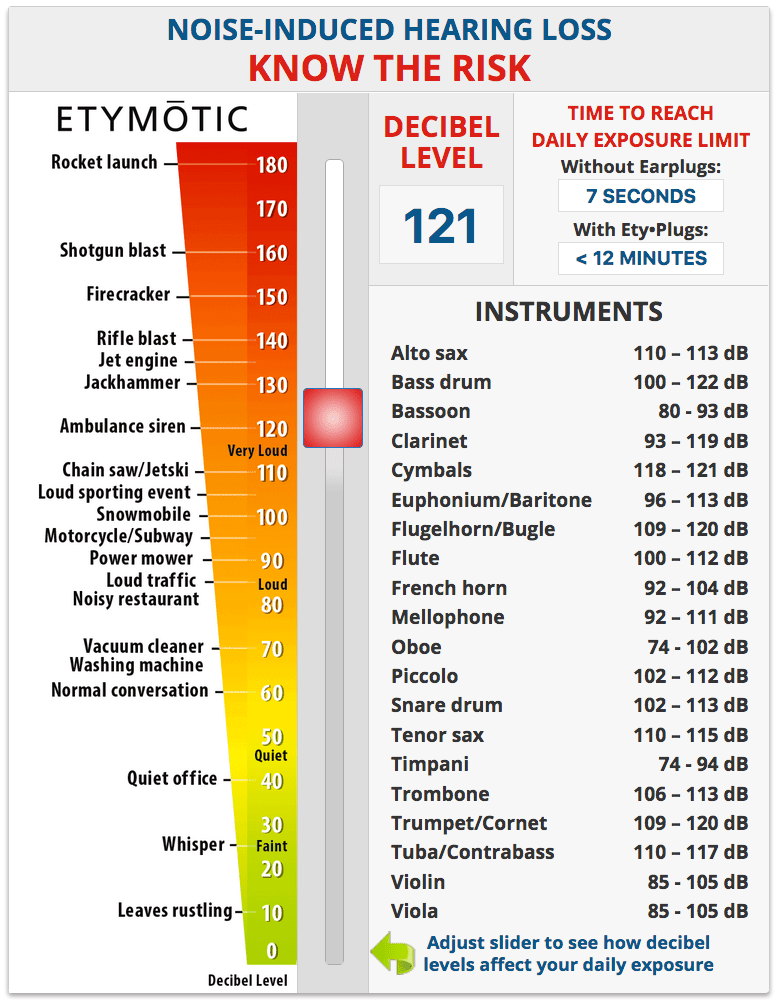
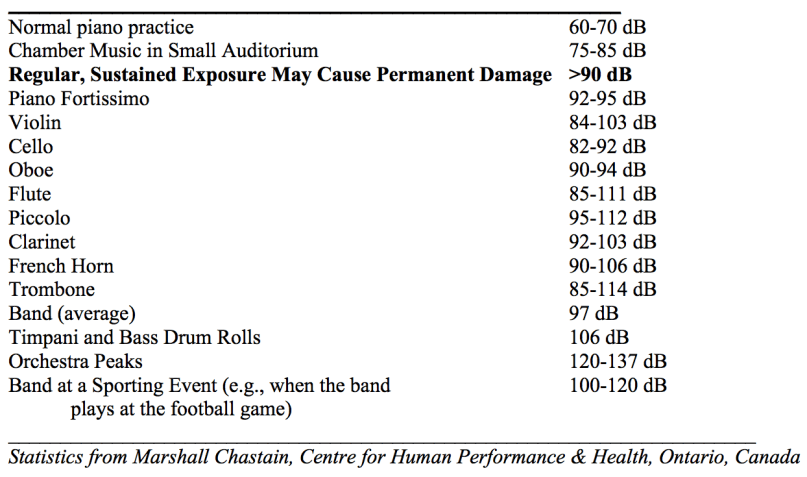
Day in and day out, music students (e.g., band and orchestra members) and their instructors are being exposed to potentially damaging levels of noise during practices and performances. Hearing loss is a function of exposure time, the average noise level, and peak level of very loud sounds. The chart below illustrates the levels of sound produced by the various instruments played in schools. Alone or together, musicians often are exceeding safe limits of noise during practice and performance.

Musical Levels

Musical Levels

I recommend perusing the entire website of the UPMC Musicians’ Hearing Center here and view Dr. Palmer’s video on noise-induced hearing loss.

trumpeters-921709_1920_skeeze

After a few additional online searches, I found numerous quotes from supportive research, articles, and links.

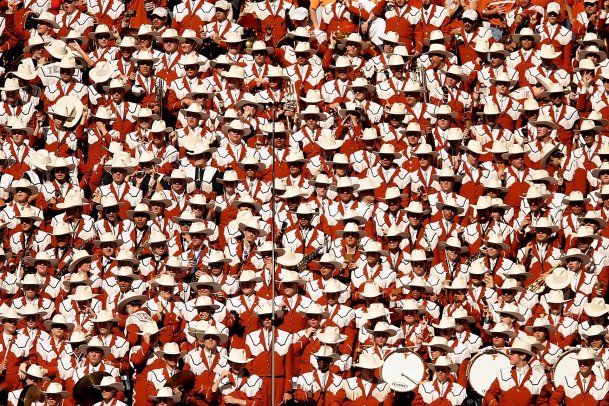
Surveys of universities reveal that more than 60% of band members suffer from tinnitus, or ringing in their ears, and more than 50% suffer from Noise-induced hearing loss. According to the World Health Organization, loss of hearing has escalated over the past 20 years and shows no sign of slowing down.

Band members have an increased risk for hearing loss as they have spent a majority of their young lives playing loud instruments near each other and during this time they have been exposed to horribly dangerous and irresponsible decibel levels without being warned about the lifelong pain and discomfort that they may potentially face due to playing in the band. Most musical instruments used in marching bands produce sound levels ranging from 92 – 126 dB as shown below will if unregulated or protected against cause irreparable hearing loss and may have already caused you tinnitus (rdistortioninging in the ears).  — Big Ear (#9)

As I understand it, the problem is two-fold: exceeding the safe decibel-levels of sound and the length of time you are exposed to these dangerous dosages without protection.

According to NIOSH, any level higher than 85 decibels (dB) for a cumulative period of 8 hours is damaging to the hearing mechanism and requires hearing protection. As the decibel level increases, the safe duration decreases. This means that a jazz band playing at 100 dB is safe for about 15 minutes before hearing damage ensues. —  BandDirectorsTalkShop (#10)

symphony-orchestra-183608_1920_takazart

Professional musicians may be at significant risk, according to many research studies, including one documented by the University of Toronto and the National Ballet Orchestra of Canada.

For the study published this month in the [January 2011] journal Noise and Health, a team from the University of Toronto’s sensory communications group attached microphones to the musicians’ shoulders — as close to their ears as possible — with a wire connecting them to a bulky box at their waist that recorded the “dose” of noise. To avoid under-estimating the risk, they chose performances of Sergei Prokofiev’s Romeo and Juliet, the loudest ballet the company performs, then extrapolated the results across the full season of shows and rehearsals.

Some of the National Ballet musicians were exposed to levels as high as 94 decibels, equivalent to the sound of an electric drill. Interestingly, the flute and piccolo players absorbed the loudest noise, followed by brass instruments, and the double bass. The violins had the quietest experience, according to the study. —  National Post (#7)

For young musicians, I have recommended the specially discounted Etymotic’s ER-20 ear plugs, which seem to offer a practical way to help protect hearing during rehearsals and performances. The company that makes them offers an interesting article about their “adopt a band” program here and a “slide rule” tool (pictured below) to help predict measurements of dangerous levels and time exposures to loud sounds here.

Know the Risk

There seems to be some debate about sound distortion with the use of these ear plugs. The cheap yellow foam plugs may cause alteration of the music’s intensity and timbre. Personally, I have noticed few problems with the ER-20s, although you may “hear” of conflicting viewpoints on hearing/comfort/distortion issues in the media.

This is the chasm between audiologists and musicians. We [Etymotic] think we’ve found the answer and the technology, and the musicians are telling us, no, not yet. This outlines the importance of collaboration between audiologists, hearing health care providers, and musicians to find what works. —  Ascent Hearing (#11)

The bottom line, if you want to protect your hearing, you will have to use them regularly.

transport-1785474_1920_3282700

Also from the University of South Carolina Marching Band and Big Ear (#11), here are a few tips on conserving your hearing in a band rehearsal. Starting right now, you can “monitor and adjust” any excessively high sound exposure and dangers to your health!

  1. If you feel any sensation in your ears, speak up. Your section leaders and band directors are across-the-board caring people with a healthy appreciation for music and those who make it, so don’t ever feel like you are being bothersome if you talk to them about pain in your ears.
  2. Notice the times of your rehearsal when the music peaks and prepare yourself by having a cheap pair of foam earplugs to stick in for that overwhelmingly loud duration.
  3. Distance yourself from an unruly player. If there is a member of your band who is known to let off an extra loud trumpet, piccolo, alto sax, or drum solo after you finish a song, try to distance yourself from the blast zone and be aware of your surroundings.
  4. Hand-in-hand with tip number 3, talk to that person about their habit and politely ask them to be mindful of their fellow musicians around them.
  5. If you are taking any medication, talk to your doctor or school nurse about the specific medications interaction with decibel levels as there are hundreds of medications that can damage your inner ear hair cells and cause you permanent hearing damage.
  6. In the same light, if you hear the word ototoxic followed by the name of a medication you are taking, speak to your doctor and band director immediately.
  7. If you hear for any reason at all ringing in your ears, address the sensation immediately with your section leader or band director.

The final authority on noise-induced hearing loss comes from the United States Department of Health and Human Services, National Institutes of Health, a good online resource posted here.

51284_w_3

For our South Hills Junior Orchestra players, we are selling the ETY-20 ear plugs (discounted by UPMC for only $6/pair). Last year (2018-2019), I made sure my piccolo players had a set, and will strongly encourage the purchase of these by all of my brass and percussion instrumentalists, especially those who participate in their school marching band programs.

PKF


References

  1. “Teen Musicians: ‘Uncool’ Earplugs May Save Your Hearing” https://www.seattletimes.com/life/wellness/teen-musicians-uncool-earplugs-may-save-your-hearing/
  2. “Musicians in an Orchestra May Be Exposed to Unhealthy Sound Levels” https://www.noisyplanet.nidcd.nih.gov/have-you-heard/orchestra-musicians-unhealthy-sound-levels
  3. “Protect Your Hearing When You Play a Musical Instrument” https://www.noisyplanet.nidcd.nih.gov/have-you-heard/musicians-face-higher-risk-of-hearing-loss
  4. “Incidence and Relative Risk of Hearing Disorders in professional Musicians” https://oem.bmj.com/content/oemed/71/7/472.full.pdf
  5. “School Band Performances Causing Hearing Loss” https://www.hearhereindy.com/school-bands
  6. “Musicians and Hearing Loss: What You Need to Know” https://www.signiausa.com/blog/musicians-hearing-loss/
  7. “Orchestral Musicians Face Unhealthy Sounds: Study” https://nationalpost.com/news/orchestral-musicians-face-unhealthy-sound-levels-study#ixzz1ApNlDV42
  8. “Turn It Up? Musicians Run Far Higher Risk of Hearing Loss” https://www.nbcnews.com/health/health-news/turn-it-musicians-run-far-higher-risk-hearing-loss-n93981
  9. “Why Do I Need Hearing Protection?” https://www.bigearinc.com/university-of-south-carolina-marching-band-hearing-protection/
  10. “Conserving Your Earsight” — https://banddirectorstalkshop.com/2017/11/24/hearing-protection-for-band-directors/
  11. “Musicians, from School Bands to Symphonies, Risk Hearing Loss” — https://www.ascenthearingsimivalley.com/musicians-from-school-bands-to-symphonies-risk-hearing-loss/
  12. “Noise-Induced Hearing Loss” — https://www.nidcd.nih.gov/health/noise-induced-hearing-loss
  13. “List of Rockers with Hearing Loss Grows” — https://www.aarp.org/health/conditions-treatments/info-2018/musicians-hearing-loss.html
  14. “Musicians’ Hearing Center” — https://www.upmc.com/services/ear-nose-throat/services/hearing-and-balance/audiology/musicians-hearing


hi-res logo 2018The mission of South Hills Junior Orchestra, which rehearses and performs at the Upper St. Clair High School in Pittsburgh, PA, is to support and nurture local school band and orchestra programs, to develop knowledge, understanding, performance skills, and an appreciation of music, to increase an individual member’s self-esteem and self-motivation, and to continue to advance a life-long study of music. Members of the Orchestra learn, grow, and achieve positions of leadership to serve their fellow members.


(For more information about SHJO, please visit www.shjo.org.)

All Fox’s Fireside blog-posts are free and available to share with other music students, parents, directors, and supporters of the arts.

Click here for a printable copy of Do I Need Earplugs?

Other “Fox’s Firesides” are available at https://paulfox.blog/foxs-firesides/.

Photo credits (in order) from Pixabay.com


© 2019 Paul K. Fox

Ethical Scenarios

Empaneling the “Ethic Jury” to Review Mock Case Studies

The study of morality in professional decision-making is essential to pre- and in-service training of music teachers. Our goal should be to reinforce recommendations for the avoidance of inappropriate behavior (or even the appearance of impropriety), and defining and modeling the “best practices” of a “fiduciary” by promoting trust, fostering a safe environment for learning, acting in the best interests of our students, and upholding the overall integrity of the profession.

ethics-2991600_1920__Tumisu

Full discussions and samples of “the codes” (ethics and conduct), professional aspirations, and government policies/statutes – a proverbial “curriculum” exploring ethics for music educators – have been posted at this blog-site. You should peruse these first before proceeding further:

In addition, articles cautioning educators’ use of social media are offered:

mobile-phone-1917737_1920_geralt

All of these should be “required” reading. Few of us have ever received a full-blown class or induction program on ethics. Now is the time to study this topic, and as ethics expert Dr. Troy Hutchings would say, to view it through multiple perspectives – “the lens of…”

  • “Ethos of care”
  • “Educator risks”
  • “Consequences”

The purpose of this blog is to provide supplemental materials for personal reflection, possibly inspiring thought-provoking group dialogue during methods classes, professional development workshops, or music staff meetings.


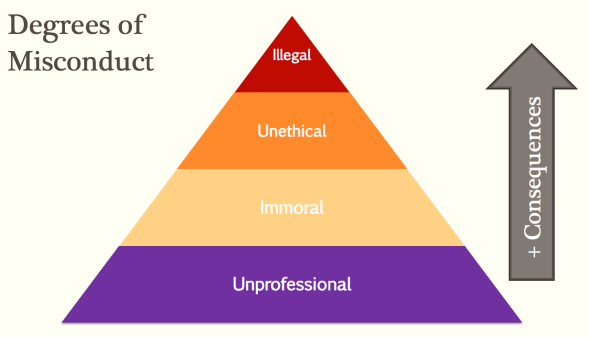
Degrees of Misconduct

The Rubric

It is more important to know why something is wrong, rather than simply labeling the degree of misconduct or likely discipline action. However, for the purpose of introspection during this exercise, we will first recognize “the problem” presented in each re-enactment. We will use these “color-coded” criteria, and allow “snap judgments” in the simulated evaluation by a “jury of our peers.” Put on your thinking caps! You may be surprised with the incongruities of your first impressions once the likely outcomes of these stories are revealed!

Use this tool to judge the severity of the upcoming case studies.

DEGREES OF MISCONDUCT (from bad to worst)

  • GREEN (not illustrated)  = not a misconduct
  • BLUE (not illustrated) = inappropriate, unwise, or “bad for appearances” – but no consequences
  • PURPLE = “Unprofessional” – unlikely to result in serious consequences except possible damage to one’s professional reputation
  • GOLD = “Immoral” – no guarantee of consequences except may result in lowering the year-end teacher evaluation score, earning a “warning” or “write-up” by the principal/supervisor, or consideration for a job re-assignment
  • ORANGE = “Unethical” – which will result in discipline action and possible loss or suspension of certificate
  • RED = “Illegal” – which may add criminal penalties, fines, jail time, etc. All it takes is a felony or misdemeanor conviction to lose your job… and your certificate… even if it is unrelated to your employment or taking place at school.


question-mark-1495858_1920_qimono

Essential Ethical Questions

It is important to analyze your response to these reflections during your assessment of each ethical dispute:

  1. What possible issues/concerns might this scenario raise?
  2. How could this situation become a violation of the law, the “Code” or other school/district policies?
  3. In this situation, what are some potential negative consequences for the teacher, students, parents, and/or school staff?
  4. How would this episode affect a teacher’s efficacy in his/her classroom, demean the employing school entity, or damage her position as a moral exemplar in the community?


Mock Scenarios

CASE #1

Melissa S. was a 23-year-old high school music teacher who also supervised the production of the school musical. After months of practices, Miss S. became very close to several seniors including David, the male lead in the musical.  She and David began sharing emails and texts with one another.  Most of the communications were playfully flirtatious but not overtly sexual.  Immediately after graduation, however, Miss S. and David began dating and became sexually intimate. After discovering the relationship, David’s parents filed a complaint against Miss S. with the district superintendent.

CASE #2

My drum major was suspended because she smoked pot and was caught. I needed her to run the half time show we had been practicing for months and so I attempted to convince administration that she had to participate because it was part of my curriculum and part of her grade. I decided the other kids shouldn’t be punished because of her idiocy so I worked hard to keep her in the show.

This assumes the principal will make the ethical decision in allowing or prohibiting the student leader to participate.

choice-3183317_1280_Kingrise

Let’s put this choice squarely on your shoulders (where it usually sits). What would you do if you were the one that discovered your soloist, lead, accompanist, or drum major was drinking on a school music trip? What if he or she was the one performer you counted on for an outstanding adjudication?

You walk into the Disney World cafeteria, see your student has a wine cooler on his/her tray sitting at the tables. Since no one else sees you standing there, you walk out as if nothing has happened.

CASE #3

You are taking your high school music department to Orlando. Because of the size of the trip, you have to put it out on bid. One company offers a generous “under the table” deal: “If you choose our travel agency for the Florida trip, we will throw-in the gift of a new conductor’s podium and set of two dozen music stands.” You decide to go with them.

CASE #4

James C. is a middle school music teacher who was arrested for drunk driving. After several months, the teacher goes to court and is convicted of the offense. When the district moves to have Mr. C fired for his conviction, he argues that this offense has no influence over his ability to instruct his students. Also, the episode happened during the weekend on his private time.

CASE #5

Mrs. K is a high school choral director whose husband recently divorced her. During a lesson one day, she breaks down in front of her class. In an attempt to calm the students, she explains her emotional state and discusses the end of her marriage. After school that day, a male student visits Mrs. K to see if she has recovered. The student explains that his parents are also divorcing and he understands her feelings. The student begins stopping in to see Mrs. K more frequently and the pair begins spending more time outside of class supporting each other. Mrs. K’s colleagues start to become suspicious of her relationship with the student and report the teacher’s actions to their principal.


ethics-2110583_1920_3dman_eu


Food for Thought – Suggestive Answers

Please keep in mind my disclaimer, “I am not an attorney, a member of a human resource staff, nor a research scholar or expert on school ethics.” However, although retired, I continue to teach (part-time) and face day-to-day decision-making… now for more than 40 years.  These are my responses to the above cases. I welcome your comments, and any input from highly respected leaders in the field of educator ethics like Dr. Troy Hutchings (Chair of Education, University of Phoenix) and Dr. Oliver Dreon (Associate Professor, Millersville State University of Pennsylvania).

RESPONSE TO CASE #
  1. ETHICS VIOLATION: In my opinion, this would likely result in loss of employment and revocation of her certificate. The debate in some areas of the world supports that it may be permissible to have an intimate relationship with a former student as long as it did not start while the student was at school. We have learned that the American Psychological Association has an ethical guideline of non-fraternization for at least two years post-treatment, while the National Association of Social Workers has a one year moratorium for sexual involvement with a client. However, frankly, in the teaching profession, due to the inherent power imbalance that can influence inappropriate relationships between teachers and students or former students – even after graduation: Are either of these models relevant?
  2. ETHICS VIOLATION: Most would say this was a serious noncompliance with the school district’s drug and alcohol policy, violation of the local laws governing underage consumption, and likely breach of your fiduciary responsibility. No decision is a decision… walking away means you condone the behavior. What if the drinker becomes sick or has an accident and gets hurt “on your watch?”
  3. ETHICS VIOLATION: Better check your state’s code of ethics. From the Pennsylvania Code of Professional Practices and Conduct, “No educator is permitted to accept personal or financial gain or advantage (other than their contractual compensation package) through their work in a school system.” Interpretations may disagree on a “true-life” experience: At a music conference, I was invited to a special dinner celebrating the “best clients” by a vendor representative who insisted on picking up the tab. Minimal infraction?  Would you change your misconduct rating if the party took place at Hooters? How about at a strip club?
  4. ETHICS VIOLATION: The convicted drunk driver did not win his argument. He probably would lose his job and faced criminal penalties! Although he may still hold his teaching certificate, it is unlikely he will ever be considered for employment as a teacher in any state.
  5. ETHICS VIOLATION: Did you initially interpret this as the choral director being misguided, emotionally immature, and only exhibiting unprofessional conduct by allowing the sharing their mutual feelings and experiences? According to the author of this scenario, after investigation, she was asked to resign from her position, and she complied. She did not lose her certificate… but could have depending on state or district regulations and the extent of her off-school behavior.


paul fox models his tshirt 030419

More ethical dilemmas and case studies for discussion are available here, the second page of a handout distributed at one of my teacher ethics workshops.

Of course, ETHICAL ISSUES are not always black and white… no one will ever agree on one definitive set of moral standards. My purpose here was only to inspire thinking and a fresh perspective on this topic… probably succeeding in creating more questions than answers in your mind.


business-1753098_1280_ Mary Pahlke

Definitions and Revisiting MCEE

To summarize, lets review the well-stated foundations of “right or wrong” making up our “ethical equilibrium,” and these concepts that represent the compass of decision-making in education:

  • Personal Morality: “Personal values and beliefs derived from one’s life experiences… subjective and may or may not align with community mores.”
  • Regulations of Law: “Policies, statues, and judicial activity that articulate conduct absolutes.”
  • Professional Ethics: “Professional ethical standards that assist practitioners within situation and systemic contexts in choosing the best course-of-action.”
  • Professional Dispositions: “Agreed upon professional attitudes, values and beliefs to be held by educational practitioners.”


MCEE

Finally, at this juncture, it would be most appropriate for you to recap your thoughts and correlate your “judgments” of the above scenarios with the National Association of State Directors of Teacher Education and Certification Model Code of Ethics for Educators. If you have not read this comprehensive document, “do it now!” You should also review your own state’s code of ethics.

This is all about BALANCE and exercising extreme care and sensitivity in meeting the needs of our students. Keep “fighting the good fight” and your commitment to ETHICS and the highest standards of what E.A. Wynn refers to as “moral professionalism” in his research article, “The Moral Dimension of Teaching.”

PKF

Special Thanks to These Sources of Mock Scenarios
  • Pennsylvania Educator Ethics and Conduct Toolkit by Dr. Oliver Dreon, Sandi Sheppeard, and the Professional Standards  and Practices Commission
  • Nebraska Professional Practices Commission
  • Connecticut Teacher Education & Mentoring Program


Featured photo credit from FreeImages.com:
“Ethics” by Olivier Le Moal


Remaining photo credits in order from pixabay.com:
“ethics-right-wrong-ethical-moral” by Tumisu
“mobile-phone-smartphone-keyboard” by Gerd Altmann
“question-mark-pile-question-mark” by Arek Socha/qimono
“choice-arrow-question-mark-path” by Eric Leroy/Kingrise
“business”-idea-style-concept-goals” by Mary Pahlke
“wooden-train-toys-train-first-class” by Couleur.

wooden-train-2066492_1920_Couleur

© 2019 Paul K. Fox

The “Care and Feeding” of Your Principal

New Teachers’ Guide for Fostering Positive Relations & Good Interactions with School Administrators

laptop-3196481_1920_Aymanejed

Conventional wisdom suggests that the initial school staff you should get to know immediately on a first-name basis in your new teaching job are 1) the building secretary, 2) head custodian, and 3) cafeteria workers. (The first one keeps you out of trouble, the second cleans up your messes, and the last group makes sure you’re well-fed!)

However, even more influential, the principal “assigned to you” will literally “make or break” a smooth transition and orientation into the workplace. Especially if this person was partially responsible for hiring you (a member of the screening committee which chose you out from all of the other qualified candidates), he/she should be your penultimate “mentor!” To validate the administrator’s judgment (and you continuing to be the “hero”), he/she will likely be highly motivated to foster your success!

So… once you land your new position, your first move should be to learn everything you marching-band-1404489_1920_sam99929can about “your champion!” Find out his/her goals, needs, and “pet-peeves,” and while you’ll at it, get off on the right foot with relations with all of your school supervisors.


Here are some tips for “rookie” or new music teachers to cultivate these relationships.

According to the article, “The Principal’s Role in the Music Program” by Orville Aftreth in the Music Educators Journal (Vol. 46, No. 3, January 1960, pp. 41-44), “A successful music program requires a principal who enables the following basic attitudes:

  • A belief in the value and importance of music;
  • A desire to grow his ability to enjoy, appreciate, and produce music;
  • A willingness to vitalize school activities through music.”

But, unfortunately, it seems that few administrators have significant and ongoing experiences in making music.

While I was doing online research for this blog, I stumbled upon an excellent thesis entitled, “Why We Love Music: a Case Study of High School Principals” by D. Benjamin Williams (https://nafme.org/ways-to-build-better-working-relationships-with-your-principal/), which seemed to support this premise.

violin-3621667_1920_horndesign

A principal’s musical background influenced their view of music as a key part of a quality education. Most of the principals’ formal experience in the arts ended early in their life, and none took classes on how to be an effective administrator for an arts program. Principal certification courses typically deal with finance, special education, and general leadership and administration.

—D. Benjamin Williams

My own history (35 years of teaching in the public schools with 30+ administrators) was to serve with only one principal who was a former music teacher, and perhaps 10% of the remaining administrators had any real arts education experience (or even regularly played an instrument or sang in a choir).

woman-2679619_1920_anna2005Williams shared the purpose of his case study: “to gain an understanding of school administrators’ thoughts on their school’s music program in regards to music’s role and value.” He documented the comments of five principals in their advocacy of the arts.

The research questions posed in this study centered on the following:

  1. What are common values and/or themes among administrators when it comes to music in their schools?
  2. Are there common points of advocacy administrators find themselves making in support of their school’s music program?
  3. What do administrators see as benefits of having a music program in their schools?
  4. Where does music fit in the overall vision of a school?
  5. What is music’s role in a quality education?

They mentioned how the arts are an opportunity to plug in, be engaged, and earn scholarships; that they create an identity for the individual and for the school; that they make a whole student and contribute to a whole education; and that they provide opportunities for higher-order thinking, such as critical or creative thinking and problem solving, that are encouraged in core-content areas as well. The pressure placed on education institutions in the 21st century are focused on these concepts, and the principals saw that music helped and encouraged students to develop these abilities. This is why they chose to support, advocate, and build up their school’s music programs.

—D. Benjamin Williams

I repeat: the first advice we give to newcomers to the profession is know your bosses! And, intentionally invite, “educate,” include, and engage them in your music classes and ensembles’ activities! Draw a circle around him/her to become a member of your team!

He drew a circle to shut me out,
heretic rebel, a thing to flout.
But love and I had the wit to win,
we drew a circle that took him in.

— Edwin Markham

people-3224723_1920_Russell_Clark

This view is reinforced by the article “Ways to Build Better Working Relationships with Your Principal” by Gabriel L. Woods on the NAfME Music in a Minuet blog-site at https://nafme.org/ways-to-build-better-working-relationships-with-your-principal/. He shares a summary of the basics:

  • Understand your principal and his/her job.
  • Build positive relationships with your principal.
  • Learn techniques to make your principal work for you and your program.
  • Learn how to think like a principal.

Each year when I return from honor bands or other music related field trips, I make it a habit to purchase my administrators a small token of appreciation to let them know the trip was a great success. Students must write an essay, and they present the administrators with the gift. In the essay, students are required to write what they learned, what the field trip meant to them, and how they will use this experience to make the school better. Praise is effective.

— Gabriel L. Woods

NAfME blogAlso, you should check out an even more recent NAfME blog, “Stronger Together – How to Get Administrators on Your Side” by Lori Schwartz Reichl, which offers a great perspective. Several meaningful quotes from her piece:

Coming together is a beginning; keeping together is progress; working together is success.

— Henry Ford

Remember that even though you are not taking the role of administrator, you are a leader. You lead a program. You lead a musical family. You are the leader of a superior sound. You are the leader of inspiration for your community. In the most genuine way, lead your administrator to a music education crescendo.

— Lori Schwartz Reichl

After a little brainstorming, I recalled my own working “top-ten list” of techniques for building harmonious interactions and collaborations with your school leaders.

  1. Be the first to arrive and the last to leave, and you will earn their respect! Professionals, especially music teachers who participate in co- and extra-curricular activities, are not “clock watchers” and need to “put in the time” before and after school to prepare and achieve meaningful learning experiences for their students.
  2. man-1020389_1920_geraltLearn what makes them tick! Is your principal a site-based manager? Is he/she a stickler for “chain of command.” I had an administrator who would go bonkers if he thought you back-copied a memo to the superintendent or called a central office manager first. Be sure you conform to the management style of your chief. This is a way of showing him/her respect and cooperation, which in all likelihood, will be returned to you in spades.

  3. Keep your principal “in the loop” and “in your corner,” and make sure you communicate any serious disputes that come up (especially with unhappy parents) that could blow up in your/his/her faces in the future. This also which means you don’t subscribe to the philosophy, “Don’t ask for permission, beg for forgiveness.” Proponents of this belief will tell you to go ahead and stick your neck out, perhaps do something “for the good of the order,” and later declare “oops!” if it goes south and your administrators disapprove. I cannot vouch for the ethics of this position, and “venturing out without a paddle” usually did not serve the best interests of the students. There’s no reason to place “the teacher’s convenience” over the safety and welfare of the children, and you should first try to obtain the legal and political endorsement of your boss(es) as you keep them appraised about what you are doing. Don’t be a nag, just “cc:” when appropriate, and “ask,” don’t “tell!”
  4. Give them credit! Publicly, you make it clear: you and your students’ awards and accomplishments are also your administrators’ awards and accomplishments. If it is possible, have your principal join you on stage to accept any ensemble honors.
  5. Serve on a non-music related committee or project. Principals are always middle stateslooking for volunteers to help fulfill the overarching goals of the district. This might mean signing up for the strategic planning committee, Middle States accreditation evaluation team, school renovation planning meetings with the architect, etc.

  6. Engage your principal as a participant in your program: concert appearances as guest conductor or solo/ensemble performer, featured narrator or announcer, limited-engagement as a walk-on part in the musical, judge of talent show, etc.
  7. Model professionalism and good time management skills. Be prompt in the completion of all deadlines assigned by administration. Don’t turn your principal (or his secretary) into a “nag” requiring numerous follow-up reminders.
  8. Understand the importance of public perceptions and “appearances.” Many school leaders spend an inordinate amount time trying to defend the sometimes questionable actions of their staff. Don’t make this necessary! Be responsible for your “public brand.” If it looks bad, it is bad… and that’s always up to you!
  9. Don’t just bring up problems, have answers! At odds with an existing policy or boss-2179948_1920_balikpractice? Suggest a solution and a Plan B to an issue you would like to address. Upholding “moral professionalism,” tactfully but firmly point out what is not working (and why). But, do your homework first. Share the “facts and stats” and try to propose several different directions to consider (even a Plan C and a Plan D). You will impress the “head honcho” by modeling the traits of flexibility, creative problem solving, and sensitivity to the needs of other staff and programs.

  10. Think long term and back-up your requests with numbers! When you submit your budget for the next school year, include the “tangibles” and statistics that your principal could use to “fight for you.” Include data on and percent changes in student enrollments, per-pupil costs, history of past purchases, etc. and separate your proposals into one, two, three, and/or five-year “plans” to spread out the expense for big-ticket items. Be specific and prioritize! When asked to “cut” my sheet music amounts, I assembled a set of sample folders with all of the music I used in the current year and broke down each selection’s current (replacement) price, each concert’s overall value, percentage of the repertoire used from my library, projected losses, etc. In one case, I predicted that if the district went through with its reduction of the music budget by 20% and (at the time) the cost of sheet music was rising 15%, I would be forced to schedule one fewer public performance in the school year. (It never happened!)

Edutopia provided excellent insight in promoting collaborative relationships with your principal. In “Five Ways to Develop a Partnership with Your Principal” by Ben Johnson, this advice was shared:

  1. Have a Face-to-Face Meeting
  2. Make Your Resource Needs Known
  3. Write It Down
  4. Invite Her into Your Classroom
  5. Offer Encouragement

apple-464182_1920_lukaszdylka

If you have an apple and I have an apple and we exchange apples, then you and I will still each have one apple. But if you have an idea and I have an idea and we exchange these ideas, then each of us will have two ideas.

— George Bernard Shaw

Another resource worth reading is “A Teacher’s Guide to Working With Your Principals” by Kristy Louden. She reflects: “But aside from the obvious factor that your principal is your boss, and you want your boss to think well of you, I have found my relationship with my principal has helped in more ways than I probably realize. Here’s why:

  • They’ll think of you… (when an opportunity comes up that you might want).
  • You can ask for what you want.
  • You’ll get respect and recognition.
  • You have a reference (just in case).”

ENhancing the Professional Practice of Music TeachersFinally, the most comprehensive manual I have ever read on this subject should be a “required read” for every music educator: Enhancing the Professional Practice of Music Teachers: 101 Tips That Principals Want Music Teachers to Know and Do by Paul Young. To add to the above guidelines, I would especially peruse these recommendations:

  • Tip #13: Work closely with classroom teachers
  • Tip #30: Take charge of your schedule
  • Tip #41: Continuously improve classroom management
  • Tip #62: Make ethical decisions
  • Tip #80: Write notes, return phone calls, reply to email
  • Tip #93: Perform (satisfy your own pursuit of creative self-expression)
  • Tip #97: Improve your leadership skills (quotes from the book Leadership 101 by John Maxwell)

This final point is an excellent one. You are “in charge” of your own self-improvement projects and professional development. Administrators want to see staff members who seek growth experiences. Don’t wait for the annual implementation of the district’s “latest flavor of the year” in-service program (as it is sometimes referred to by teachers) or your supervisor’s year-end conference. Do your own self-assessment and plan specific and measurable goals and tasks to fulfill them. Always strive to do your best and be harder on yourself than anyone else (even administration) can ever be. Model the concepts of focus, cooperation, self-discipline, and a positive attitude in the workplace.

Now, take a deep breath. It’s all about one step at a time. Soak up these ideas. You can and will nurture happy and productive relationships with your principal and other school administrators, enhance your professional image and effectiveness, and foster opportunities of achievement and self-fulfillment for you and your music students!

PKF

© 2019 Paul K. Fox


wooden-train-2066492_1920_Couleur

Photo credits in order from Pixabay.com: “handshake-regard-cooperate-connect” by johnhain, “laptop-office-hand-writing” by Aymanejed, “marching-band-chicago-thanksgiving” by sam99929, “violin-flute-music-classic” by horndesign, “woman-business-woman-boss” by anna2005, “people” by Russell_Clark, and “wooden-train-toys-train-first-class” by Couleur.


Collegiates – Clean Up Your Social Media

banner-935469_1920_geralt

Getting Ready to Apply for a Job? It’s Time to Curate Your Social Media!

[Portions of this blog-post were first published in the January 31, 2019 issue of the Collegiate Communique sponsored by the PMEA State Council for Teacher Training, Recruitment, and Retention.]


Have you ever gone on the Internet and searched for your name? Have you assessed tree-1148032_1920_geraltwhat your image (and “personal brand”) say about you on all the social media platforms?


According to a McAfee family safety blog, in anticipation of future employers researching you and everything with your name on it, you should make a concerted effort to “launder” your online presence.

People are watching you right now. Like it or not — agree with the intrusion or not — you are being Googled, judged, and analyzed by the body of content you’ve posted online. Whether you are applying to a college, for a summer job, or even currently employed, you can bet someone who matters to your future is on your digital trail.

 “10 Easy Ways to Clean Up & Curate Your Social Media” by Toni Birdsong


laptop-3087585_1920_jeshoots-com_

Also recommended by Birdsong, the new “best practice” is to A) clean up any questionable content from all social profiles and B) design your social content in a way that “reflects your best self.” This means you should delete permanently from Facebook and other platforms:

  • Provocative or inappropriate photographs, videos, or posts
  • Posts or photos that include drinking or using drugs
  • Discriminatory comments related to race, religion, gender, etc.
  • Content that complains about a previous employer or colleague
  • Posts that are overly cynical, grumpy, or mean

notebook-614213_1920_firmbeeInstead, your profile information should reflect integrity and responsibility, so you should expand or add content that:


  • Projects a professional image
  • Shows a friendly, positive personality
  • Demonstrates that you are well-rounded, with wide range of interests
  • Models that you have great communication skills

Think the whole “future employers checking your social media accounts” thing is just an annoying urban legend? Think again.

It turns out that one in three employers have rejected candidates based on something they found out about them online.

“How to Clean Up Your Social Media During the Job Search” by Lily Herman

personal-3139194_1920_geralt

The McAfee blog really does a good job summing up ten steps to a better online presence:

  1. Make a hit list
  2. Think like the decision maker.
  3. career-3478983_1920_mohamed_hassanStreamline your selfies.
  4. Review past blogs.
  5. Google yourself.
  6. Inventory all social profiles.
  7. Edit your Twitter feed.
  8. Secure names and URLs.
  9. Change your online persona – for good.
  10. Start a career-focused Blog.

There are many samples for that last tip, my favorite from a former student of mine freely sharing his professional website at daviddockan.com. (Use “Music” for the password.) David included his resume, philosophy of music education, employment history, and photo/video samples of his teaching… a very powerful digital portfolio and marketing/branding technique… and of course, he landed his first music teacher job immediately after graduating from West Virginia University!

online-3412473_1920_kreatikarIf you need more than ten suggestions or a lot more detailed instructions based on the specific social media platforms, check out 30 Quick Tips to Spring Clean Your Social Media Presence” by Yvonne Dutchover.

Related articles previously posted at this site:


Employers can learn a lot about you from your resume and interview, but sometimes it takes a little bit more to sell yourself (although there’s a delicate balance between selling yourself and being transparent in the hiring process). Take advantage of the benefits of social media – it’s an often-needed extra step to show what you bring to the table, a way to add flair to your application, and make a lasting impression on your potential employers.

– “How to Clean Up Your Social Media Presence Before the Job-Search” by Lauren McAdams

job-3790033_1920_tumisu

In short, keep it clean and professional! “Police” your social media image and brand. And, as they say, “break a leg” at your interviews! Good luck in job hunting!

PKF

© 2019 Paul K. Fox


Photo credits in order from Pixabay.com: “social media” by Alexas_Fotos, “banner” and “tree” by geralt, “laptop” by JESHOOTS-com, “notebook” by FirmBee, “personal” by geralt, “career” by mohamed_hassan, “online” by kreatikar, and “job” by Tumisu.