

“Learning never exhausts the mind.” – Leonardo da Vinci
 Article submitted for future publication in PMEA News – the state journal of the Pennsylvania Music Educators Association


Preparing for an employment interview? Looking for that first job or interested in transferring to a new school district?
How well do you know current trends, key “buzz words,” and jargon in education? Even though no music teacher would have trouble identifying the meaning of our own abbreviations like D.C. al Coda or GM (G Major or General Music), administrators would expect that you know relevant and evolving general education terms, such as the following:
- The Common Core
- Customization and Differentiation of Instruction
- The Four Cs – Creativity, Collaboration, Communication and Critical Thinking (21st Century Learning Skills)
- Flipped Classrooms and Blended Schools
- HOTS – Higher Order Thinking Skills and DOK – Depth of Knowledge
- Assessments – Diagnostic, Formative, Summative, Authentic
- PDE (Pennsylvania Department of Education) SAS (Standards Aligned Systems) Portal
- UBD (Understanding By Design) Curriculum Development with EU (Enduring Understandings) and EQ (Essential Questions)
Keeping up with the formation of new acronyms is quite a challenge… something you will have to do throughout your entire career. Get started by looking up any of these with which you feel unfamiliar. You can never predict when one of these will pop-up at a job interview!
Just for the fun and the challenge of it, try taking this crossword puzzle. For a printable copy of this article, full-size puzzle grid, clues, the answers and definitions, click on the link at the bottom of the page. Enjoy! PKF
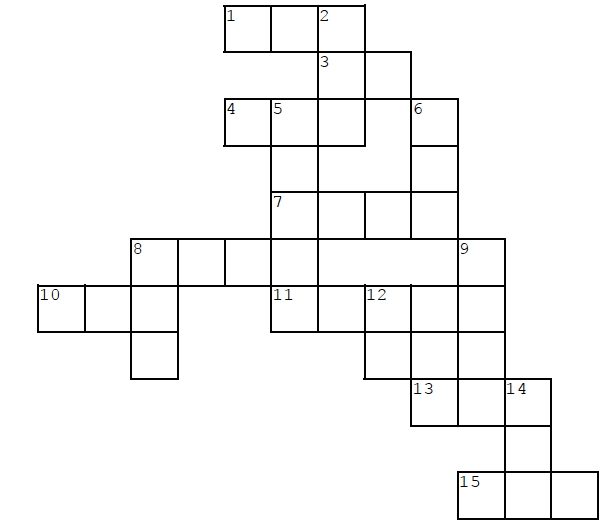
Across
Down
Click here: Alphabet Soup Educational Acronyms puzzle with answers
Terms used in alphabetical order
ADHD…………. Attention Deficit Hyperactivity Disorder: A psychiatric disorder in which there are significant problems of attention, hyperactivity, or acting impulsively that are not age-appropriate.
DOK……………. Depth of Knowledge: Developed by Norman L. Webb, the complexity or depth of understanding required to answer or explain an assessment related item.
EQ………………. Essential Questions (UBD): Inquiries focusing on the key concepts in the curriculum, the big ideas and core content, provoking deep thought, lively discussion, and new understanding as well as more questions.
ESL……………… English as a Second Language: Staff or programs to facilitate the acquisition of English language skills of students whose native or first language is not English.
EU………………. Enduring Understandings (UBD): Statements summarizing important ideas and core processes that are central to a discipline and have lasting value beyond the classroom—what students should understand—not just know or do.
IEP………………. Individualized Education Program: A customized statement of a child’s present level of performance, annual educational goals, modifications, accommodations, and special education supports and services to meet these goals.
PLC…………….. Professional Learning Communities: An extended learning opportunity such as a grade-level teaching team or a school committee formed to foster collaborative learning among colleagues in order to improve student achievement.
PMEA………….. Pennsylvania Music Educators Association: Statewide nonprofit organization of over 4,500 members, dedicated to promoting the musical development of all PA residents – your number one professional development resource.
PSSA…………… Pennsylvania System of School Assessment: Standards-based, criterion-referenced assessment used to measure a student’s attainment of the academic standards while also determining the degree to which school programs enable students to attain proficiency.
PVAAS………… Pennsylvania Value Added Assessment System: A statistical analysis of PA state assessments of growth and achievement data, allowing educators to make data-informed instructional decisions to promote student progress.
RTI……………… Response to Intervention: A multi-tier approach to the early identification, intervention, and support of students with learning and behavioral needs.
SAS…………….. Standards Aligned Systems: A comprehensive, researched-based resource identifying six elements for improvement of student achievement developed by the Pennsylvania Department of Education.
SLO…………….. Student Learning Objectives: A process to document a measure of educator effectiveness based on student achievement of content standards developed for Pennsylvania’s new Educator Effectiveness System.
SPP……………… School Performance Profile: A web-based resource for districts/schools to communicate performance results to various constituencies and assist districts and schools in aligning and focusing resources for continuous improvement.
STEAM……….. Science, Technology, Engineering, Arts, Mathematics: Framework of study in science, technology, engineering, arts, and mathematics, bridging the gap between business and educational goals, and blending of science, the arts, and creativity in school.
UBD Understanding By Design: Using a backwards-design focus on the outcomes in order to design curriculum units, a tool utilized for educational planning in “teaching for understanding” advocated by Jay McTighe and Grant Wiggins.
© 2015 Paul K. Fox



 paulfox.blog