The Life Cycle of a Successful and Happy Music Educator
Joyous Holidays, Season Greetings, and Happy New Year from “The Foxes!” This is a time for reflection and gratitude… and we feel blessed for all the opportunities allowing us to share our insights, gifts and experiences with other music education professionals.
We hope to inspire YOU and literally model the concepts in this blog series. We continue with our discussion first introduced a month ago in Bookends – Part One – The Life Cycle of a Successful and Happy Music Educator, exploring:
Stage 3: Inservice/Growing Years (this blog)
Stage 4: Veteran/Sustaining Years (future blog)
Stage 5: Next Chapter/Living the Dream (future blog)
This article is an abstract from a session presented to Seton Hill University music education student teachers on October 17, 2023. Click on this link to download the slide summary in PDF format.
“I have written a lot of articles in support of these topics… now compiling them for your easy access. Depending on your current status and interests, feel free to peruse the checklists (links) in this series. It is possible a few of the resources contained within these blogs have gone inactive, but I believe enough are there for you to gain the insight, tools and motivation to achieve professional development for life.”
– Paul Fox
Stage 3 – Inservice/Growing Years
[ ] 8. Becoming a Music Educator:For a review of Bookends – Part One, take a step backward and revisit what you have done to “get ready” for your “rookie years.” Take special note on the things-to-do list (“secrets”) as a first-year educator (perhaps completed during your student teaching semester):
Subscribe to a discounted NAfME + PMEA first-year membership (If you are a recent college graduate in your first year of teaching, or if you are the spouse of a current or retired NAfME member, contact NAfME at 800-336-3768 or email memberservices@nafme.org) to find out if you qualify for a reduced rate.
Hook up to PMEA Mentor or other state’s MEA support program for new teachers.
Need to fill in a few gaps missing from your college courses in skills and knowledge? Continue your “enrichment” viewing PMEA Webinars and the exhaustive video library in the NAfME Academy.
At some point you will be writing/editing curriculum, so research the awesome resource of Model Curriculum Framework (Have to be a PMEA member)
Too busy to participate in the PMEA Annual Conference or NAfME national events? Look into going to a PMEA summer conference (usually at a lower-cost!). Check out your own state’s MEA discounts and offers for collegiate members and new teachers!
[ ] 9. The Care & Feeding of Your Principal:Although not covered in any detail during the Seton Hill University presentation, it is recommended that you read in its entirety “The New Teacher’s Guide to Fostering Positive Relations and Good Interactions with School Administrators” offering a wealth of excellent recommendations from these trustworthy sources:
Enhancing the Professional Practice of Music Teachers: 101 Tips that Principals Want Music Teachers to Know and Do by Paul G. Young (my personal favorite, available from Amazon here)
A favorite question I pose to college music ed seniors is, “In what professional associations are you a member and actively involved?” For the price of consuming one fewer Starbucks latte a week, you can open up the Wonderful World of “C’s” – Contacts, Coachings, and other Connections, including research and resources that will benefit your Continuing Education. You can’t afford NOT to join groups like these.
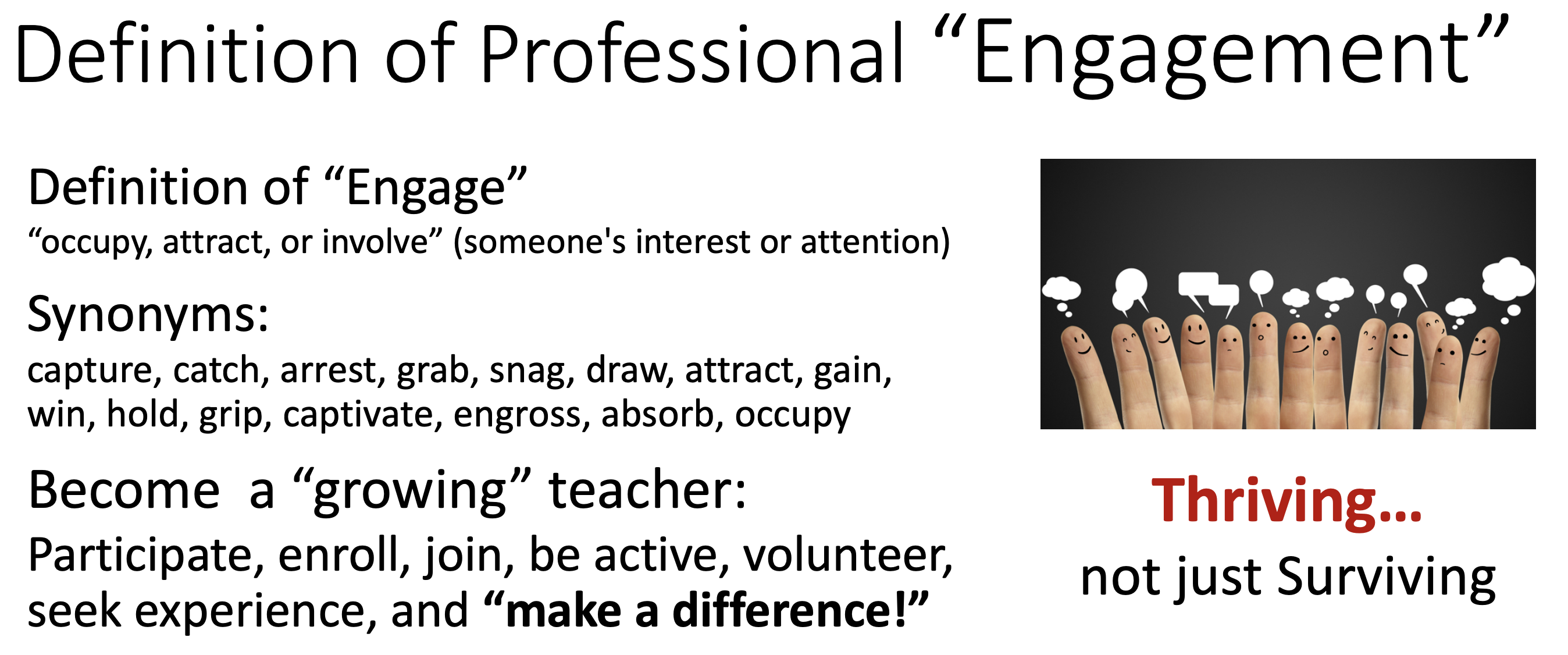
To help “nail down” a few related definitions critical to personal growth and career development in our profession, especially “engagement,” “professionalism,” “collaboration,” and “networking,” please take a little time to travel and consume the following archived blog postings.
[ ] 10. The Meaning of PRO:This is one of the oldest articles at the paulfox.blog site. How about a little soul searching? Are you truly a professional? Do you have the skills, habits, and attitudes of a professional in the field of education?
[ ] 11. Transitioning from Collegiate to Professional (Part II):New teachers have to move away from “book learning” or higher education research and emphasize “practical application,” and at the same time, assess the precise areas needed for immediate (re-)training… everything from new exposure to specialized teaching areas and grade level focus for the job to which you have been assigned, to the enhanced skills of classroom management, student assessment, curriculum writing, class or ensemble warm-up materials, music repertoire and programming, etc.
While we are on the subject, it is important to intentionally seek out mentors or consultants in your early years of becoming an educator. PMEA offers a mentoring program (read all about it here) and PMEA Retired Members are also an excellent resource to “phone a friend” for advice as needed (see their section on the PMEA website here). That leads us to the next most essential “habit” of attending professional conferences… #12 below.
[ ] 12. Getting the Most Out of Music Conferences:Our PMEA Annual Conference sites are cyclical. This article, written on March 5, 2017, showcased that year’s event at the Erie Bayfront Convention Center – coincidentally the same location for this year’s PMEA Annual Conference: April 17-20, 2023. For a sneak peek at the proposed sessions and guest performers, click here.
There are a myriad of conferences offered every year… something for everybody in just about every state. Make plans to go, “recharge your batteries,” and pick up new state-of-the-art ideas, lessons, music, technology, etc. Again, you cannot afford NOT to attend… or becoming stale in your teaching or “stuck in a rut!” Besides, going to your state’s or national conferences and regional workshops are FUN places to meet other like-minded, inspiring colleagues! This is how professionals network, collaborate, and share their “latest and greatest!“







 paulfox.blog