

Practice, Patience, Perseverance & Belief in Yourself!

To inspire greater forward progress and more resolve in meeting our goals, I wrote this “Fox Fireside” back in 1995 for the student, parents, directors, and family members of the South Hills Junior Orchestra (SHJO). This “pep talk” was motivated by reading anecdotes from my favorite series, “Chicken Soup for the Soul” by Jack Canfield and Mark Victor Hansen, and begs these three essential questions:
- “Why were there so many people who “put down” the achievements or aptitude of these historical figures?”
- “What would have happened if these individuals had received more encouragement and support along the way?”
- “Are you living up to YOUR potential?”
We are very optimistic about the future! Perhaps if we all “put down” our tech devices (instead of each other) and focused more time and energy on making music together, we can attain new levels of creative self-expression and artistry. Really, all you need is a little practice, patience, and perseverance… so lets make a New Year’s resolution to “play more music,” “attend more rehearsals,” and “share more of our love of music!”
Paul K. Fox, SHJO Founding Director
Life is full of course corrections, not failures! Throughout our learning in school or at a job, we face many challenges, some that do not immediately bring us the just rewards for our time and hard work. Every one of us occasionally gets a little discouraged, but we must not give up hope nor fail to commit the resources to continue our pursuits. Consider many of history’s great geniuses who faced similar “bumps” along their pathway to fame:
- After Fred Astaire’s first screen test, the memo from the casting director of MGM, dated 1933 said, “Can’t act! Slightly bald! Can dance a little!” Astaire kept that memo over the fireplace in his Beverly Hills home.
- An expert said of Vince Lombardi: “He possesses minimal football knowledge. Lacks motivation.”
- Socrates was called, “An immortal corrupter of youth.”
- When Peter J. Daniel was in fourth grade, his teacher Mrs. Phillips constantly said, “You’re no good. You’re a bad apple, and you’re never going to amount to anything.” Peter was totally illiterate until he was 26. A friend stayed up with him all night and read him a copy of Think and Grow Rich. Now, he owns the street corners he used to fight on and has published a book, Mrs. Phillips, You Were Wrong!
- Louisa May Alcott, the author of Little Women, was encouraged to find work as a servant or seamstress by her family.
- Beethoven handled the violin awkwardly and preferred playing his own compositions instead of improving his technique. His teacher called him hopeless as a composer.
- The parents of the famous opera singer Enrico Caruso wanted him to become an engineer. His teacher said he had no voice at all and could not sing.
- Charles Darwin, father of the Theory of Evolution, gave up a medical career and was told by his father, “You care for nothing but shooting, dogs, and rat catching.” In his autobiography, Darwin wrote, “I was considered by all my masters and by my father a very ordinary boy, rather below the common standard in intellect.”
- Walt Disney was fired from a newspaper for lack of ideas, and also went bankrupt several times before he built Disneyland.
- Thomas Edison’s teachers said he was too stupid to learn anything.
 Albert Einstein did not speak until he was four years old and didn’t read until he was seven. HIs teacher described him as “mentally slow, unsociable, and adrift in his foolish dreams.” He was expelled and was refused admittance to the Zurich Polytechnic School.
- Louis Pasteur was only a mediocre pupil in undergraduate studies and ranked 15th out of 22 in chemistry.
- By all accounts, Isaac Newton did very poorly in grade school.
- The sculptor Rodin’s father said, “I have an idiot for a son.” Described as the worst pupil in the school, Rodin failed three times to secure admittance to the school of art. His uncle called him ineducable.
- Leo Tolstoy, author of War and Peace, flunked out of college. He was described as “both unable and unwilling to learn.”
- Playwright Tennessee Williams was enraged when his play Me, Vasha, was not chosen in a class competition at Washington University where he was enrolled in English XVI. The teacher recalled that Williams denounced the judges’ choices and their intelligence.
- F.W. Woolworth’s employers at the dry goods store said he had not enough sense to wait upon customers.
- Henry Ford failed and went broke five times before he succeeded.
- Babe Ruth, considered by sports historians to be the greatest athlete of all time and famous for setting the home run record, also holds the record for the greatest number of strike outs.
- Winston Churchill failed sixth grade. He did not become Prime Minister of England until he was 62, and then only after a lifetime of defeats and setbacks. His greatest contributions came when he was a “senior citizen.”
- Eighteen publishers turned down RIchard Bach’s 10,000 word story about “soaring” seagull, Jonathan Livingston Seagull, before Macmillan finally published it in 1980. By 1975, it had sold more than seven million copies in U.S. alone.
- Richard Hooker worked for seven years on his novel, M*A*S*H, only to have it rejected by 21 publishers before Morrow decided to publish it. It became a runaway bestseller, spawning a blockbuster movie and a highly successful TV series (still airing today on cable channels as reruns!).
A Modern Day Parable…
There was once a wise woman who lived by herself near a small village. Rumor had it that she could always accurately predict when the rains would come, or help heal a sick child with herbs, or calm angry neighbors and help them to resolve their fights and arguments. People came from all over the land to meet with her and seek her advice on matters both small and great. Her reputation was such that was said she was never wrong — not ever.
Some of the children of the village didn’t believe that it was possible to always be right. Surely she could not know everything! They decided to test her knowledge. First they asked her to answer questions about the planets, the animals, and the world. No matter how hard the questions, she always answered correctly.
The children were amazed at her knowledge and learning and most were ready to stop testing the wise woman. However, one boy was determined to prove that the old woman couldn’t know everything. Hatching a devious scheme, he told all of his friends to meet him at the woman’s home the following afternoon so he could prove she was a faker.
All through the next day he hunted for a bird. Finally he caught a small songbird in a net. Holding it behind his back so no one could see what was in his hands, he walked triumphantly to the wise woman’s home.
“Old woman!” he called. “Come and show us how wise you are!”
The woman walked calmly to the door. “May I help you?” she simply asked.
“You say you know everything — prove it — what am I holding behind my back?” the young boy demanded.
The old woman thought for a moment. She could make out the faint sounds of a birds wings rustling. “I do not say I know everything — for that would be impossible,” she replied. “However, I do believe you are holding a bird in your hands.”
The boy was furious. How could the woman have possibly known he had a bird? Thinking quickly he came up with a new scheme. He would ask the woman whether the bird was alive or dead. If the woman replied, “alive,” he would crush it with his hands and prove her wrong. If she answered, “dead,” on the other hand, he would pull the living bird from behind his back and allow it to fly away. Either way he would prove his point and the wise woman would be discredited.
“Very good,” he called. “It is a bird. But tell me, is the bird I am holding alive or dead?”
The wise woman paused for a long moment while the boy waited with anticipation for his opportunity to prove her wrong. Again the woman spoke calmly, “The answer, my young friend, is in your hands. The answer is in your hands.”
The boy realized that the wise woman had once again spoken correctly and truthfully. The answer was indeed in his own hands. Feeling the bird feebly moving in his hands as it tried to escape his grasp, he felt suddenly very ashamed.
The answer was in his hands — slowly and gently he brought his hands to the front of his body. Looking into the eyes of the delicate bird he apologized, “I am sorry little one,” and he opened his hands to let her go free.
https://www.uua.org/re/tapestry/children/tales/session11/story1

Is this fable a little too deep for you? Well, remember: the answer is in your hands.
Only you have the power to succeed or fail. Regardless of what others say about your present or future worth, your “wins or losses” are in your hands. You need to trust your mentors/teachers/parents and especially believe in yourself!
Then, the application of practice, patience, and perseverance (never giving up!) will make all the difference!
What are your goals and ambitions for 2019?
Happy New Year!
PKF
 The mission of South Hills Junior Orchestra, which rehearses and performs at the Upper St. Clair High School in Pittsburgh, PA, is to support and nurture local school band and orchestra programs, to develop knowledge, understanding, performance skills, and an appreciation of music, to increase an individual member’s self-esteem and self-motivation, and to continue to advance a life-long study of music. Members of the Orchestra learn, grow, and achieve positions of leadership to serve their fellow members.
(For more information about SHJO, please visit www.shjo.org.)
This and all Fox’s Fireside blog-posts are free and available to share with other music students, parents, directors, and supporters of the arts.
Click here for a printable copy of The 3 Ps and 1 B to Success
Other “Fox Firesides” are available at https://paulkfoxusc.wordpress.com/foxs-firesides/.
© 2019 Paul K. Fox
Photo credit from Pixabay.com: “Ember” by VIVIANE6276 and “bird” by Pezibear









 (Getting a little revenge? On trip #6, when we hooked up to the Apple Store’s computer, our Time Capsule crashed their hardware.) With all of my wife’s documents long-gone from the computer and a couple terabytes of data on the Time Capsule now inaccessible, we were “saved” by our subscription to the cloud-based backup program Carbonite which did restore most of her files… but took five days 24/7 via WIFI to bring them back!
 One way to help educate yourself on all of these 21st Century “innovations” is to watch the podcast
  The original saved document is considered Copy #1. You need to then transfer this to an external location, outside your hard drive. Copy #2 could be sent to a flash or jump drive (just plug it into your USB port), or an external hard drive. (Understandably, my wife is no longer willing to trust the Apple Time Capsule which uses a program called Time Machine that automatically backups every file you save via WIFI… but there are other brands you could consider.)
 From password management to virus protection, and simply knowing not to click on any random link or attachment in email are essential. Online security has become a very important issue. The experts tell us we should not have the same password for all of our applications, and it should not have any portion of our name, phone number, or other easy-to-guess info. My solution to resolve the conundrum of being safe and catering to a “senior citizen’s memory” was to create a core password that I could remember but no one else could figure out, and then add a prefix or suffix of a couple additional letters that describes the name of the applications. (Whatever you do, don’t use “123” as a password!) You should write down on paper an alphabetical listing of your user names and passwords, store the journal in your safety deposit box away from fire, flood, or theft, and share another copy of it with your spouse or at least one other family member. But, don’t forget to update the catalog frequently! (Passwords should change from time to time.)
 for your eye glasses to avoid scratching the lenses?


 The purpose of this short SHJO “Series to Share” is to get you started with some basic “how-to steps” to learn how to conduct. Truly, for success in directing an ensemble, the only thing you need to do is “give it a try” and practice those beat patterns with your favorite musical selections. During the Saturday SHJO rehearsals in December, we will give you the opportunity to direct the entire group and provide you a few hints!
 The mission of South Hills Junior Orchestra, which rehearses and performs at the Upper St. Clair High School in Pittsburgh, PA, is to support and nurture local school band and orchestra programs, to develop knowledge, understanding, performance skills, and an appreciation of music, to increase an individual member’s self-esteem and self-motivation, and to continue to advance a life-long study of music. Members of the Orchestra learn, grow, and achieve positions of leadership to serve their fellow members.
 documented to a great extent, stress, burnout, and stage fright have become real concerns for music education majors completing their coursework, juries/recitals/concerts, methods exams, student teaching, and other field experiences. This may be affecting statistics on college enrollments, graduation rates, and job placements!
 College funding
 Music Teacher Education
 Learning to “manage your burdens,” class schedules, assignments, calendar, etc.
 2009), “deep listening” as “a way of hearing in which we are fully present with what is happening in the moment” (Barbezat and Bush 2014), contemplative movement activities including methodologies of Orff, Kodaly, Dalcroze, and Gordon adapted for other music teaching contexts (Benedict, 2010), walking meditation, tai chi ch’uan, yoga, and labyrinth walking (Center for Contemplative Mind in Society, 2016), contemplative reading, writing, and other self-help practices.



 “When musicians think about performing, they eventually think about performance anxiety — ‘stage fright.’ Performance anxiety can be defined as a physical and mental deviation from a ‘normal state’ and is perhaps one of the most misunderstood areas of performance practice… A reduction in anxiety levels especially with musicians with extensive formal training may actually diminish performance quality. For musicians with low mastery skills, the prudent approach would seem to be to undertake more formal training.” — Donald L. Hamann

 Job placement



















 you to reflect and respond to “what would you do?” and even re-orient you to the paradoxes in which you may encounter that may not seem to offer an obvious resolution.
 Use of social media networks to support student learning versus the risk of crossing the student/teacher boundary with inappropriate informal communications? (See
  To foster meaningful scrutiny and study of the bulleted issues in bold above, we will sort these problems by Principle III “Responsibility to Students” and Principle IV “Responsibility to the School Community” of the National Association of State Directors of Teacher Education and Certification (NASDTEC) “Model Code of Ethics for Educators” (MCEE):



 MY SOLUTION: This is more common than you would like. This episode compels you to figure out how to wear two unique hats simultaneously – the educator and the judge. Assuming you were clear (in writing) on the requirements of the try-outs, even sharing the blank rubric that would be used for the evaluations, you are now charged to find the “best” person for each lead assignment based on a number of criteria:
 Workplace” are applicable

 Example of a screening: Pennsylvania Music Educators Association (PMEA) District One regularly sponsors a pre-audition for sopranos and altos auditioning for District SHS Chorus, as well as flute, clarinet and trumpet players for seating in Honors Band and other instrumental festivals.
 ith all groups at all adjudications. When I was teaching at the Upper St. Clair High School, this adjudication process took more than a day for all of our ensembles to participate—thirty minutes per performance, costing as much as $50/student, and involving more than ten professional adjudicators and fifteen festival staff members for a multitude of adjudication sites.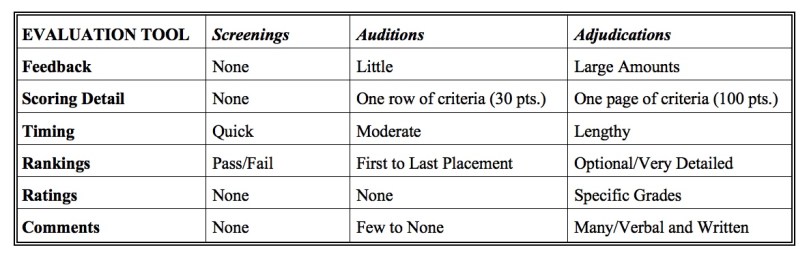




 paulfox.blog